How Can the GCC Turn Urban Heat Risk Into a Targeted Investment Agenda?
Ken Research
July 24, 2026 - 6 min read
July 24, 2026
by Ken ResearchUrban heat is no longer only a climate concern for GCC cities. It is reshaping investment priorities across real estate, infrastructure and urban development. Ken Research identifies the largest opportunity areas in HVAC and insulation, permeable materials, green infrastructure, and cool roofs and reflective surfaces, but the real value lies in knowing where to act first. That requires linking the dominant source of heat with the most exposed urban clusters, the stage of development and the feasibility of implementation.
Urban areas can run 1°C to 3°C hotter than their surroundings, with the difference reaching up to 8°C at night. Extreme heat can reduce labour productivity by 10% to 30% and increase cooling demand by 20% to 40%. Dense city cores can reach 7°C to 8°C above nearby areas, while asphalt and dark pavements absorb 80% to 95% of solar radiation and may reach approximately 70°C to 80°C on extreme heat days.
For developers, governments, infrastructure investors and asset owners, the central question is no longer whether intervention is required. It is how to match the right intervention to the relevant heat mechanism, location and stage of the real estate lifecycle.
Four Solution Pools Define the GCC Opportunity
Ken Research presents the estimates across base and optimistic scenarios. Four categories carry the largest identified values:
- HVAC and insulation systems: USD 105 billion to USD 210 billion
- Permeable materials: USD 70 billion to USD 175 billion
- Parks, green roofs and vertical gardens: USD 52 billion to USD 140 billion
- Cool roofs and reflective materials: USD 52 billion to USD 122 billion
Each category responds to a different structural cause of urban heat.
HVAC and insulation systems address cooling demand, HVAC dependency and pressure on building energy efficiency. Permeable materials respond to surface sealing and the loss of evaporative cooling. Parks, green roofs and vertical gardens restore shade and evapotranspiration. Reflective roofs and façades reduce the solar radiation absorbed and retained by buildings and paved surfaces.
The largest category will not automatically be the most relevant intervention for every location. Extensive dark roofing and paving point toward reflective materials. Restricted airflow requires attention to spacing, height and street orientation. High cooling intensity increases the relevance of HVAC, insulation and building controls. Limited vegetation raises the importance of tree canopy, parks and green roofs.
Investment prioritisation therefore begins with the mechanism driving heat accumulation. Download the full POV to access the complete GCC opportunity analysis, compare cities and urban clusters, and build a focused investment roadmap across design, construction, cooling, materials and retrofit solutions.
Priorities Shift Across the Real Estate Lifecycle
Urban heat resilience can be embedded at three stages of the real estate lifecycle: design, construction, and optimisation and retrofit.
The available intervention set changes at each stage. Planning influences orientation, shading, airflow and the allocation of green and permeable space. Construction determines roofing, façades, insulation, glazing and cooling systems. Existing assets rely more heavily on operational improvements, building retrofits and targeted upgrades to roofs, open spaces and urban surfaces.
Design Prevents Heat From Being Embedded
Building orientation, façade depth, roof and wall exposure, street alignment, spacing and height influence direct solar gain, airflow and heat retention.
Relevant measures include reducing exposed roof and wall surfaces, optimising shading through overhangs and façade depth, orienting buildings to minimise direct solar gain and integrating cross-ventilation. At district level, building spacing and height controls can improve airflow, while street orientation can preserve ventilation corridors.
Ken Research analysis estimates the opportunity for shading and façade optimisation at USD 26 billion to USD 52 billion, followed by USD 17 billion to USD 44 billion for building spacing, height control and airflow corridors, while passive cooling represents USD 26 billion.
These measures apply to master planning, new communities and developments at the design stage. They address excess heat absorption and urban heat trapping before the physical layout has been completed.
Construction Determines Thermal Performance
Once a project enters construction, the focus shifts to materials, building envelopes, cooling equipment, permeable surfaces and green infrastructure.
High-Solar Reflectance Index roofing, reflective coatings, light-coloured finishes and reflective façades reduce heat absorption. High-efficiency HVAC systems, low-E glass and high-performance insulation improve thermal efficiency.
Ken Research's analysis shows the opportunity is concentrated most heavily in HVAC and insulation, estimated at USD 105 billion to USD 210 billion, with cool roofs and reflective materials contributing a further USD 52 billion to USD 122 billion.
Cooling is particularly material across GCC cities. It can account for more than 60% of peak electricity demand, while extreme heat can increase peak power loads by 15% to 25%. Cooling demand across the Middle East is expected to rise by two to three times by 2050.
Effective cooling strategies combine HVAC systems with insulation, low-E glass and improvements to building-envelope performance. Cooling technology and thermal design form part of the same response to sustained heat exposure.
Existing Assets Require Targeted Retrofit Strategies
For existing buildings and districts, heat resilience depends on focused upgrades rather than changes to the original urban layout. Relevant measures include HVAC and insulation retrofits, smart Building Management Systems, cool-roof coatings, reflective façades, green roofs, expanded tree cover and permeable paving.
Priorities should be set by assessing heat exposure, cooling demand, asset vulnerability and investment feasibility. This allows owners to compare interventions across mechanical systems, building envelopes, landscaping and surface materials, and direct near-term investment toward the areas of greatest need.
High-Exposure Clusters Provide the First Screen for Intervention
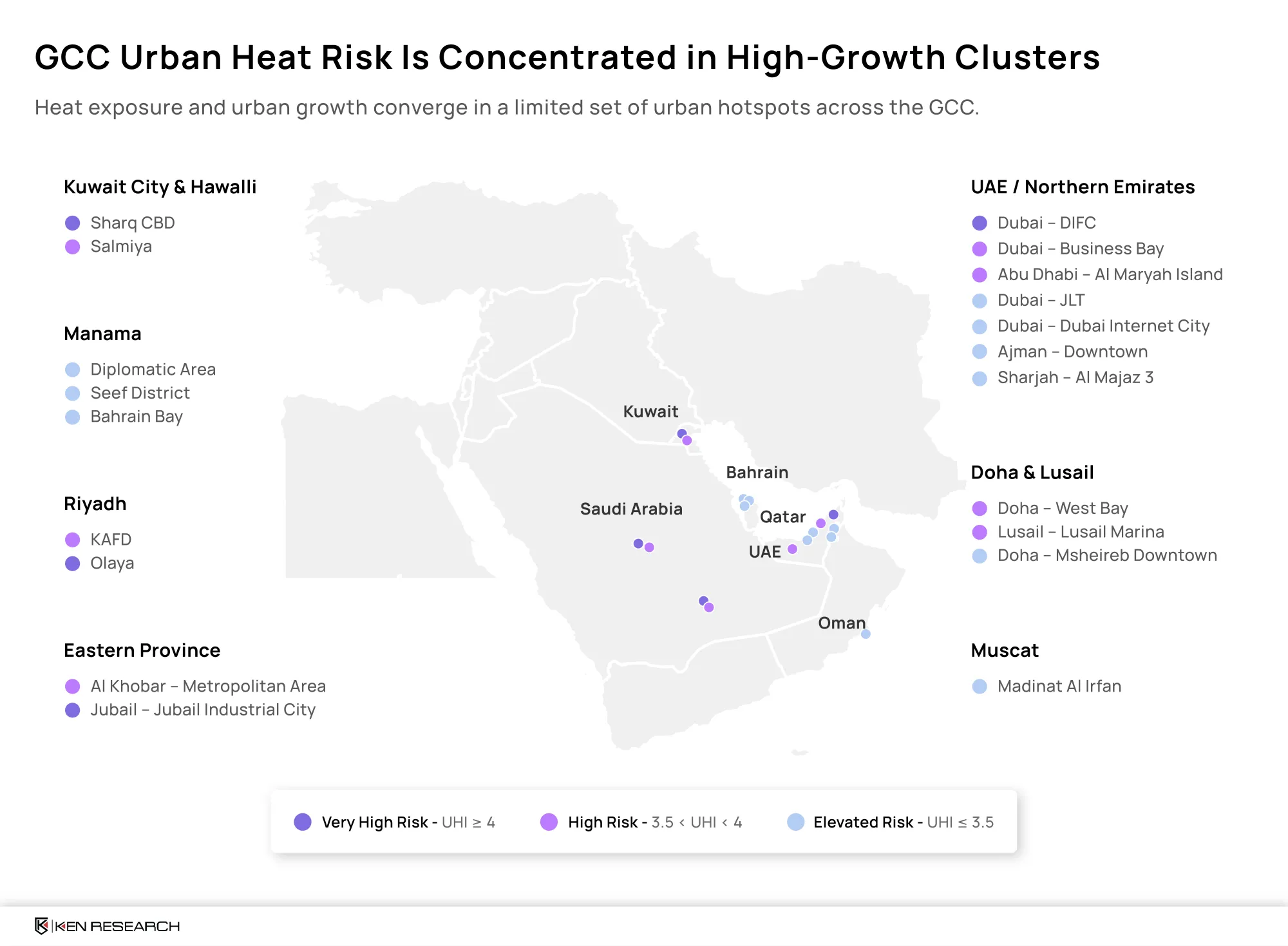
Heat exposure is not distributed evenly across the GCC. It is concentrated in urban clusters where dense development, limited green cover, high maximum temperatures, prolonged heat spells and population intensity converge.
Ken Research’s Urban Heat Island scoring model compares clusters using population density, green-area availability, maximum temperature, days above 40°C, longest heat spell and relative Urban Heat Island intensity.
DIFC records the highest score at 4.2. Olaya, Jubail Industrial City and Sharq CBD each score 4.0. West Bay and Salmiya follow at 3.8, while Business Bay, Al Maryah Island, KAFD, Al Khobar Metropolitan Area and Lusail Marina each score 3.7.
The concentration of high scores across commercial, industrial and mixed-use districts shows why city-level averages are insufficient for prioritisation. Heat exposure can vary materially within the same metropolitan market, depending on local density, surface composition, green cover and the duration of extreme heat.
This cluster-level view provides a more targeted starting point for intervention. It identifies where thermal pressure is most concentrated and where further analysis of cooling demand, infrastructure stress, asset vulnerability and retrofit requirements should begin.
GCC Initiatives Demonstrate Five Implementation Pathways
The GCC already provides examples of heat resilience being applied through regulation, passive design, urban greening, reflective materials and centralised cooling.
Abu Dhabi’s Estidama Pearl Rating System integrates passive cooling, shading and building-envelope requirements into development standards.
Masdar City uses narrow shaded streets, wind corridors and passive urban design to improve airflow and thermal comfort. Msheireb Downtown Doha applies street orientation, shading, insulation and optimised building orientation to reduce pedestrian heat exposure and cooling demand.
Green Riyadh is targeting approximately 7.5 million trees to improve shading and reduce urban temperatures. A Riyadh pilot combining reflective materials with irrigated greenery demonstrated potential temperature reductions of approximately 4.5°C.
Dubai’s Empower district cooling network and Tabreed’s Downtown Dubai cooling network demonstrate centralised cooling across dense urban districts.
Together, these initiatives demonstrate five implementation pathways: regulation, passive design, urban greening, reflective materials and district cooling.
Implementation Requires the Right Partners and Financing
Urban heat resilience involves developers, government authorities, infrastructure investors, planners, facility managers, cooling providers, material suppliers and technology companies. Moving from identified opportunity to implementation requires coordination across these stakeholders, supported by suitable partnerships and financing structures.
Partner identification, solution scouting, government and developer engagement, PPP and climate-financing assessment, pilot deployment, KPI tracking and scale-up planning can help translate resilience priorities into measurable outcomes.
Ken Research Converts Exposure Into an Investment Roadmap
Urban heat resilience requires decision-makers to move through four connected stages: identify where exposure is concentrated, diagnose the source of heat accumulation, determine which interventions are economically relevant and establish how they can be implemented at scale.
Ken Research combines Urban Heat Island risk assessment, thermal-stress analysis and city and cluster benchmarking to identify priority markets and vulnerable urban areas. Cooling-demand analysis, infrastructure-impact assessment and asset-vulnerability benchmarking then clarify where heat is creating the greatest operational, financial and livability pressure.
Opportunities are evaluated across passive design, construction materials, cooling systems, green infrastructure and retrofits. ROI, CAPEX, OPEX and lifecycle-cost analysis provide the basis for comparing interventions and developing an investment roadmap.
Execution planning extends from solution scouting and partner identification to PPP and climate-financing assessment, pilot deployment, KPI tracking and scale-up strategy. This connects heat-risk diagnosis with opportunity prioritisation and implementation, allowing stakeholders to move from a broad resilience objective to a defined programme of action.
The GCC will not address urban heat through a uniform package of cooling, materials and greening measures. The investment pathway begins with the dominant heat mechanism and exposed cluster, followed by the appropriate development-stage intervention and a rigorous test of vulnerability, feasibility and execution readiness.
Get started
We've helped companies around the world future-proof
their businesses - and we can do the same for you.