Global Contact Lens Manufacturing Market 2025–2030: From USD 20.24B to USD 33.80B - Cost vs Quality Battle
Ken Research
December 22, 2025 - 5 min read

December 22, 2025
by Ken ResearchThe global contact lenses market was valued at USD 20.24 billion in 2024 and is projected to reach USD 33.80 billion by 2030, expanding at a CAGR of 8.9% between 2025 and 2030.
As this market grows, manufacturing competitiveness rather than end-user demand has become the defining factor shaping long-term advantage.
Global supply is increasingly concentrated in a few countries with favourable labour structures, mature regulatory environments, and resilient supply chains.
Export data highlights this trend clearly: in 2023, Ireland shipped USD 1.30–1.58 billion, the United States exported USD 1.07 billion, and Germany exported USD 1.03 billions of contact lenses, demonstrating how tightly clustered global production has become.
Manufacturing Economics Now Define Competitive Advantage in Contact Lenses
Contact lens manufacturing is concentrated across six strategic hubs: the United States, Japan, South Korea, Taiwan, Malaysia, and Ireland. Each market plays a different role based on labor economics, automation levels, regulatory alignment, and supply-chain depth.
Labor costs vary sharply from USD 29.03 per hour in the United States in 2025 to approx. USD 797 per month in Malaysia in 2024 influencing production allocation and automation adoption. The U.S., Japan, and Ireland operate highly automated moulding and inspection systems, while South Korea, Taiwan, and Malaysia continue accelerating automation to improve consistency and yields. Regulatory frameworks add another layer of specialization, as FDA- or PMDA-certified output supports premium segments, while Southeast Asian regions enable faster, more cost-efficient production cycles. Together, these structural factors shape the global manufacturing hierarchy.
Cost Structures and Quality Capabilities Are Reshaping Global Contact Lens Manufacturing
A clear tiering emerges when comparing cost structures across regions. The United States, Japan, and Ireland sit in the highest-cost band, with Japan’s manufacturing wages reaching 365,245 Japanese yen per month in 2025 and Ireland closely aligned with European MedTech wage structures.
South Korea and Taiwan fall into the mid-cost range, reporting 4.69 million Korean won per month (Q2 2025) and 62,264 New Taiwan Dollars per month, respectively.
Malaysia provides one of the most cost-competitive environments globally at approx. 3,479 Malaysian Ringgit per month in 2024.
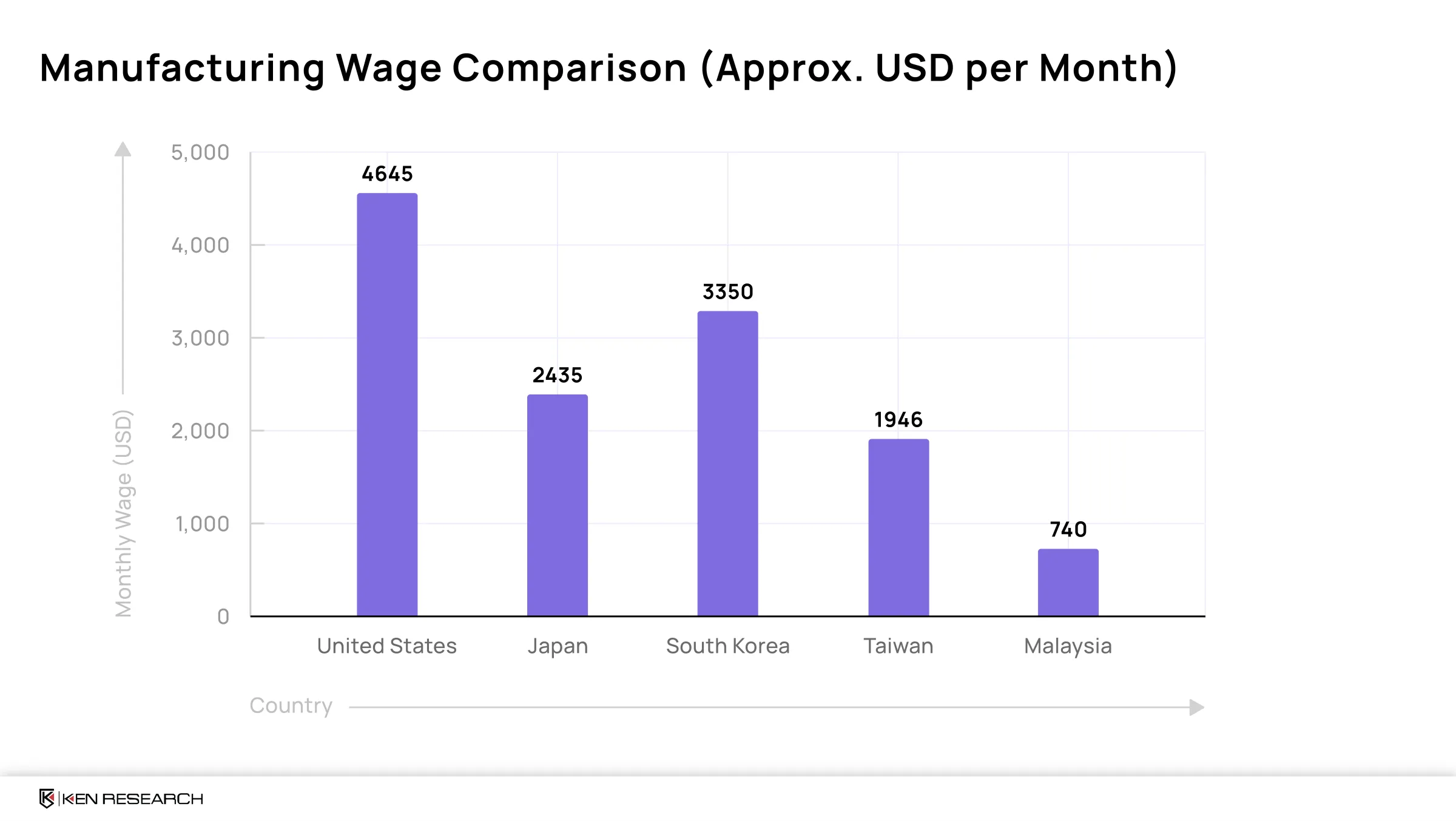
Despite the cost gap, high-cost markets remain competitive through superior defect control, technical precision, and validated production systems that support premium silicone-hydrogel SKUs. Mid- and low-cost regions excel in producing large-scale daily disposable and hydrogel lenses, where labor-cost leverage and flexible production capacity matter more. This explains the industry’s increasing reliance on a multi-country manufacturing architecture rather than a single “ideal” location.
Quality Output Comparison Precision Manufacturing, Defect Rates, and Material Innovation
Quality performance in contact lens manufacturing depends on micron-level uniformity, oxygen permeability, hydration durability, and strict defect detection. Japan leads global quality output due to advanced silicone-hydrogel research and PMDA-driven process standards. The United States matches this performance through FDA-regulated manufacturing systems, extensive automation, and strong clinical-validation capabilities.
South Korea has established a competitive edge in cosmetic and color lenses, where pigment placement and surface consistency are critical. Taiwan delivers reliable quality at scale through a mature OEM/ODM ecosystem.
Malaysia has improved quality outcomes due to significant investments in cleanroom infrastructure, mold precision, and automated inspection. Across all these markets, the strongest quality outcomes correlate with regulatory depth and material science expertise rather than labor cost.
FDA, EMA, and PMDA Regulations Are Shaping Global Manufacturing Economics
Regulation shapes manufacturing feasibility by influencing documentation, audit intensity, and global acceptability. The U.S. FDA enforces some of the highest compliance standards worldwide such as Key standards include FDA 21 CFR Part 820 (QSR), EU MDR (2017/745) with EU GMP, Japan QMS Ordinance/JGMP, and globally harmonized frameworks such as ISO 13485 and ICH Q10, which collectively define compliance cost and market access, increasing production cost yet enabling broad international acceptance .
The European Medicines Agency (EMA) and the EU Medical Device Regulation (MDR) adopted in 2017 and fully enforced from May 2021 reinforce documentation and surveillance requirements, strengthening Ireland’s position as the EU’s largest contact lens export hub. Japan’s PMDA imposes similar rigor, supporting its strength in specialty and premium segments.
Meanwhile, South Korea, Taiwan, and Malaysia offer faster registration timelines and more flexible compliance pathways, enabling frequent SKU updates and high-volume production cycles. These differences create a clear division between premium, regulated manufacturing hubs and cost-efficient scale-oriented markets.
Supply Chain Integration Is Now Central to Contact Lens Manufacturing Scale
The global supply chain for contact lenses is built on a network of interdependent material and packaging suppliers. The United States, Japan, and South Korea dominate silicone monomer and hydrogel polymer production, which are core inputs for high-performance lenses.
Taiwan, Malaysia, and China supply packaging films, thermoform materials, and consumables used across global manufacturing lines. While China is not a top exporter of regulated corrective lenses, it plays a major upstream role by producing molds, polymer intermediates, and optical equipment.
Export volumes reinforce each region’s role. Ireland shipped approx. 4.76 billion units in 2023 through EU-aligned logistics. The United States exported 641.5 million units through its established optical clusters.
East Asia relies heavily on distribution hubs in South Korea and Singapore to connect manufacturers with global buyers. These supply-chain patterns demonstrate that competitive advantage depends on material access, tooling ecosystems, and freight reliability not labor savings alone.
Where Global Contact Lens Manufacturing Is Headed Next?
By 2030, the global contact lenses market is forecast to reach USD 33.80 billion, up from USD 20.24 billion in 2024, reflecting an 8.9% compound annual growth rate. This expansion is underpinned by concentrated manufacturing in the United States, Japan, South Korea, Taiwan, Malaysia, and Ireland.
High-cost, high-regulation hubs remain critical for premium silicone-hydrogel and specialty lenses, while South Korea, Taiwan, and Malaysia increasingly handle scale production for daily disposable and hydrogel formats.
Export leaders such as Ireland and the United States show how regulatory credibility and integrated logistics now sit at the core of manufacturing competitiveness in this landscape.
Ken Research assessment suggests that the most resilient operating models will link at least two complementary footprints: one in high-regulation markets such as the United States, Japan, and Ireland, and another in cost-competitive hubs such as South Korea, Taiwan, and Malaysia.
The first footprint concentrates R&D and premium portfolios, while the second focuses on unit-cost optimization and fast-moving SKUs. As companies plan capacity, decisions around polymer sourcing, blister and packaging suppliers, and access to Asian and European export corridors will increasingly influence margins, service levels, risk, and the ability to support growth across multiple regions in the coming years sustainably.
Related tags
Cosmetics and Personal Care
Healthcare
Get started
We've helped companies around the world future-proof
their businesses - and we can do the same for you.