Which Global Markets Should India Target for Its Next Industrial Export Breakthrough?
Ken Research
July 28, 2026 - 11 min read

July 28, 2026
by Unnati MiglaniIndia’s next industrial export wave will not be determined by how many countries exporters can reach. It will be determined by how selectively they match the right products to the right markets.
India’s industrial export platforms already connect to several major global demand hubs, including the United States, China, the UAE, Germany and Singapore. Yet those markets do not offer the same commercial proposition for every product. Demand varies. Tariff treatment changes by HS code. Certification requirements differ. A corridor that works for semiconductor chips may not work for electric motors, even when the destination is the same.
India’s next export opportunity is increasingly concentrated in five technology-led platforms: semiconductor chips, network devices, PLC and SCADA panels and cabinets, electric motors and generators, and wind-turbine equipment and spare parts. These platforms serve industrial value chains spanning automotive, telecom, data centres, automation, power generation and renewable energy. The strategic question is now where each platform can build a commercially defensible position.
That question should be answered at the level of the product-market corridor. A corridor combines a clearly defined product with a destination where demand, market access and execution conditions support investment.
Ken Research's Export Intelligence identifies three corridors that currently warrant immediate commercial validation: semiconductor chips to the United States, network devices to Germany, and PLC and SCADA systems to the UAE. Each combines visible demand with favourable or workable tariff access, although investment should still depend on product-level compliance and commercial readiness.
India’s Export Opportunity Is Concentrated Across Distinct Global Hubs
Ken Research’s product–market mapping shows visible Indian export flows to the United States across all five priority industrial categories: semiconductor chips, network devices, PLC and SCADA systems, electric motors and generators, and wind-turbine components.
Its importance is particularly pronounced in telecom instruments. The United States accounts for 33.7%, approximately USD 5.8-7.9 billion, of India’s total telecom-instrument exports, making it the country’s largest market for that export segment.
China, the UAE, Germany and Singapore form the next group of important destinations, but their roles differ. Germany carries a particularly visible concentration of network-device exports. The UAE attracts a broader industrial mix spanning automation systems, electric motors, renewable-energy components, semiconductors and network equipment. Singapore represents a smaller destination flow, but its zero-tariff position gives it continuing relevance as a trading and re-export hub.
This concentration provides exporters with a more focused starting point. Every international market does not need to be evaluated with equal intensity. The immediate task is to determine which established hub best fits the product being exported and whether the market is expected to provide direct industrial demand, regional distribution access or a combination of the two.
The distinction between those roles is often overlooked.
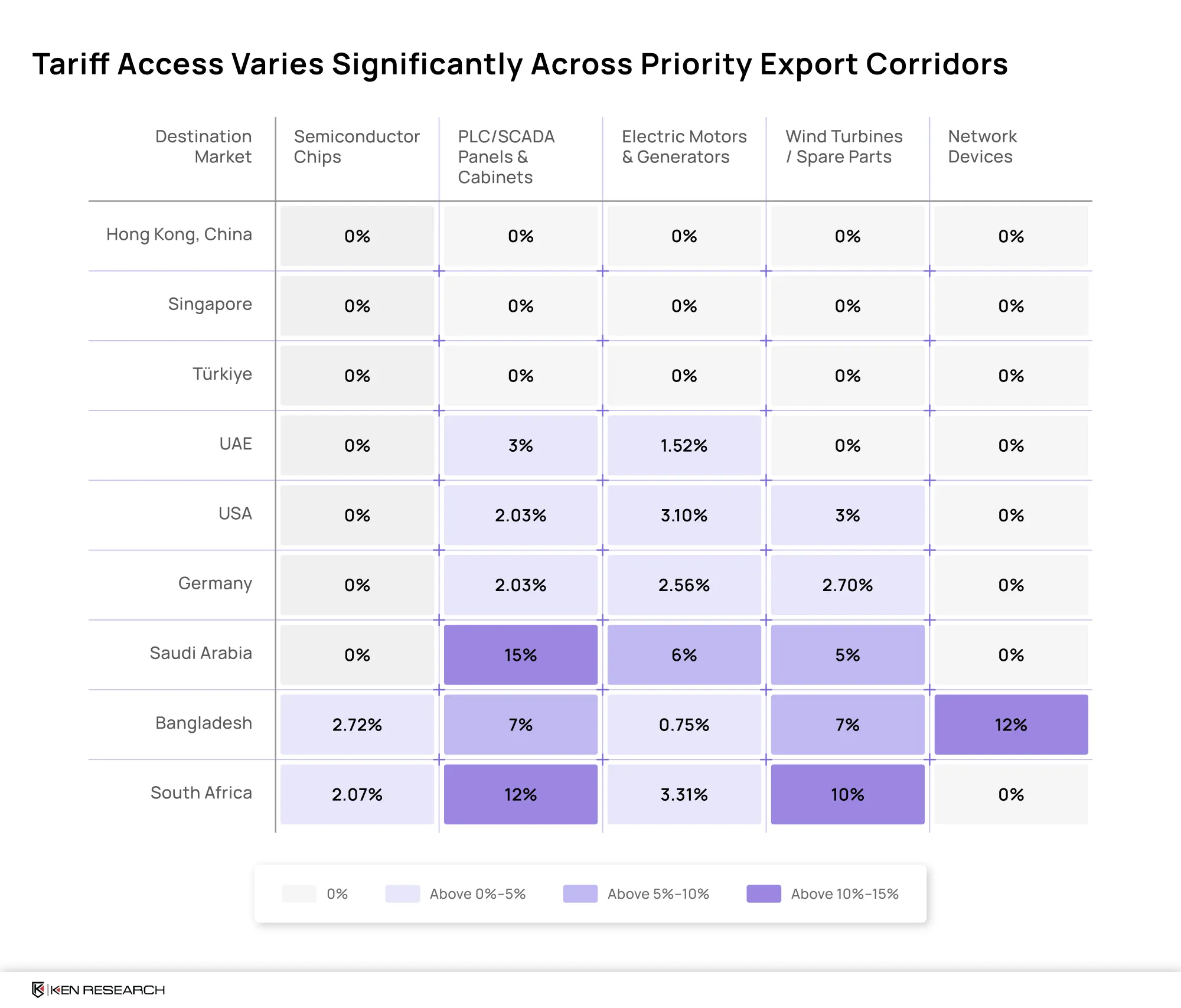
Hong Kong, Singapore and Türkiye provide zero-tariff access across all five priority product categories. This makes them strategically relevant for semiconductors, network devices and electrical equipment, but not necessarily for the same reasons as the United States, Germany or the UAE. Their value may lie in regional aggregation, trading and onward-market access rather than the depth of direct demand available within the domestic market.
Exporters must therefore make two distinct decisions. The first is where the product is ultimately demanded. The second is whether direct entry or a hub-led regional route offers the stronger commercial model.
Hong Kong may provide an access point into wider Asian trade flows. Singapore can support regional distribution across Southeast Asia. Türkiye can provide tariff-free access across the five selected categories while also offering proximity to European, Middle Eastern and Central Asian markets. These possibilities should be assessed as route-to-market options, not assumed to be equivalent to direct-demand corridors.
The opportunity set also extends beyond the five established demand hubs. France, South Korea, Japan, Indonesia and Brazil stand out as automotive and EV-linked hot spots, while Italy and the United States remain relevant telecom hubs. These countries should not be combined into a generic second-wave expansion list. Their relevance depends on the product platform and application being served.
An electric-motor or automotive-component exporter requires a different destination screen from a network-device or industrial-automation company. Core demand hubs warrant corridor-level evaluation now. Application-specific hot spots should enter the next round of product-led screening rather than receive automatic market-entry investment.
A Low Tariff Can Open a Market, but It Cannot Select It
The tariff landscape is favourable across much of India’s priority export basket.
Semiconductor chips and network devices enter the United States and Germany at 0% duty. The UAE also offers 0% tariffs for semiconductor chips, network devices and wind-turbine equipment, while electric motors face 1.52% and PLC and SCADA systems face 3%.
These conditions create a meaningful access advantage, but tariff treatment should remain a screening criterion rather than become the entire export strategy.
The United States provides zero-duty access for semiconductors and network devices, but applies 3.10% to electric motors. Germany applies zero duty to network devices but 2.56% to motors. The UAE offers better motor access at 1.52%, while PLC and SCADA systems face 3%.
The destination has not changed. The product economics have.
This is why a market should never be prioritised independently of the product and its HS code. A country described as low tariff may contain both highly attractive and comparatively weaker opportunities.
The effect is even more visible in markets with selective tariff pressure.
Saudi Arabia provides zero-duty access for semiconductor chips and network devices, but imposes 15% on PLC and SCADA panels, 6% on electric motors, and 5% on wind-turbine products. Bangladesh applies only 0.75% to electric motors, yet network devices face 12%. South Africa allows network devices to enter duty-free while applying 10% to wind-turbine products and 12% to PLC and SCADA systems.
This has direct implications for capital allocation. Certification expenditure, channel development and commercial resources should follow the corridor with the strongest economics. They should not be distributed across countries merely because those countries appear on a generic priority-market list.
The costliest export mistake is often not choosing a bad country. It is choosing a plausible country for the wrong product. Access the complete India Industrial Exports assessment to compare product-level tariffs and identify which destination corridors warrant deeper commercial evaluation.
Three Corridors Merit Immediate Commercial Attention
The most attractive export corridors combine visible demand with favourable market access. Three combinations currently meet that test most clearly.
Semiconductor Chips to the United States: A Corridor Built on Momentum and Access
India’s semiconductor-chip exports reached approximately USD 1,424.4 million in 2025, with value growth of 59.5%. The platform includes controlled diodes, electronic components, photoconductive cells, photovoltaic cells and other semiconductor products serving automotive, industrial automation and telecom applications.
The United States combines high demand with 0% tariff access, making this one of the strongest corridors for near-term commercial validation.
The existing destination pattern further strengthens its strategic importance. Ken Research’s product-market mapping shows the largest semiconductor export flow from India going to the United States, with additional flows to China, the UAE, Germany and Singapore. The United States therefore represents both favourable access and the largest visible demand hub within the current semiconductor export footprint.
For manufacturers and investors, the quality of the United States entry case will have a disproportionate influence on the platform’s international growth. This does not justify treating semiconductors as one undifferentiated opportunity. It raises the value of choosing the correct product within the broader platform.
The category covers multiple applications, from EV control units and ADAS systems to smartphones, laptops, televisions and routers. The commercial case will differ across those applications.
Exporters should therefore resist the temptation to treat semiconductor growth as a single market proposition. The stronger decision begins with the precise product, the applicable HS code and the customer qualification requirements in the United States.
The United States corridor deserves attention because demand and access are favourable. It deserves investment only when the selected product can meet the requirements that sit beyond the tariff line.
Network Devices to Germany: Export Scale Meets Zero-Duty European Access
India’s network-device exports reached approximately USD 1,455.1 million in 2025, with value growth of 21.1%. The platform covers routers, switches, modems, access points, gateways, firewalls, set-top boxes and enterprise Wi-Fi systems used across telecom, IT and data-centre infrastructure.
Germany offers 0% tariff access, creating a strong starting point for a category that already carries meaningful export scale.
The export geography is also more concentrated than a broad global telecom narrative would suggest. The United States and Germany absorb the most visible network-device flows, with Germany standing out as a major European demand hub for the category.
This supports a more focused European-entry strategy. Rather than distributing resources across several European markets from the outset, exporters can first determine whether a defined network product can establish a competitive position in Germany. Evidence from that corridor can then guide decisions on wider regional expansion.
The opportunity, however, is not “network equipment to Germany” in the abstract. A router, switch, modem or gateway represents a separate product-market proposition. Demand, technical requirements and exporter competition must be considered at that level.
Germany’s position within Europe’s industrial and technology ecosystem makes the corridor strategically important. Zero duty protects the landed-cost case, but product precision and technical readiness will determine whether access can be converted into revenue.
PLC and SCADA Systems to the UAE: Workable Access Meets Industrial Demand
PLC and SCADA panels and cabinets serve energy and power generation, industrial automation, oil, gas and petrochemical applications. The product group includes PLC panels, SCADA cabinets, remote terminal unit panels and pump-control panels.
The UAE corridor combines strong demand with a 3% tariff, giving it a strong near-term case despite the absence of absolute zero-duty access.
Its importance also extends beyond PLC and SCADA systems. The UAE receives visible export flows across all five priority platforms, including semiconductor chips, electric motors, wind-turbine components and network devices. This breadth strengthens its position as a diversified industrial demand hub rather than a narrow single-product destination.
The strongest corridor is not necessarily the one with the lowest tariff. A workable duty can support an attractive opportunity when destination demand is sufficiently strong.
The UAE case should therefore be built around the application rather than the full automation category.
For Indian automation exporters, the UAE provides a route into a high-demand industrial market under manageable tariff conditions. The opportunity is strongest where the exporter can combine technical capability with an application-specific proposition.
A 3% duty has not prevented PLC and SCADA systems from emerging as one of the three strongest corridors because the demand side of the equation remains compelling.
Semiconductors to the United States, network devices to Germany and PLC/SCADA systems to the UAE are attractive for different reasons. Speak with a Ken Research export intelligence consultant to determine which corridor best matches your product portfolio, technical readiness and growth priorities.
Where to Commit, Where to Wait
Not every plausible export market deserves the same level of capital, management attention or commercial effort. The discipline lies in separating corridors that merit immediate validation from those that should advance only when a specific trigger improves the economics.
Electric motors to Saudi Arabia fall into the second category. Demand is strong, but the 6% tariff weakens the near-term case relative to the UAE at 1.52%, Germany at 2.56%, the United States at 3.10% and South Africa at 3.31%.
The correct response is not to exit the opportunity, but to preserve readiness. Exporters should continue tracking demand and policy developments while avoiding the fixed costs associated with a full market-entry push. A material improvement in tariff access, potentially through FTA progression, could strengthen the corridor within the next 18 months.
Wind-turbine spares to South Africa warrant a different decision. Limited demand and a 10% tariff make the corridor unattractive for near-term investment. It should be deferred and reassessed in 12 to 18 months, rather than allowed to absorb resources simply because the broader renewable-energy equipment category is growing.
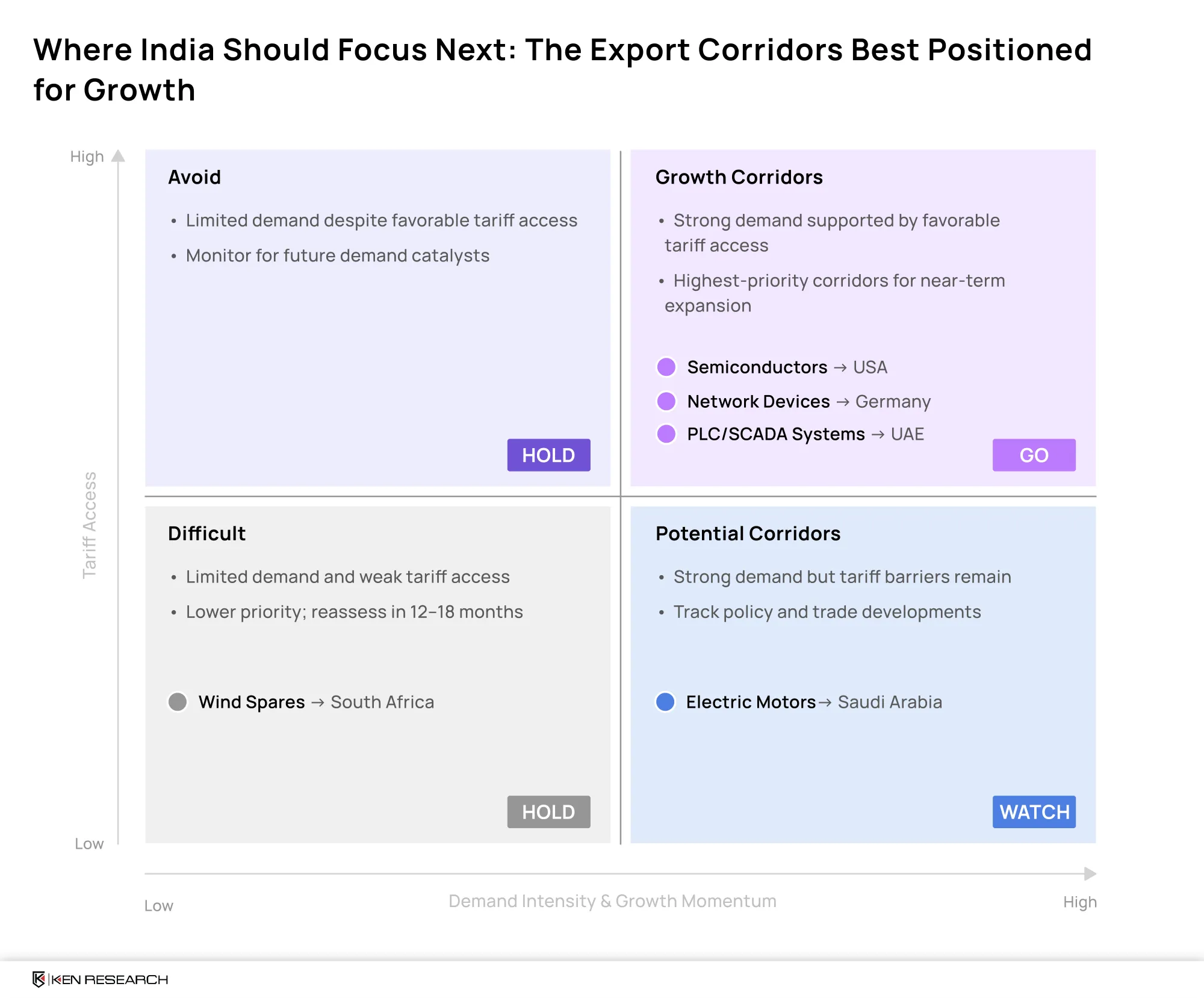
For CEOs and strategy heads, the governance implication is clear. Near-term priority corridors should receive validation resources. Trigger-dependent opportunities should remain tied to defined tariff or policy milestones. Deferred corridors should stay outside the immediate capital plan until their underlying economics improve.
This approach creates a focused export portfolio: act where the case is strong, preserve optionality where conditions may change, and withhold capital where demand and access do not yet justify commitment.
Compliance Determines Whether Access Becomes Revenue
Demand and favourable tariffs can establish that a product-market corridor is attractive. They do not establish that the exporter is ready to serve it.
Technical certification, including UL, CE and IEC requirements, determines whether market access can be converted into revenue. Readiness must also be tested against the presence of certified exporters within the relevant HS code, evidence of exports to the destination during the previous 24 months, and landed-cost competitiveness.
A low- or zero-tariff corridor can still weaken when certification gaps remain unresolved. Strong destination demand is insufficient when the exporter cannot meet the required technical standards. Even a compliant product should not progress if its landed-cost position is uncompetitive.
Compliance readiness should therefore be assessed before the corridor advances to go-to-market development. Exporters should validate certification gaps, existing exporter proof and landed-cost advantage before scaling commercial investment.
For governments and export-promotion institutions, the implication is to assess policy and FTA alignment alongside demand, tariffs and compliance readiness. Support creates the greatest value when it strengthens a product-market corridor that already has a credible demand and access case.
From Export Opportunity to Investable Corridors
Trade flows and tariff data can show where an opportunity exists. They cannot determine whether a specific product-market corridor is ready for investment.
Ken Research’s Export Intelligence closes that gap by screening approximately 20 industrial products for export value, growth and exporter density, then testing the strongest candidates across 40+ markets for demand, tariffs and policy or FTA alignment. The final test is execution readiness: certification gaps, certified-exporter presence within the HS code, evidence of exports to the destination during the previous 24 months, and landed-cost competitiveness.
This separates corridors that merit immediate commercial validation from those dependent on a tariff or policy trigger, and those where investment should be deferred. Exporter benchmarking further reveals where Indian companies are already competitive and where product-market whitespace remains.
The outcome is not another country list. It is a focused corridor agenda showing which product to take where, what must be resolved before entry, and which two or three opportunities deserve a go-to-market sprint. Country playbooks then map tariffs, certifications, buyers, partners and channels before resources are scaled.
India’s Export Ambition Requires Fewer, Better-Chosen Bets
India’s technology-led export opportunity is already visible across several global industrial hubs. The challenge is no longer finding possible destinations. It is choosing the corridors where product strength can be converted into a durable commercial position.
Semiconductor chips to the United States, network devices to Germany and PLC and SCADA systems to the UAE deserve immediate commercial validation.
Electric motors to Saudi Arabia should remain a trigger-dependent opportunity, with tariff and FTA developments determining when the corridor merits greater commitment.
Wind-turbine spare parts to South Africa should remain deferred under current conditions and be reassessed if demand or market access improves.
These decisions are not permanent. They reflect where exporters should place resources under current conditions.
The broader strategic lesson is more enduring.
Demand identifies where the opportunity sits. Tariffs determine whether the door is open. Compliance and landed-cost competitiveness decide whether an exporter can walk through it profitably.
India’s next industrial export wave will be built by companies that make those choices with discipline - one product, one market and one validated corridor at a time.
Related tags
Manufacturing and Construction
Get started
We've helped companies around the world future-proof
their businesses - and we can do the same for you.