Global Insurance 2025: How 3–7 pt Loss-Cost Inflation, USD 100B+ Climate Losses, and a USD 1.8T Protection Gap Are Rewriting Profitability
Ken Research
December 2, 2025 - 4 min read

December 2, 2025
by Khushi RastogiThe insurance industry is shifting rapidly as loss-cost inflation rises approx. 3–7 percentage points faster than premium growth and climate losses exceed USD 100 billion annually for the fourth consecutive year. GenAI is compressing underwriting and claims cycle times by 30-50%, while emerging markets expand 3-5 points faster than mature economies. With the global protection gap now above USD 1.8 trillion, insurers must adapt to a landscape where risk, cost, and opportunity are evolving simultaneously. The following five forces capture the most significant shifts shaping performance and strategic advantage today.
Inflation Resets Cost Structures and Squeezes Margins
Persistent cost pressure is redefining pricing discipline across insurance markets. Loss-cost inflation is outpacing premium growth by 3–7 percentage points, eroding profitability even in segments with active repricing cycles.
Also, medical, labor, and repair-part inflation continue to push combined ratios upward, with several key markets seeing 5–8 point deterioration in underwriting performance.
Pricing agility is becoming a core differentiator, as carriers slow to adjust risk selection and exposure management face rising capital strain. As inflation reshapes cost curves, climate volatility is adding a second layer of unpredictability that insurers must now price into portfolios.
Climate Volatility Pushes Cat Losses and Reinsurance Costs to New Highs
Rising catastrophe frequency is reshaping capital and risk-transfer structures. Insured catastrophe losses have exceeded USD 100 billion for four consecutive years, driven by more frequent convective storms, floods, and extreme weather events.
Reinsurance markets are tightening, raising retentions and pushing more volatility onto primary carriers, especially in property-heavy portfolios.The gap between insured and economic losses continues to widen in emerging regions, exposing structural underinsurance and heightening long-term risk.
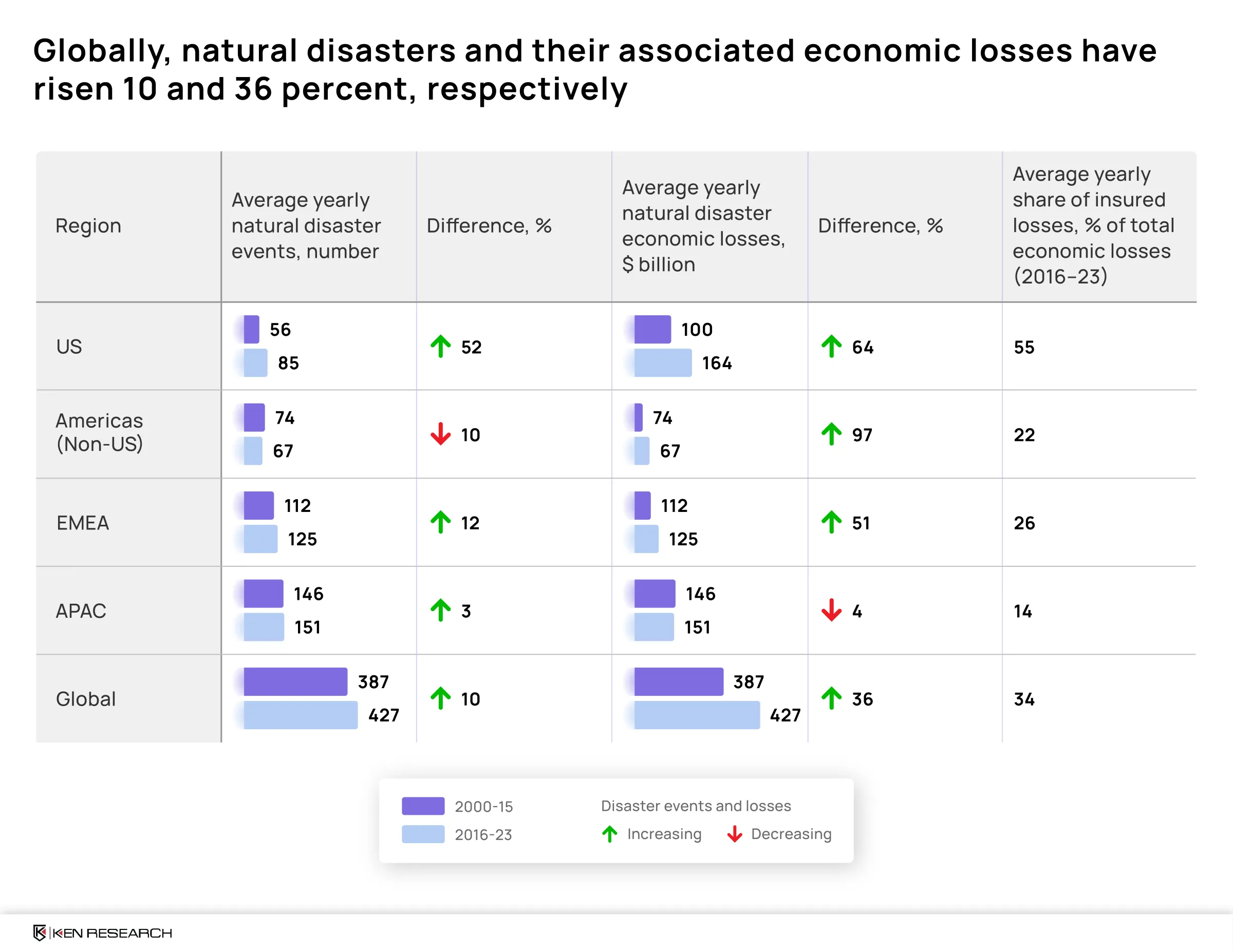
To counter rising volatility, insurers are accelerating technology adoption—especially GenAI to build operating leverage and restore efficiency.
GenAI Becomes the New Productivity Engine Across the Value Chain
AI deployment is scaling from isolated pilots to enterprise transformation.
GenAI is reducing underwriting and servicing cycle times by 30–50%, as automated document handling, summarization, and customer-assist tools streamline workflows. Claims organizations using GenAI are lowering processing costs by 10–20%, supported by intelligent FNOL, fraud detection, and automated adjudication.
Early adopters are achieving 3–5 point reductions in expense ratios, widening the performance gap between digital leaders and legacy-constrained carriers.
As technology reshapes cost structures, the geography of growth is shifting toward markets that remain underpenetrated and demographically dynamic.
Emerging Markets Outpace Mature Economies in Premium Expansion
Premium growth is increasingly concentrated in high-momentum regions. Emerging markets across Asia-Pacific, Latin America, and Africa are expanding 3-5 % points faster than mature economies in North America and Western Europe, supported by rising incomes, a growing middle class, and rapid digital adoption.
Insurance penetration in many of these markets remains below 4% of GDP, creating significant opportunity across motor, health, life, and micro-insurance segments.
In contrast, mature markets face slower expansion due to demographic aging, saturated product portfolios, and tighter margin pools, reinforcing the need for geographic diversification. Despite strong growth in emerging regions, the global protection gap continues to widen, highlighting persistent underinsurance across multiple segments.
The Global Protection Gap Widens into a Trillion-Dollar Opportunity
Underinsurance in life, health, and property is expanding faster than coverage growth.The global protection gap surpasses USD 1.8 trillion, driven by demographic change, healthcare inflation, and accelerating climate exposure.
Middle-income households across Asia, Africa, and Latin America remain significantly underinsured, even as digital distribution lowers access barriers. Modular, parametric, and low-cost digital products are emerging as scalable responses, though widespread adoption is still in its early stages.
Conclusion
The global insurance sector is entering a period where economic pressure, climate volatility, and accelerating technology adoption will determine competitive positioning far more than legacy market share. Inflation is reshaping cost structures, catastrophe exposure is tightening reinsurance markets, and GenAI is redefining productivity at scale.
Meanwhile, emerging markets are capturing a growing share of global premium expansion, even as the protection gap widens across multiple segments. Insurers that respond with disciplined pricing, deeper digital adoption, and strategic allocation of capital toward high-growth markets will be best positioned to navigate this rapidly shifting environment.
Ken Research Insight
Emerging economies are positioned to drive a larger share of global insurance expansion as penetration levels remain well below those of advanced markets. According to the OECD Global Insurance Market Trends 2024, global insurance penetration averaged 7.4% of GDP, yet major emerging markets operate at significantly lower coverage levels. India’s FY24 figures from IRDAI show total penetration at 3.7% of GDP with life at 2.8% and non-life at 0.9% illustrating the scale of underinsurance across high-growth regions.
This structural gap signals substantial, long-term premium headroom across Asia, Africa, and Latin America, especially in health, protection, and micro-insurance. Rising digital adoption, broader financial inclusion initiatives, and expanding middle-income populations will accelerate coverage uptake as governments formalize regulatory frameworks and strengthen consumer protection mechanisms.
For insurers, prioritizing capital allocation and digital distribution in these underpenetrated markets will be essential to capturing the next decade of sustainable premium growth.
Related tags
Insurance
Banking Financial Services and Insurance
Get started
We've helped companies around the world future-proof
their businesses - and we can do the same for you.