Hospital Chain Brand Salience & Patient First-Choice Recall Survey: Why India’s Hospital Chains Are Winning Awareness but Losing the Patient Decision
Ken Research
August 5, 2026 - 9 min read

August 5, 2026
by Ken ResearchIndia’s Hospital Chain Market: A Crowded Race Where Awareness No Longer Wins the Patient
India’s organised hospital chain sector crossed INR 1.1 trillion in revenue by FY2025, growing at a roughly 15% CAGR since FY2021 on the back of corporate consolidation, aggressive bed-capacity expansion, and a surge in insurance-led demand. Yet the more strategically significant number is not in the bed count or the revenue line. It is in the patient’s mind at the precise moment they decide where to go for care.
To understand how patients actually form first-choice preference among competing hospital brands, Ken Research conducted its inaugural Hospital Chain Brand Salience & Patient First-Choice Recall Survey across six major cities, tracking the awareness, consideration, shortlisting, and first-choice recall behaviours of over 3,900 patients and primary healthcare decision-makers. What emerged is not a simple brand-tracking report. It is a salience-anatomy study that reveals the precise stages where a hospital chain converts top-of-mind awareness into an actual visit - and the equally precise stages where it loses a patient who already knew its name.
National corporate chains, regional multi-specialty groups, and new-age boutique brands collectively compete for the same patient, yet fewer than 27% of surveyed respondents named a single hospital chain as their unprompted first choice for serious or planned care. Awareness without salience, recall without conviction, and reputation without accessibility are not peripheral marketing concerns. They are the structural reasons patients default to the nearest facility, switch chains between care episodes, and recommend competitors to their families. India’s hospital patient is more aware of brands than ever - and less loyal to them than ever.
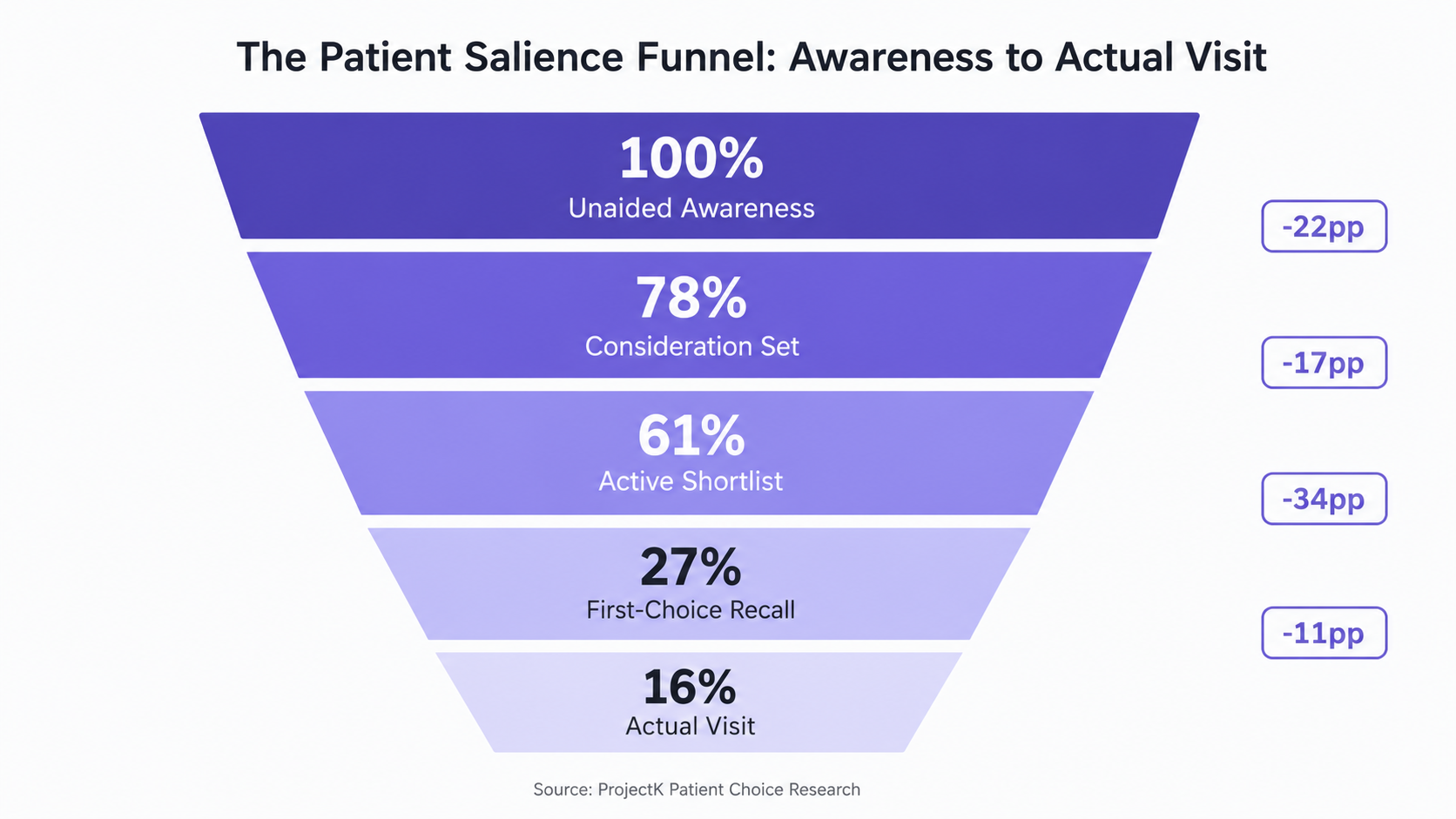
The implication reframes where hospital chains must compete. The funnel does not collapse at the awareness stage; it collapses at the conversion stages that awareness spending cannot reach. Proximity in an emergency, insurance network coverage for a mid-income family, and a specialist’s direct referral each override brand recall at different points in the journey - and no advertising budget addresses all three simultaneously.
Survey Profile: Who We Studied, Where, and Why It Matters
Sample and Geography
The survey was conducted between Q4 2024 and Q1 2025, covering a stratified sample of 3,912 patients and primary healthcare decision-makers across Delhi-NCR, Mumbai, Bengaluru, Hyderabad, Chennai, and Pune. These cities represent approximately 56% of organised hospital chain revenue in India as of 2024. The survey was administered through online panels, hospital-precinct intercept interviews, and assisted mobile surveys to capture respondents across digital proficiency and household income levels.
Demographic Profile
- Care-context split: 37% planned or elective procedures, 29% emergency or urgent care, 21% chronic-condition management, 13% diagnostic or preventive visits
- Income brackets: 40% in INR 6-15 lakh annual household income; 31% above INR 15 lakh; 29% below INR 6 lakh
- Decision-maker profile: 46% deciding for a family member; 33% for themselves; 21% for an elderly dependent
- Chain type considered: 49% considered a national corporate chain; 33% a regional multi-specialty chain; 18% a new-age boutique or single-specialty brand
The Salience Anatomy: Where Patients Recall, Where They Defect
The hospital-choice journey in urban India is neither linear nor brand-loyal. The survey maps a five-stage funnel from unaided awareness through to an actual visit, and across that funnel the sharpest attrition occurs not at the awareness stage but at the first-choice recall stage, where patients narrow from several familiar names to a single intended destination. Clinical reputation, specialist availability, insurance tie-ups, and physical accessibility each determine the outcome at that critical narrowing point.
The drivers that decide the funnel vary sharply by care context. Clinical reputation was cited as the primary first-choice driver by 38% of respondents for planned and elective procedures, yet 54% reported they could not confidently distinguish one chain’s clinical quality from another’s before arriving, relying instead on word-of-mouth and specialist referral. In emergency situations, proximity and accessibility dominated for 41% of respondents, meaning even the strongest brand salience collapses when minutes matter and the nearest credible facility wins regardless of recall.
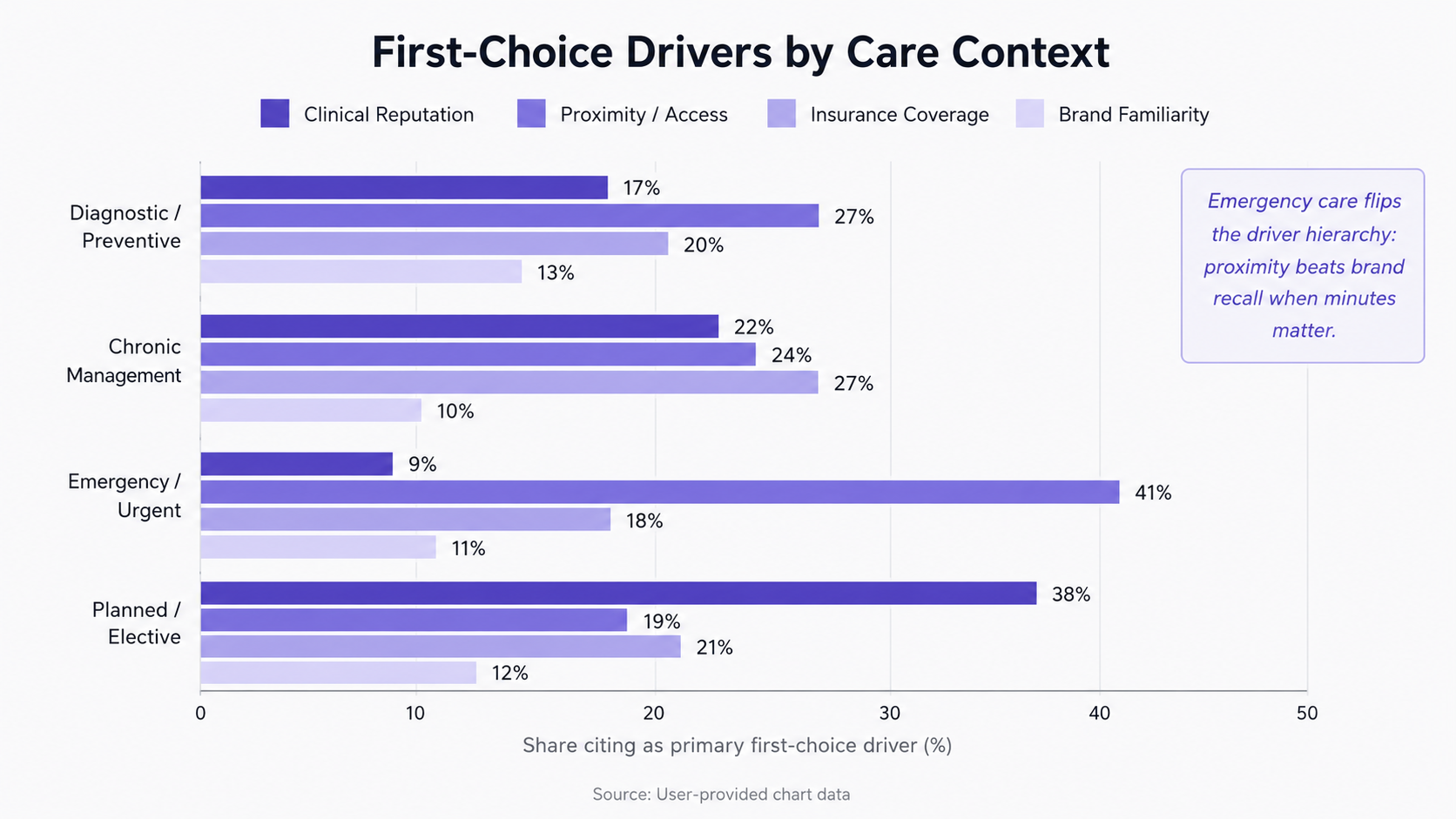
The insurance dimension adds a structural layer. Among patients earning INR 6-15 lakh, cashless insurance network coverage ranked as the second-most-cited first-choice factor at 14% primary citation, driven by out-of-pocket cost anxiety rather than brand preference. Across all segments, only 12% of respondents cited brand familiarity alone as their primary first-choice driver, confirming that recall without a clinical, accessibility, or financial advantage does not reliably convert to a visit.
The Conversion Deficit: Why Recall Fails to Become a Visit
If first-choice drivers reveal what patients want, the brand salience matrix reveals how seriously chains are squandering the awareness they have already paid to build. The matrix below positions each chain type simultaneously on first-choice recall salience and recall-to-visit conversion rate, with bubble size reflecting relative patient volume share.
The most revealing finding is the divergence between national chains and boutique brands. National corporate chains score highest on salience at 74% but achieve only 41% recall-to-visit conversion, placing them in the awareness-rich, conversion-weak quadrant. Boutique and single-specialty brands invert this entirely: low overall salience at 34% but the highest conversion rate in the matrix at 65%, demonstrating that being chosen does not require the largest brand - it requires the smallest gap between being recalled and being reachable.
The Conversion Paradox
India’s hospital chains are not losing patients because they are unknown. They are losing because being known is no longer enough to be chosen. The chains with the highest awareness scores are consistently converting at the lowest rates, while boutique and regional specialists - with a fraction of the brand investment - convert recalled patients into actual visits at rates that national chains cannot currently match. Salience without conversion infrastructure is brand equity that cannot be monetised.
The Insurance Anchor: How Network Coverage Is Reshaping First-Choice Dynamics
The role of insurance network coverage in the first-choice decision is not uniform across income bands or chain types. It is structured, predictable, and growing. The heatmap below scores the proportion of each income-bracket segment that cites cashless insurance tie-up as their primary first-choice factor, broken down by chain type considered.
The pattern is striking in both directions. Among below-INR 6 lakh households considering national corporate chains, 48% cite insurance coverage as the primary first-choice factor - a figure that reflects access anxiety more than brand preference. At the other end, above-INR 30 lakh households considering boutique or single-specialty brands score 63% on insurance as a primary driver, reflecting premium insurance plan alignment rather than cost anxiety. Regional multi-specialty chains show the most consistent insurance sensitivity across income bands, scoring above 31% even in the highest income bracket.
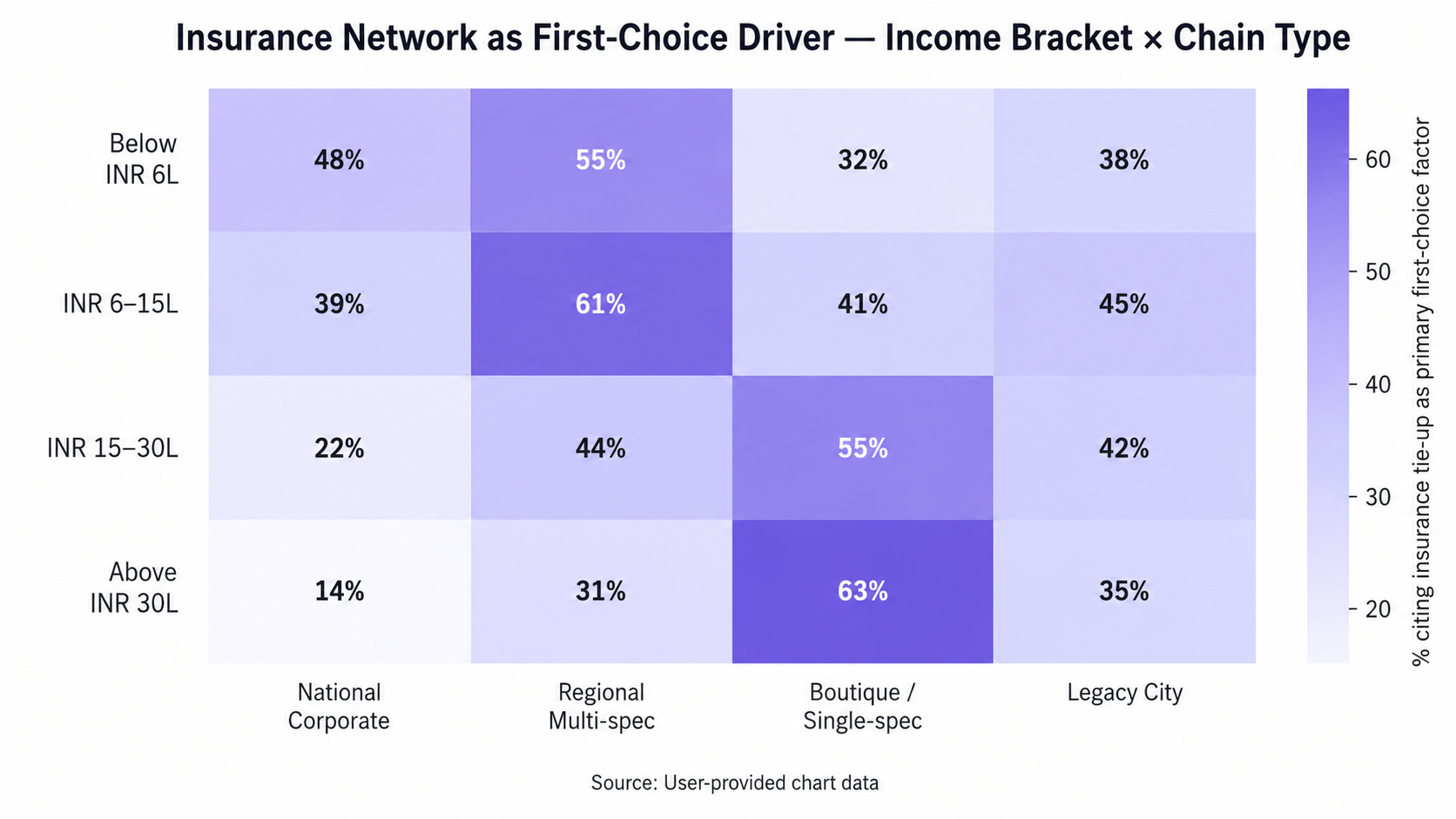
The insurance dimension is not a demographic footnote. For hospital chains, insurance network depth is becoming the access infrastructure that determines whether brand recall translates into a first visit. A chain that a patient recalls but cannot access through their cashless network is, for that patient, functionally absent from the choice set regardless of awareness score.
Referral Dependence: The Invisible Force That Redirects the Patient
Even among patients who have named a chain as their first choice, a significant proportion ultimately visit a different facility. The chart below tracks what percentage of patients across each chain type were redirected by a doctor or family referral away from their stated first-choice brand, broken down by care context.
Referral dependence is highest for legacy city hospitals across planned care, where 62% of patients who named one as a first choice ultimately visited a different facility on the recommendation of a referring doctor or family member. National corporate chains are not immune: 53% of planned-care patients recalled as a first choice were redirected away by referral, exposing how thin direct brand pull remains even for the most salient names in the market. Boutique brands show the lowest referral-driven attrition at 31% for planned care - a figure that reflects their specialist-referral integration rather than brand loyalty in the conventional sense.
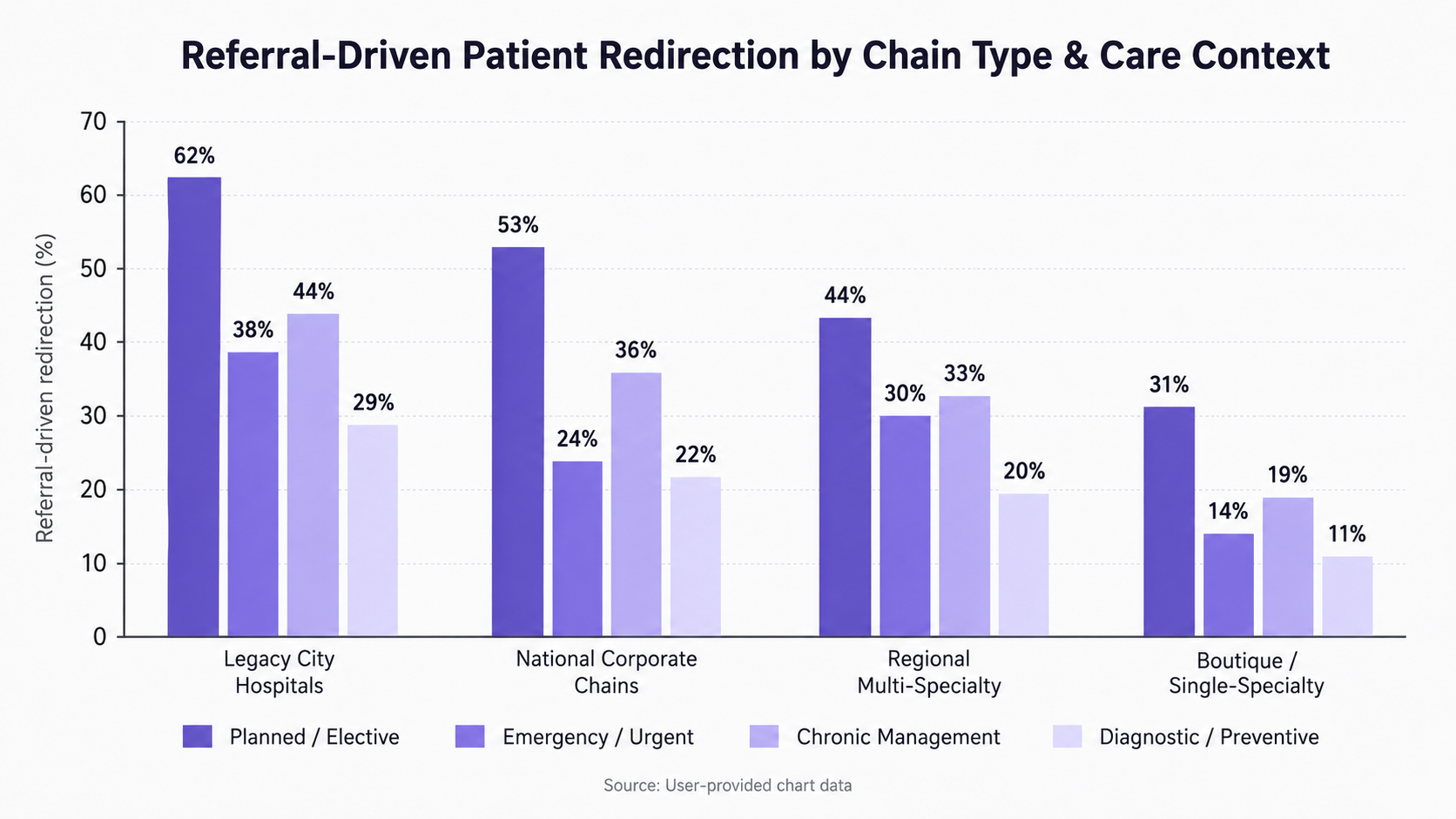
The referral finding reframes the competitive strategy. The referring doctor is not a passive channel; the referring doctor is the brand decision at the planned-care stage for the majority of patients. Hospital chains that have not built structured referring-physician relationship programmes are ceding the most valuable conversion moment in the patient journey to chains and boutique specialists that have.
What Lies Ahead: The Strategic Reckoning for India’s Hospital Chain Ecosystem
The rise of the aware yet unattached patient has triggered more than a marketing challenge for India’s hospital chains. It has exposed a structural salience gap that no advertising spend alone can close. What worked for the sector’s growth decade - mass-brand awareness campaigns, bed-capacity expansion, and reputation as a substitute for accessibility - is no longer sufficient in a market where a patient compares facilities, checks insurance networks, reads peer reviews, and evaluates specialist availability in under ten minutes on a smartphone before a planned procedure, or simply drives to the nearest credible name in an emergency.
Hospital chains must now confront hard strategic questions that their current brand and network architectures are not always designed to answer:
Do they invest in accessible network presence and frictionless digital appointment infrastructure that converts recall into a visit, or continue to treat brand advertising as the primary growth lever while the conversion gap widens?
Do they build transparent, comparable clinical-outcome and insurance-network signals that give patients a concrete reason to choose, or accept that referral dependence will continue to dilute hard-won brand equity at the planned-care stage?
Do they design distinct salience propositions by care context - clinical reputation and specialist depth for planned care, proximity and speed for emergencies, insurance breadth for mid-income families - or deploy a uniform brand message that wins none of these moments decisively?
The market is beginning to answer these questions on behalf of chains that do not. Boutique and regional specialists have demonstrated that being chosen does not require the largest brand or the most beds. It requires the smallest gap between being recalled and being reachable. India hospital chain market is no longer an awareness game. It is a salience game, and the winners will be those who turn recall into a reason to choose before their competitors do.
For national and legacy chains alike, the message from this data is direct: close the recall-to-visit gap with insurance depth, network accessibility, and referring-physician relationships - or risk forfeiting a patient who already knew your name to whoever makes the next step easier.
About the Author - Sidhika Jain:
Sidhika Jain is a survey research associate at Ken Research, specialising in market research and consumer insight analysis. She works on survey design, data analysis, and research-driven strategies to help organisations make informed business decisions.
From the Author
"At Ken Research, we have been tracking patient decision-making at the point of choice across India's top cities, and the pattern is consistent and confronting, hospital chains are capturing brand awareness but not converting it into first-choice recall. The salience gap is not random. It is predictable, measurable, and addressable. India's hospital chain sector is not short of ambition or capacity. What it is short of is a credible answer to a simple question that every patient is asking at the moment of need: will this brand actually be there for me? Until chains can answer that with evidence, the awareness story will remain structurally fragile."
About Ken Research:
Ken Research is a market intelligence and strategy consulting firm delivering actionable insights across the various sectors in dynamic markets. We support industry stakeholders with data-driven analysis on emerging trends, competitive benchmarking, pricing strategies, and shifting consumer preferences. Our expertise enables clients to refine market entry and penetration strategies, optimize product positioning, and respond effectively to evolving competitive landscapes.
Subscribe to Ken Research Survey Results | kenresearch.com
Related tags
Healthcare
Get started
We've helped companies around the world future-proof
their businesses - and we can do the same for you.