97% of India’s Aluminium Fenestration Fabrication Market Remains Unorganised: The Consolidation Window Is Opening
Ken Research
August 31, 2026 - 10 min read
August 31, 2026
by Unnati MiglaniIndia's aluminium fenestration market is approaching a point at which market growth and industry structure are beginning to move in different directions.
The market is expected to reach approximately ₹66,000 crore by 2032, growing at around 12% CAGR. Demand is moving towards applications where aluminium has a structural advantage, particularly premium residential, high-rise and commercial construction. Yet the industry serving that demand remains overwhelmingly fragmented. India has approximately 11,000 aluminium fabricators, around 97% of them unorganised, while organised system penetration remains below 5%, compared with approximately 50% in mature markets.
This gap is creating an opportunity that goes beyond participating in market growth.
India is at a stage where system players can still influence how the market organises.
That window is important. Europe and North America are already mature aluminium fenestration markets. Developed Asia-Pacific markets including Japan, China, South Korea, Singapore and Australia have also moved into mature or sustainability-led phases of adoption. India, by contrast, remains in the commercial expansion phase, alongside parts of Southeast Asia.
Global system companies have recognised the opening. Schüco, Reynaers, Alumil, Technal, ALUK and TOSTEM have already established positions in India, while localisation and manufacturing partnerships are beginning to develop around the category.
The opportunity for players in India is therefore not simply to sell into a growing market. It is to capture position while the market remains fragmented, system penetration is still low, and the structure of the organised ecosystem is not yet settled.
Within that opportunity, residential deserves particular attention. It already accounts for approximately 62% of India's aluminium fenestration value, while homes priced above ₹2 crore account for around 82% of residential aluminium fenestration value.
The strategic opportunity sits at the intersection of these conditions: a large residential value pool, rising system adoption, low organised penetration and a fragmented fabrication network that has yet to consolidate around a dominant operating model.
India Is Entering the Aluminium Adoption Cycle Later Than Mature Markets, but at a More Investable Stage
The timing of India's opportunity becomes clearer when viewed against the development of aluminium fenestration globally.
Europe and North America have already passed through the rapid adoption phase. Aluminium is established, and market development is increasingly driven by sustainability requirements and smart systems.
Developed Asia-Pacific markets have followed a similar trajectory. Japan, China, South Korea, Singapore and Australia are established or mature markets where aluminium adoption has already achieved considerable depth.
India has not yet reached that point. It remains in the commercial expansion phase, where aluminium penetration is increasing as construction shifts towards premium housing, larger formats, high-rise developments and façade ecosystems.
That creates a materially different competitive environment. In mature markets, the opportunity is increasingly about competing within an established aluminium ecosystem. In India, the ecosystem itself is still being formed.
The underlying global application data explains why this stage matters.
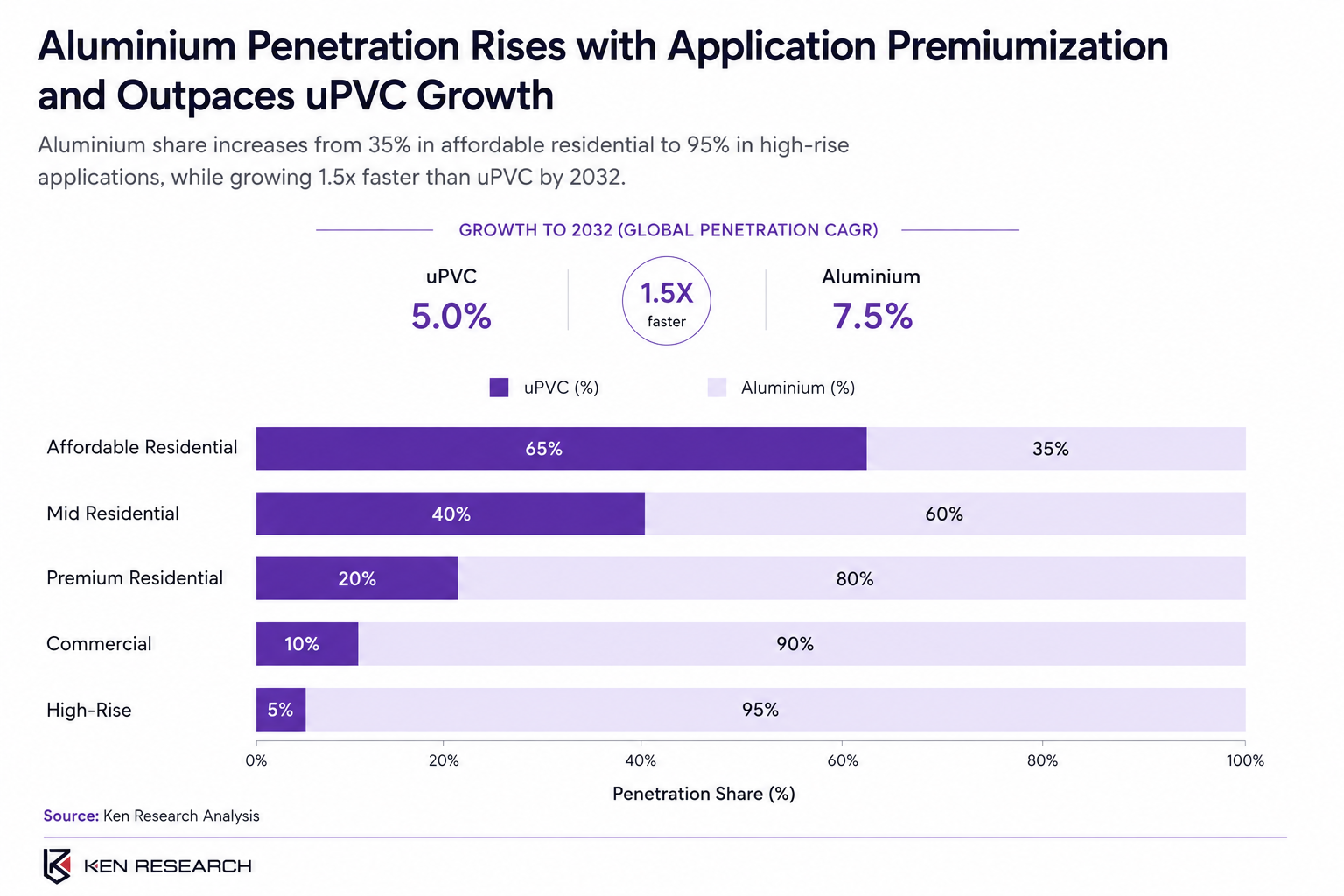
Aluminium accounts for approximately 35% of fenestration penetration in affordable residential applications, compared with 65% for uPVC. Its penetration rises to 60% in mid-residential, 80% in premium residential, 90% in commercial and 95% in high-rise applications.
Globally, aluminium fenestration is expected to grow at approximately 7.5% CAGR through 2032, compared with around 5.0% for uPVC, making aluminium's growth rate approximately 1.5 times higher.
The drivers are also changing. Earlier, fenestration demand was associated with affordable housing, basic insulation, cost optimisation, standardised windows and low-rise construction. The emerging aluminium market is increasingly associated with premium housing, large-format aesthetics, slim profiles, lifecycle performance, durability, smart integrated systems, high-rise development and façade ecosystems.
India is moving into the space between two strategic conditions: demand has developed sufficiently to support scale, while the organised market remains sufficiently immature to leave room for position-building.
62% of Aluminium Fenestration Value Sits in Residential. That Makes It the First Market to Capture
Residential real estate accounts for approximately 62% of India's aluminium fenestration value, making it the industry's largest demand pool. Within residential, the opportunity is sharply concentrated: homes priced above ₹2 crore account for approximately 82% of aluminium fenestration value.
That concentration has an important implication for system players. The near-term opportunity is not simply to widen residential coverage, but to build stronger access to the premium housing segments where aluminium fenestration value is already concentrated.
This also brings the industry's fragmented execution structure into sharper focus. Capturing premium residential demand requires the system brand, specification process, fabricator and installation network to work together. With approximately 97% of India's fabrication market still unorganised, residential growth and fabricator organisation are increasingly connected strategic questions.
Also Read: Why premium residential is becoming a key value pool in India’s aluminium fenestration market, and the demand fundamentals supporting its growth.
With 97% of Fabrication Still Unorganised, India’s Consolidation Opportunity Is About Organising Capability
India's aluminium fabrication market presents an unusual consolidation problem.
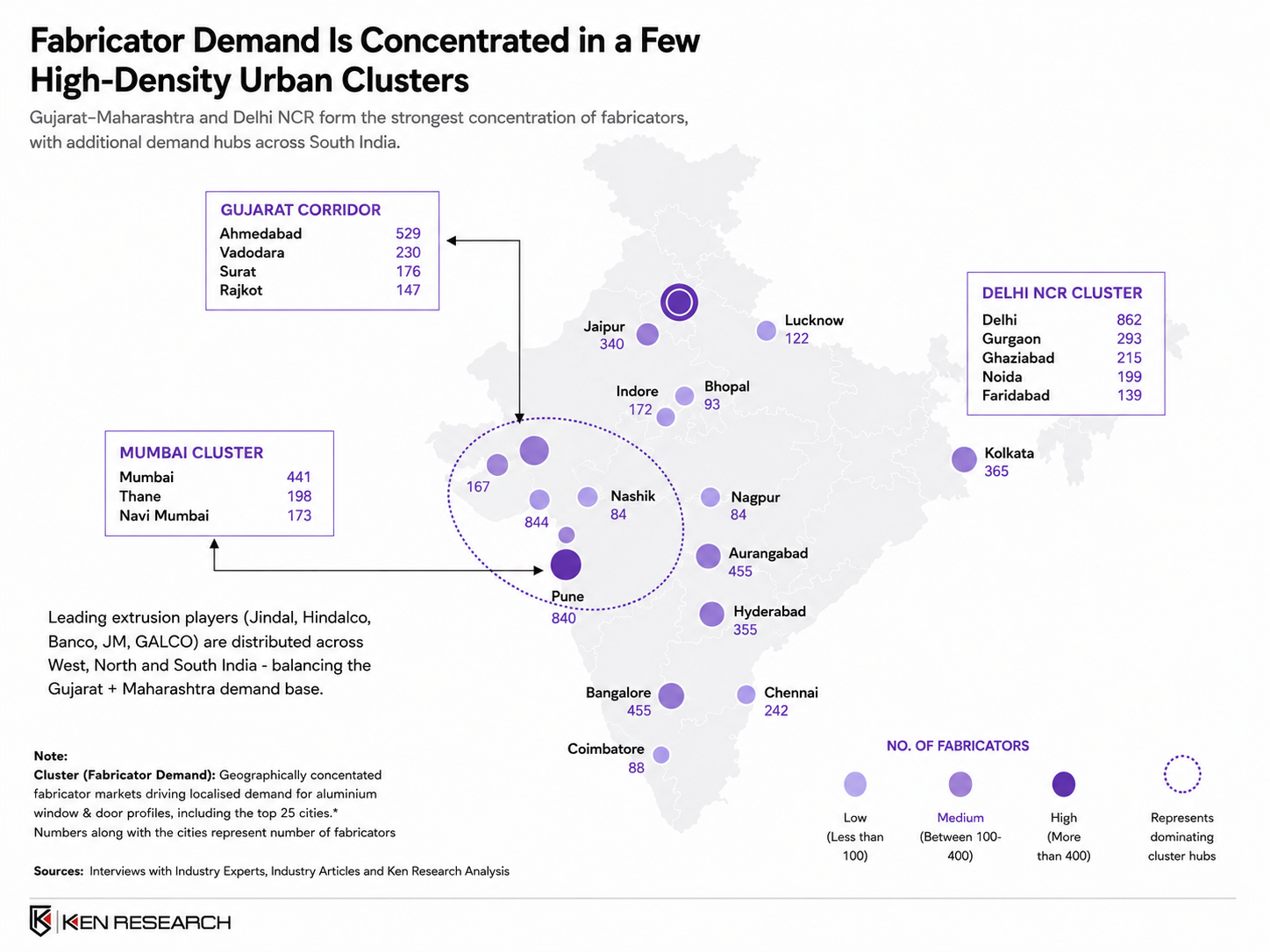
There are approximately 11,000 fabricators, but only around 3% of the fabrication market is organised. The fragmentation is not scattered randomly across the country. It is concentrated within a limited number of high-density urban clusters, particularly Delhi NCR, Gujarat–Maharashtra and major southern cities.
The concentration is material. Delhi NCR alone accounts for roughly 1,700 fabricators, while the Gujarat corridor and Mumbai cluster each represent sizeable pools of local fabrication capacity. Pune is another major standalone hub, and Bengaluru, Hyderabad, Chennai and Kolkata add further depth to the network.
This changes how the consolidation opportunity should be viewed.
India does not need to create fabrication capacity from scratch. The capacity already exists, and in many cases it is concentrated in markets where system players can build structured local networks. The opportunity is to bring a greater share of that existing capacity into organised systems.
That distinction matters because the industry has already moved through several structural stages. Before 2005, generic aluminium profiles supplied by local extruders and Chinese imports dominated. Between 2005 and 2015, local job-work fabrication networks expanded. From 2015 onwards, branded engineered systems became increasingly visible.
With approximately 97% of fabrication still unorganised, greater formalisation will depend on how effectively system players work with the existing fabricator base.
The opportunity is not to build a parallel fabrication network, but to bring more local fabricators into structured branded ecosystems.
This requires more than appointing authorised partners. The gaps in the current network include uneven technical capability, limited standardised certification, weak specification orientation and insufficient reach into smaller fabricator networks, particularly in Tier-2 markets.
Addressing these gaps puts fabricator training, certification, specification support and structured partner networks at the centre of the consolidation opportunity. The concentration of fabricators in major urban clusters also provides a practical starting point for building these networks.
The question for system players is therefore not whether fabrication capacity exists. It is how much of that existing capacity can be brought into a more organised, technically capable system.
Making that call requires a detailed view of the ecosystem at the city and cluster level. Ken Research works with fenestration players to map fabrication hubs, assess fabricator capabilities and brand affiliations, and prioritise partners for market entry and expansion. Connect with our experts.
Global Brands Are Betting on India Before the Organised Market Is Fully Formed
International activity in the category is already visible.
Schüco, Reynaers, Alumil, Technal, ALUK and TOSTEM have established positions in India. ALUK India has also collaborated with AIS Windows for manufacturing and distribution.
Their presence is significant because India's organised-system market remains small relative to mature-market benchmarks.
Organised system penetration is currently below 5% in India versus approximately 50% in mature markets. The difference represents more than a penetration gap. It illustrates how early India's system-led market remains.
Four conditions are supporting global interest:
- The first is early-mover formalisation. More than 95% of fabricators remain outside the organised system ecosystem, leaving substantial room for brands capable of building structured networks.
- The second is premiumisation, particularly in ₹2 crore-plus housing and in façade and system-led applications.
- The third is the architect ecosystem. Premium aluminium systems are increasingly influenced through specification, making architect and developer relationships relevant to market development.
- The fourth is localisation and sourcing, including the opportunity to develop manufacturing and distribution structures in India.
India has also received approximately ₹123,000 crore of NRI investment in real estate through 2025, with luxury real estate identified as a key segment.
Taken together, these conditions explain why global brands are entering before the organised market has reached maturity.
Waiting for formalisation to occur first would mean entering a market whose partner relationships, specification channels and organised fabrication networks may already be more established.
The current period therefore offers an opportunity to participate in the formation of those networks rather than compete only after they have formed. Download the full India Aluminium Fenestration Opportunity Assessment to examine the market structure, fabricator ecosystem, distribution gaps and emerging models shaping this opportunity.
The Existing Distribution Architecture Is the Constraint on Faster Consolidation
If India has attractive demand, low organised penetration and an extensive fabrication base, the obvious question is why formalisation has not moved faster.
The answer lies partly in the structure used to connect brands with the market.
One model has relied on a master fabricator supported by approximately 10 attached dealers. Industry experience indicates that this model has produced limited visible outcomes after five to seven years in some cases.
The underlying issues are operational.
Fabricators tend to concentrate on execution and cost rather than dealer-led sales development. Dealers tend to favour faster-moving and lower-cost brands rather than building demand for premium systems. Dealers also have limited accountability for installation quality, customer experience and technical execution.
The incentive structure compounds the problem because it remains centred on volume and discounts rather than capability and relationships.
The authorised-fabricator model improves brand connectivity but does not eliminate the structural gaps.
Technical capability remains uneven. Installation quality and finishing vary. Premium fabricators lack standardised certification. Many fabricators remain execution-oriented and have limited proactive engagement with architects and developers. Tier-1 networks are stronger, but Tier-2 markets remain underpenetrated and smaller fabricators often sit outside the branded ecosystem.
This is why market consolidation cannot be achieved simply by appointing more dealers or adding more authorised names to a partner list. The bottleneck is capability consolidation.
The Anchor-Fabricator Model Can Bridge the Execution and Reach Gap
Ken Research recommends an anchor-fabricator model as a practical route to organise the fragmented fabrication network while extending the reach of existing authorised partners. Under this structure, an authorised fabricator supports approximately eight to ten smaller fabricators, allowing local market coverage to expand while technical responsibility remains with a more capable partner.
The division of roles is clear. Smaller fabricators remain close to customer enquiries, while the anchor handles site visits, measurement, specification and profile ordering. Supply and installation are then undertaken jointly under the anchor’s supervision. Smaller fabricators can therefore participate within the branded system without being expected to independently replicate the technical capabilities of an established authorised partner.
This structure directly addresses three gaps in the current network: uneven technical capability, weak specification orientation and limited sub-network reach. Technical responsibility remains concentrated with the anchor, while smaller fabricators extend the network into local markets, including Tier-2 and Tier-3 cities where many operators remain outside established brand ecosystems.
The model also has a clear role in retail and homeowner demand. Smaller fabricators already provide the local interface, and training in products, specification and installation can strengthen their ability to support both customer engagement and execution. This creates a broader network around the anchor without diluting responsibility for the more technical stages of the project.
Rather than expanding through standalone partners alone, the anchor-fabricator model allows system players to organise groups of smaller fabricators around stronger authorised partners, combining wider local reach with more structured specification, supervision and execution.
Residential Capture Requires Fabricators to Become Part of the Sales System
The anchor model becomes more relevant when fabricators are treated as more than execution partners. Ken Research sees an opportunity to develop fabricators into a more active specification and sales network, particularly in residential markets where installers influence brand selection and local relationships remain important.
The priority is capability building. Training and certification in products, specification and installation can give fabricators a stronger role in customer conversations while improving their ability to represent branded systems. Recognition and digital engagement can reinforce that relationship and help system players build a more structured fabricator ecosystem.
The paints industry offers a useful precedent. Asian Paints had trained more than 600,000 contractors by FY2025, with over 1.56 million painters on its app. Significantly, 72% preferred recognition over rewards, showing the value that professional recognition can carry within a large installer network.
Aluminium fenestration is a different category, but the underlying principle is relevant: the installer can influence what gets recommended and ultimately used. For system players, developing fabricators therefore serves a commercial purpose alongside improving execution. It creates a larger network of partners capable of supporting specification, influencing brand choice and connecting branded systems more effectively with residential customers.
Combined with the anchor-fabricator model, this provides a clearer route to residential expansion: organise the network around capable partners, then strengthen the fabricators within it to participate more actively in specification and sales.
The Market-Capture Opportunity Is Open, but It Will Not Remain Structurally Open Forever
India's aluminium fenestration opportunity is attractive because several conditions are occurring at the same time.
The market is expected to reach approximately ₹66,000 crore by 2032 at around 12% CAGR.
Residential already accounts for approximately 62% of aluminium fenestration value, and homes above ₹2 crore account for around 82% of residential aluminium fenestration value.
India remains in the commercial expansion stage of aluminium adoption while Europe, North America and developed Asia-Pacific markets are already mature or moving towards sustainability-led growth.
Organised system penetration in India remains below 5% versus approximately 50% in mature markets.
And approximately 97% of India's 11,000 fabricators remain unorganised.
These conditions define the opportunity more precisely than market growth alone.
There is sufficient demand to support system-led expansion, but the organised ecosystem remains immature enough for companies to shape how that expansion occurs.
For global system brands, the priority is to deepen local specification and fabrication capability. For Indian aluminium and system players, the opportunity is to move beyond material supply and build stronger positions across the fabrication ecosystem. In residential, the focus should remain on the premium value pools where aluminium adoption and fenestration spend are already concentrated, supported by a fabricator network capable of selling, specifying and executing branded systems.
Consolidation does not need to begin with ownership of thousands of small fabricators. A more immediate route is to organise that fragmented base through stronger anchor relationships, certification, training and specification support.
This is what makes the current stage of the market distinctive. India already has meaningful demand, an extensive fabrication footprint and growing participation from organised system brands, but formalisation remains limited. The next phase will therefore depend on how effectively players can connect premium residential demand with stronger specification capability and a more organised fabrication network.
Related tags
Metals & Minerals
Metal, Mining and Chemicals
Get started
We've helped companies around the world future-proof
their businesses - and we can do the same for you.