India’s BESS Market: The Storage Revolution Reshaping an Entire Economy
Ken Research
June 13, 2026 - 9 min read
June 13, 2026
by Ken ResearchUnderstanding the Landscape: What BESS Is and Why India Needs It Now
India’s energy sector is currently facing a structural imbalance, with rapid renewable energy capacity addition outpacing the grid’s ability to effectively absorb and manage intermittent power. Solar and wind capacity additions have accelerated rapidly, yet the grid continues to experience peak load stress, frequency instability and inefficiencies due to mismatched supply and demand cycles. Battery Energy Storage Systems (BESS) directly address this challenge by enabling energy to be stored during periods of surplus generation and dispatched during peak demand. This capability transforms intermittent renewable energy into firm, reliable supply, making BESS central to achieving India’s long-term decarbonization targets, including the 500 GW non-fossil fuel capacity goal.
The Indian BESS market has evolved into multiple deployment configurations that serve distinct operational requirements across the grid. Standalone systems are being deployed by utilities for peak shaving and frequency regulation, while hybrid solar-plus-storage systems extend the effective generation window of renewable assets. More advanced round-the-clock configurations combine solar, wind and storage to ensure uninterrupted supply, while utility-scale systems operate at the transmission level to support grid stability. What differentiates India from global markets is the simultaneous emergence of multiple demand drivers, including rapid urbanization, expansion of industrial corridors and data centers while increased electrification without proportional infrastructure upgrades. As a result, BESS has transitioned from a future-facing technology to an immediate infrastructure necessity.
The Numbers Don’t Lie: A Market on the Edge of Exponential Take-off
India’s BESS market is witnessing one of the fastest growth trajectories within the infrastructure sector. From a nascent base in 2021, the market has expanded significantly and is projected to reach over INR 500 thousand crore in revenue by 2032, with installed capacity expected to scale from under 18.5 MWh (CY21) to over 459.0 GWh (CY25) during the same period.
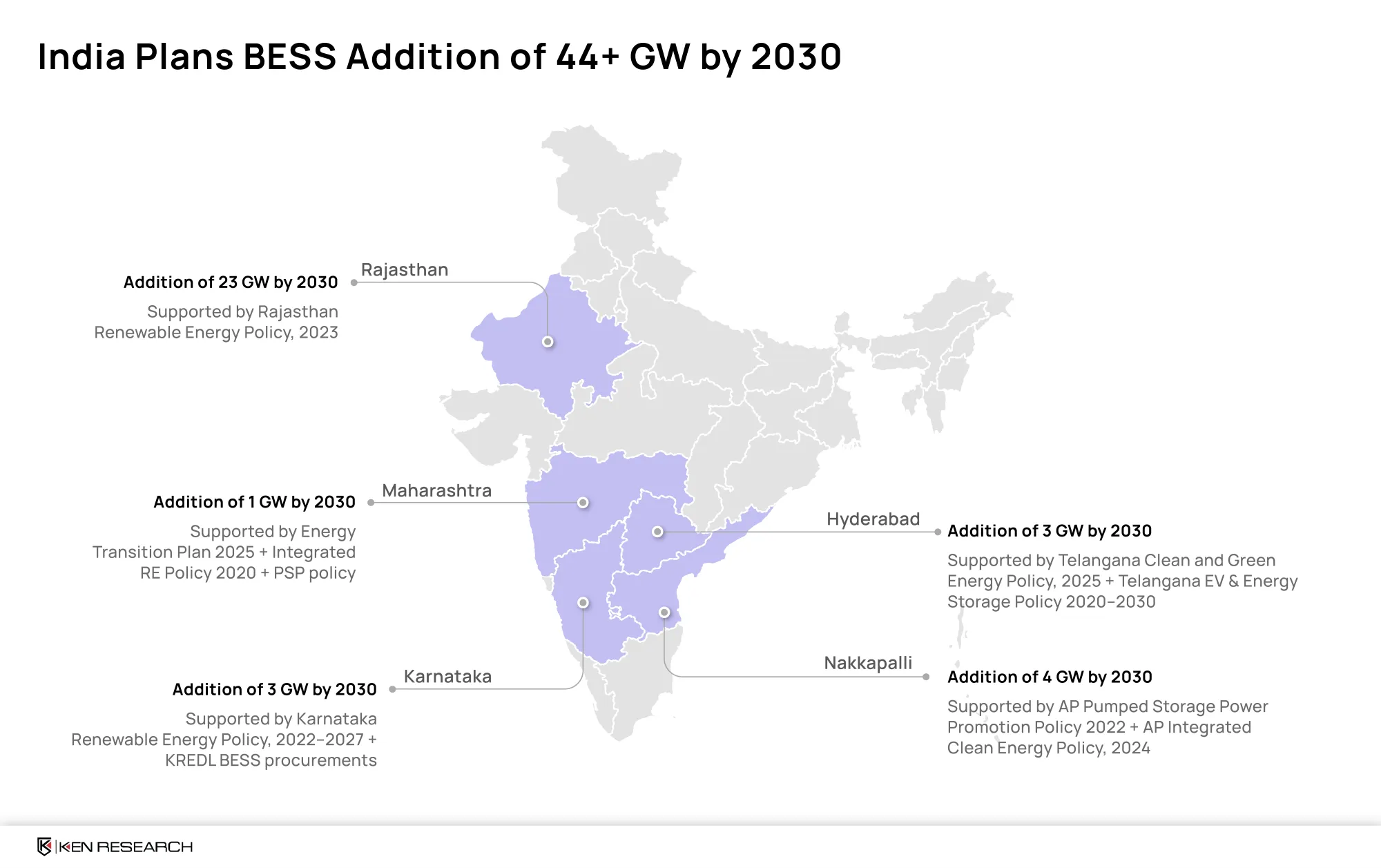
This growth is supported by a strong pipeline of projects across various stages of development. Several gigawatt-hours of capacity are already under construction, with additional projects being tendered under government-supported frameworks. Major developers such as JSW Energy, NTPC, Adani and other renewable players are actively investing in both standalone and hybrid BESS systems. The increasing participation of large-scale developers and the transition toward asset ownership models indicate that the market is moving beyond pilot projects into a phase of sustained infrastructure deployment.
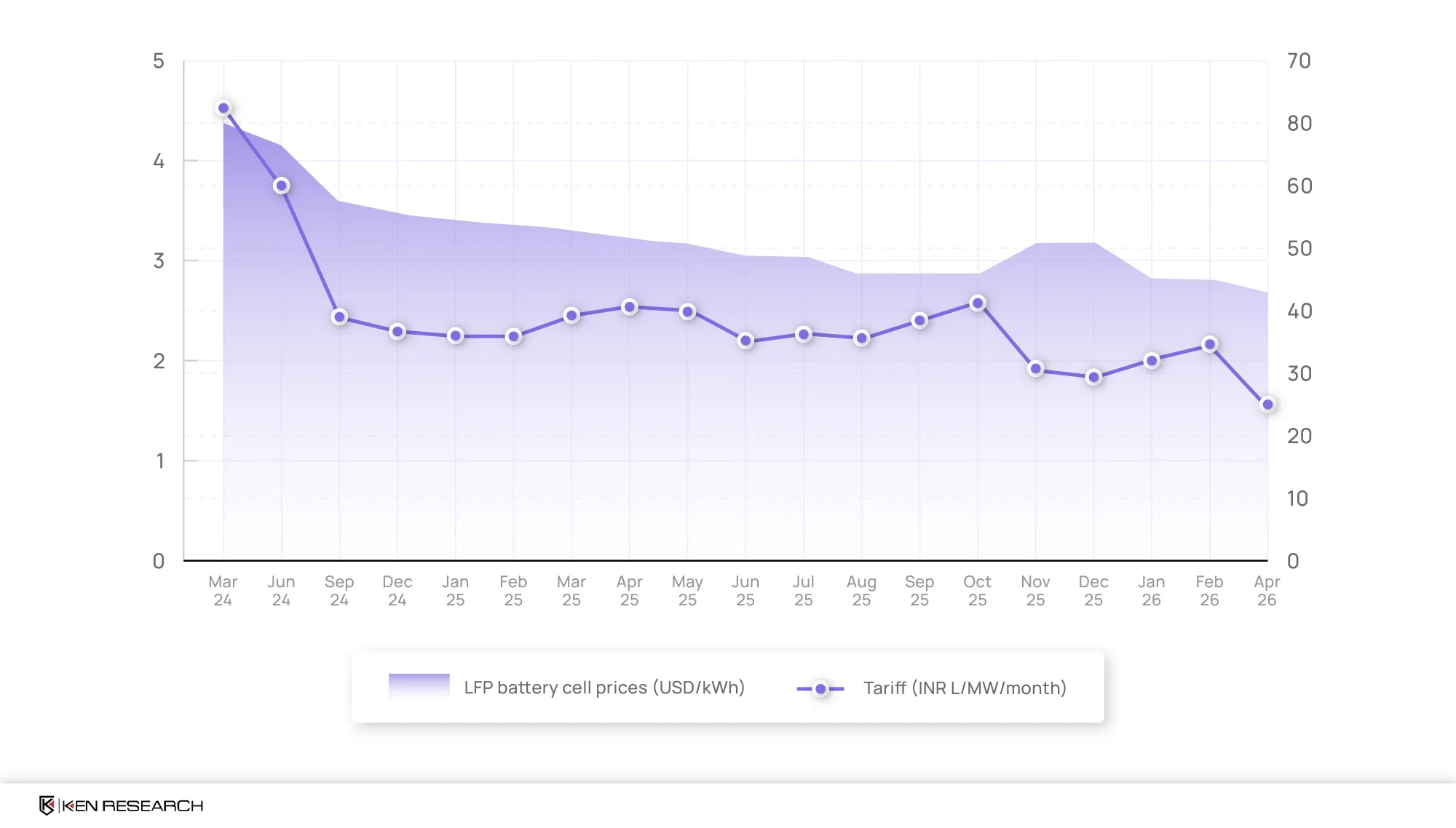
A key enabler of this growth has been the sharp decline in battery costs globally. Advances in manufacturing efficiency and scale have driven down lithium-ion battery prices significantly, with stationary storage applications witnessing some of the steepest reductions. These cost declines have directly impacted project economics in India, leading to a substantial reduction in tariffs observed in recent tenders. As BESS becomes more cost-competitive, its adoption is accelerating across both utility-scale and commercial applications.
The Raw Material Equation: What Goes into Every Battery Deployed in India
The expansion of India’s BESS market is fundamentally dependent on the availability of critical raw materials required for lithium-ion battery production. Each battery cell is composed of key components including the cathode, anode, electrolyte and separator, with the cathode accounting for the largest share of material cost. The most commonly used chemistries in India’s BESS deployments are Lithium Iron Phosphate (LFP) and Nickel Manganese Cobalt (NMC) with LFP increasingly becoming the preferred choice due to its safety, cost efficiency and longer lifecycle.
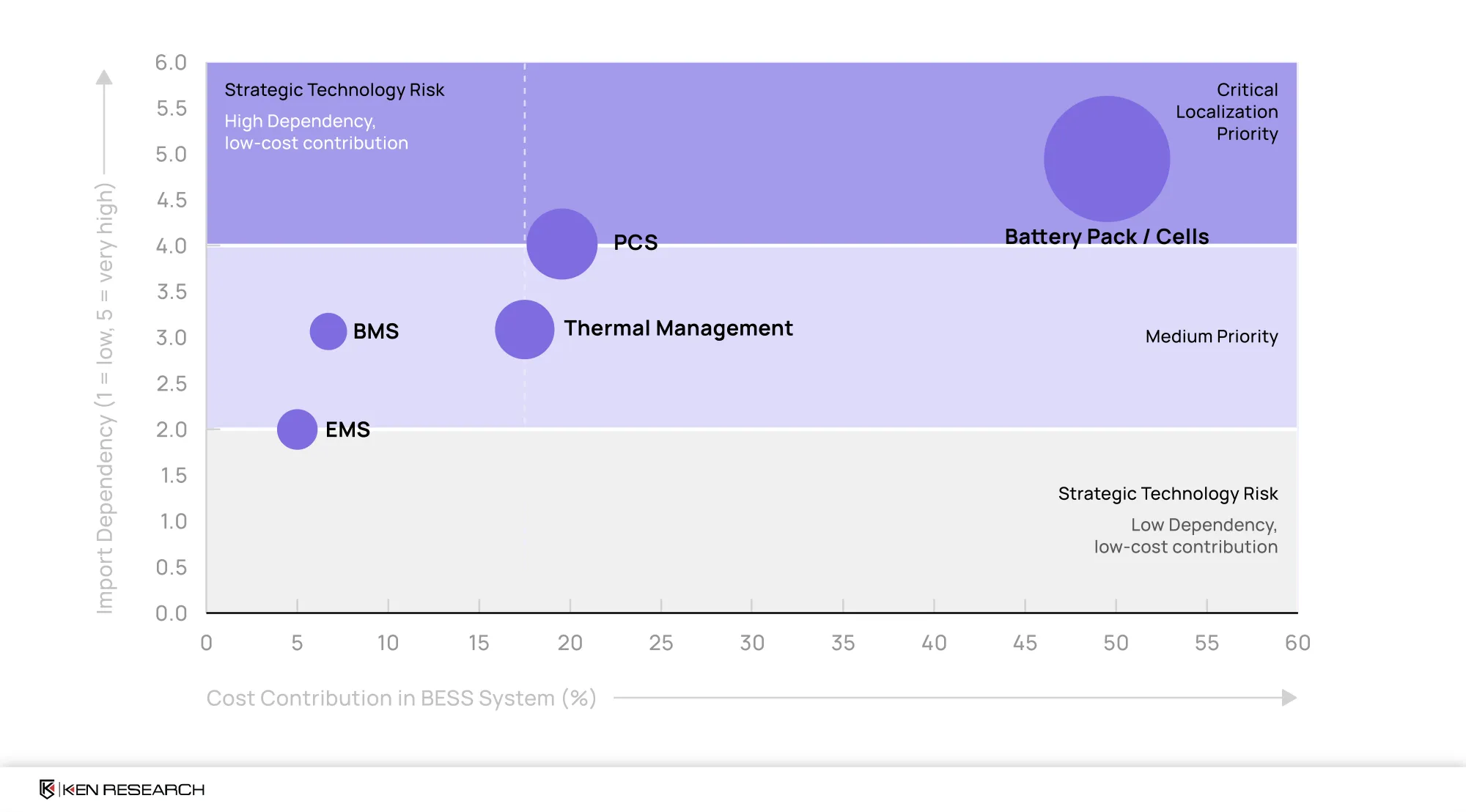
India currently faces a structural challenge in this segment due to its heavy reliance on imports for critical materials such as lithium, graphite, cobalt and nickel. The country imports nearly all of its battery-grade lithium and graphite, with a significant portion of global processing capacity concentrated in China. This dependency exposes the Indian BESS ecosystem to supply chain risks, geopolitical uncertainties and price volatility. While government initiatives aimed at securing critical mineral resources and encouraging domestic manufacturing are underway, the development of a fully integrated supply chain will take time.
Efforts are being made to address these gaps through investments in domestic material processing and battery component manufacturing. Companies are beginning to establish capabilities in graphite anode production and cathode manufacturing, supported by policy incentives and strategic partnerships. However, large-scale domestic production is still several years away, making import dependency a key consideration in the near term.
The Policy Tailwind: How the Government Is De-Risking BESS Investment
India’s BESS market is strongly supported by a comprehensive policy framework designed to accelerate adoption and reduce investment risk. The government has introduced multiple financial and regulatory mechanisms to address key barriers, particularly high upfront capital costs and uncertain revenue streams. The Viability Gap Funding scheme has been instrumental in making large-scale BESS projects financially viable by providing capital subsidies, thereby improving project returns and encouraging private sector participation.
In parallel, the Production Linked Incentive scheme for Advanced Chemistry Cells aims to establish domestic manufacturing capacity for battery cells, reducing reliance on imports over time. Regulatory mandates such as the requirement for energy storage integration in renewable energy projects and exemptions from transmission charges have created a structural demand base for BESS. Additionally, the introduction of energy storage obligations ensures that utilities progressively incorporate storage into their planning frameworks.
The inclusion of BESS in ancillary service markets and power trading platforms has further expanded revenue opportunities, allowing developers to monetize services such as frequency regulation and peak load management. While these mechanisms are still evolving, they represent a critical step toward establishing a diversified revenue model for BESS projects.
The Auxiliary Boom: Industries Being Remade by India’s BESS Revolution
The growth of the BESS market is not limited to the power sector but is driving transformation across multiple adjacent industries. The demand for critical minerals and battery materials is expected to increase significantly, creating opportunities for domestic manufacturing and supply chain development. As India’s battery demand grows, investments in cathode and anode production, as well as material processing, will become increasingly important.
The development of giga factories for cell manufacturing is another major outcome of the BESS expansion. These facilities require advanced equipment, specialized engineering capabilities and a robust supplier ecosystem, leading to the creation of a new industrial segment within the country. At the same time, large-scale BESS installations are driving demand for infrastructure development, including civil works, electrical systems and grid integration components.
The digital and technology layer of the BESS ecosystem is also gaining importance. Power conversion systems, battery management systems and energy management platforms play a critical role in ensuring optimal performance and reliability. As BESS systems become more integrated into grid operations, the need for advanced analytics, real-time monitoring and predictive maintenance solutions will continue to grow.
The scale of capital required for BESS projects is substantial and the availability of structured financing solutions will be critical for sustaining growth. At the same time, the recycling segment is expected to gain importance as the installed base of batteries increases, creating demand for end-of-life management and material recovery solutions.
The Competitive Landscape: Who Is Building India’s Storage Future
India’s BESS market is currently characterized by a mix of established power utilities, renewable energy developers, EPC players and emerging storage-focused companies. Large players such as NTPC / NTPC Renewable Energy, JSW Energy, Tata Power, Adani Green Energy, Greenko, ReNew, SJVN, NHPC and ACME Solar are shaping the utility-scale storage pipeline, leveraging their experience in power generation, renewable energy projects and large-scale infrastructure execution. Recent projects by players such as JSW Energy, Tata Power, Adani Group and NTPC further indicate that BESS is moving from pilot-stage adoption to large-scale infrastructure deployment.
The business model is evolving from traditional EPC contracts to build-own-operate and build-own-operate-transfer structures, as developers become more willing to hold storage assets and capture long-term recurring revenue. At the same time, companies across adjacent parts of the value chain, including L&T, Sterling and Wilson Renewable Energy, Siemens, ABB, Schneider Electric, Exide, Amara Raja, Reliance New Energy and Waaree, are strengthening their presence across EPC, power electronics, battery manufacturing, pack assembly and system integration. This shift reflects growing confidence in BESS as a core infrastructure asset, where future winners will be those that combine capital strength, execution capability, technology partnerships and long-term asset ownership.
Challenges Facing India’s BESS Market
Despite strong growth prospects, the BESS market in India faces several structural challenges. High upfront capital costs remain a key barrier, particularly for projects that do not benefit from government subsidies. While costs have declined significantly, large-scale installations still require substantial investment, making access to financing critical.
Import dependency for critical materials continues to expose the sector to supply chain risks and price volatility. The absence of a mature domestic manufacturing ecosystem further amplifies this challenge.
Another critical challenge is the lack of a well-developed recycling infrastructure. As the installed base of batteries grows, the need for efficient end-of-life management will become increasingly important. Addressing this gap will be essential for ensuring the long-term sustainability of the sector.
Where the Market Is Going: Bigger, Smarter, More Integrated
India’s BESS market is poised for large-scale expansion, driven by strong policy support, improving project economics and the growing need to manage renewable energy variability. However, this growth will be accompanied by increasing complexity. The future will be shaped not only by deployment scale but also by integration, specialization and the ability to deliver reliable and flexible energy solutions across use cases.
Standalone BESS systems are expected to dominate near-term growth due to policy push and faster execution. At the same time, hybrid and round-the-clock configurations are gaining traction as utilities and developers look to provide firm renewable power. The commercial and industrial segment is also emerging as a high-margin opportunity, driven by rising demand for energy reliability and cost optimization.
Meanwhile, the broader ecosystem is evolving rapidly. Upstream segments such as battery materials and cell manufacturing are gradually scaling, while downstream areas like system integration, software and project development are expanding faster. At the same time, boundaries between players are beginning to blur, with developers moving upstream, manufacturers exploring project ownership and technology providers embedding deeper into operations. This convergence suggests that future leaders will be those who can combine scale, integration and execution strength.
Let’s Talk Strategy
India’s BESS market is undergoing a structural shift, creating a compelling opportunity across infrastructure, manufacturing, technology and finance. This is not just a growth phase, it is a moment where market positions are being established rapidly.
The current environment offers early movers a clear advantage to secure partnerships, build capabilities and align with future demand. As the market matures, competition will intensify, entry barriers will rise and value capture will increasingly concentrate among a few strong players.
Whether you are a manufacturer looking to localize, a developer aiming to scale, a technology provider building differentiated solutions or an investor seeking exposure to the energy transition, this is the time to act. The policy environment is supportive, demand visibility is strong and the ecosystem is actively developing.
The reality is simple: the BESS value chain is being built today. Those who participate now will shape the market, while those who delay risk missing out on long-term value creation.
Related tags
Power Components
Power
Energy and Utilities
Get started
We've helped companies around the world future-proof
their businesses - and we can do the same for you.