India’s Coking-Coal Imports to Hit 115 MT by FY30: How Australia, Russia, Canada & Mongolia Really Stack Up
Ken Research
November 26, 2025 - 4 min read
November 26, 2025
by Khushi RastogiIndia’s steel expansion, projected to reach 300 MT capacity by 2030, is accelerating coking-coal demand far faster than domestic capabilities, pushing imports from 81 MT in FY25 toward a projected 115 MT by FY30.
This sharp rise elevates supplier comparison from a procurement exercise to a strategic priority. Additionally, Mongolian cargoes, overseas mine acquisition pushes, and diversification patterns confirm that supplier stability, metallurgical consistency, and geopolitical exposure will define India’s cost curves and operating margins through the next decade.
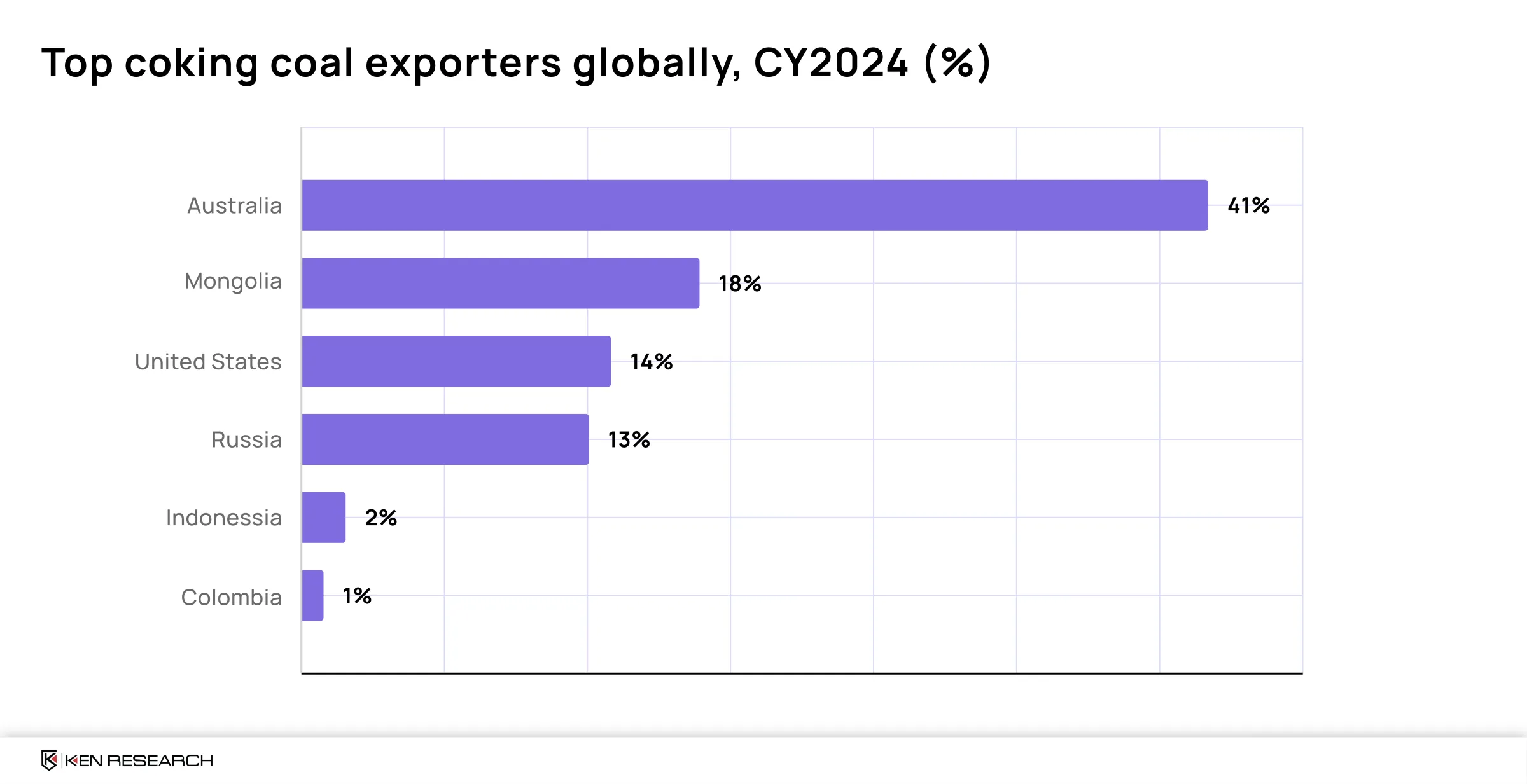
Australia: Benchmark Quality but Rising Volatility and Premium Cost Exposure
- Australia supplies the bulk of India’s 81 MT imported coking coal (FY25), driven by premium CSR, low ash, and furnace efficiency demanded by India’s BF-BOF system, which still accounts for approx. 72% of national steelmaking.
- However, Queensland disruptions and index-linked prices sharply affect CFR India, creating quarterly swings that mills increasingly find difficult to hedge.
Analysts warn that India’s dependence may become “misplaced” as extreme volatility pressures margins, especially when Indian demand is forecast to reach 136 MT by FY30.
Russia: 25% Discount Advantage but Sanctions, Banking & Routing Risks
- Russian coal trades 20–30% below Australian PHCC, materially reshaping delivered cost economics at a time when Indian mills face narrow spreads between raw-material cost and steel ASPs.
- Yet sanctions restrict payment channels, raise insurance premia, and complicate maritime routing, making Russian cargoes operationally unpredictable despite pricing benefits.
- Market intelligence shows rising Indian reliance on Russia over the past 24 months, though the presence of high-risk corridors continues to limit Russia’s suitability as a long-term anchor source.
Canada: Stable Low-Sulphur Coal, +38% YoY Supply Growth, but Higher Baseline Costs
- Canada’s shipments to India grew 38% YoY, tapping demand for predictable CSR and low sulfur critical for plants seeking furnace stability under tight productivity targets.
- Despite this, Canadian CFR India pricing is structurally higher due to long-distance freight and cost-intensive extraction economics, placing Canada at the premium end of India’s supply curve.
- Even so, Canadian coal is increasingly used as a stability hedge as Australian volatility accelerates, and Russian sanctions add complexity to discounted buys.
United States: Reliable Metallurgy but Limited Volumes and High Delivered Cost
- U.S. coking coal supports precise blend adjustments due to its consistent volatile matter (VM) and sulphur profile, making it valuable for premium metallurgical requirements.
- However, U.S. mining cost structures and trans-Atlantic freight result in some of the highest CFR prices among India’s supplier basket, restricting its role to strategic furnace-stabilizing volumes.
- With global index volatility increasing, U.S. coal retains relevance for operational discipline but cannot serve as a scalable alternative for India’s surging demand curve.
Mongolia: Emerging Source with Promising CSR but Limited by Infrastructure & Transit
- Mongolia is entering India’s supplier matrix, with 2025 trial cargoes marking the first formal supply tests and a potential breakthrough in diversifying away from seaborne volatility.
- Coal from Mongolia generally reflects strong CSR characteristics, but overland multi-modal logistics via China or Russia impose delivery delays and scaling limitations.
- Mongolia’s role will remain supplementary until rail, corridor, and port infrastructure improve enough to support India’s large-volume (115 MT by FY30) requirements.
Cost Dynamics: Delivered-Price Spread Expands Across a Fragmented Supplier Matrix
- Australia is at the center of global PHCC cost benchmarks, but supply shocks routinely widen price spreads, leaving India exposed to unpredictable procurement cycles.
- Russia remains the lowest-cost option on a delivered basis, though penalty layers, sanctions, financing risk, and insurance limits often neutralize part of the discount.
- Canada and the U.S. occupy premium positions; however, their cost stability and predictable delivery make them important hedges against seaborne market spikes.
Quality Dynamics: Metallurgical Properties Create a Hierarchy of Furnace Performance
- Australia and Canada lead metallurgical performance with superior CSR, coke yield, and predictable ash content critical for India’s BF-BOF dominance until at least 2050, when BF share declines to approx. 55%.
- Russia competes well in energy value but shows higher mine-to-mine variability, forcing Indian mills to adjust blends regularly to sustain furnace stability.
- Mongolia’s CSR profile is competitive, but inconsistent delivery timing reduces its operational utility in high-throughput mills.
Risk Dynamics: Geopolitics, Regulatory Certainty & Routing Sensitivity Define Supplier Risk
- Australia and Canada offer the highest contract reliability and regulatory comfort key factors when India’s annual demand is projected to rise from 87 MT (FY25) to 136 MT (FY30).
- Russia faces acute sanction exposure and payment challenges that complicate even discounted procurements, reducing practical reliability for large Indian buyers.
- Mongolia’s risk is tied to dependency on transit routes through China/Russia, making it sensitive to border restrictions and cross-border logistics unpredictability.
Strategic Fit for India: Steel Growth Requires a Multi-Origin Portfolio, Not Dominant Dependence
- India steel capacity of 300 MT by 2030 and its shift toward low-carbon steel amplify the need for diversified sourcing that balances cost, CSR, reliability, and risk.
- India’s 2025 push urging steelmakers to acquire overseas coking coal mines underscores the government’s recognition that supply diversification must become a structural strategy.
- India must blend Australian quality anchors, Russian discount opportunities, Canadian/U.S. stability premiums, and Mongolia’s long-term potential to safeguard raw-material continuity.
KEN RESEARCH INSIGHT
- India’s supplier landscape is entering a new competitive cycle in which resilience, not just cost, will determine long-term sourcing strategy as steel capacity expands aggressively.
- The data clearly indicates India cannot rely on any single supplier, no matter how high-quality or cost-effective, without risking exposure to outage cycles, sanctions, or freight volatility.
- Companies that build multi-origin, risk-balanced, and logistics-diversified portfolios will secure sustainable furnace performance, cost stability, and competitive advantage across the 2030 horizon.
Related tags
Mining
Metal, Mining and Chemicals
Get started
We've helped companies around the world future-proof
their businesses - and we can do the same for you.