India’s Lightweight Building Materials Market Is Set to Grow 2.9x by 2032: Who Will Capture the Opportunity?
Ken Research
July 31, 2026 - 7 min read
July 31, 2026
by Unnati MiglaniIndia’s lightweight building materials market is entering a period in which construction growth, material substitution and changing building-performance requirements are beginning to reinforce one another.
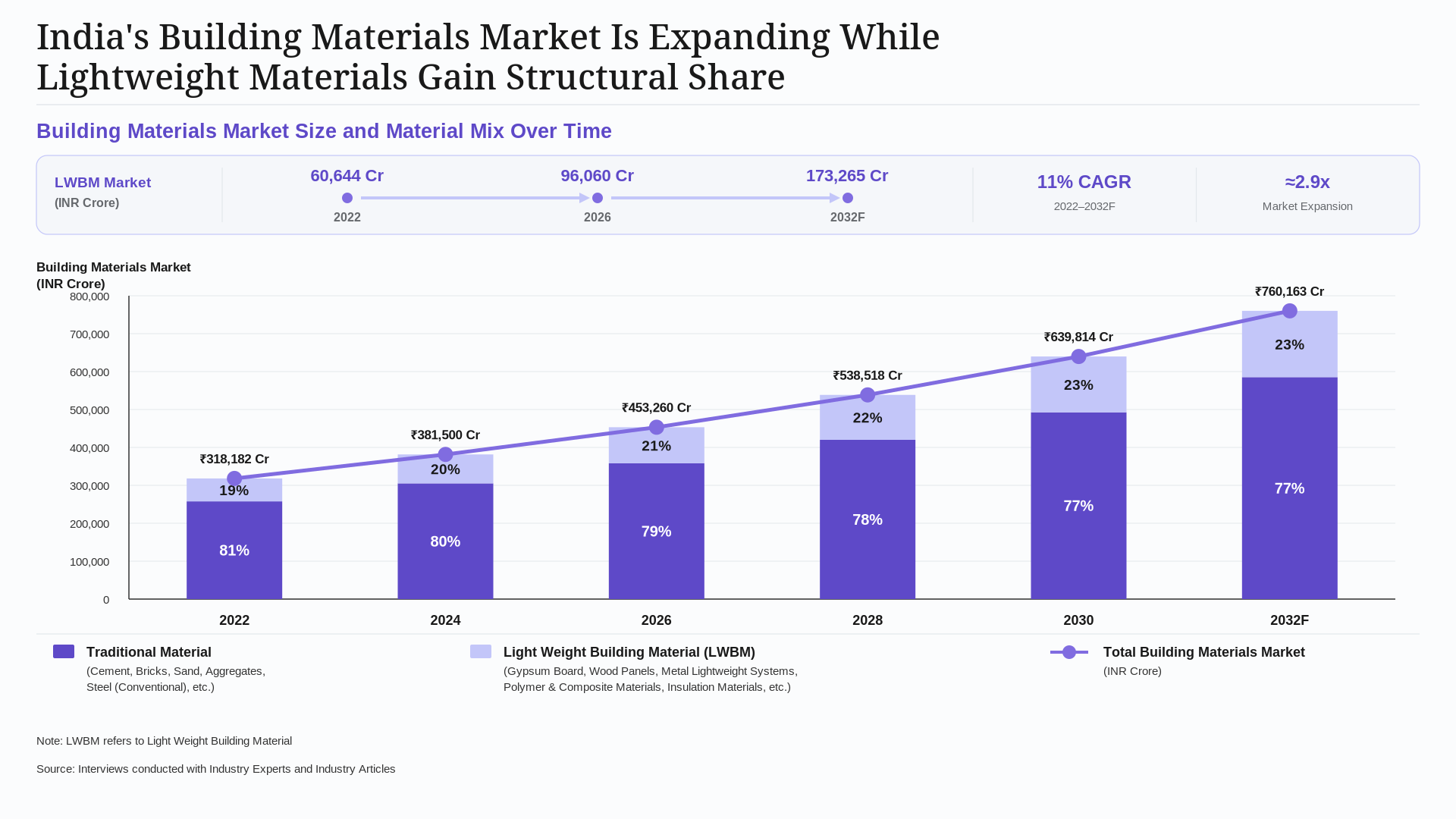
The market is projected to expand from approximately INR 60,644 crore in 2022 to INR 96,060 crore in 2026 and INR 1,73,265 crore by 2032. This represents close to 2.9 times expansion over the decade, with an annual growth rate of approximately 11%.
This growth is taking place within an Indian building-materials market that is itself expanding from approximately INR 3,18,182 crore in 2022 to INR 7,60,163 crore by 2032. Lightweight materials are expected to increase their share of this wider market from approximately 19% to 23% over the same period. A four-percentage-point increase may appear moderate, but it occurs within a market that is projected to more than double. The combination of construction expansion and higher LWBM penetration explains why the absolute market can approach three times its 2022 size.
The next three years matter because demand acceleration, regulatory support and market fragmentation still coexist. Lightweight systems are moving from early adoption towards mainstream specification, while the absence of scaled integrated leaders leaves room for category leadership and ecosystem development.
India’s Construction Market is Changing How it Evaluates Materials
Cement, bricks, sand, aggregates and conventional steel will continue to account for most building-material demand. The opportunity for lightweight materials does not depend on these products disappearing. It is emerging because a growing set of projects is evaluating materials through structural efficiency, construction speed, resource use and building performance.
Traditional materials can impose 20% to 50% higher dead loads than lightweight systems. Wet construction can extend execution timelines by 15% to 30%, consume up to 90% more water and generate two to three times more construction waste than prefabricated lightweight alternatives.
These benefits have particular relevance across high-rise commercial buildings, redevelopment projects and industrial assets. High-rise buildings benefit from lower structural weight, redevelopment projects value faster renovation and reduced disruption, while industrial assets increasingly require structural-load optimisation and rapid project execution.
The shift is therefore taking place application by application. AAC blocks are used in residential walling, gypsum systems in partitions and ceilings, metal and insulated systems in roofing and building envelopes, and drywall and panel systems in renovation and interior fit-outs.
This is why the lightweight building materials market is expected to grow faster than the wider building-materials market. India is constructing more buildings, lightweight systems are gaining share within existing applications, and new performance-led requirements are expanding the number of applications in which these materials are considered.
The Market is Expanding Through Three Distinct Growth Pools
The first growth pool comes directly from construction expansion. Residential, commercial, industrial and retail assets account for approximately 42%, 25%, 20% and 13% of lightweight building material demand, respectively. Each segment generates requirements for walling, roofing, façades, partitions, ceilings, insulation and other lightweight systems.
The second pool comes from material substitution. Material substitution from conventional building systems is expected to contribute to the incremental opportunity alongside construction-market expansion and increasing LWBM penetration across end-use segments.
The third pool comes from new and higher-specification applications. Commercial offices require flexible interiors and performance-led envelopes. Data-centre expansion is increasing demand linked to energy efficiency, fire safety and thermal insulation. Premium housing places greater emphasis on comfort, usable space and aesthetics. Redevelopment projects value faster construction and reduced disruption.
These demand pools will not grow at the same pace or reward the same capabilities. Residential construction creates scale, while commercial and industrial projects create more specification-led requirements. The market’s attractiveness therefore depends on where a material participates and what building-level outcome it delivers.
Which LWBM Categories Will Lead on Scale and Growth?
Wood-based materials will dominate market size, while gypsum, glass and AAC blocks will lead the next wave of category expansion.
Wood-based building materials represent the largest pool. The category is projected to expand from approximately INR 53,927 crore in 2025 to INR 1,17,386 crore by 2032, more than doubling. Its scale reflects broad participation across residential interiors, commercial fit-outs, wall panels, partitions and decorative applications.
Metal-based lightweight materials are expected to grow from approximately INR 14,143 crore to INR 23,787 crore over the same period. Their demand is connected to metal roofing, insulated panels, prefabricated structures and building-envelope applications where rapid execution and lower structural weight are important.
Glass-related building systems are projected to rise from approximately INR 12,723 crore in 2025 to INR 29,153 crore by 2032. Growth is supported by commercial façades, premium housing, and building envelopes, where design, glazing area, and thermal performance influence specification.
AAC blocks are projected to increase from approximately INR 5,771 crore to INR 12,477 crore, more than doubling over seven years. Their position is anchored in residential walling, where lower weight, construction speed and thermal performance must be balanced against the cost requirements of high-volume housing.
Polymer and composite building materials are expected to expand from approximately INR 5,190 crore to INR 9,219 crore. These materials participate in specialised façade, cladding, roofing and interior applications where durability, lower weight and design flexibility are important.
Gypsum-based materials form a smaller market but show one of the strongest expansion profiles, rising from approximately INR 3,346 crore to INR 7,723 crore. The category is closely linked to drywall partitions, ceilings, acoustic systems, commercial fit-outs and renovation. Its forecast value is more than twice its 2025 level, reflecting the growing use of dry-construction systems.
Insulation and thermal-performance materials are projected to grow from approximately INR 1,839 crore to INR 2,672 crore. This remains the smallest material pool shown, but it is strategically connected to energy-efficient commercial assets, data centres, premium residential buildings and higher-performance envelopes.
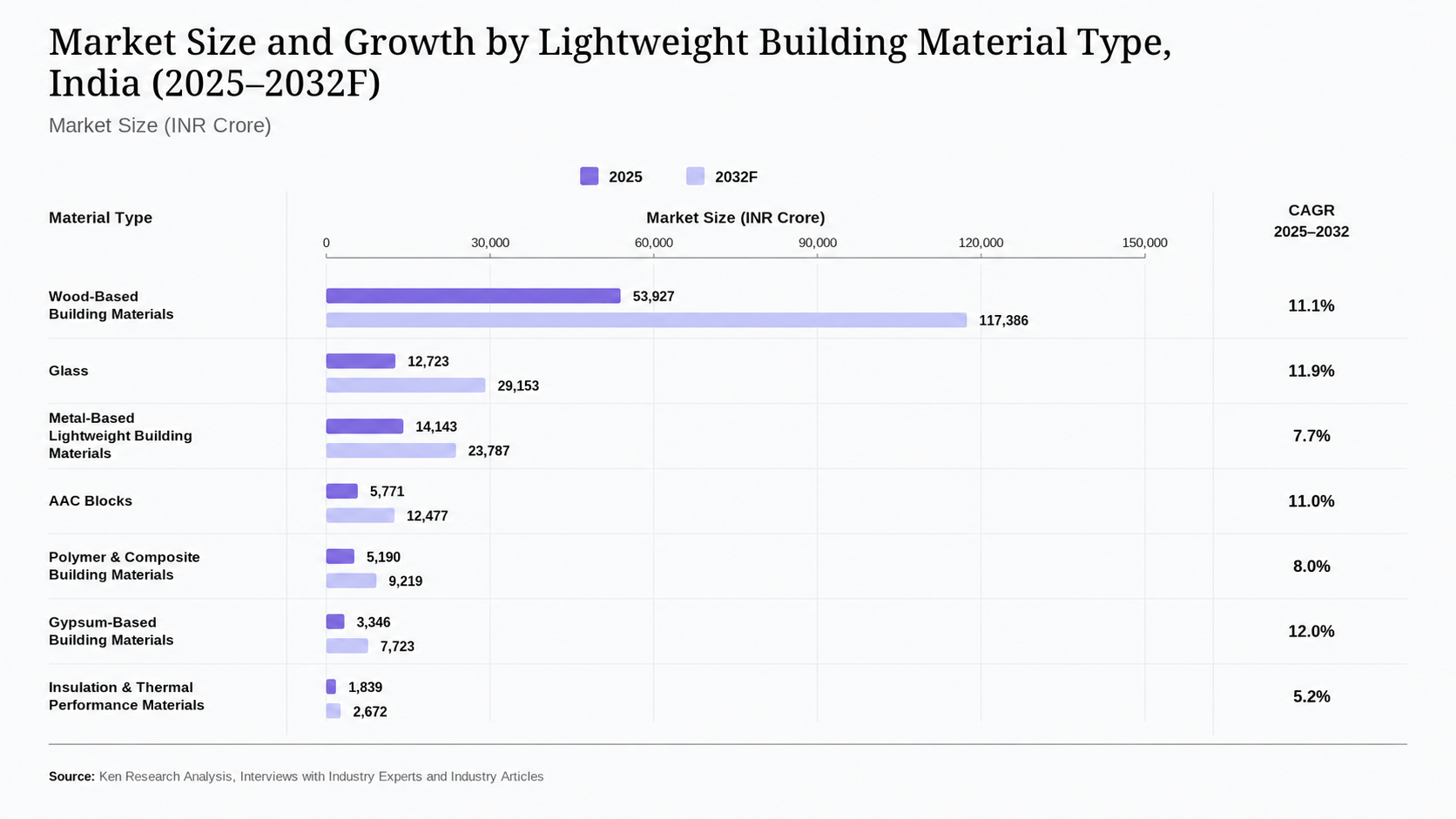
The figures show why a broad LWBM growth strategy is insufficient. Wood-based products provide the largest scale. Gypsum and AAC offer strong expansion from smaller bases. Metal systems serve execution-intensive applications. Insulation is closely tied to energy and thermal-performance requirements. The right opportunity depends on the intersection between material type, application and building segment.
Competitive Whitespace Exists Despite the Presence of Established Players
India’s LWBM industry is not an empty market. It already contains established companies across wood products, gypsum, AAC blocks, metal systems, composites, insulation and glass.
The whitespace lies in how the market is structured.
Most companies remain concentrated within individual product categories. A smaller group operates across multiple materials or provides broader systems directly to developers and EPC contractors. The industry is transitioning from product-based competition towards multi-category solution providers serving developers and EPC contractors more directly.
This matters because many building requirements cannot be delivered by one material in isolation. A façade can involve glass, composite panels, insulation, fixing systems and fire protection. A partition system can require gypsum boards, metal framing, insulation and finishing materials. An insulated roof combines structural, enclosure and thermal requirements.
The performance of the completed application depends on how these components work together. A supplier that understands the full system can compete through application compatibility, technical support and execution reliability rather than through product price alone.
The market currently remains populated largely by single-segment category players, while a smaller group operates across multiple material categories and solution areas. Assess whether to deepen category leadership or expand into adjacent solution areas as India’s LWBM market shifts towards broader multi-category offerings. Speak to a Ken Research expert.
Why the Next Three Years Will Shape India’s LWBM Leadership
India’s lightweight building materials market is entering a limited formation window in which demand acceleration, higher performance standards, sustainability priorities, competitive fragmentation and capital readiness are converging. Construction activity is expanding across residential, commercial, industrial and retail assets, while the market remains divided among specialised suppliers and relatively few scaled integrated leaders. As adoption moves from early adoption towards mainstream specification over the next three to five years, the immediate three-year period will influence how material categories, application value pools and competitive positions develop.
Commercial construction provides the clearest evidence of this transition. Lightweight systems can reduce structural weight by 30–50%, shorten installation time by 20–30% and improve thermal efficiency by up to 25–35%, alongside stronger fire and acoustic performance than conventional materials. Approximately 75–80% of commercial LWBM demand is concentrated in building envelopes and interior fit-out systems, concentrating commercial LWBM demand across façades, roofing, insulation, partitions, ceilings and fire-protection systems.
The opportunity differs materially by category and application. Gypsum is closely aligned with partitions, ceilings and renovation; AAC blocks with residential walling; metal systems with roofing, insulated panels and building envelopes; and insulation with energy-efficient commercial assets, data centres and premium housing. These differences will shape which material categories are best positioned to capture demand across residential, commercial and industrial growth pools. The competitive outcome will also be influenced by which applications move into broader specification and which suppliers evolve from individual product providers into multi-category solution providers serving developers and EPC contractors.
The strategic question is therefore no longer whether India’s LWBM market will expand. It is which material categories and applications will capture that growth before market positions become more established. The next three years will be decisive in shaping where value pools form, which applications move towards mainstream specification and how the industry’s competitive structure evolves.
Market Growth Will Not Create Leadership on its Own
India’s LWBM market could add more than INR 77,000 crore between 2026 and 2032, but this expansion will be distributed across different materials, applications and end-use segments.
The market’s expansion will be distributed unevenly across materials and end uses. Wood-based materials provide the largest material pool, while gypsum, glass, AAC blocks and other categories follow different growth trajectories. Residential construction provides the largest volume base, while commercial, industrial and retail segments contribute disproportionately to specification-led adoption, material innovation and higher-value LWBM applications.
The strongest positions will combine a relevant material category with a clear application, an appropriate customer interface and reliable execution capability.
This is the significance of the current market whitespace. It does not represent an absence of competitors. It represents a period in which category leadership, application credibility and integrated propositions are still being established.
India’s lightweight building materials market is approaching a larger role within construction. As the market moves from early adoption towards mainstream specification, the next three years will be decisive in shaping category leadership, value-pool formation and the competitive structure of India’s LWBM industry.
Related tags
Construction Materials
Manufacturing and Construction
Get started
We've helped companies around the world future-proof
their businesses - and we can do the same for you.