India Lightweight Building Materials Market: 11% CAGR to 2032
Why the Next Three Years Could Define India’s Lightweight Building Materials Market
A Ken Research POV on how performance-led construction, material substitution and integrated solutions are creating a narrow window for market leadership
India’s construction industry is beginning to shift from material-intensive building methods toward performance-led systems.
A Ken Research POV on how performance-led construction, material substitution and integrated solutions are creating a narrow window for market leadership
India’s construction industry is beginning to shift from material-intensive building methods toward performance-led systems.
Developers, architects and EPC contractors are placing greater emphasis on structural efficiency, faster execution, energy performance, resource productivity and lifecycle economics. This is expanding the role of lightweight building materials across residential, commercial, industrial and retail construction.
The opportunity, however, is not simply about replacing bricks, cement or conventional steel with lighter alternatives.
The next phase of value creation will depend on three factors:
Which material categories become mainstream specifications
Which construction segments create the most attractive value pools
Which companies evolve from individual-product suppliers into integrated solution providers
India’s lightweight building materials market is approaching an inflection point where demand is accelerating, adoption remains fragmented and scaled category leadership has not yet been fully established.
Ken Research’s POV examines why the next three to five years represent a critical window for companies seeking to shape specifications, consolidate categories and establish leadership before lightweight construction becomes mainstream.
Will India’s construction market simply consume more lightweight materials, or reorganise around performance-led building systems?
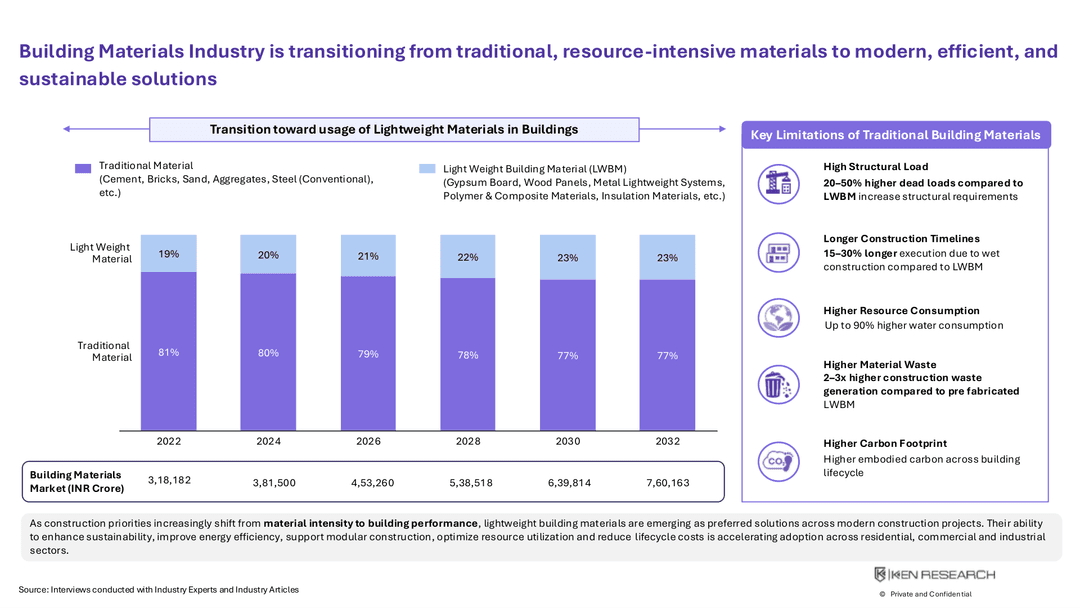
Traditional materials continue to dominate Indian construction, but their operating limitations are becoming increasingly visible.
Conventional construction methods can create:
Higher structural loads
Longer execution timelines
Greater water consumption
More construction waste
Higher lifecycle carbon impact
Lightweight building materials address these limitations through lower dead loads, dry construction, prefabrication, improved insulation and more efficient material utilisation.
This changes how materials are evaluated.
The purchasing decision is gradually moving away from:
What is the lowest-cost material per unit?
toward:
Which system delivers the required performance at the lowest total project and lifecycle cost?
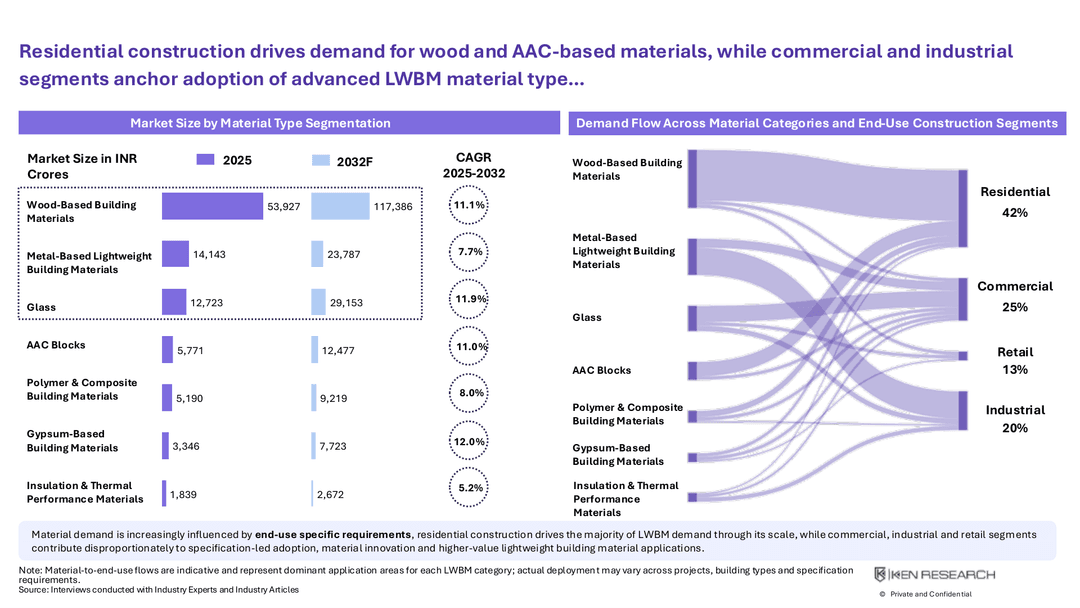
This shift creates opportunities across gypsum systems, wood panels, lightweight metals, polymers and composites, AAC blocks, insulation products and performance glass.
The deck positions lightweight building materials as a central part of India’s movement from resource-intensive construction toward modern, efficient and sustainable building solutions.
A Large Opportunity Is Forming Through Three Simultaneous Shifts
Construction expansion, material substitution and new applications are reinforcing one another
The lightweight building materials opportunity is not being created by one isolated demand driver.
It is being shaped by the convergence of three structural changes.
Construction-market expansion
India continues to add residential units, commercial floor space, industrial assets, retail developments and specialized infrastructure.
Lightweight systems are gaining acceptance in applications where speed, thermal efficiency, structural optimization, fire performance and design flexibility matter.
This increases the share of construction spend captured by LWBM categories.
Substitution of conventional systems
Drywall, lightweight partitions, insulated panels, modular systems and advanced façades are replacing selected wet-construction and high-load applications.
This creates incremental demand beyond ordinary construction-market growth.
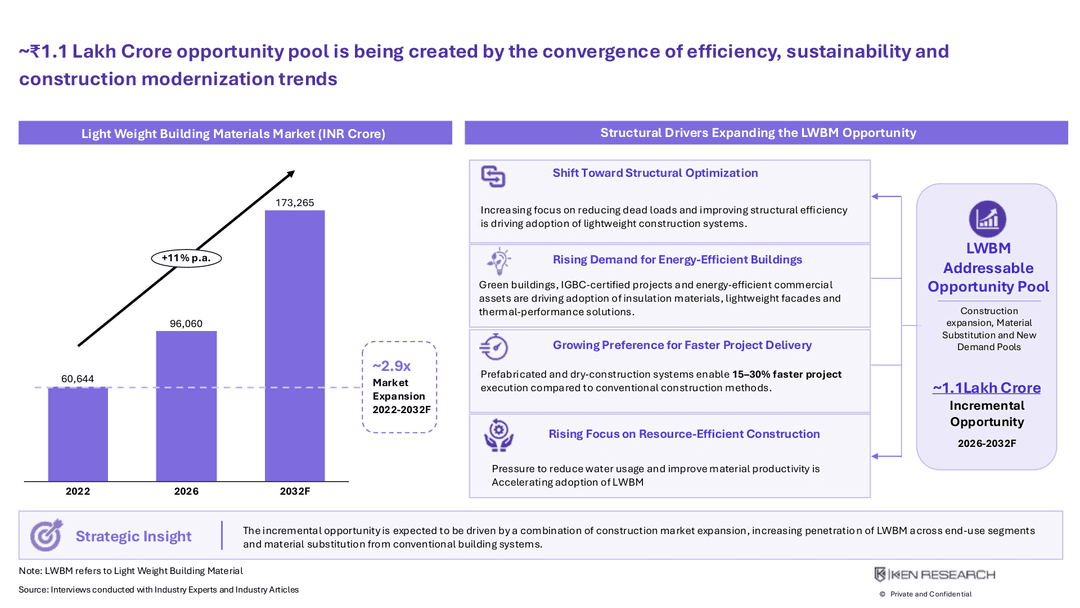
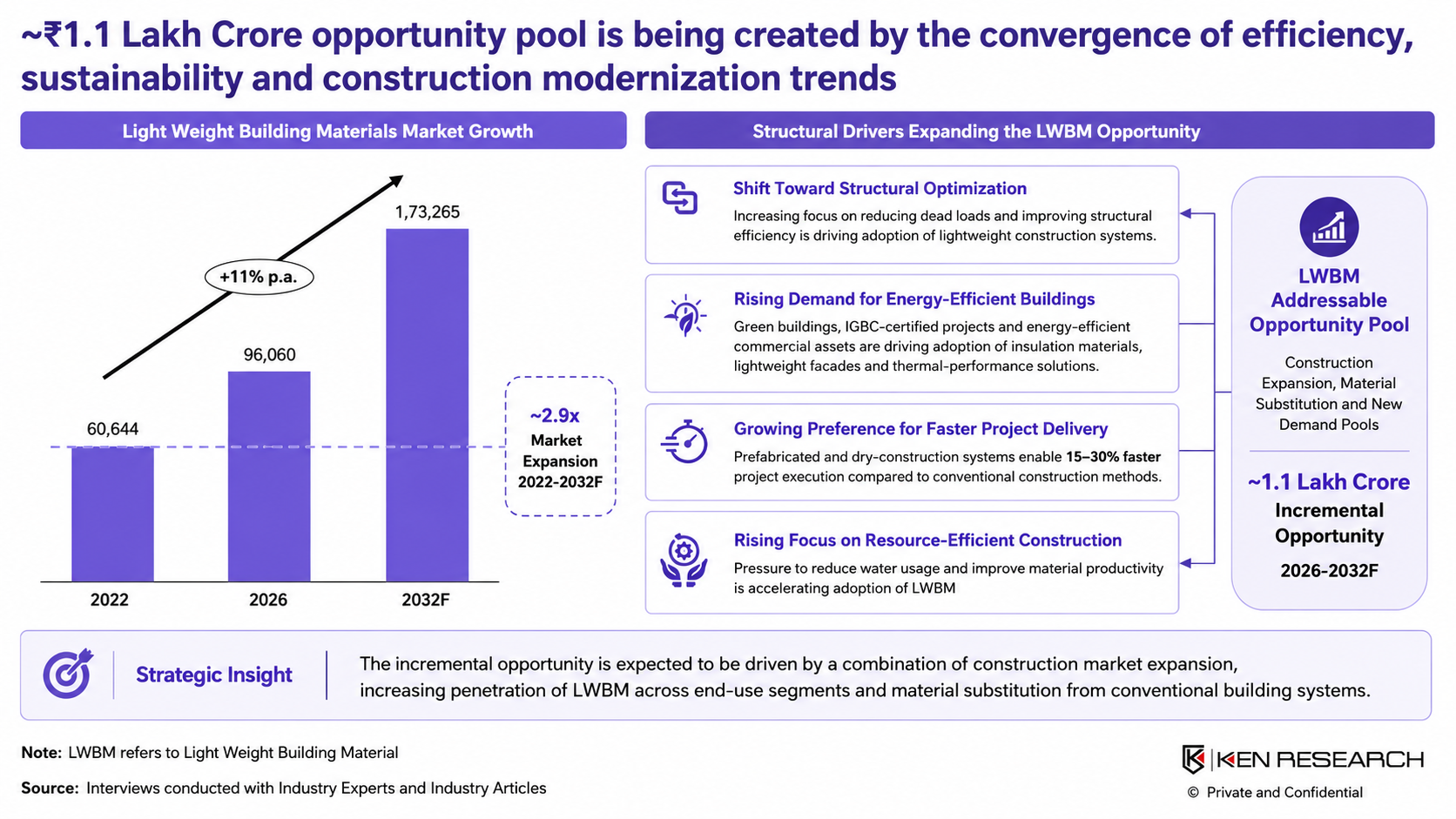
The deck identifies an incremental opportunity pool of approximately ₹1.1 lakh crore between 2026 and 2032, generated through market expansion, penetration growth and material substitution.
India’s lightweight building materials market is projected to expand from ₹96,060 crore in 2026 to ₹1,73,265 crore by 2032, creating an incremental opportunity of about ₹1.1 lakh crore.
Not Every Construction Segment Will Create the Same Economics
Residential provides scale, while commercial, industrial and retail assets create higher-intensity value pools
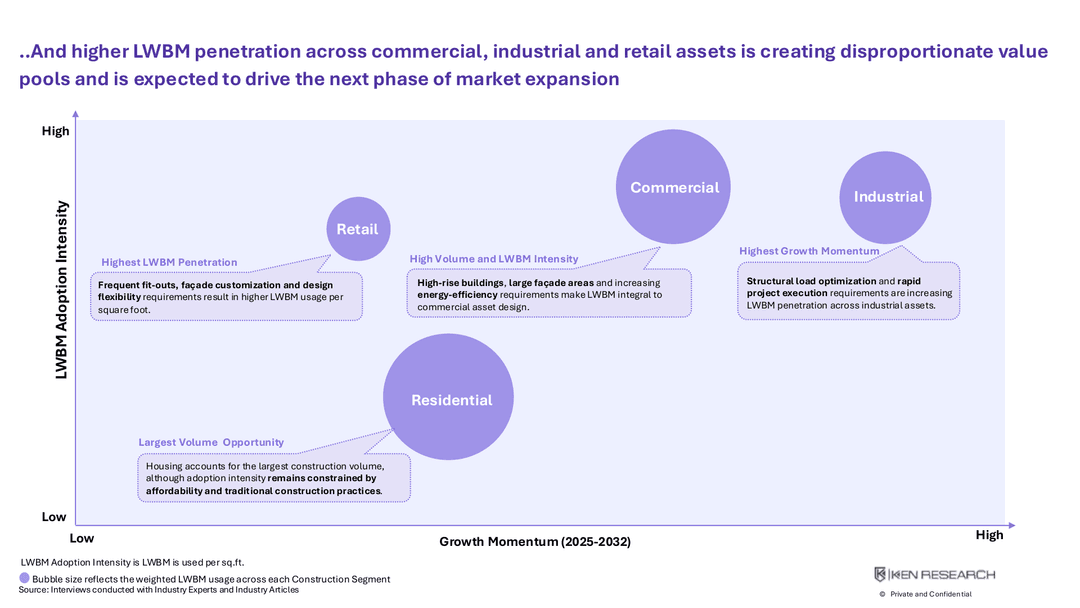
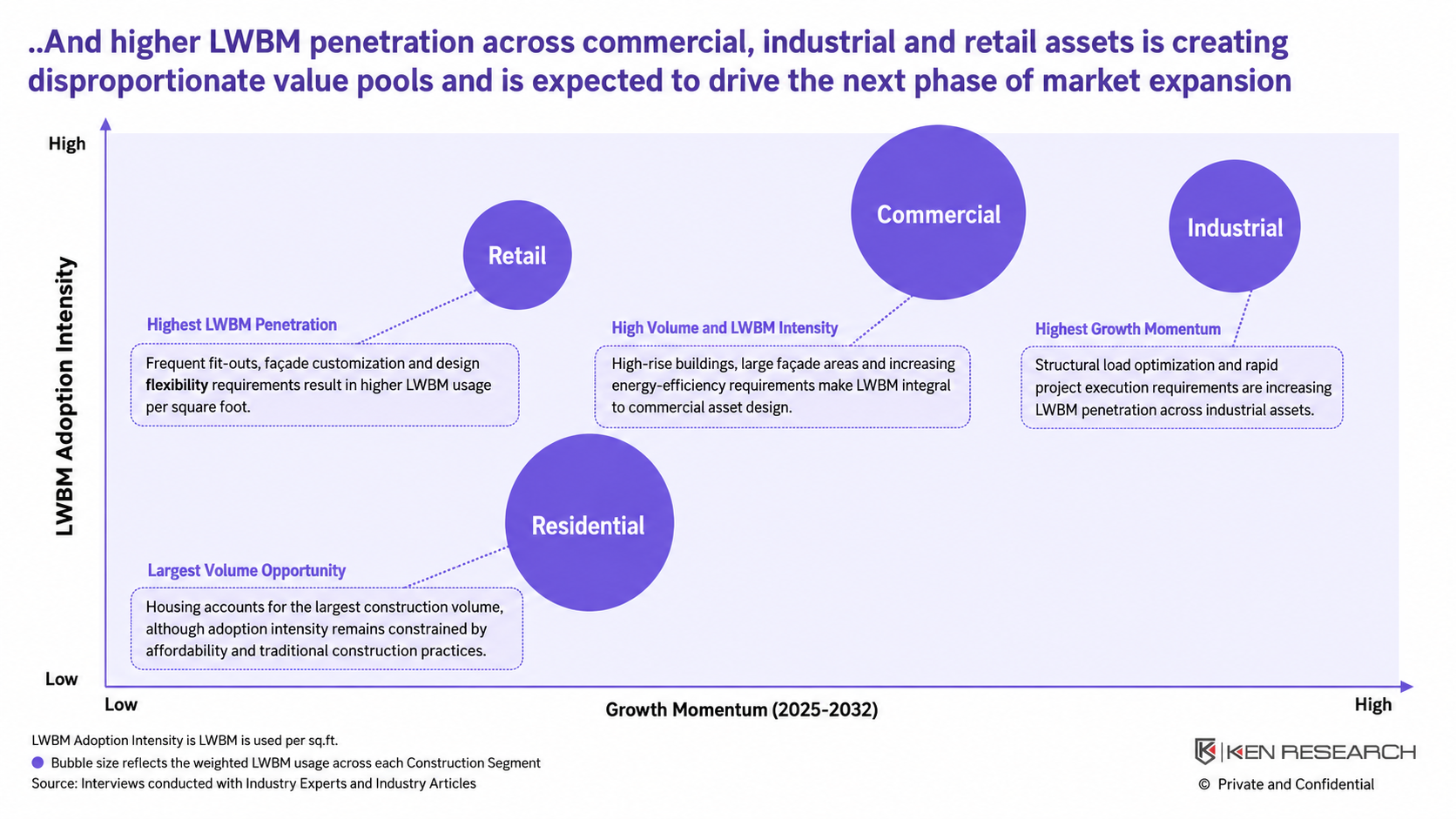
Residential constructionrepresents the largest overall volume opportunity for lightweight building materials.
However, high construction volume does not always translate into the highest material intensity or realization.
Affordable residential projects remain constrained by cost sensitivity and established construction practices. Lightweight-material adoption is more selective and often concentrated in AAC blocks or value-engineered walling systems.
Commercial, industrial and retail developments operate differently.
These assets typically require:
Faster project delivery
Lower structural loads
Larger façade systems
Higher thermal performance
Fire and acoustic compliance
Flexible interior layouts
Frequent fit-outs and refurbishments
As a result, they use more advanced lightweight materials per square foot and provide greater scope for specification-led selling.
The strategic distinction is therefore:
Residential provides the largest volume base
Commercial provides a large, specification-intensive demand pool
Industrial offers strong growth through structural and execution efficiency
Retail delivers high adoption intensity through fit-outs and customization
The deck concludes that commercial, industrial and retail construction will contribute disproportionately to the next phase of market expansion because of higher LWBM penetration and performance requirements.
Commercial, industrial and retail construction are emerging as higher-intensity value pools for lightweight building materials, while residential remains the largest volume segment.
Commercial Construction Is Becoming the Specification Engine
Performance requirements are accelerating adoption across building envelopes and interiors
Commercial construction could become one of the most important adoption engines for advanced lightweight materials.
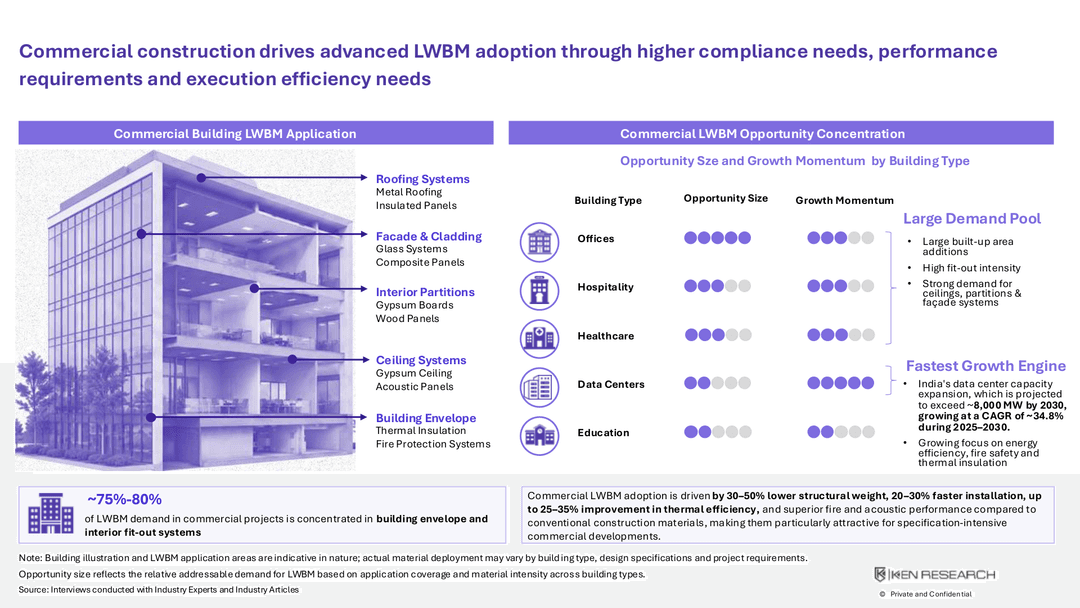
Office buildings, hotels, healthcare facilities, educational assets and data centres require more sophisticated building-performance outcomes than standard construction.
LWBM demand is concentrated across:
Façades and cladding
Roofing and insulated panels
Interior partitions
Ceiling systems
Thermal insulation
Acoustic systems
Fire-protection applications
These systems influence operating efficiency, occupant experience, project timelines and compliance.
Commercial projects also involve stronger architect, consultant and developer participation. This makes the market more specification led and gives technically differentiated suppliers a greater opportunity to influence material selection.
The deck indicates that approximately 75%–80% of commercial-project LWBM demand is concentrated in building-envelope and interior fit-out systems. It also identifies data centres as a particularly fast-growing opportunity because of requirements around energy efficiency, thermal management and fire safety.
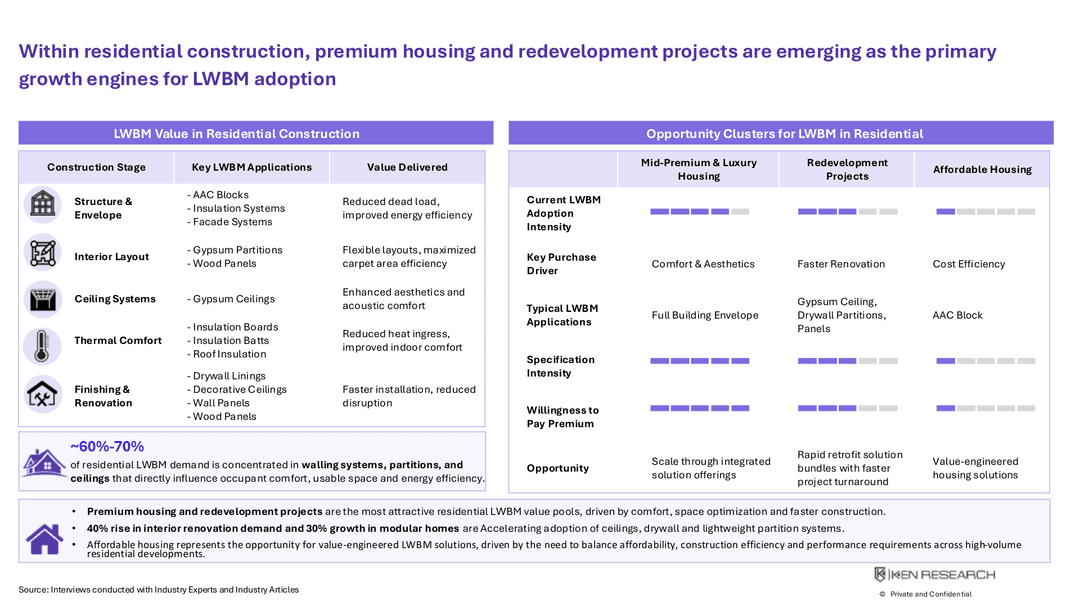
Residential Growth Will Be Led by Premium Housing and Redevelopment
The strongest residential opportunity is not uniform across housing categories
Residential construction remains the largest demand base, but lightweight-material adoption varies significantly by project type.
Mid-premium and luxury housing
Premium projects place greater value on:
Thermal comfort
Acoustic performance
Design flexibility
Usable-space optimization
Aesthetic finishes
Integrated façade systems
This supports a broader portfolio of lightweight systems across the building envelope and interiors.
Redevelopment and renovation
Redevelopment projects create a distinct opportunity because lightweight and dry-construction systems can reduce disruption and accelerate completion.
Relevant applications include:
Gypsum ceilings
Drywall partitions
Decorative panels
Lightweight wall linings
Insulation systems
Affordable housing
Affordable projects offer substantial volume, but the winning proposition must remain value engineered.
Solutions need to balance:
Material cost
Faster execution
Structural efficiency
Repeatability
Basic performance requirements
The deck identifies premium housing and redevelopment as the primary residential growth engines, while affordable housing remains an opportunity for carefully engineered, high-volume solutions.
Value Is Moving from Individual Products to Integrated Solutions
The competitive model is beginning to shift from category supply toward application delivery
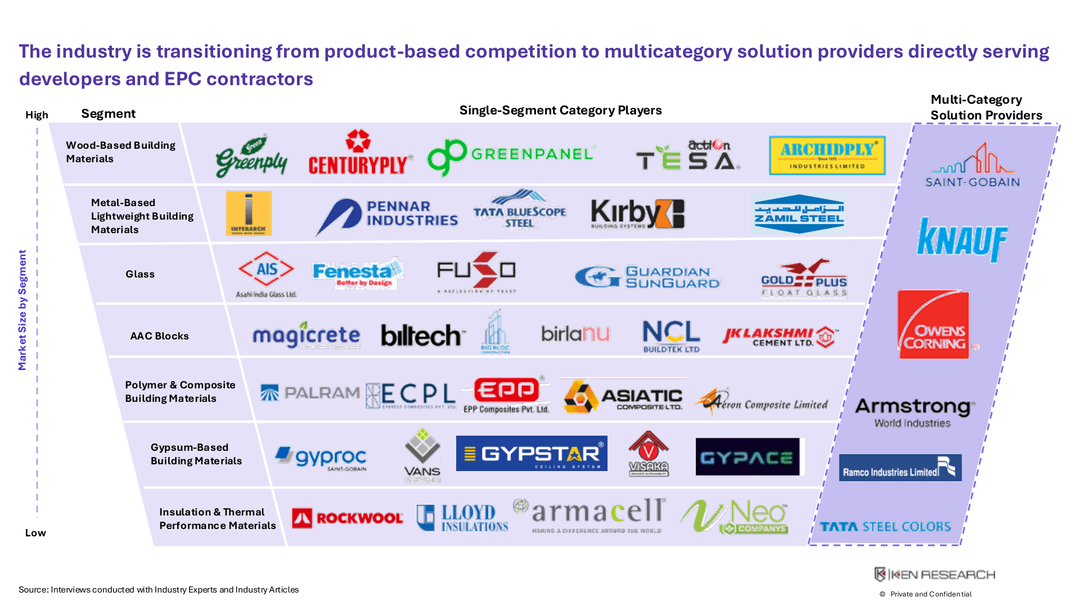
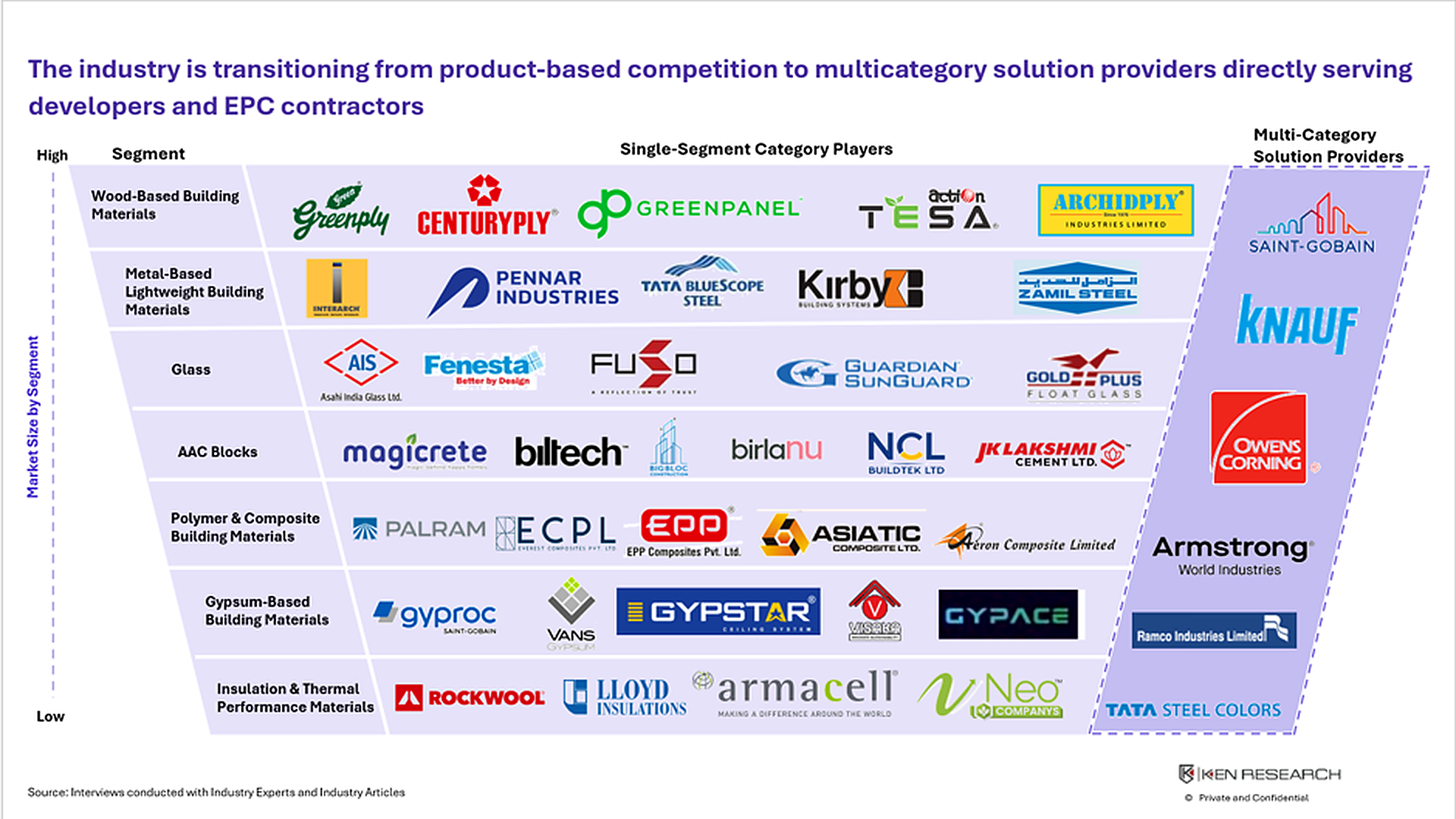
India’s lightweight building materials market remains divided across several product categories:
Wood-based materials
Gypsum-based systems
Lightweight metals
Polymers and composites
AAC blocks
Insulation products
Glass systems
Many suppliers still compete within a single material category.
However, developers and EPC contractors increasingly require coordinated solutions rather than isolated products.
A commercial project may require a complete combination of:
Façade systems
Insulation
Internal partitions
Ceiling solutions
Fire protection
Acoustic performance
Installation support
This creates an advantage for companies that can bundle products around a building application or customer requirement.
The strategic shift is from:
Selling gypsum board, insulation or panels
to:
Delivering a lightweight envelope, partition, roofing or fit-out solution
Integrated providers can potentially capture greater share of wallet, strengthen specification influence and simplify procurement for developers and contractors.
The deck identifies an industry transition from product-based competition toward multi-category solution providers serving developers and EPC contractors more directly.
India’s lightweight building materials market is shifting from single-category suppliers toward multi-category solution providers serving developers and EPC contractors.
The Leadership Window Is Narrow
Conditions are attractive today because adoption is accelerating while the market remains fragmented
The opportunity for category leadership will not remain equally open indefinitely.
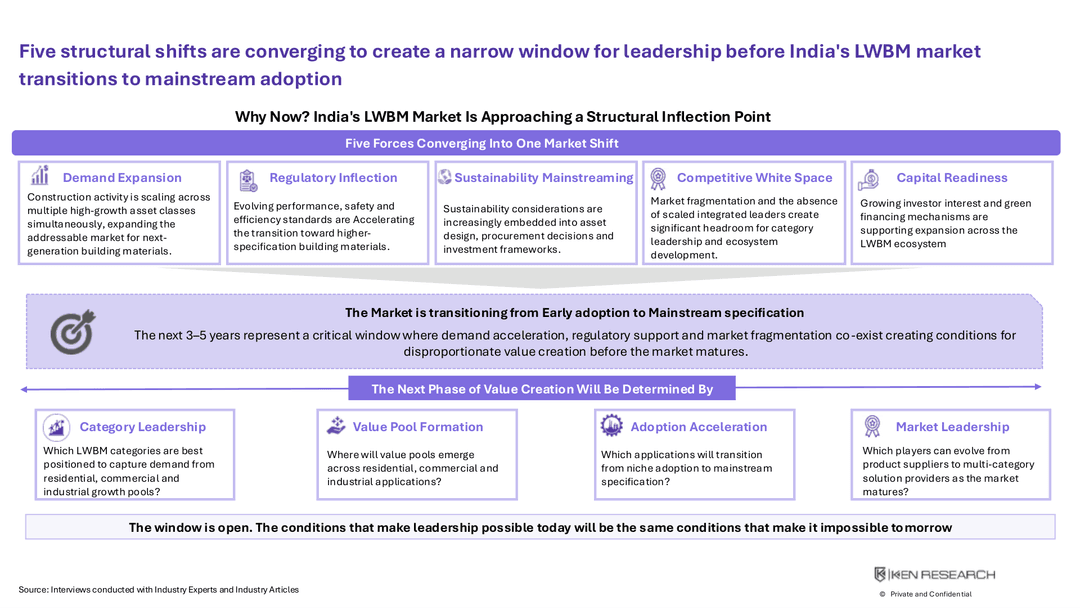
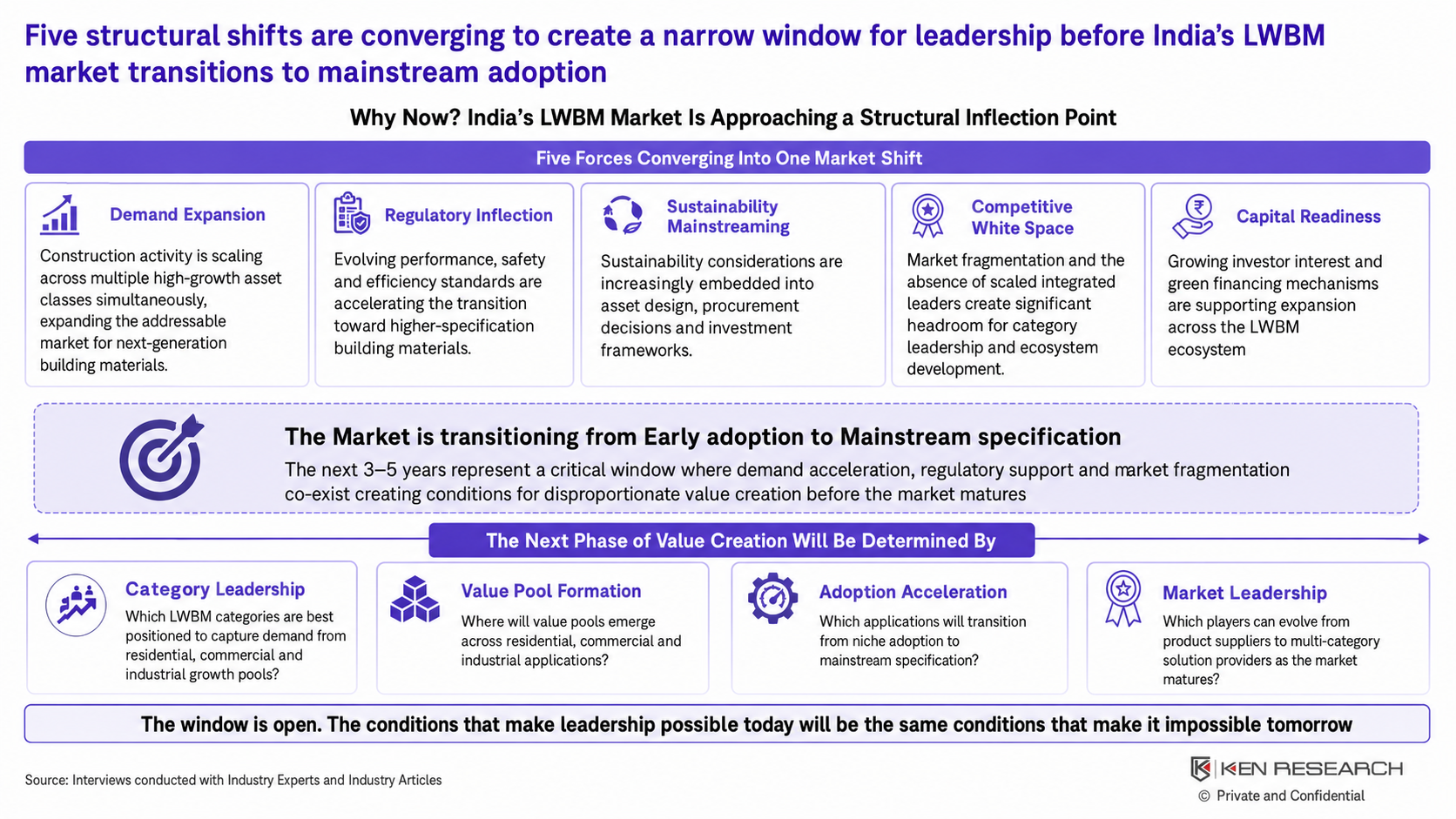
Five forces are converging:
Demand expansion
High-growth construction asset classes are increasing the addressable market simultaneously.
Regulatory inflection
Building-performance, efficiency and safety requirements are encouraging higher-specification materials.
Sustainability mainstreaming
Environmental performance is moving into design, procurement and investment decisions.
Competitive white space
The market remains fragmented, with limited scaled integration across categories.
Capital readiness
Investor interest and green-financing mechanisms can support capacity, product development and ecosystem expansion.
These conditions create a temporary strategic advantage for companies willing to invest before specifications, distribution relationships and customer preferences become more established.
Once mainstream adoption occurs, market entry may become more difficult because:
Architect and developer specifications will be more entrenched
Distribution and installer ecosystems will consolidate
Established brands will control reference projects
Customer switching costs will increase
Category positions will become harder to displace
The deck describes the next three to five years as the critical period during which demand acceleration, regulatory support and fragmentation coexist.
Five structural forces are creating a three-to-five-year window for leadership as India’s lightweight building materials market moves toward mainstream adoption.
The Central Takeaway
India’s lightweight building materials market is moving from early adoption toward mainstream specification.
The opportunity is being supported by construction expansion, sustainability, energy efficiency, modularity and the requirement for faster project delivery.
But market growth alone will not determine the winners.
Leadership will be shaped by the ability to:
Select the right material categories
Target the most attractive construction applications
Influence architects, developers and EPC contractors
Demonstrate project-level performance
Build multi-category solution capabilities
Establish position before market consolidation accelerates
The next three years matter because the companies that shape today’s specifications and solution ecosystems could define tomorrow’s mainstream LWBM market.