India’s Apparel Exports at USD 13 Bn: Can It Catch Up with Those of Bangladesh & Vietnam?
Ken Research
September 23, 2025 - 5 min read
September 23, 2025
by Khushi RastogiGlobal fashion is at an inflection point, and India’s apparel industry stands on the edge of opportunity. Few countries can match India’s scale of cotton production, its deep pool of skilled labour, and its heritage in textiles.
Additionally, overall textile and apparel market in India is projected to grow from USD 165 billion in 2022 to USD 350 billion by 2030 tiles, in global trade, smaller neighbors such as Bangladesh and Vietnam continue to outpace India, leveraging efficiency, speed, and trade agreements to achieve, signalling massive domestic and export potential. Yet in global trade, smaller neighbours such as Bangladesh and Vietnam continue to outpace India, converting efficiency, speed, and trade agreements into sharper export competitiveness.
The numbers illustrate both the hurdles India faces and the opportunities ahead, as Apparel exports slipped from USD 15.4 billion in FY23 to USD 13.04 billion in FY24.
Also, the decline was sharpened by the US decision in August 2025 to impose 50% tariffs on Indian apparel. Still, resilience is evident: in early FY25, exports climbed nearly 4% to USD 12.18B, proving that global demand for Indian apparel remains intact despite external shocks.
This article examines where India stands today at global level, what structural barriers hold it back, and whether the current wave of reforms and investments can finally bridge the gap with Bangladesh and Vietnam by 2030.
India vs. Its Neighbors: A Benchmark Reality Check
India’s vast textile base and workforce suggest export leadership, yet WTO (2024) data shows Bangladesh at USD 46.9 billion, Vietnam at USD 40.2 billion and India trailing at USD 13 billion, a gap explained by lower productivity and weaker policy support.
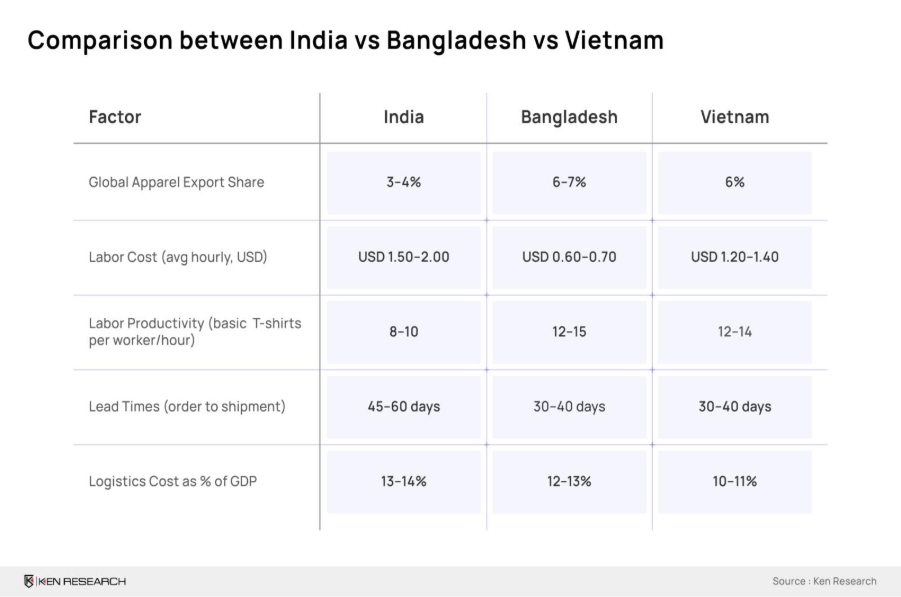
According to Ken Research, the average production rate per worker in India apparel industry stands at only 8 - 10 T-shirts per hour. In comparison, workers in Bangladesh and Vietnam produce an average of 12 - 15 T-shirts per hour per individual, giving these countries a clear cost and efficiency advantage.
Speed is another differentiator, with Apparel Export Promotion Council (AEPC) data showing India’s lead times at 45–60 days, compared with 30–40 days in Bangladesh and 35–45 days in Vietnam, leaving India less attractive for fast-fashion sourcing.
Policy access further compounds the disadvantage: Bangladesh enjoys EU GSP duty-free access, Vietnam benefits from an EU FTA, while India faces tariffs in Europe and now higher duties in the US.
Export composition further highlights the competitiveness gap, as Directorate General of Commercial Intelligence and Statistics (DGCI&S) data for FY24 shows that cotton garments still make up 55% of India’s apparel exports (USD 7.2B / ₹59,800 crore), while MMF accounts for only USD 5.5B (₹45,600 crore).
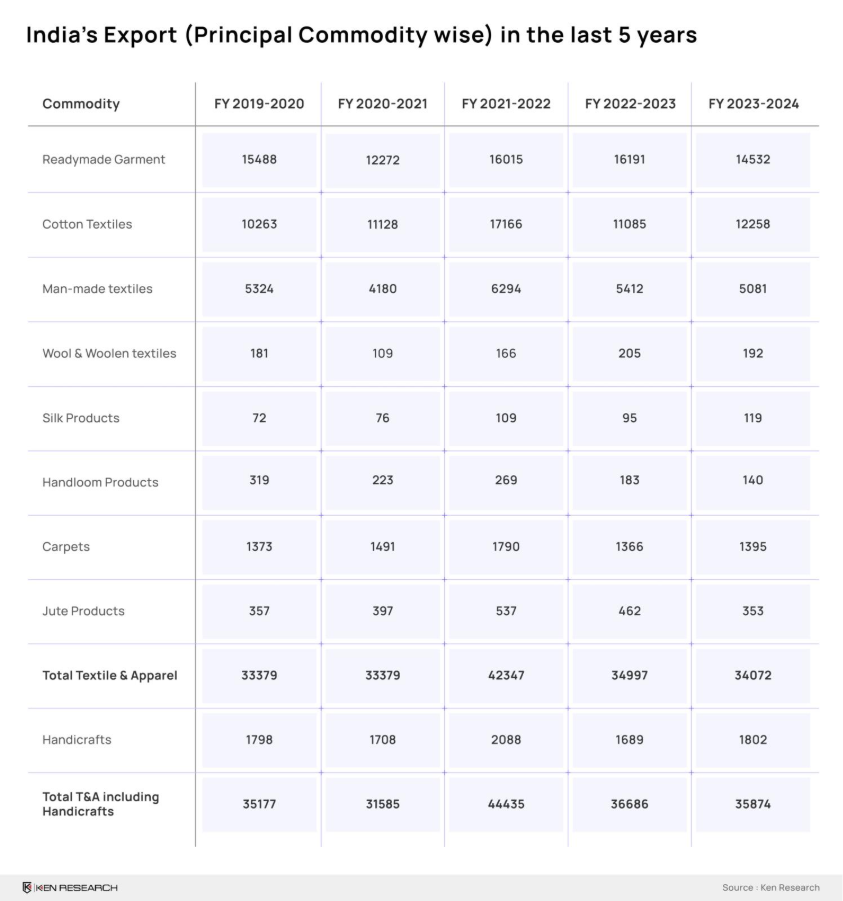
In contrast, Bangladesh and Vietnam have built their export strength on MMF and synthetics, which now dominate global demand. India is beginning to adjust clusters, such as Tiruppur, which are gradually shifting toward MMF, but the transition remains far slower than its rivals.
What Can India Do to Beat Its Neighbours in Apparel Exports?
Tackle the Structural Challenges Holding Back Indian Apparel Exports
India’s apparel sector remains fragmented, as the (Ministry of Textiles) MoT Annual Report 2023–24 notes that over 80% of exporters are SMEs operating with fewer than 50 machines, limiting economies of scale and consistency in serving global buyers. Without consolidation or integration, small-scale producers cannot match the reliability or scale of rivals.
High logistics costs further increase competitiveness, with the National Logistics Policy 2022 estimating India’s logistics expenses at 13–14% of GDP, compared with a global benchmark of 8–9%. Inland transport delays and port congestion at hubs such as Nhava Sheva and Chennai stretch delivery schedules, undermining India’s ability to compete in time-sensitive markets.
Sustainability and compliance challenges add to the pressure, as the Ministry of Textiles (MoT) data for 2023–24 shows that fewer than 15% of apparel units are certified under global ESG standards, compared with more than 20% in Vietnam. This risks India being sidelined as buyers increasingly prioritize green-certified suppliers.
Leverage Policy Pushes Like PLI and PM MITRA to Bridge the Gap
The Production Linked Incentive (PLI) scheme, reopened until September 2025, is designed to boost MMF apparel, MMF fabrics, and technical textiles.
As of July 2025, 74 companies have applied under the reopened scheme, with committed investments of USD 3.3B projected to deliver USD 24.9B turnover (India Briefing, 2025). By incentivizing scale and technology adoption, PLI aims to lift competitiveness in segments where India lags.
The PM MITRA initiative complements this effort, with seven integrated textile parks approved across TN, UP, Gujarat, Karnataka, MP, Maharashtra, and Telangana.
The Dhar (Madhya Pradesh) park, scheduled for inauguration on September 17, 2025, has already secured USD 2.75B from 114 companies. These parks are expected to reduce logistics costs, co-locate value chain stages, and boost export competitiveness.
Capture Growth Opportunities in the Apparel Sector
India’s export mix presents its biggest growth opportunity, as global buyers are shifting demand toward MMF and performance fabrics while India still relies on cotton-heavy exports. The PLI scheme for textiles, which prioritizes MMF and technical textiles, is structured to help the country diversify its export base and align with evolving market demand.
Productivity improvements are another lever, as the MSME Ministry (2023) highlights that fewer than 20% of apparel MSMEs use advanced machinery. By scaling automation and digital manufacturing, India could reduce lead times by weeks and lift worker productivity by 20–25%, narrowing efficiency gaps.
Make Sustainability and MMF the Game-Changers
Sustainability offers a premium growth path currently, only 5% of India’s apparel exports are green-certified, compared with >20% in Vietnam. Expanding eco-certified production through renewable-powered factories and water-recycling processes would both meet global sourcing requirements and strengthen India’s access to premium buyers.
The government’s Vision 2030 strategy targets approx. USD 100 Bn textile exports, with apparel contributing USD 40 B. Meeting this depends on accelerating the shift toward MMF, automation, and sustainable production models.
Conclusion
India’s apparel exports, at USD 13 billion in FY24, remain far behind Bangladesh and Vietnam despite the country’s abundant resources.
The competitiveness gap is driven by fragmented production, high logistics costs, and limited ESG compliance, alongside a slower shift from cotton to MMF compared with rivals. These structural weaknesses have kept India’s productivity and speed below global benchmarks.
At the same time, strong reforms in the PLI scheme and PM MITRA Parks aim to scale up MMF, technical textiles, and integrated supply chains, while recent growth in technical textiles exports grew by +15.5% YoY in FY25, Looking ahead, the government’s Vision 2030 targets USD 40B in apparel exports and 10 million new jobs, but success depends on execution. If reforms are implemented swiftly and the industry adapts to global demand shifts, India can narrow the gap with Bangladesh and Vietnam. If not, it risks remaining a secondary player in one of the world’s most competitive markets.
Related tags
Consumer Products and Retail
Get started
We've helped companies around the world future-proof
their businesses - and we can do the same for you.