Indonesia Car Rental and Leasing Market Is Racing Toward IDR 110 trillion as OTAs Cross 42% Share and B2B Contracts Dominate
Ken Research
January 16, 2026 - 13 min read

January 16, 2026
by Ken ResearchThe Indonesian car rental and leasing market is being reshaped by rapid digitisation. With over 75% internet penetration in 2024 and 50% social media penetration, the demand for digital mobility solutions is accelerating. This surge in digital engagement is particularly evident in the B2C segment, where consumers are moving away from traditional offline rental models in favour of online platforms. As a result, the market is seeing significant shifts in how consumers book rentals, with OTAs and rental apps capturing the largest shares of demand.
The total market revenues are expected to rise from around IDR 12 Tn in 2019 to around IDR 30 Tn by 2029. The total fleet size expanded from over 190,000 vehicles in 2019 to around 240,000 in 2024, and revenue growth consistently outpaced fleet expansion, signalling improving monetisation per vehicle.
B2B Consumers Generate the Highest Revenue with Long-Term Contracts, Higher Utilisation, and Value-added Services
Indonesia’s car rental and leasing market shows a clear structural tilt toward B2B consumers, where long-term contracts and higher utilisation rates translate into disproportionate revenue capture compared to consumer-led segments. Even with a smaller fleet base, enterprise clients continue to outperform B2C segments on revenue intensity, making B2B demand the most resilient pillar of market profitability.
The revenue leadership of B2B rentals is driven by contract structure, fleet efficiency, and predictable demand economics:
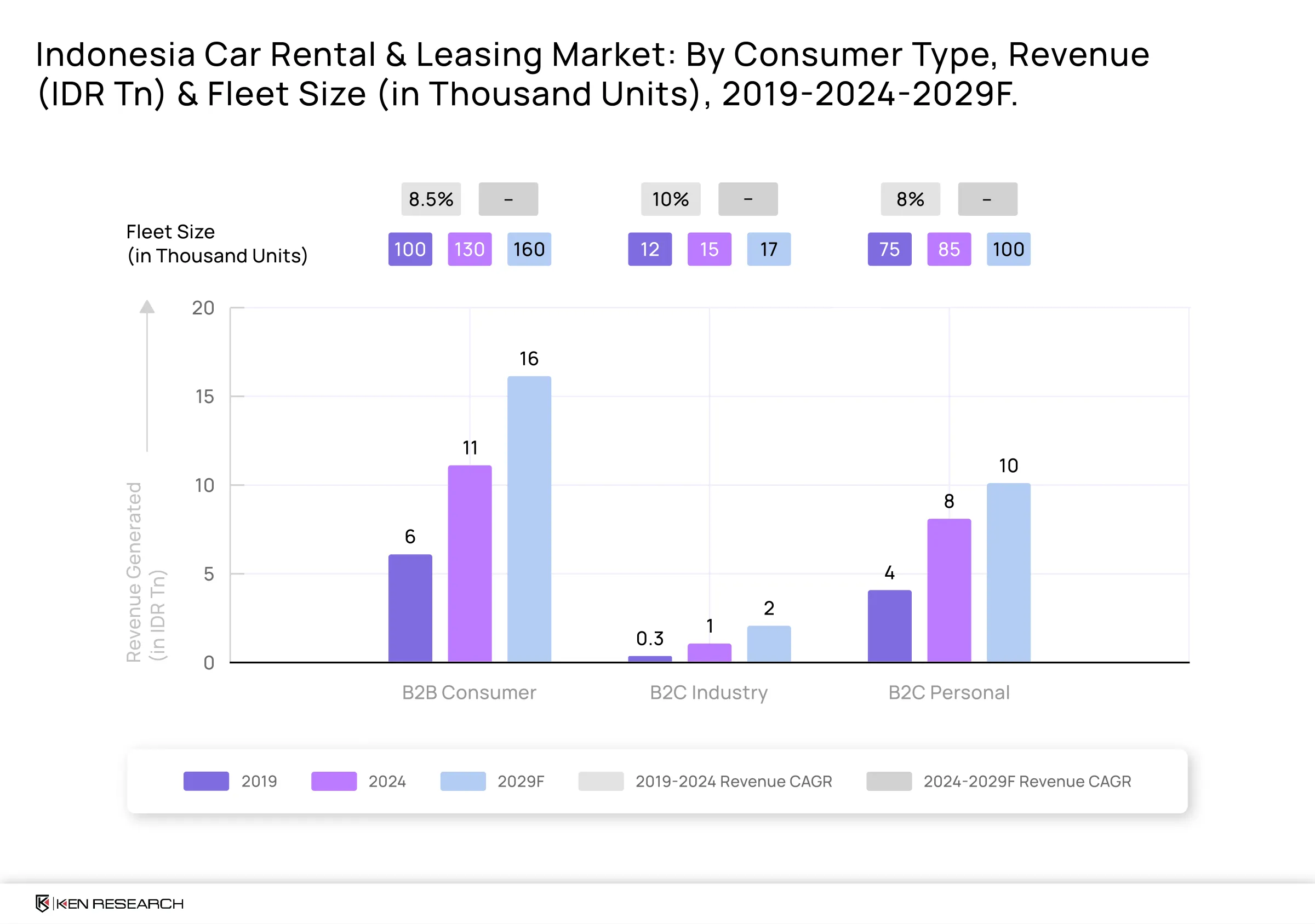
- B2B consumers generated over IDR 6 Tn in 2019, rising to over IDR 11 Tn in 2024 and reaching over IDR 16 Tn by 2029, making it the single largest revenue-contributing segment across the market despite operating with fewer vehicles than personal rentals.
- Fleet size for B2B rentals expanded from over 100,000 units in 2019 to over 130 thousand units in 2024 and around 160,000 units by 2029, reflecting steady expansion aligned with corporate mobility, higher utilisation, and multi-year leasing agreements.
- B2C Industry rentals remained niche, with revenue rising from even less than IDR 1 Tn in 2019 to around IDR 1.5 Tn in 2024 and around IDR 2 Tn by 2029, supported by short-term business needs, resulting in moderate fleet growth and stable revenue but limited by lower contract tenures.
- In contrast, B2C Personal rentals recorded a larger fleet of over 75,000 units in 2019, increasing to around 85,000 units in 2024 and over 100,000 units by 2029F. Revenue reached around IDR 4 Tn in 2019, around IDR 8 Tn in 2024 and is projected to reach over IDR 10 Tn in 2029.
Overall, Indonesia’s car rental economics are increasingly shaped by B2B-led demand, where long-term contracts, bulk volumes, and value-added services deliver superior revenue density per vehicle, positioning enterprise mobility as the core earnings engine of the market, even as consumer fleets continue to expand in absolute terms.
Online Channels Drive Structural Shift in B2C Industry Rentals
B2C industry customers in Indonesia are rapidly migrating toward online rental channels, reflecting a structural shift in how short-term corporate mobility is sourced and executed. As transaction speed, real-time availability, and reduced human dependency become critical, digital platforms are emerging as the primary growth engine within this segment, while offline channels lose relevance.
This channel rebalancing is clearly visible across revenue growth, fleet allocation, and utilisation patterns:
- Online B2C industry revenue was around IDR 0.3 Tn in 2019 and is projected to reach around IDR 2 Tn by 2029, making it the fastest-growing channel within the B2C industry segment.
- Fleet size supporting online B2C industry rentals was around 6,000 units in 2019 and is projected to rise over 12,500 units by 2029, highlighting capacity reallocation toward digital demand channels.
- In contrast, offline B2C industry revenue remained largely stagnant at around IDR 0.3 Tn in 2019 and is projected to rise to over IDR 0.4 Tn by 2029, indicating limited pricing power and declining transaction relevance.
- Offline fleet size is expected to contract from over 6,000 units in 2019 to around 4,000 units by 2029, reflecting lower utilisation and gradual channel obsolescence.
Overall, Indonesia’s B2C industry rental market is undergoing a decisive digital pivot, where online platforms are no longer complementary but central to growth, forcing operators to redesign fleet deployment, pricing models, and channel strategies around speed, automation, and real-time customer engagement.
Offline Dedicated Spaces Control Over 50% of B2C Industry Revenue Through Expanded Footprints of Small- and Large-Scale Enterprises
Within Indonesia’s B2C industry rental segment, offline distribution remains structurally concentrated around dedicated locations, which continue to command the largest revenue share despite overall channel pressure. These spaces, typically corporate branches and business-district offices, benefit from predictable enterprise demand, cost efficiency, and operational convenience, allowing them to outperform other offline formats.
A closer look at offline channel economics highlights why dedicated spaces continue to dominate:
- Dedicated spaces generated around IDR 0.2 Tn in 2019 and are expected to be over IDR 0.15 Tn by 2029, still retaining the highest revenue contribution among offline B2C industry channels.
- Fleet size at dedicated locations is expected to decline from around 4,000 units in 2019 to around 2,000 units by 2029, indicating consolidation rather than demand erosion, as operators optimise utilisation and margins.
- Hub spaces recorded revenue of around IDR 0.10 Tn in 2019 and are expected to remain stable at around IDR 0.15 Tn by 2029, supported by airport and station-based demand.
- Public spaces showed gradual revenue growth from around IDR 0.10 Tn in 2019 to around IDR 0.15 Tn by 2029, while fleet size remained flat at around 1,400-1,200 units, reflecting usage driven by hotels.
Overall, while offline B2C industry rentals are structurally ceding ground to online platforms, dedicated spaces remain the backbone of offline revenue, anchored by enterprise accessibility, lower fleet costs, and operational efficiency, making them a critical profitability lever even as operators streamline physical footprints.
Online Travel Agents and Rental Apps Capture Over 70% of B2C Industry Demand, Driven by Convenient and Flexible Digital Booking Solutions
Indonesia’s B2C industry car rental market is now decisively online-led, with OTAs and rental applications emerging as the dominant booking gateways for short-term corporate travel. As business users prioritise speed, flexibility, and multi-city access, digital platforms are absorbing the bulk of incremental demand, fundamentally reshaping how organised rental players acquire and retain corporate customers.
The internal mix of online channels highlights where growth, scale, and monetisation are concentrating:
- Online Travel Agents (OTAs) generated around IDR 0.10 Tn in 2019, scaling sharply to IDR 0.35 Tn in 2024 and are projected to reach over IDR 0.45 Tn by 2029, supported by strong inbound corporate travel and international business users booking short-duration rentals.
- OTA-supported fleet size expanded from around 2,500 units in 2019 to 4,500 units in 2024 and is projected to reach around 5500 units by 2029, reflecting sustained capacity allocation toward aggregator-led demand.
- Ride-hailing-linked rentals, though smaller in absolute terms, recorded the fastest growth, with revenue expected to increase from around IDR 0.01 Tn in 2019 to reach over IDR 0.15 Tn by 2029, backed by a fleet expansion from around 200 to over 1,500 units over the same period.
- Rental applications and direct websites generated around IDR 0.05 Tn in 2019, are expected to reach over IDR 0.40 Tn by 2029, as organised operators increasingly push app-based booking and account-linked corporate rentals.
- Social media-driven bookings grew steadily and are expected to reach around IDR 0.20 Tn by 2029, expected to reach around IDR 0.20 Tn by 2029, supported by targeted promotions.
- Overall, OTAs and rental applications together accounted for over 70% of online B2C industry revenue in 2024, reinforcing their role as the primary digital acquisition channels for short-term corporate rentals.
In effect, Indonesia’s B2C industry rental market is consolidating around scalable digital ecosystems, where OTAs deliver reach and volume while rental apps strengthen direct control, making platform strategy, not physical presence, the key determinant of competitive advantage in short-term corporate mobility.
Online Channels Overtake Offline in B2C Personal Rentals as Tourist-Led Demand Accelerates
Indonesia’s B2C personal car rental segment is undergoing a decisive channel transition, with online platforms emerging as the primary growth driver over the past five years. Rising foreign tourist inflows, higher digital adoption, and preference for instant booking have structurally shifted demand away from traditional offline rentals, positioning online channels to decisively outperform during the forecast period.
The divergence between offline stagnation and online acceleration is clearly visible across revenue and fleet deployment:
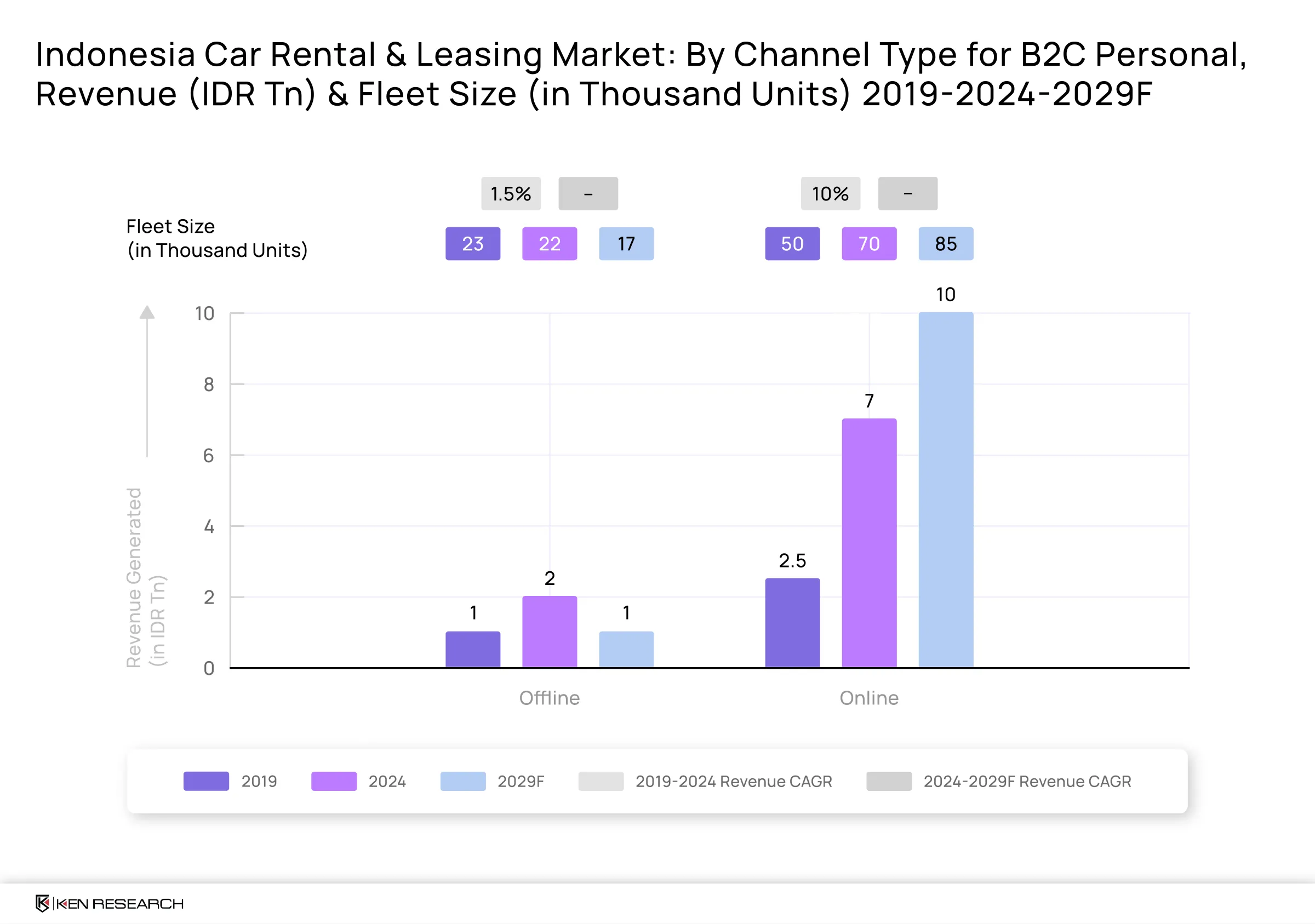
- Offline B2C personal rental revenue remained largely flat, increasing marginally from around IDR 1 Tn in 2019 to around IDR 2 Tn in 2024 and is expected to fall to around IDR 1.2 Tn by 2029, reflecting limited pricing power and declining relevance among digitally native travellers.
- Offline fleet size contracted from around 23,000 units in 2019 to around 22,000 units in 2024 and further to around 16,000 units by 2029, as unorganised and local operators face utilisation pressure and customer migration to digital platforms.
- In contrast, online B2C personal rental revenue expanded sharply from IDR 2.5 Tn in 2019 to IDR 7 Tn in 2024 and is projected to reach IDR 10 Tn by 2029, firmly establishing online as the dominant channel.
- Online fleet size scaled from around 50,000 units in 2019 to around 70,000 units in 2024 and is projected to rise further to around 85,000 units by 2029, highlighting aggressive capacity expansion aligned with tourist-heavy demand corridors.
- Indonesia recorded around 14 million foreign tourist arrivals in 2024, reflecting over 19% year-on-year growth, reinforcing the structural tailwind for online B2C personal rentals, where international tourists prefer transparent pricing and pre-arranged mobility.
Overall, Indonesia’s B2C personal rental market is transitioning from a fragmented, offline-led structure to a digitally dominated ecosystem, where online platforms capture both volume and value, making digital channel scale and tourist-centric positioning the defining success factors for operators going forward.
Hub Spaces Command Over 40% of Offline B2C Personal Rentals, Driven by High Footfall and Short-Term Mobility Among Transient Travelers
Within Indonesia’s B2C personal rental market, offline demand is increasingly concentrated around hub spaces, where immediate access and high traveller footfall outweigh the declining relevance of traditional branch-based formats. Airports, railway stations, and major transit nodes continue to anchor short-term rental demand from transient travellers, even as the overall offline channel contracts.
A breakdown of offline B2C personal channels explains why hub spaces retain strategic importance:
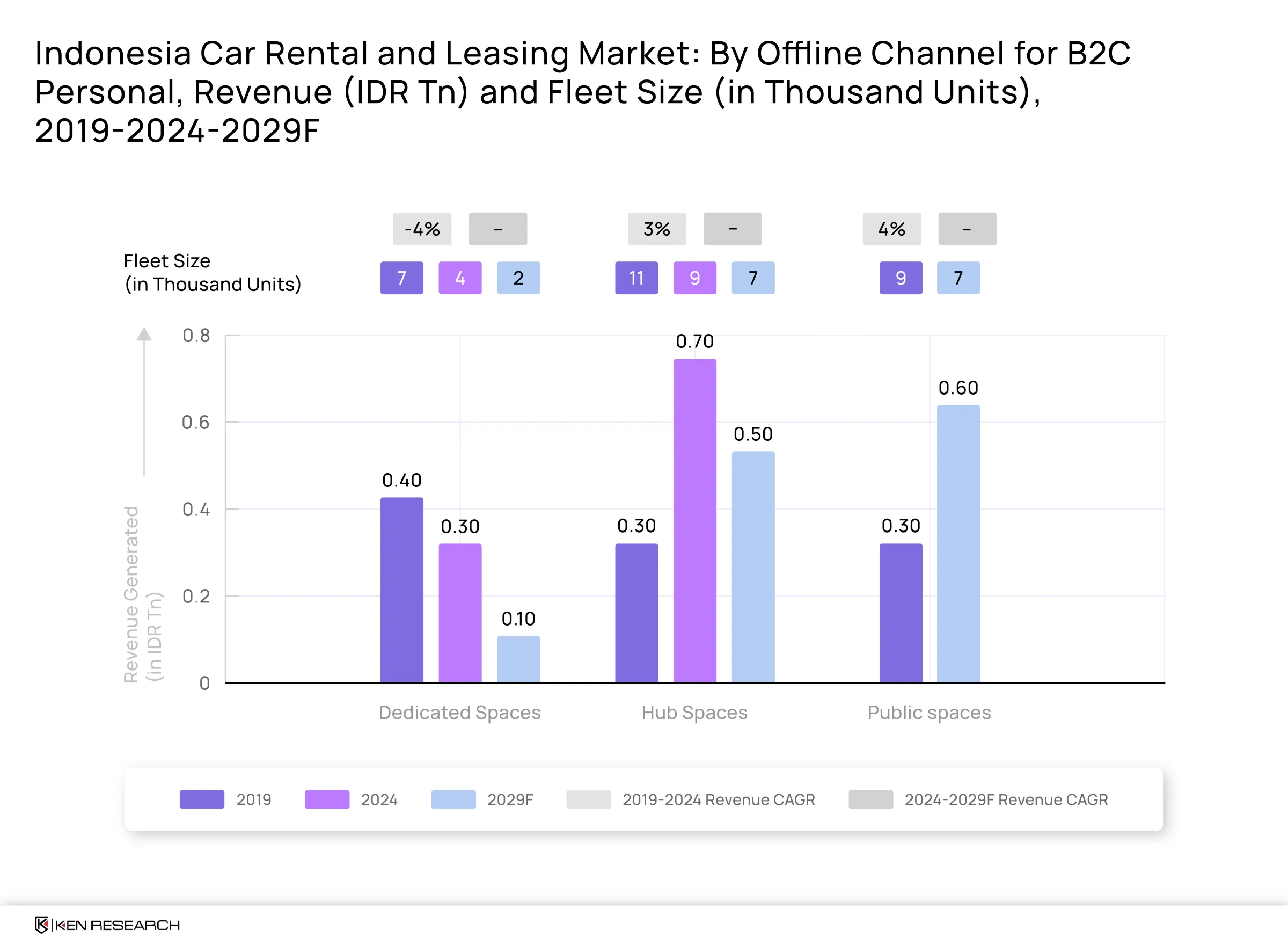
- Hub spaces generated around IDR 0.30 Tn in 2019, increased to around IDR 0.70 Tn in 2024, and are projected to moderate slightly to IDR 0.50 Tn by 2029, accounting for over 40% of total offline B2C personal rental revenue.
- Fleet size at hub locations declined from around 11,000 units in 2019 to 9,000 units in 2024 and is projected to decline further to around 7,000 units by 2029, indicating optimisation rather than demand erosion, as operators focus on high-yield, short-duration rentals.
- Dedicated spaces witnessed sharper contraction, with revenue declining from around IDR 0.40 Tn in 2019 to around IDR 0.30 Tn in 2024 and are expected to decline further to around IDR 0.10 Tn by 2029, alongside fleet reduction from around 7,000 to around 2,000 units for the same period, reflecting weakening appeal for walk-in personal renters.
- Public spaces showed relative resilience, with revenue rising from around IDR 0.30 Tn in 2019 to around IDR 0.70 Tn in 2024 and are expected to reach around IDR 0.60 Tn by 2029, supported by rentals originating from hotels, malls, and mixed-use developments.
- Soekarno-Hatta International Airport handled around 50 million passengers in 2023, ranking as the third busiest airport in Southeast Asia, underscoring why airport-linked hub spaces remain critical access points for immediate mobility needs.
In summary, while Indonesia’s offline B2C personal rental channel is structurally shrinking, hub spaces continue to dominate revenue due to concentrated footfall and urgent travel requirements, making transit-linked locations the last stronghold of offline relevance in an increasingly digital rental ecosystem.
Online Travel Agents Lead B2C Personal Rentals with Over 40% Share on Tourist-Led Demand
Online Travel Agents (OTAs) have emerged as the single largest booking channel in Indonesia’s B2C personal car rental market, driven by their ability to aggregate demand, offer bundled travel services, and provide high visibility to international and domestic tourists. As leisure travel scales and digital discovery becomes the default, OTAs are structurally positioned to capture the highest share of online personal rentals.
The internal economics of online B2C personal channels underline why OTAs remain the primary demand gateway:
- OTAs generated revenue around IDR 1.50 Tn in 2019, expanded to IDR 3.0 Tn in 2024, and are projected to reach around IDR 4.0 Tn by 2029, translating into over 40% market share in 2024, the largest among all online personal rental channels.
- OTA-linked fleet size increased from around 20,000 units in 2019 to around 30,000 units in 2024 and is expected to reach around 35,000 units by 2029, reflecting sustained capacity allocation toward aggregator-led tourist demand.
- Ride-hailing-linked rentals, while smaller in scale, showed the fastest acceleration, with revenue increasing from around IDR 0.10 Tn in 2019 to around IDR 0.40 Tn in 2024 and are projected to reach around IDR 1.0 Tn by 2029, reflecting experimentation with hybrid mobility use cases.
- Rental applications and direct websites recorded strong momentum, with revenue rising from around IDR 0.50 Tn in 2019 to around IDR 1.50 Tn in 2024 and are expected to reach around IDR 2.5 Tn by 2029, supported by fleet expansion from 10,000 to around 22,000 units in the same period, as organised players deepen direct-to-consumer engagement.
- Social media-driven bookings emerged as the second-largest channel, generating about IDR 1.0 Tn in 2019 (over 25% share) and scaling to around IDR 1.50 Tn in 2024 and are expected to rise to over IDR 2.0 Tn by 2029.
Overall, Indonesia’s B2C personal rental market is consolidating around high-visibility digital platforms, where OTAs dominate tourist-led demand through scale and bundling, while rental apps and social channels steadily gain ground, making digital discoverability and platform partnerships critical for long-term volume leadership.
Conclusion
Indonesia's car rental and leasing market is experiencing robust growth, driven by increasing B2B contracts, the recovery of tourism, and the rapid digitalisation of booking channels. The market is expected to expand from IDR 70 Tn in 2024 to over IDR 100 Tn by 2029, growing at an 8% CAGR. B2B rentals remain the dominant segment in terms of revenue despite a smaller fleet size, with long-term contracts and high fleet utilisation driving profitability. Meanwhile, the B2C segment is shifting rapidly towards digital platforms, with OTAs and rental apps capturing a significant share of demand, while offline channels face decline. This structural shift highlights the increasing importance of digitalisation in both B2B and B2C sectors.
Ken Research recommends stakeholders to prioritise digital transformation in their fleet and distribution strategies, particularly in the B2C segment, where online channels like OTAs and rental apps are driving most of the revenue growth. For B2B, the focus should be on strengthening long-term leasing agreements, optimising fleet utilisation, and exploring value-added services to increase revenue per vehicle. Emphasising operational efficiency, leveraging digital platforms, and expanding the corporate client base will be key to capitalising on the growth potential in the coming years.
Get started
We've helped companies around the world future-proof
their businesses - and we can do the same for you.