How Mortgage Lending of USD 70 billion by 2030 is Rewiring Indonesia's Real Estate Market?
Ken Research
January 22, 2026 - 11 min read
January 22, 2026
by Khushi GuptaIndonesia’s real estate market is undergoing a remarkable transformation, driven by a combination of rising foreign interest, expanding urbanisation, and favourable government policies. Foreign buyers are increasingly targeting premium and luxury properties, particularly in major urban centres such as Jakarta and Bali.
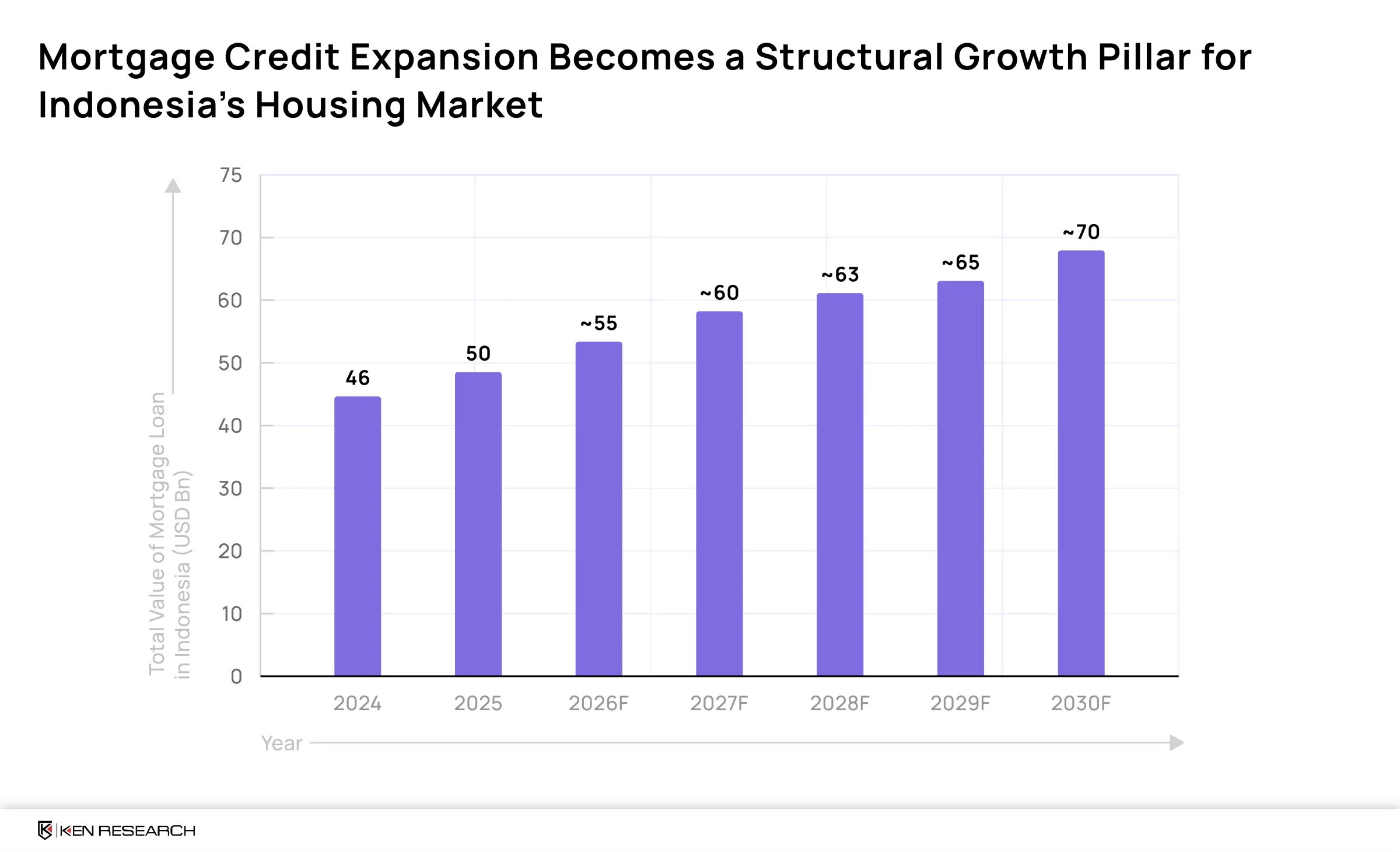
With foreign buyers accounting for 60% of luxury property purchases and 42% of premium class buyers, the demand for high-end real estate is soaring, especially from regions like Singapore (22%), the USA (16%), and Australia (12%). The Indonesian mortgage market is set to expand significantly, with total mortgage loans expected to rise from USD 46 billion in 2024 to around USD 70 billion by 2030.
Rising Incomes and a Young Workforce Are Strengthening Indonesia’s Mid-Market Housing Base
Indonesia’s housing demand is increasingly shaped by income growth, controlled labour costs, and a young domestic population. While affordability remains intact, margin discipline and segment focus are becoming critical for developers.
The following points highlight how labour, income, and demographics are influencing housing demand fundamentals:
- Employment growth is stable, but wages are rising. Indonesia’s employed population grew from around 130 million to around 145 million from 2020 to 2024. Wage hikes of around 8% every 18 months are pushing up development costs, increasing the need for productivity-led execution.
- Labour remains cost-efficient despite wage pressure. The national average monthly wage is around USD 187, keeping Indonesia among Southeast Asia’s most cost-efficient labour markets.
- GDP and incomes are strengthening housing affordability. GDP expanded from over USD 1,000 billion in 2020 to over USD 1,400 billion in 2025.
- A young, domestic population anchors long-term demand. Indonesia’s population reached 282 million with around 60% urbanisation in 2024. Nearly 48% are under 30, while foreigners account for just 0.01%, showing minimal expatriate presence.
Indonesia’s residential market is supported by income growth and demographics, but success will depend on cost control and focus on the mid-market, where real purchasing power is strongest.
Business-Class Housing Leads Jakarta’s Recovery as 2024 Unit Sales Reach Over 21,000
Jakarta’s residential market has clear volume concentration in business-class housing. Buyer’s preferences have shifted towards ready-to-move projects, strong connectivity, and defensible resale value, while luxury remains a structurally limited niche.
The points below summarise what Jakarta’s housing-class sales mix (2020-2024) reveals about demand direction and developer strategy:
- Business-class housing is the primary growth engine. Unit sales doubled from 2020 to 2024. Demand is driven by buyers seeking scale, accessibility, and long-term value stability.
- Comfort housing posted the fastest rebound in 2024. Volumes rose from around 5,000 in 2020 to over 12,500 in 2024, supported by steady gains through 2021-2023.
- Premium housing turned selective after a 2023 peak. Sales climbed to around 5,000 units in 2023 before correcting to around 3,000 in 2024, indicating sharper buyer scrutiny and weaker tolerance for undifferentiated premium offerings.
- Luxury remains structurally small despite positive price trends. Unit sales stayed below 1,000 units annually through 2024 and are projected at around 1,300 units only by 2030, reinforcing its position as a boutique, location-sensitive segment.
Jakarta’s residential market is rewarding scale, readiness, and ecosystem-led value, while premium and luxury demand increasingly depends on clear differentiation rather than pricing narratives alone.
Jakarta’s Zoning Framework Limits Hospitality Plays and Keeps Residential Supply Owner-Driven
Jakarta’s property ecosystem is tightly regulated, with no resort zoning and a clear separation between residential ownership and commercial hospitality use. The regulatory clarity is the key constraint shaping investment models, rental yields, and foreign participation.
The points below summarise how ownership titles and zoning rules directly influence Jakarta’s residential and investment landscape:
- Jakarta does not permit resort-style residential zoning. Short-term rentals and hospitality use are not allowed in residential zones and must operate under commercial zoning, requiring TDUP (Tanda Daftar Usaha Pariwisata) and OSS-RBA registration, irrespective of owner nationality.
- Indonesian citizens retain the strongest ownership rights. Locals can hold Hak Milik (freehold) with unlimited tenure, applicable to private homes and apartments, making domestic buyers the dominant force in long-term residential absorption.
- Foreign ownership is structured and restrictive. Foreigners with valid visas can access Hak Pakai (Right to Use) for 30+20+30 years (get it for 30 years, then you can renew for 20, then another 30, total 80 years), limited to one residential property (<2,000 m²) for personal use only, or Hak Guna Bangunan (HGB) for commercial property on state/Hak Milik land.
- Residential zones strictly limit monetisation. Private homes and apartments are barred from short-term rentals, reinforcing Jakarta’s residential market as end-user and long-stay driven, rather than tourism-led.
Jakarta’s regulatory framework structurally favours owner-occupied and long-term rental housing, while hospitality-led returns are confined to commercially zoned, fully licensed assets, a dynamic that limits supply and stabilises residential demand.
Jakarta’s Housing Supply Continues to Outpace Demand by Up to 31%, Signalling Structural Oversupply
Jakarta’s residential market is characterised by a persistent supply-demand imbalance, with new unit additions consistently exceeding effective demand. This gap is structural rather than cyclical, shaped by investor-led supply, product mismatch, and policy-driven distortions.
The points below explain how the supply-demand gap has evolved and what it means for market absorption:
- Supply has exceeded demand every year since 2020. The gap widened from around 2020 to 2024, before moderating slightly in 2025, indicating persistent but gradually rationalising oversupply.
- Absolute volumes highlight the imbalance. Demand is expected to rise to around 60,000 by 2030, while supply is expected to expand faster to over 70,000 by 2030.
- Investor-led development is inflating supply. A large share of mid to high-end units has been purchased for capital appreciation rather than occupancy, increasing vacancy and weakening true end-user absorption.
- Product mismatch is constraining demand realisation. Supply is skewed towards vertical, higher-end apartments, while unmet demand persists in affordable and end-user-led segments.
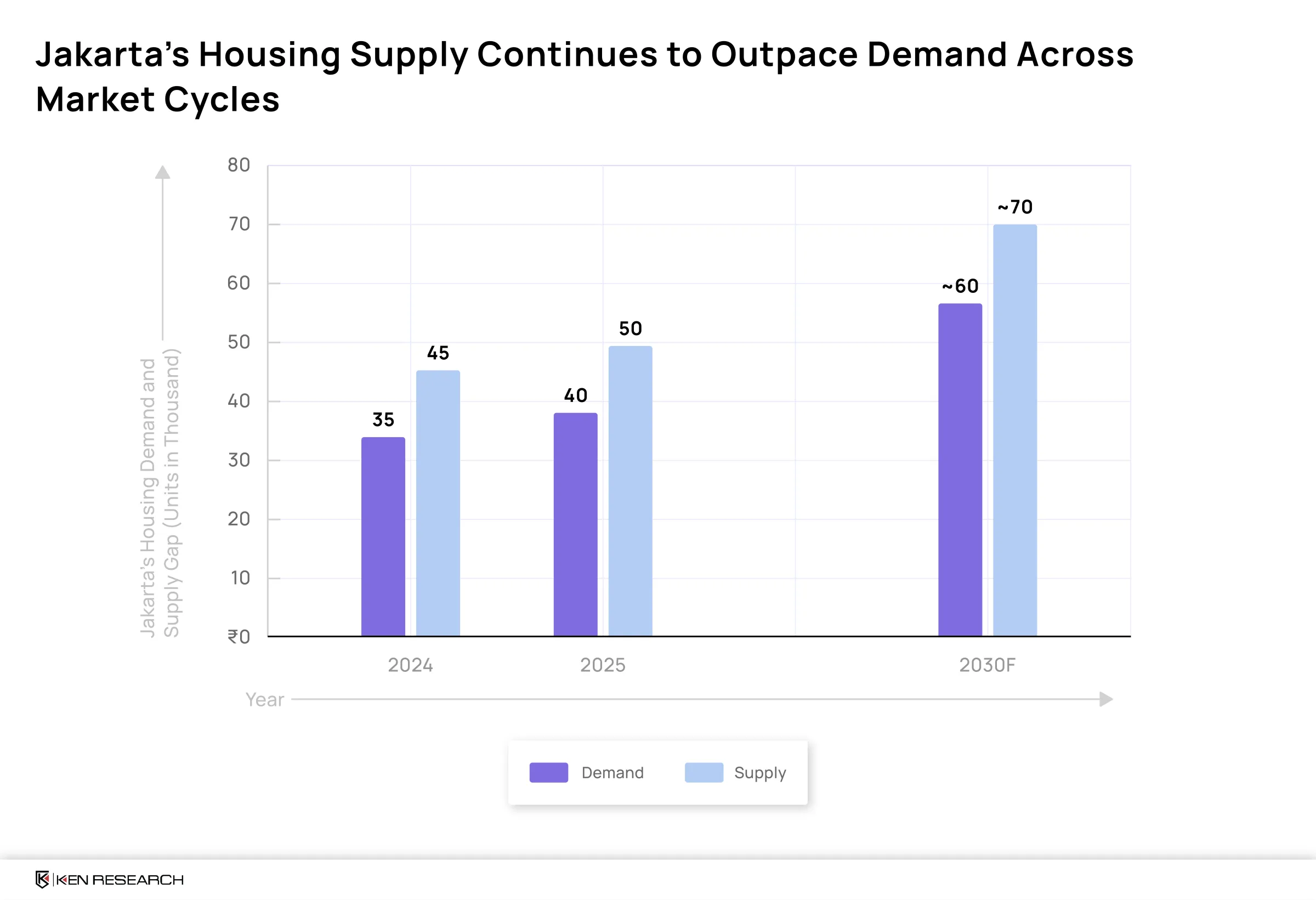
Jakarta’s housing market is not demand-constrained but absorption-constrained. Developers with end-user-aligned pricing, right-sized inventory, and location-led differentiation are best positioned as the market works through this structural oversupply.
Comfort & Business Unit Sales More Than Quadruple by 2030, Driving Bali’s Residential Growth
Bali’s residential market has shifted decisively toward mid-market housing, with comfort and business segments driving the bulk of unit sales recovery post-COVID. The growth is no longer confined to luxury-led demand but is increasingly supported by end-users and revived tourism-linked confidence.
The points below summarise how housing-class sales trends are reshaping Bali’s residential landscape:
- Comfort housing is the fastest-growing segment. Unit sales rose from around 1,350 in 2020 to around 3,000 in 2024, reflecting strong demand for affordable and liveable homes aligned with local buyers and long-stay residents.
- Business-class housing closely mirrors comfort-led growth. Sales increased from over 1,300 in 2020 to around 2,950 in 2024, confirming a parallel rise in mid-income and investor-backed demand seeking balanced pricing and usability.
- Premium housing is expanding steadily but at a slower pace. Unit sales grew from around 800 in 2020 to around 1,400 in 2024, indicating a selective appetite for differentiated premium offerings rather than broad-based upscale absorption.
- Luxury remains niche despite recovery. Luxury units increased from around 600 in 2020 to around 1,100 in 2024, underscoring Bali’s continued reliance on volume-led mid-market growth.
- Policy and execution tailwinds supported the rebound. Permit accelerations under the Omnibus Law and OSS-RBA have streamlined licensing, especially for landed and hospitality-linked residential products.
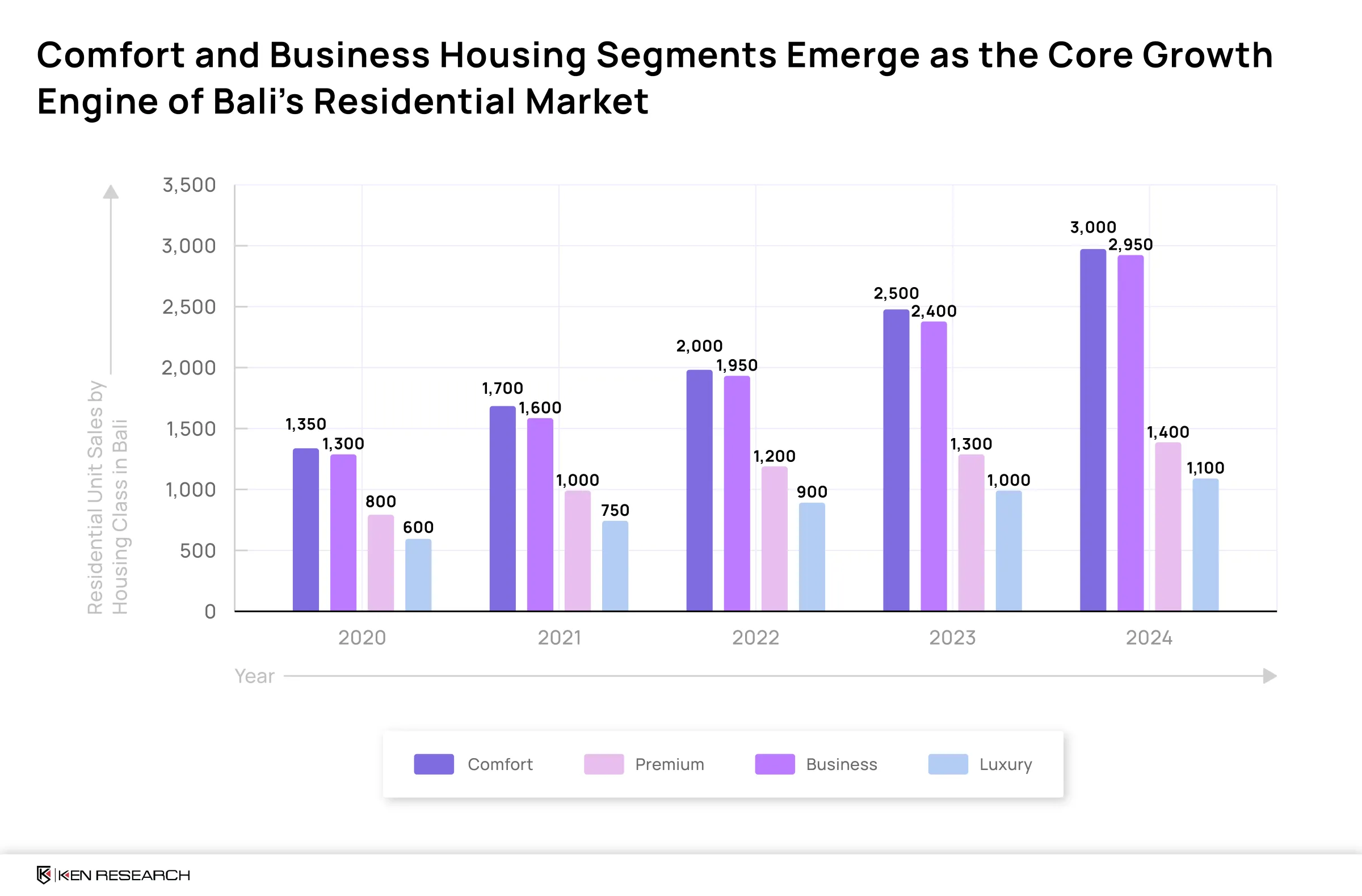
Bali’s residential growth, with comfort and business housing forming the structural backbone of demand, while premium and luxury segments grow selectively on confidence and tourism recovery rather than scale.
Supply Freeze and Tourism Revival Will Lift Bali’s Occupancy to Over 80% by 2030
Bali’s rental and hospitality market is entering a tight-supply, high-utilisation phase, driven by a construction freeze, revived tourism, and sustained digital-nomad inflows. The occupancy is rebounding sharply from pandemic lows and stabilising at structurally higher levels through 2030.
The points below explain what is driving the sustained rise in occupancy and why it is durable:
- Occupancy rebounded strongly after the COVID disruption. Rates fell from 16% in 2020 to 60% in 2023 as travel restrictions eased and demand returned.
- A supply freeze is tightening the market. A moratorium on new hotel and villa permits across key regions (Denpasar, Badung, Gianyar, Tabanan) has capped new additions, preventing oversupply despite rising demand.
- Tourism recovery is driving short-stay demand. Restored international flights and eased entry rules lifted occupancy to 63-66% in 2024-2025, with utilisation projected to reach over 70% by 2027.
- Digital nomads are extending average stays. Growth in remote work and co-working infrastructure has increased long-stay occupancy, pushing utilisation beyond seasonal tourism peaks.
- Infrastructure upgrades support year-round utilisation. Expanded Ngurah Rai Airport capacity, the Bali Mandara Toll Road, and improved inter-regency connectivity are opening new catchments and smoothing demand across the year.
With supply tightly controlled and demand diversified across tourism and long-stay residents, Bali’s occupancy is projected to rise to over 80% by 2030, creating a structurally favourable environment for rental and hospitality-led residential assets.
Domestic Buyers in Bali Prioritise Completed Homes, Keeping Absorption High
Bali’s residential market remains confidence-led, with domestic buyers showing a clear preference for completed properties in established locations. This behaviour is sustaining consistently high absorption rates through the forecast period.
The points below summarise how buyer behaviour is shaping Bali’s absorption profile:
- Absorption remains structurally strong. Residential sales absorption rises steadily from around 85% in 2020 to around 90% by 2030, reflecting stable end-user demand despite market cycles.
- Domestic buyers are risk averse. Local purchasers focus on ready-to-move homes for long-term living or stable rentals, particularly in established areas such as Denpasar and Ubud.
- Under-construction demand is driven by foreign buyers. International investors are more willing to purchase properties in luxury segments in high-tourism zones like Seminyak and Uluwatu, targeting high rental yields.
- Mid-market participation will expand gradually. As financing access improves and economic confidence strengthens, local buyers are expected to increase participation in mid-market residential projects.
Bali’s absorption strength is anchored by domestic, end-user demand for completed homes, while foreign capital selectively drives luxury off-plan sales, creating a stable and low-volatility residential market.
Regional Comparison Highlights How Jakarta and Bali Are Diverging Across Demand, Supply, and Absorption Dynamics
Indonesia residential real estate market is no longer moving as a single, homogeneous system. Jakarta and Bali are diverging sharply in terms of demand drivers, supply discipline, and absorption behaviour, creating two distinct regional investment profiles.
The points below outline how regional dynamics are reshaping investment outcomes:
- Demand composition differs structurally across regions. Jakarta’s residential volumes are concentrated in business and comfort housing, with business-class unit sales exceeding 21,000 units in 2024, driven by domestic end-users prioritising connectivity, readiness, and resale defensibility. In contrast, Bali’s demand is more evenly split between comfort and business housing, with both segments expanding steadily post-COVID, supported by revived tourism confidence and long-stay residential demand.
- Supply discipline is the key point of divergence. Jakarta continues to face a structural oversupply of up to 31%, with supply consistently outpacing demand and is projected to exceed 70,000 units by 2030, compared to demand of around 60,000 units. Bali, however, is operating under a construction and permit freeze across key regencies, which has capped new additions and prevented excess inventory buildup despite rising demand.
- Absorption dynamics favour Jakarta. Jakarta’s market absorption is constrained, with investor-led supply and product mismatch weighing on effective demand realisation. Bali, by contrast, shows structurally high absorption, with residential sales absorption expected to reach around 90% by 2030, anchored by domestic buyers prioritising completed homes in established locations.
- Buyer profiles and risk appetite vary meaningfully. Jakarta’s market is dominated by domestic owner-occupiers, reinforced by freehold ownership rights and restrictions on short-term rentals. Bali exhibits a dual-buyer structure, where domestic buyers focus on ready-to-move homes, while foreign investors selectively participate in under-construction luxury projects in high-tourism zones such as Seminyak and Uluwatu.
The regional comparison underscores that Indonesia’s residential opportunity set is increasingly location-specific rather than market-wide. Jakarta remains a scale-driven, efficiency-sensitive market where absorption and inventory control determine success, while Bali presents a tighter, utilisation-led environment with structurally stronger absorption and occupancy fundamentals.
Conclusion
Indonesia’s real estate market is shaped by strong domestic fundamentals and selective foreign participation. Comfort and business housing segments are consistently driving volume, accounting for most unit sales and sold-area growth in both Jakarta and Bali, while premium and luxury remain boutique and highly location-specific. In Jakarta, supply continues to exceed demand by up to 31%, making absorption, pricing discipline, and delivery speed critical differentiators. In Bali, a permit freeze, revived tourism, and remote-work inflows are expected to lift occupancy from around 16% in 2020 to over 80% by 2030.
Ken Research highlights that the strongest risk-adjusted opportunities lie in comfort and business housing, supported by rising incomes, a young urban population, and expanding mortgage credit, from USD 46 billion to USD 70 billion in 2024-2030. Developers that align with end-user affordability, high efficiency, and regulatory compliance, while integrating rental-yield-generating components in selected projects, are best positioned to outperform. Premium and luxury growth will persist, but returns will increasingly depend on product differentiation and micro-location strength, not scale.
Related tags
Real Estate
Manufacturing and Construction
Get started
We've helped companies around the world future-proof
their businesses - and we can do the same for you.