Latin America Nearshoring Is Shifting Logistics Value Beyond Freight
Ken Research
August 21, 2026 - 7 min read
August 21, 2026
by Unnati MiglaniLatin America’s logistics market is expected to expand from approximately USD 390 billion in 2025 to USD 527 billion by 2030, representing a 6.6% CAGR. For logistics companies, however, the more important development is taking place inside that growth. Ken Research's analysis shows nearshoring shifting logistics revenue towards warehousing, freight forwarding, inventory visibility and value-added supply-chain solutions, widening the opportunity beyond core movement services.
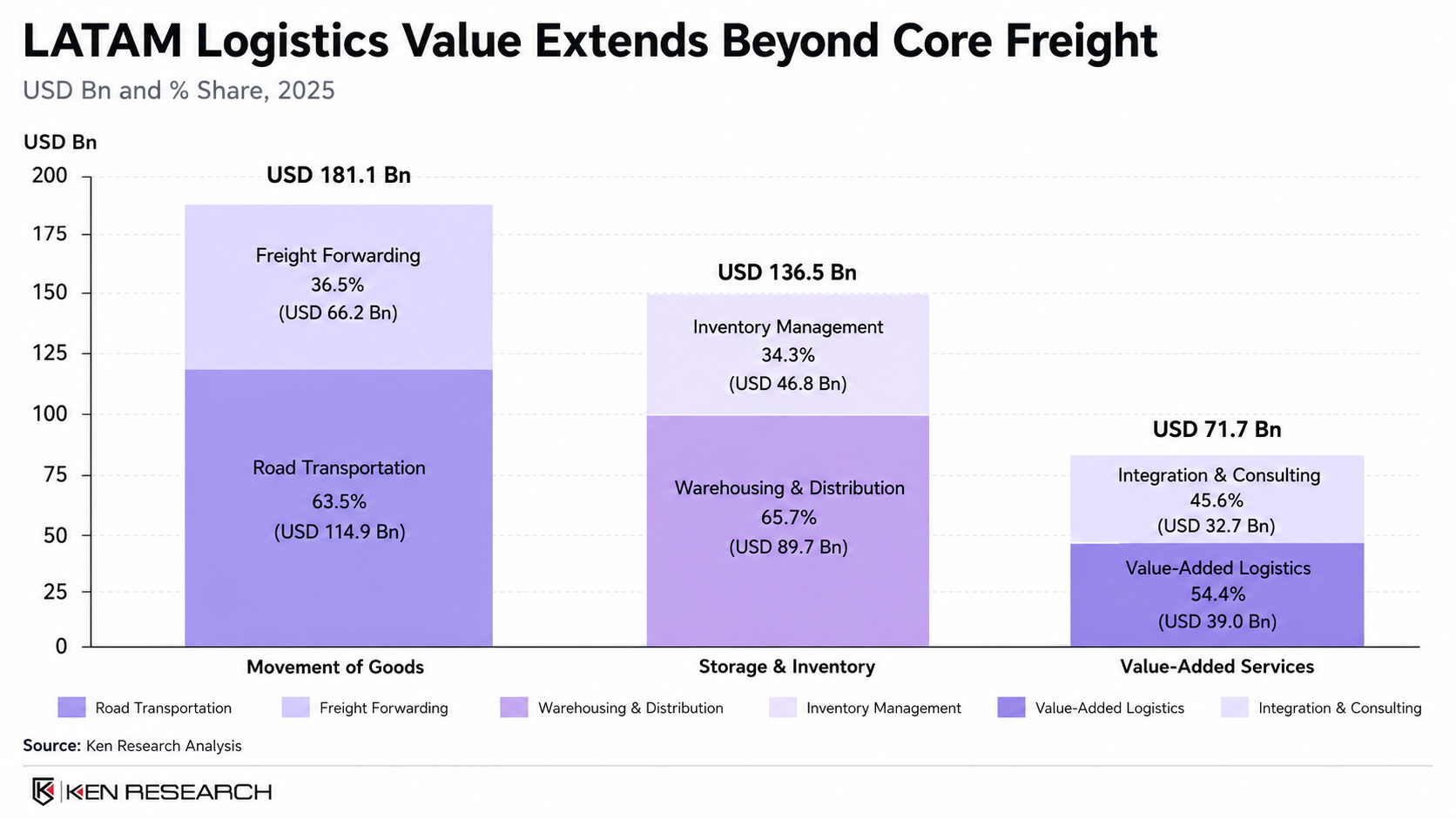
The scale of these service pools is already substantial. Movement of goods represents approximately USD 181.1 billion, storage and inventory another USD 136.5 billion, and value-added services USD 71.7 billion. Nearshoring and supplier diversification are simultaneously creating demand for warehouses, supplier parks, cross-border trucking and regional distribution networks, while companies are moving from lean-only inventory models towards localised buffers, bonded warehouses and regional stock positioning.
That changes the commercial lens for 3PLs, freight forwarders, warehouse operators and integrated logistics providers.
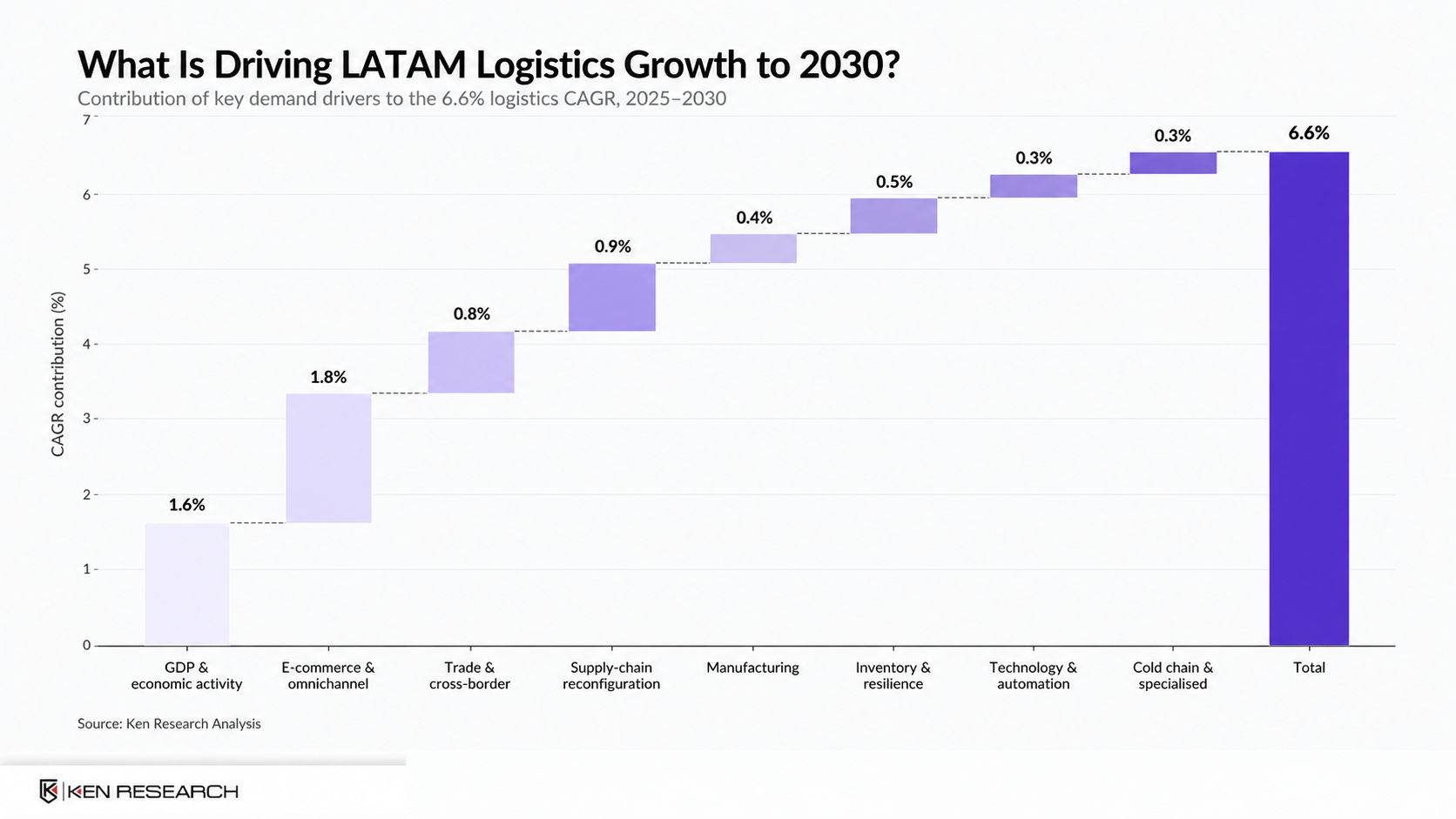
USD 527 billion is the headline. The real question is where the value is moving. Download the full Ken Research LATAM Nearshoring POV to examine the service pools, demand shifts and competitive dynamics shaping the next phase of logistics growth.
Nearshoring Is Expanding the Revenue Attached to Trade Flows
Transport remains the foundation of Latin America’s logistics system. Around 85% of regional freight moves by road, and rising Mexico-US nearshoring volumes are already benefiting major logistics providers. USMCA-linked trade, Pacific trade lanes and regional exports are also increasing demand for freight forwarding, customs brokerage and multimodal transport.
The same manufacturing and trade activity is creating logistics demand beyond transportation.
Nearshoring and supplier diversification are increasing requirements for warehousing, supplier parks, cross-border trucking and regional distribution networks. Growth in automotive, electronics, pharmaceuticals, consumer goods and broader industrial production is supporting plant logistics, inbound freight and B2B distribution.
The resulting service mix now spans road transport, forwarding, warehousing and distribution, inventory management, value-added logistics and integrated supply-chain services.
This is the central shift for logistics operators. Nearshoring is increasing activity across several parts of the service portfolio at the same time. Transport remains critical, but additional demand is appearing around the movement of goods through storage, customs, inventory management and outsourced logistics activities. The growth opportunity therefore needs to be read at the service level, not only at the market level.
Movement of Goods Remains the Largest USD 181.1 Billion Value Pool
At approximately USD 181.1 billion, movement of goods remains the largest of Latin America’s three major logistics value pools. Within this segment, road transportation accounts for 63.5% and freight forwarding 36.5%, reflecting the continued importance of physical freight movement alongside the services required to manage increasingly active trade flows. Around 85% of LATAM freight moves by road, while rising Mexico-US nearshoring volumes are already benefiting major logistics providers.
The composition of this pool is particularly relevant as USMCA-linked trade, Pacific trade lanes and regional export flows increase demand for freight forwarding, customs brokerage and multimodal transport. Nearshoring is therefore adding logistics activity around a transport market that already represents the region’s largest service pool, while simultaneously increasing demand in the adjacent storage, inventory and value-added segments examined next.
USD 136.5 Billion of Storage Is Being Reshaped by Inventory Localisation
Nearshoring is developing alongside a clear change in inventory behaviour.
Ken Research analysis shows companies moving away from lean-only inventory models towards localised buffers, bonded warehouses and regional stock positioning. Logistics providers are also expanding fulfilment centres and distribution hubs to support inventory localisation and faster deliveries.
That puts the USD 136.5 billion storage and inventory segment firmly inside the nearshoring growth story.
Several demand drivers are contributing to this pool. Automotive, electronics, pharmaceuticals, consumer goods and other industrial production are supporting plant logistics and inbound freight. E-commerce and omnichannel retail are expanding fulfilment centres, last-mile networks and marketplace-led logistics.
Taken together, these shifts show why the storage opportunity cannot be understood through warehouse capacity alone. Different sources of demand are expanding the role of warehousing across manufacturing support, inventory localisation, distribution and fulfilment.
Cross-Border Growth Is Raising the Value of Forwarding and Customs
Nearshoring is not only adding freight volume; it is making cross-border execution more important. USMCA-linked trade, Pacific trade lanes and regional export flows are increasing demand for freight forwarding, customs brokerage and multimodal transport, while greater customs complexity is pushing more shippers towards specialist forwarding support.
The opportunity, however, will not be uniform across every corridor. Ken Research assesses origin-destination flows across automotive, electronics, MedTech, perishables, pharmaceuticals and e-commerce to identify where trade growth is translating into demand for forwarding, warehousing, customs, cold chain and last-mile fulfilment.
For freight forwarders, that distinction matters. A high-growth trade lane becomes more commercially valuable when cargo movement is accompanied by greater customs requirements, multimodal coordination and adjacent logistics needs. The strategic priority is therefore to identify which corridors are becoming more service-intensive, and where deeper forwarding and customs capability can capture more value from the same trade flow.
USD 71.7 Billion of Value-Added Services Sits Beyond Core Freight
A further layer of opportunity sits in activities performed around storage and distribution.
Value-added services already represent approximately USD 71.7 billion across Latin America. The category includes packaging, labelling, assembly, repacking and customs documentation.
The shift is visible in operator behaviour. DHL, CEVA and Maersk are expanding packaging, labelling and reverse-logistics capabilities as customers increasingly outsource non-core supply-chain activities. This is an important signal because it demonstrates that logistics revenue is already extending into activities beyond movement and storage.
The USD 71.7 billion market value establishes the scale of that layer. The activity of major providers shows that packaging, labelling, reverse logistics and related services are already becoming part of competitive portfolio expansion.
The investment question is more specific than whether value-added logistics is attractive as a category. Logistics companies need to determine which services are relevant to their target sectors and how those services sit within their broader freight, warehousing and distribution offering.
When Logistics Costs Reach 18-35% of Product Value, Visibility Becomes Harder to Ignore
Latin America’s logistics costs can represent 18-35% of product value. Ken Research links these high costs with increasing adoption of inventory visibility. Warehouse automation, transport-management systems, visibility tools and control towers are also gradually improving service value and pricing.
Supply-chain digitisation and nearshoring are simultaneously accelerating demand for integrated logistics and consulting solutions.
Ken Research defines this integrated layer as logistics solutions combining digital visibility, 4PL coordination, customs support, network design and advisory services to manage and optimise end-to-end supply chains. These developments place digital capability alongside physical services in the regional logistics portfolio.
Visibility tools support inventory management. Transport-management systems sit within freight execution. Control towers and 4PL coordination extend into integrated logistics. The growth of these capabilities is therefore being linked directly to the wider shift in how logistics services are delivered and valued.
For companies considering technology-enabled logistics investments, the evidence is clear on three points: logistics costs remain high, adoption of inventory visibility is increasing, and operators are using technology and integrated solutions to improve service value and pricing.
Different Demand Drivers Are Pulling Different Logistics Services
The change in service mix is being reinforced by several distinct sources of regional demand.
E-commerce and omnichannel retail are expanding fulfilment centres, last-mile networks and marketplace-led logistics. Automotive, electronics, pharmaceuticals, consumer goods and wider industrial production are supporting plant logistics, inbound freight and B2B distribution. Pharma, MedTech, perishables, food exports and other high-value goods are increasing demand for specialised logistics.
These sectors do not pull the same combination of logistics services.
Manufacturing growth supports plant logistics, inbound freight and B2B distribution. E-commerce expands fulfilment and last-mile activity. High-value and regulated goods increase demand for specialised logistics. Sector exposure therefore becomes an important part of any service-portfolio decision.
Ken Research’s competitive benchmarking framework reflects this by assessing providers across sector focus and client base, alongside geographic coverage, service portfolio, pricing model and digital capability.
The relevance for logistics management teams is straightforward. A regional growth forecast may show where the market is expanding, but it does not show which service categories are most closely aligned with the sectors a provider intends to serve. Download the full Ken Research LATAM Nearshoring POV to examine where logistics demand is building across services, sectors and markets, and where the competitive picture becomes materially different.
Growth Does Not Mean the Opportunity Is Open
Nearshoring is expanding demand across warehousing, forwarding, customs, value-added logistics and integrated supply-chain services. But growing demand does not automatically translate into attractive whitespace for every provider.
The more relevant question is how crowded each opportunity already is. A provider may see rising demand for bonded warehousing, control towers or cross-border logistics, yet still face a market where competing 3PLs, freight forwarders and warehouse operators have already built strong sector relationships, geographic coverage or digital capability.
That makes competitive positioning as important as market growth. Service portfolio, sector focus, client base, pricing model, geographic presence and digital capability will collectively determine whether an expanding logistics pool represents genuine whitespace or simply a larger but more contested market.
The Next Move Is a Portfolio Choice
Freight continues to remain fundamental, while warehousing, forwarding, inventory visibility and value-added services are taking a larger role in how customers manage regional supply chains.
What the market data cannot decide is which capability an individual operator should strengthen next.
That choice depends on where the provider already competes, which sectors it serves, how rival operators are positioned and whether the next opportunity sits in extending an existing strength or filling a service gap.
For some operators, the answer may sit closer to customs and cross-border execution. For others, it may lie in bonded warehousing, value-added logistics or technology-enabled coordination. The market direction is increasingly visible; the company-specific whitespace is not. Connect with our LATAM logistics experts to assess where your current portfolio is best positioned to capture the next wave of nearshoring-led demand.
Related tags
Logistics
Logistics and Shipping
Automotive, Transportation and Warehousing
Get started
We've helped companies around the world future-proof
their businesses - and we can do the same for you.