Global Online Travel Market: 1.4 billion Trips, USD 10.9T Tourism - Yet Digital Demand Is Now Region-Ruled
Ken Research
November 25, 2025 - 6 min read

November 25, 2025
by Khushi RastogiThe global online travel market is growing rapidly, but the mechanisms that convert travel demand into digital bookings are no longer global in nature. In 2024, travel & tourism contributed USD 10.9 trillion to global GDP, accounting for 10% of the world economy, and supported 357 million jobs, or about one in ten jobs worldwide.
International tourist arrivals reached an estimated 1.4 billion in 2024, an 11% increase over 2023 and roughly 99% of 2019 levels, marking the near-full recovery of global tourism from the pandemic shock.
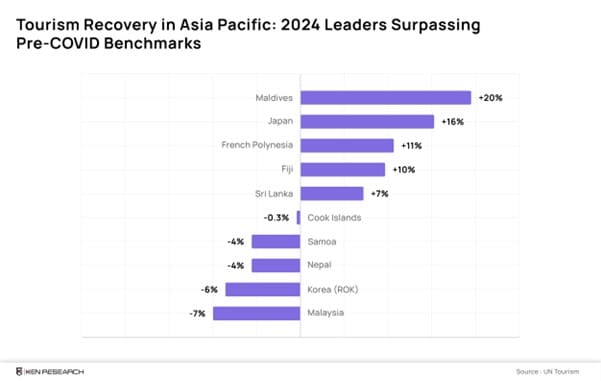
Regional performance diverged: Europe, the Middle East and Africa all surpassed pre-pandemic arrival volumes in 2024, while the Americas recovered to around 97% of 2019 and Asia & the Pacific remained about 13% below 2019 levels.
Within this macro rebound, digital travel is being reshaped by region-specific combinations of regulation, payment infrastructure, and domestic platforms. Rather than a single global online marketplace, executives now face a landscape of distinct digital economies, each governed by its own structural rules.
1. Regional Demand Patterns Are Redrawing Digital Travel Behaviour
Europe illustrates what a mature, high-penetration digital travel market looks like. In 2024, guests spent 854.1 million nights in short-term rental accommodation in the EU booked via Airbnb, Booking, Expedia Group or TripAdvisor, an 18.8% increase over 2023, when such platforms accounted for 719.0 million nights. This concentration of demand on a few intermediaries is now structurally embedded.
The region’s digital readiness underpins this behavior. By 2024, 94% of EU households had internet access at home, and 94% of individuals aged 16–74 had used the internet in the previous 12 months, with a steadily rising share engaging in e-commerce. This creates fertile ground for online travel platforms to capture both search and transaction behaviour.
At the city level, major destinations have become deeply reliant on platforms for visibility and bookings. Eurostat data highlight how platform nights are heavily concentrated in leading urban hubs; cities such as Paris account for a disproportionate share of the 854 million nights booked via the four large platforms, illustrating how digital channels now shape occupancy and rate dynamics at a granular level.
Asia follows a different pattern, where demand growth and digital adoption are channelled through domestic ecosystems. In 2024, Trip.com Group reported net revenue of RMB 53.3 billion (USD 7.3 billion), up 20% year-on-year, with packaged-tour revenue rising 38% and corporate travel revenue up 11% versus 2023. This mix of strong leisure and corporate demand, anchored in a Chinese-headquartered platform, shows how regional markets are scaling digital travel on local, not global, rails.
2. Platform Power Is Now the Core Engine of Market Outcomes
As regional demand recovers, digital intermediaries increasingly function as infrastructure rather than optional channels. In the EU, the 854.1 million platform-booked nights in 2024 represent not just volume, but a structural dependence on four global platforms for accommodation discovery and transaction.
Additionally, this 2024 level is 18.8% higher than the 719.0 million nights in 2023, underscoring how platform intermediation is growing faster than underlying tourism volumes. For hoteliers and hosts, visibility, pricing and occupancy are increasingly mediated by platform ranking algorithms, not just location or brand.
In China, platform power is expressed through domestic rather than foreign brands. Trip.com Group’s RMB 53.3 billion in 2024 net revenue, split across accommodation (RMB 21.6 billion, +25%), transportation ticketing (RMB 20.3 billion, +10%) and packaged tours and corporate travel, reflects the depth of local integration. Here, the “infrastructure layer” of travel is effectively nationalised through a domestic champion.
The implication is clear: in many markets, the online travel sector no longer behaves as a fragmented space of many small actors, but as a set of platform-centric micro-economies where a handful of intermediaries define access to demand.
3. Regulation Has Become the Industry’s Operating System
As platforms centralise power, regulators have moved decisively to rebalance the system. On 13 May 2024, the European Commission designated Booking as a “gatekeeper” for its Booking.com intermediation service under the Digital Markets Act (DMA). Gatekeepers face stringent obligations on ranking transparency, self-preferencing and data access, and can be fined up to 10% of global turnover, or 20% for repeated infringements.
Data protection enforcement has become equally material. In May 2023, Meta was fined €1.2 billion by Ireland’s Data Protection Commission for unlawful transfers of Facebook user data to the United States, the largest GDPR penalty to date.
Competition authorities are now focusing directly on OTA conduct. In July 2024, Spain’s CNMC fined Booking.com USD 413.24 million for abusing its dominant position in the Spanish market over a five-year period, a decision widely reported by EU institutions and international media.
The case centres on unfair trading conditions and parity-type clauses restricting hotels’ freedom to price and distribute across channels.Taken together, DMA obligations, GDPR enforcement and national antitrust actions mean that regulatory fluency now directly shapes permissible business models, risk to EBITDA, and long-term market access.
4. Payments Are Quietly Redefining Where Profits Accrue
While regulation governs behaviour, payment systems increasingly determine where and how profit pools form. According to Worldpay’s 2023 Global Payments Report, digital wallets accounted for 49% of global e-commerce transaction value and 32% of point-of-sale (POS) spending in 2022, and are projected to reach 54% of e-commerce and 43% of POS transactions by 2026. Worldpay’s 2024 update further projects that wallets will exceed USD 25 trillion in combined online and POS transaction value by 2027, representing about 49% of all sales.
India exemplifies how domestic payment rails can structurally rewrite digital economics. RBI-based data reported in Indian media show that in H1 2025, digital payments accounted for 99.8% of all payment transactions by volume and 97.7% by value, totalling ₹1,572 trillion in value.
Within this, the Unified Payments Interface (UPI) captured about 85% of digital transactions by volume, cementing its position as the dominant retail payment rail.
Market share is highly concentrated as NPCI data summarised by Indian business media indicate that PhonePe and Google Pay together handle more than 80% of UPI transaction volume, with one recent month showing them jointly processing over 82% of all UPI payments. The National Payments Corporation of India has therefore postponed enforcement of a 30% market-share cap on third-party UPI apps until December 2026, signalling both concern about concentration and recognition of current dependence.
For online travel players, this means that checkout economics—payment method mix, chargeback risk, refund friction, FX cost—are now region-specific strategic levers, not generic operational details.
5. Domestic Champions Have Become the Gatekeepers of Growth
Domestic platforms are increasingly functioning as strategic infrastructure in their home markets. In China, Trip.com Group’s RMB 53.3 billion (USD 7.3 billion) net revenue in 2024, up 20% year-on-year, alongside strong growth in accommodation, ticketing, packaged tours and corporate travel, highlights the extent to which a single domestic player intermediates demand.
In Europe, the infrastructure role is performed by a handful of global platforms. The 854.1 million platform-booked nights in 2024 underscore how Airbnb, Booking, Expedia Group and TripAdvisor have become the default access points for a vast share of lodging demand in the EU. This dependence explains why European regulators have targeted these platforms under both competition law and the DMA.
UN Tourism’s 2025 Barometer shows that Europe, the Middle East and Africa all exceeded pre-pandemic arrival levels in 2024, while Asia & the Pacific remained 13% below 2019 and the Americas about 3% below. Within these aggregates, subregions in the Middle East and parts of North Africa have posted some of the strongest relative gains globally, creating fertile ground for new or expanding regional champions.
The message is that access to customers, inventory and data is increasingly mediated by local ecosystems global reach alone is no longer sufficient to secure growth.
6. Leaders Must Adopt Region-Native Strategies, Not Global Templates
Taken together, the data point to a structurally fragmented landscape. Global tourism volumes have effectively recovered, but regional digital behaviour, regulation, payments and platform structures differ sharply. Europe rewards firms built around DMA/GDPR-compatible models and constructive relationships with powerful intermediaries.
India and other UPI-led markets reward payment-native platforms that can embed themselves within domestic real-time rails at low marginal cost.
China rewards data-sovereign ecosystems aligned with national rules on personal information and cross-border transfer.
The strategic reality is that “global online travel” now behaves as a portfolio of region-native digital economies. Competitive advantage lies not in uniformity, but in the precision with which firms can vary their model by region while maintaining global scale where it still matters - technology, brand, and data capabilities.
Conclusion
Global tourism is expanding steadily, with 1.4 billion international arrivals in 2024 (UN Tourism), marking a near-complete recovery in global travel flows. Travel & tourism contributed USD 10.9 trillion to world GDP in 2024 (WTTC), reflecting strong leisure and business demand.
UN Tourism expects global arrivals to rise by 5% in 2025, supported by improving aviation capacity and Asia-Pacific’s ongoing reopening. By 2030, international arrivals are projected to reach around 1.8 billion, driven by rising incomes and greater regional connectivity.
Digital travel dynamics are diverging across markets, shaped by local regulations, payment systems, and domestic platform ecosystems. The implication is straightforward: value creation in online travel over the next decade will depend less on generic global expansion and more on region-native strategy design.
That requires compliance depth in Europe, payment integration in India, and ecosystem partnerships in China, the Middle East, and Africa. Ken Research analysis shows that firms adapting early to these structural differences will be better positioned to capture growth, protect margins, and navigate rising policy risks.
Related tags
Tourism
Media and Entertainment
Get started
We've helped companies around the world future-proof
their businesses - and we can do the same for you.