Saudi Telecom Market Set to Reach USD 22 Billion by 2033 – Can STC and Mobily Sustain Their Profit Momentum?
Ken Research
October 24, 2025 - 4 min read
October 24, 2025
by Khushi RastogiSaudi Arabia’s telecom sector, valued at nearly USD 18 billion in 2024 and projected to reach USD 22 billion by 2033, is transitioning from traditional connectivity to a digital-infrastructure-driven economy. The first half of 2025 has underscored that evolution.
Both STC Group and Etihad Etisalat (Mobily) reported steady revenue growth and expanding profitability, reflecting how strategic diversification and disciplined capital management are shaping Saudi Arabia’s USD 22 billion data economy.
A USD 22 Billion Data Economy — The Stage for STC and Mobily’s Next Act
With internet penetration at 99% with 33.9 million users as of early 2025, reflecting near-saturation of internet access across the population., Saudi telecoms can no longer rely on new users. Data monetization, enterprise services, and digital ecosystems under Vision 2030 power the next wave of growth. The government’s national digitisation program is catalysing investments in 5G, fibre, cloud infrastructure, and smart-city connectivity, redefining what a telecom company is.
For STC, this means scaling beyond connectivity toward cloud, fintech, and infrastructure ownership. For Mobily, it means tightening operational efficiency while growing enterprise revenue. Both operators now compete less for subscribers and more for a share of Saudi Arabia’s rapidly expanding digital value chain.
STC Q1 2025 — Profit Growth Outpaces Revenue, but Quality Matters
In Q1 2025, STC reported SAR 19.21 billion in revenue, up 1.6 % YoY, while net profit surged 11 % to SAR 3.65 billion. EBITDA rose 5 % to SAR 6.12 billion, with margins steady above 31%. This performance highlights STC’s resilience at scale, stable top-line expansion, supported by growth in business and wholesale segments, even as consumer markets plateau.
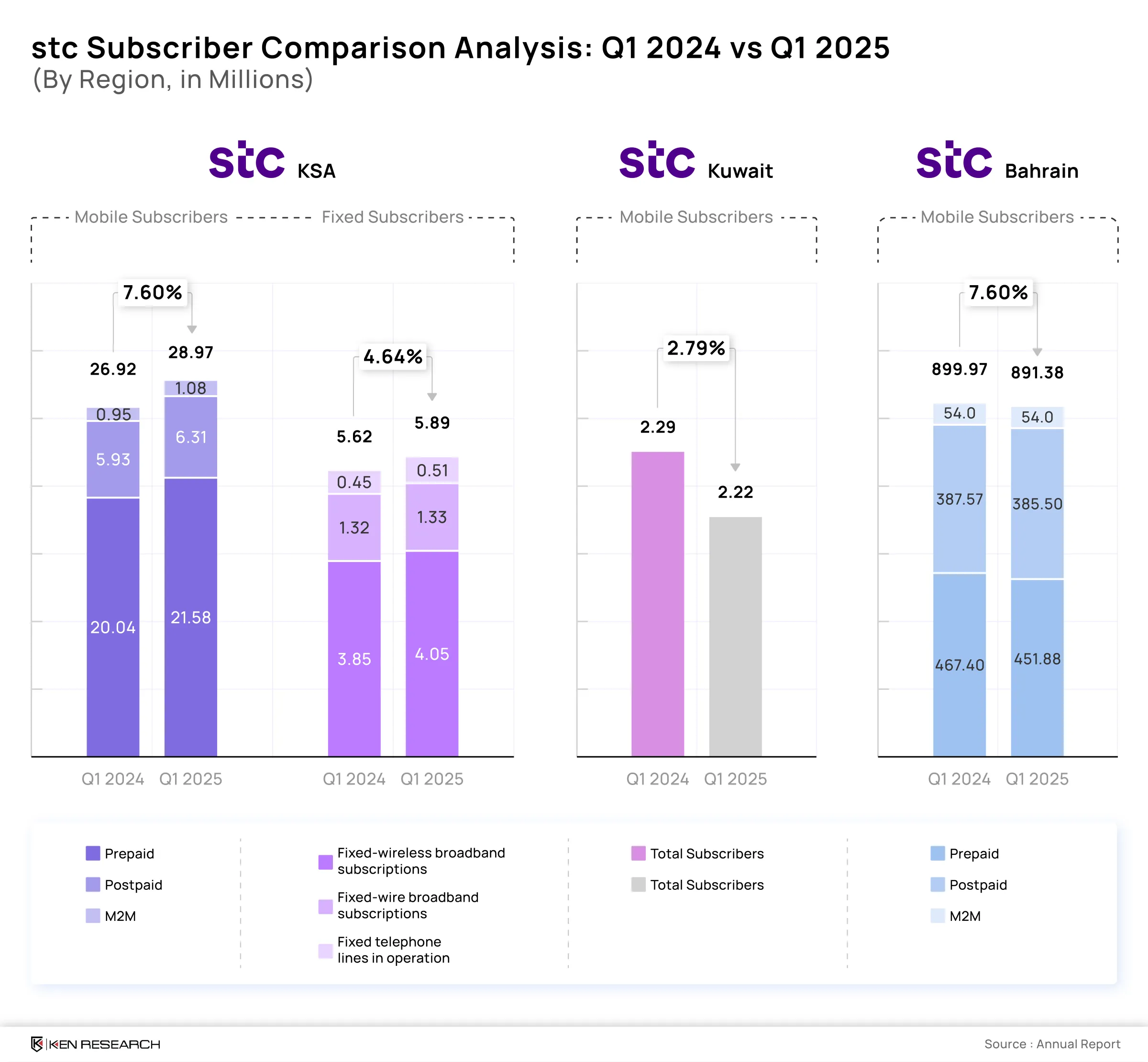
However, some of the profit uplift came from non-recurring zakat reversals and gains tied to its increased stake in Telefonica. While this boosted net income, it doesn’t reflect organic operating performance. STC’s true strength lies in its ability to maintain margin consistency amid rising depreciation from 5G and data-centre investments, a sign of sound cost control even during heavy capital cycles.
Mobily Q1 & Q2 2025 — Core Growth, Cleaner Margins
Mobily’s performance through mid-2025 demonstrates steady operational progress and margin discipline. In Q1 2025, revenue grew 5.1 % YoY to SAR 4.78 billion, while net profit climbed 20 % to SAR 767 million. EBITDA rose 7.5 % to SAR 1.78 billion, sustaining margins around 37 %.
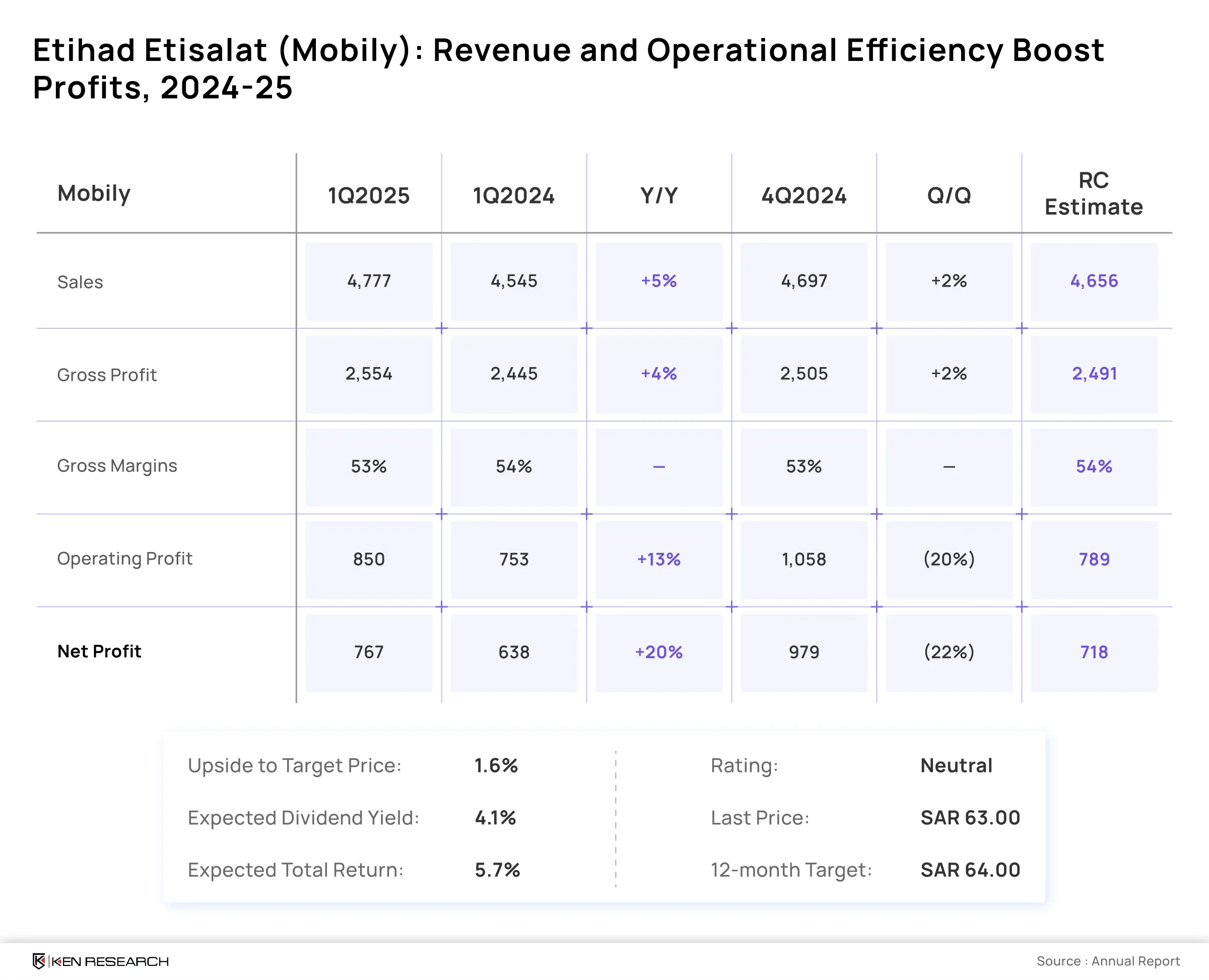
Momentum accelerated in Q2 2025, when Mobily achieved SAR 4.83 billion in revenue (+8.1 %) and SAR 830 million in net profit +25.6 %. EBITDA increased to SAR 1.82 billion, lifting the half-year total to SAR 9.6 billion in revenue, up 6.6 % year-on-year.
These gains came without one-off items — a key indicator that Mobily’s profit growth is operationally driven. Lower finance costs, improved working-capital efficiency, and enterprise contract expansion supported consistent margin delivery.
Segment Strategy — Two Routes to Sustainable Profit
STC: Diversifying for Scale
stc is leveraging its size to expand into adjacencies that blend infrastructure, finance, and technology.
Its Center3 subsidiary is building regional datacentre and submarine-cable capacity, positioning Saudi Arabia as a digital hub for the Middle East. STC Bank (formerly stc Pay) anchors the group’s fintech play, targeting financial inclusion and transaction revenue.
Meanwhile, the PIF–STC tower merger, uniting TAWAL and Golden Lattice into a 30,000-site infrastructure giant, is designed to unlock asset-light growth and improve return on invested capital. This new company is majority owned by the Public Investment Fund (PIF) with a 54% stake, while STC retains 43.1% ownership.
The merged entity is projected to generate annual revenues exceeding 1.3 billion and has an enterprise value close to USD 6 billion. These moves extend STC’s reach from telecom into fully digital-infrastructure ownership.
Mobily: Discipline and Enterprise Focus
Mobily’s approach is more focused but equally strategic. Its B2B and wholesale segments are driving top-line growth through managed connectivity, IoT, and cybersecurity offerings. The sharp rise in Q1 CAPEX SAR 2.13 billion vs 223 million YoY signals front-loaded spectrum and network upgrades to support 5G demand. By optimising spending and targeting high-margin enterprise clients, Mobily is reinforcing its position as a lean, profit-focused challenger rather than a volume chaser.
Barriers to Sustained Market Development
The biggest challenge for both operators is balancing capex with profitability. STC’s earnings benefited from accounting reversals that may not recur, while Mobily’s aggressive Q1 spending could compress near-term cash flows.
Competitive pricing remains a structural risk: as data becomes commoditized, maintaining ARPU without resorting to discounts will determine long-term margin stability.
Regulatory obligations, spectrum fees, data-localization rules, and compliance costs also continue to weigh on sector profitability, though they strengthen the overall ecosystem.
Ken Research Insight
Saudi Arabia telecom market is entering a phase of measured, quality-driven growth, where profitability hinges on digital diversification and capital efficiency. stc exemplifies scale leadership, leveraging its infrastructure and verticals, Center3 (data centres), stc Bank (fintech), and the PIF tower merger to become a regional digital powerhouse. Its Q1 2025 results highlight strong leverage, though reliance on one-off gains underscores the need for sustained core margin expansion.
Mobily, by contrast, is executing a lean, enterprise-focused model, delivering double-digit profit growth in Q2 2025 through cost discipline and strategic reinvestment. Together, both operators reflect a sector shifting from volume to value creation.
Ken Research expects 3–4 % annual market growth through 2033, with rising contributions from enterprise ICT, 5G-enabled services, and cloud infrastructure. Saudi telecoms are no longer competing for connections, they’re competing for the digital backbone of Vision 2030.
Related tags
Telecommunications and Networking
Technology and Telecom
Get started
We've helped companies around the world future-proof
their businesses - and we can do the same for you.