65% of India’s Curtain Market Is Still Unorganised, But a ₹7,600 Crore Industry Is Quietly Setting Up Its Next Winners
Ken Research
February 2, 2026 - 14 min read
February 2, 2026
by Khushi RastogiIndia’s curtain manufacturing market is entering a decisive phase of transition, shaped by steady demand growth and gradual industry formalisation. Valued at INR 7,600 crore (USD 735–760 million) in 2024, the market is projected to expand at a 5.90–7.38% CAGR through 2033, offering manufacturers a sustained growth runway rather than a short-term cycle.
The more significant opportunity, however, lies in market structure: nearly 65% of the sector remains unorganised, creating substantial headroom for organised players to scale through standardised quality, operational efficiency, and brand development.
These structural opportunities are reinforced by strong demographic and economic tailwinds. India’s middle-class population is expected to reach approximately 447 million consumers by 2025, driving higher discretionary spending on home furnishings across Tier-1 and Tier-2 cities. At the same time, the hospitality and real estate pipeline includes over 2,000 hotel projects adding around 300,000 rooms between 2023 and 2025, each requiring comprehensive window treatment solutions. Rising energy costs further support demand, as blackout curtains can reduce residential cooling expenses by up to 25%, positioning them as both functional and cost-efficient products in an increasingly energy-conscious market.
Structural Demand Drivers Accelerating India’s Curtain Market Expansion
Home Textiles Growth and Rising Urban Incomes Anchoring Residential Demand
The Indian curtain market operates within the broader context of a home textiles sector experiencing exceptional growth momentum. The home textiles industry, valued at USD 10.78 billion in 2023 according to Facts & Factors research, is expanding at 8.9% CAGR toward USD 23.32 billion by 2032, with curtains representing a significant product category alongside bed linens, towels, and upholstery fabrics.
This sectoral growth reflects fundamental shifts in Indian consumer priorities as urbanisation accelerates and per capita income rises. The residential segment dominates demand, accounting for 73.9% of market value in 2024, while commercial applications, particularly in hospitality, healthcare, and corporate real estate, drive the remaining 26.1% with notably higher average order values and longer product lifecycles.
Product Segmentation Reflecting Clear Price–Performance Trade-offs
Product segmentation within the curtain market reveals distinct consumer preference patterns across price points and fabric technologies. Woven Jacquard curtains command the largest market share, valued for their intricate patterns and perceived premium positioning. Printed finished curtains follow, appealing to cost-conscious consumers seeking aesthetic variety without significant investment. The market also encompasses plain and Jacquard variants, sheer curtains for light diffusion applications, and increasingly popular blackout curtains serving both energy efficiency and privacy requirements. Geographic demand concentrates heavily in metropolitan areas, with Mumbai, Delhi, and Bengaluru collectively representing over 40% of organised retail sales, though secondary cities are exhibiting faster growth rates as prosperity diffuses beyond primary urban centres.
Fragmented Competition, Import Pressure, and Consolidation Opportunity
The competitive landscape presents both challenge and opportunity, while 65% market share resides with unorganised players operating at local scales with minimal brand investment, this fragmentation creates pricing pressure through lower overhead structures but simultaneously opens consolidation pathways for organised manufacturers who can leverage quality consistency, supply chain efficiency, and brand recognition to capture premium market positions. Import competition adds another dimension to competitive dynamics: India imported USD 30 million worth of curtains in 2023, representing 44% year-on-year growth, with 61% of these imports originating from China.
This import penetration signals both price competition intensity and consumer willingness to purchase from international sources, underscoring the imperative for Indian manufacturers to match or exceed import quality standards while leveraging domestic cost advantages.
Manufacturing Hub Selection as a Strategic Advantage
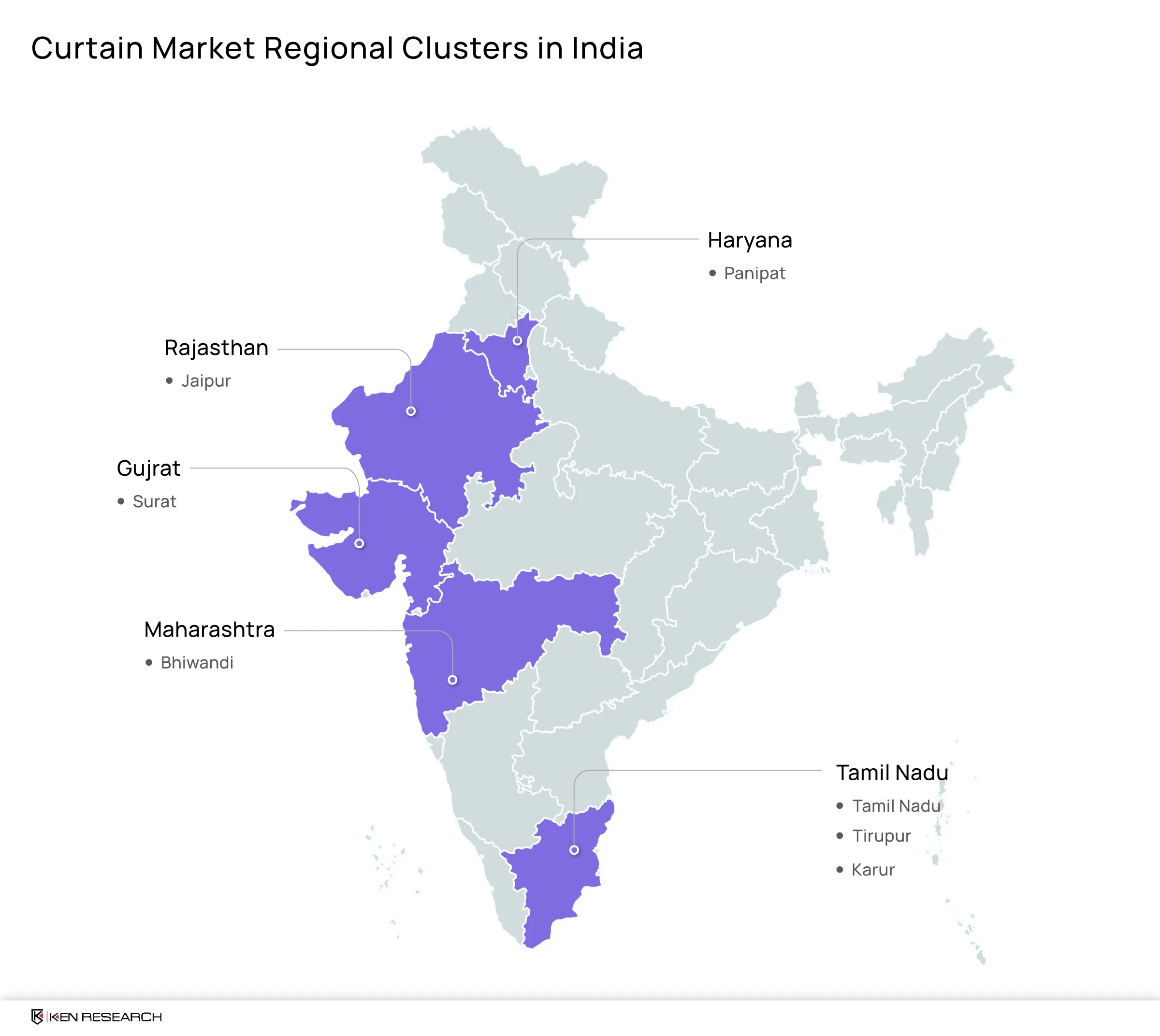
Manufacturing location is the single most important strategic choice for curtain manufacturers, fundamentally determining material sourcing costs, labour quality and expense, export logistics efficiency, and ultimately competitive positioning. Three primary manufacturing corridors have emerged across India, each offering distinct advantages aligned with specific business models and market strategies.
Tamil Nadu’s Export-Ready Home Textiles Ecosystem
Tamil Nadu, particularly the Karur district, has established itself as India's preeminent home textiles manufacturing hub with infrastructure, workforce capabilities, and international buyer relationships that position it as the optimal choice for export-oriented strategies. Karur, aptly termed the "Textile Capital of Tamil Nadu", generates Rs. 6,000 crores annually in foreign exchange through direct and indirect textile exports, employing approximately 300,000 people across allied industries, including ginning, spinning, dyeing, and weaving. The district's export credentials are validated through established supply relationships with global retail giants, including IKEA, Target, Walmart, and Carrefour, demonstrating a consistent ability to meet international quality standards, compliance requirements, and delivery schedules.
Tamil Nadu's advantages extend beyond Karur's established reputation. The state hosts over one-third of India's apparel factory workers, creating a deep labour pool with technical textile manufacturing skills uncommon in other regions. This workforce quality combines with competitive wage rates, delivering the rare combination of excellence and affordability that underpins export competitiveness. Infrastructure investments further enhance the region's appeal: the Karur Textile Park, developed under the Scheme for Integrated Textiles Parks with Rs. 235 crore total investment, provides manufacturers with ready-built factory spaces, shared utilities, effluent treatment facilities, and testing laboratories that dramatically reduce capital requirements and time-to-market for new manufacturing ventures.
For manufacturers targeting export markets, particularly in Europe, North America, and the Middle East, where quality certifications and compliance documentation represent entry barriers, Tamil Nadu's established ecosystem provides invaluable advantages. Certification bodies, compliance consultants, and quality testing laboratories are readily accessible. Shipping logistics through Chennai and Tuticorin ports are well-established, with freight forwarders experienced in textile export documentation and container optimisation. Perhaps most critically, the region's reputation for quality acts as a trust signal with international buyers, reducing customer acquisition costs and accelerating deal cycles compared to emerging manufacturing clusters without proven track records.
Gujarat’s Synthetic-Led Cost Leadership Model
Gujarat, anchored by Surat's polyester manufacturing dominance, represents the optimal hub selection for manufacturers pursuing volume-oriented strategies built on synthetic fabrics. Surat produces 90% of India's polyester, with a daily processing capacity exceeding 25 million metres of finished fabric plus 30 million metres of raw material. This concentration creates unmatched material with sourcing advantages: proximity reduces transportation costs, shortens supply chain response times, and enables more effective supplier relationship management. Gujarat's cotton production adds further strategic value, with the state contributing approximately 28% of India's cotton output at 90.60 lakh bales (170 kg each) in 2023-24, making it the nation's largest cotton producer.
The region's advantages extend to infrastructure and logistics. Port access through Kandla and proximity to Mumbai's port infrastructure facilitate both raw material imports and finished goods exports. Maharashtra's 11 exclusive textile parks provide additional ecosystem support with research and development facilities, technical training centres, and trade promotion services. The integrated supply chain from fibre production through weaving, dyeing, printing, and finishing enables manufacturers to source complete requirements within relatively compact geographic areas, reducing working capital tied up in transit inventory and enabling faster response to demand fluctuations.
Manufacturers should select Gujarat when business models prioritise polyester or synthetic fabric curtains targeting mass-market price points where material cost optimisation drives competitive advantage. The region also suits manufacturers requiring rapid scale-up capabilities, as the supplier ecosystem can accommodate significant volume increases without the supply constraints that might emerge in less developed textile regions. However, labour costs run approximately 5-10% higher than in Tamil Nadu, and export logistics, while serviceable, lack the specialised home textiles expertise concentrated in Southern India.
Northern India’s Premium and Customisation-Driven Advantage
Northern India, encompassing Delhi-NCR, Panipat, and Jaipur, offers distinct advantages for manufacturers targeting domestic premium segments and customisation-driven business models. Proximity to major consumption centres in Delhi, Chandigarh, Lucknow, and surrounding regions reduces distribution costs for finished goods by 15-25% compared to Southern manufacturing, a material advantage when serving price-sensitive mass-market segments. Quick turnaround capabilities enable made-to-order business models with 3-5 day delivery windows, impossible to achieve from Tamil Nadu or Gujarat when serving Northern consumers.
The region's traditional strength in handcrafted textile work, particularly embroidery and artisanal techniques, creates unique product differentiation opportunities for premium positioning. Delhi-NCR's design ecosystem, including interior designers, architects, and affluent consumer segments, provides immediate market feedback and trend insight unavailable in manufacturing-centric regions. For manufacturers pursuing project-based commercial business (hotels, corporate offices, residential high-rises), physical proximity to decision-makers and installation sites reduces sales cycle friction and project management complexity.
These advantages come with tradeoffs. Land and labour costs run 15-30% above Southern India significantly impacts manufacturing economics for volume-orientated strategies. The region lacks Tamil Nadu's export infrastructure depth and Gujarat's raw material ecosystem proximity, making it suboptimal for strategies dependent on either dimension. Northern India makes strategic sense for manufacturers prioritising rapid domestic market penetration in premium segments, particularly when combining manufacturing with showroom retail, which represents a weaker choice for export-first or volume-cost-leadership strategies.
Raw Material Strategy as the Primary Profitability Lever
Raw material costs typically represent 40-50% of total curtain manufacturing expenses, making material sourcing decisions primary determinants of gross margin achievement and competitive positioning. Three material categories dominate the market, each presenting distinct economic characteristics, sourcing requirements, and strategic implications.
Cotton Sourcing Economics and Upcoming Compliance Pressures
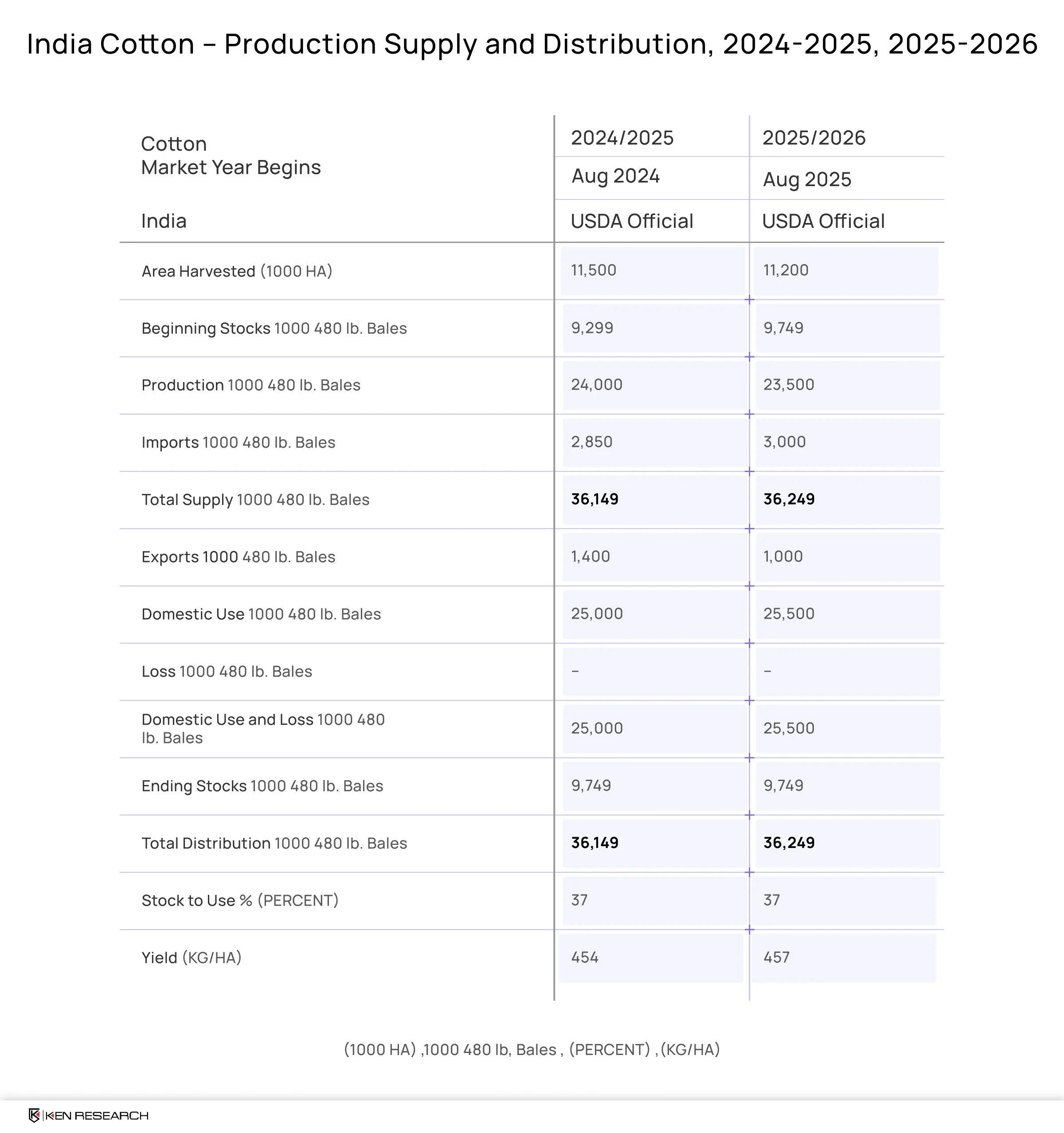
India ranks as the world's largest cotton producer by volume, generating 29.4 million bales (170 kg each) provisionally in 2024-25, according to IBEF data, representing approximately 23% of global production. This domestic production concentrates in Gujarat (27.85% of national output), Maharashtra (24.73%), Telangana (15.62%), Rajasthan (8%), and Madhya Pradesh, creating clear sourcing geographies for cotton-focused manufacturers. The Cotton Bales Quality Control Order, scheduled for full implementation in August 2026, will mandate BIS compliance for all cotton bales, standardising quality metrics but potentially increasing sourcing costs for manufacturers accustomed to unregulated markets.
Despite production strength, Indian cotton pricing presents strategic complexity. As of July 2024, Indian cotton spot prices averaged 5-7% above international benchmarks, according to USDA Foreign Agricultural Service data, creating margin pressure for export-oriented manufacturers competing against imports manufactured with cheaper international cotton.
For curtain manufacturers, this pricing differential can materially impact competitiveness: with cotton representing 45-50% of production costs for cotton curtains, a 5-7% cotton price premium translates to approximately a 2.25-3.5% total product cost disadvantage. Manufacturers pursuing export strategies or competing against Chinese imports must either absorb this margin erosion or consider selective cotton imports for price-sensitive product lines.
Strategic sourcing approaches vary by business model. Manufacturers focused on domestic premium segments benefit from local cotton's shorter supply chains and ability to verify sustainability credentials increasingly important to affluent consumers. Volume manufacturers targeting export markets should conduct rigorous total landed cost analyses comparing domestic Gujarat/Maharashtra sourcing against international cotton imports, factoring in quality consistency, payment terms, and inventory carrying costs. Direct relationships with ginning mills in primary cotton-producing states enable 15-20% cost reductions through volume commitments and disintermediation of trading margins.
Polyester and Recycled Polyester as Scale and Export Enablers
Polyester offers cost leadership for volume-driven strategies in India's synthetic textile market. The sector is valued at USD 3.24-6.5 billion in 2024 with 3-9.6% CAGR growth, propelled by polyester's 30-35% cost edge over cotton at equivalent weights (USD 2.04/kg vs. USD 3.12/kg) alongside superior dimensional stability and low-maintenance appeal for commercial use. Surat in Gujarat accounts for over 60% of filament yarn capacity (2.53 million tonnes in 2024), streamlining sourcing with daily deliveries, lower working capital, and agile adjustments to proximity. colours or specs via Mundra port proximity.
Export markets drive recycled polyester adoption, mirroring Europe's 12% recycling rise in 2023 and mandates from H&M and IKEA for rPET content. In India, early movers like Filatex and Badri Group build rPET (Recycled Polyethene Terephthalate) chains in Madhya Pradesh, targeting 1.6 million tonnes of recycled capacity by 2030, with Organic Textile Standard) 3-5% to OEKO-TEX/GOTS (Global Organic Textile Standard) certifications, adding pprox. 3-5% costs but becoming essential for 40-50% of EU/NA buyers.
Polyester yarn makers should secure primary ties in Surat with Reliance (2.5-3 MTPA), Indorama, and Sanathan, backed by secondary rPET suppliers in Maharashtra and Madhya Pradesh to counter disruptions from petrochemical volatility or port issues. Long-term pacts with testing protocols ensure quality over spot buys, while volume/colour forecasts yield 15-20% savings desp downturns. ite inventory risks in downturns.
Silk: High Unit Value, Export-Led Premium Positioning
According to World Bank WITS, India exported approximately 376,258 kilograms of woven silk fabrics (HS 500720) in 2024, with a total export value of USD 104.4 million, implying an average export unit value of approximatel kilogram. y USD 277 per kilogram.This unit value places silk fabrics among the highest-value textile export categories from India on a per-kilogram basis, underscoring silk’s role as a premium material rather than a volume-driven product line.
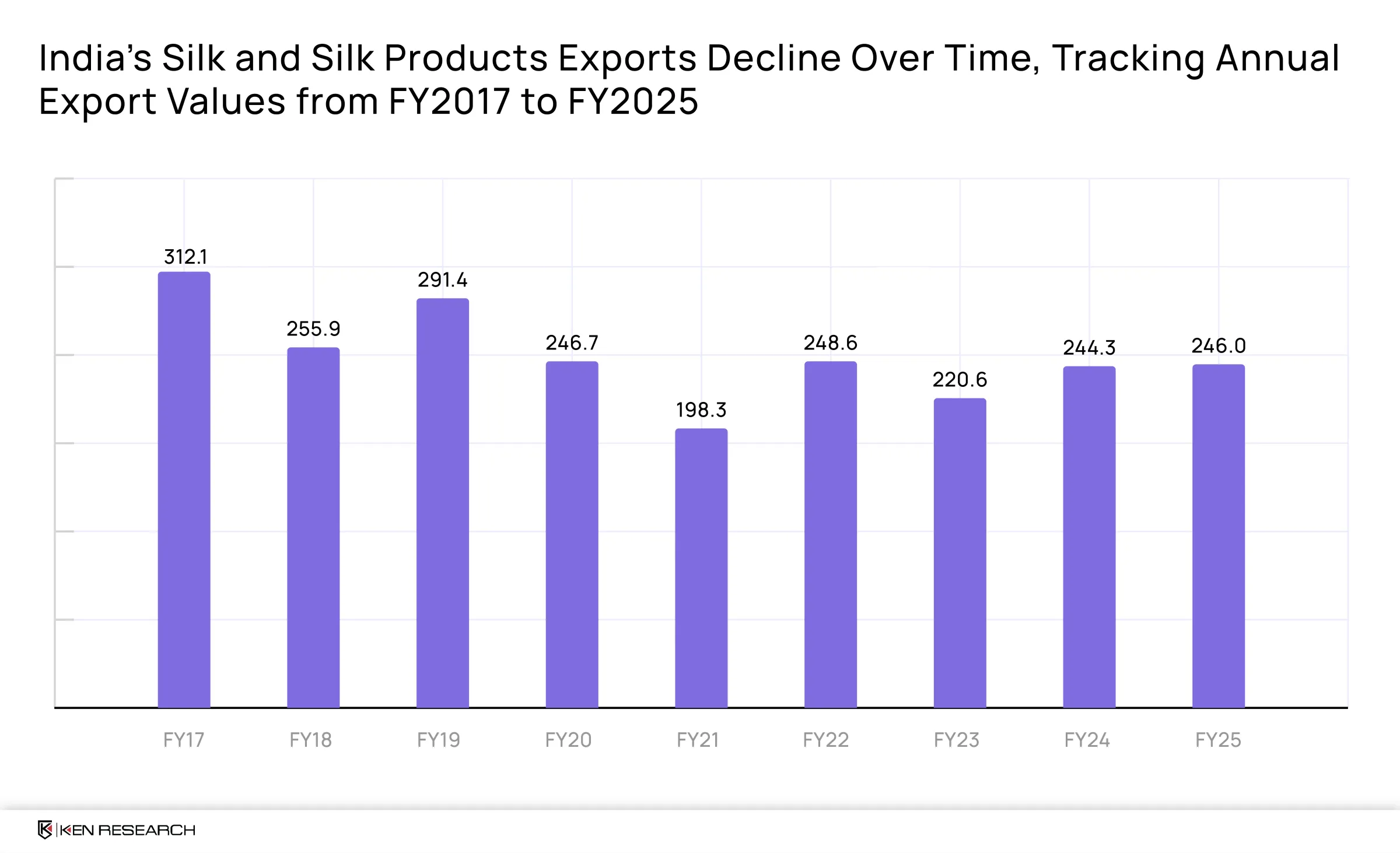
At an aggregate level, the Indian silk and silk products sector generated approximately USD 246 million in exports in FY2024-25. The UAE was the top importer of silk products from India with a share of 49.07% as of FY26 (April-July). China was the second largest importer of Indian silk after the UAE, with a share of 11.11%. These countries were followed by the USA, imported woven Trade Data, ts share, respectively, encompassing silk yarns, fabrics, garments, and made-ups.
While silk products account for a relatively small share of India’s overall textile export volumes, their export realisation per unit remains substantially above sector averages, reinforcing their importance for value capture and brand positioning rather than scale economics.
Linen: Import-Dependent Supply Chain with Verifiable Cost Premiums
Linen’s premium economics are most clearly observable through import unit value data. As per World Bank WITS (UN Comtrade), India imported approximately 614,491 kilograms of woven flax/linen fabrics (HS 530919) in 2023, with a total import value of USD 24.29 million, translating to an average import unit value of USD 40.5 per kilogram.
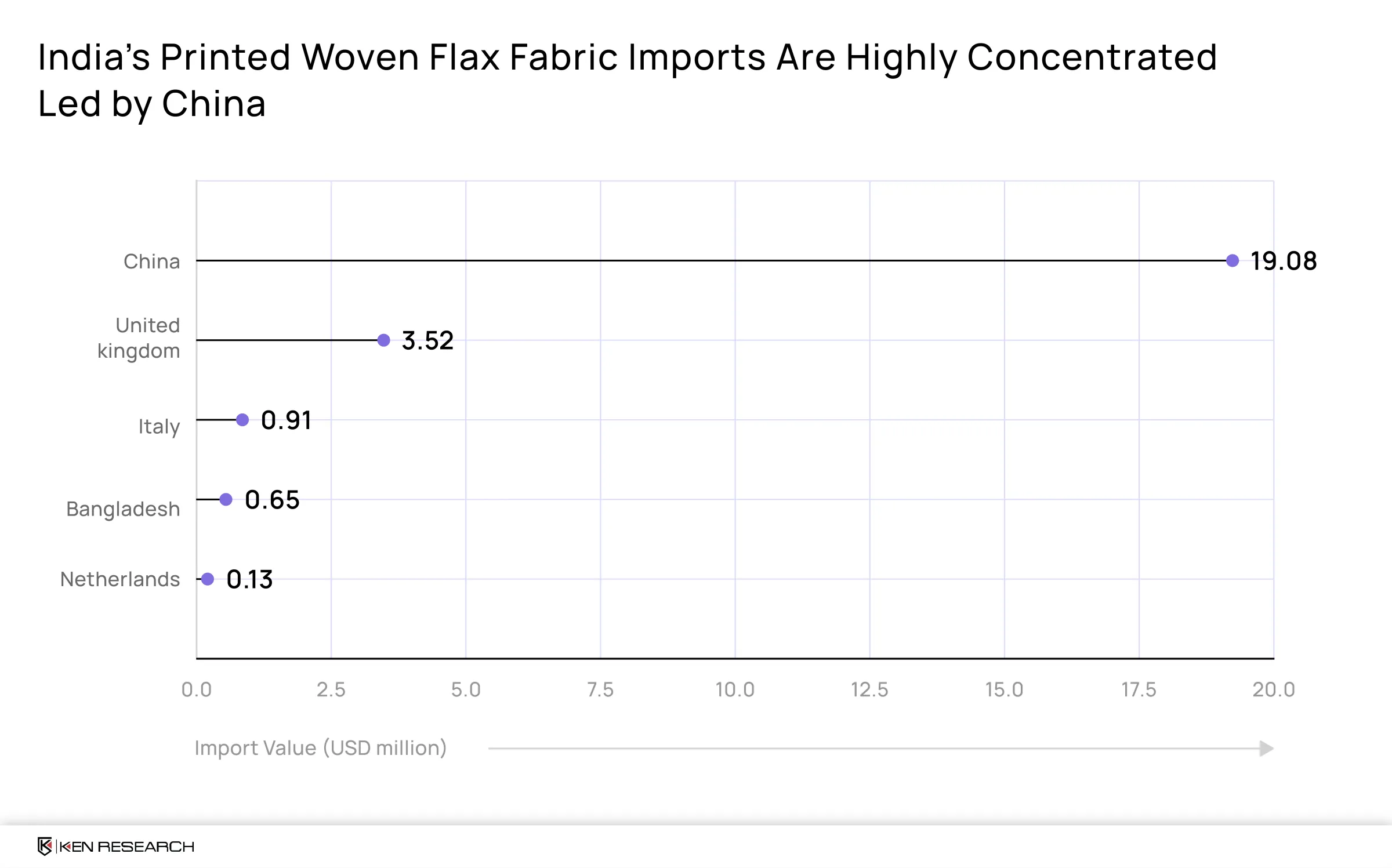
By contrast, official trade data for synthetic fabrics, which are predominantly polyester-based, indicates significantly lower unit values. According to OEC World trade data, India’s exports of synthetic fabrics in 2023 amounted to approximately USD 74.5 million, spread across substantially larger volumes, implying materially lower per-unit realisations compared with flax-based fabrics.
This differential demonstrates a structural cost and pricing premium for linen, rooted in lower global production scale, higher processing intensity, and India’s reliance on imported flax fabrics for higher-quality applications.
Portfolio Economics and Strategic Implications
At the macro level, textiles and apparel accounted for approximately 8.21% of India’s total exports in FY2023–24, while representing about 3.9% of global textile trade. Within this export base, premium materials such as silk and linen contribute disproportionately to export value relative to physical volumes, as evidenced by their significantly higher unit values in official trade statistics.
While public disclosures do not break out material-specific margins, the combination of high export unit values (silk) and import cost premiums (linen) establishes a clear economic rationale for luxury materials as margin and brand multipliers within manufacturer portfolios. Their contribution lies in value density, pricing power, and premium signalling, rather than throughput efficiency, making them best suited as selective portfolio additions rather than mass-scale strategies.
Segment-Led Business Models Across Price Bands
Manufacturers should begin with clear segment selection. Economy volume strategies targeting INR 800-1,500 curtain price points require Gujarat hub selection for material cost optimisation, polyester sourcing dominance, and distribution through value retailers and e-commerce platforms. Mid-market balanced strategies serving INR 1,500-3,500 price ranges benefit from Tamil Nadu's quality infrastructure, cotton-polyester blended fabrics, and mixed distribution combining organised retail and direct commercial projects. Premium margin strategies positioning at INR 3,500-8,000 demand Northern India market proximity, customisation capabilities, cotton and linen materials, and direct customer engagement through showrooms and design consultancies. Luxury niche strategies above INR 8,000 necessitate specialised heritage craft skills, silk and imported linen sourcing, and relationship-based sales to designers and affluent consumers.
Operational Scale, Compliance, and Quality Systems
Operational excellence determines which manufacturers translate opportunity into advantage. Volume-led players must reach 10,000+ monthly units to unlock 15-20% material cost savings and reduce per-unit overheads from around 40% at low scale to 25-30% at scale. Parallel investments in BIS compliance, readiness for the Cotton Bales Quality Control Order effective August 2026, and certifications such as OEKO-TEX and GOTS create 12 - 18 month entry barriers once established. Flexible, made-to-order manufacturing further strengthens competitiveness by serving the 40% of consumers seeking personalisation while limiting inventory risk.
As formalisation accelerates, the real race is no longer growth-it is who organises the unorganised first and secures scale, compliance, and credibility before competitors catch up.
Future-Proofing and Strategic Priorities for India’s Curtain Manufacturers
Future-proofing in India curtain manufacturing industry increasingly depends on how early manufacturers align with structural shifts in sustainability, technology adoption, and digital distribution. As regulatory oversight and buyer expectations tighten, proactive investments in organic cotton, recycled polyester, natural dyes, and certifications such as BIS, GOTS, and OEKO-TEX move from optional differentiators to baseline competitive requirements, particularly for export-orientated and premium domestic players.
Alongside sustainability, smart curtain solutions are emerging as a meaningful value-creation lever. Although smart curtains currently account for under 5% of total unit volumes, early adopters report 12–15% revenue contribution, driven by higher average selling prices and bundled installation services. Capturing this segment requires deliberate capability building, including motor component sourcing from China or Europe, technician training, and partnerships with smart home integrators.
Digital channels further reinforce long-term competitiveness. Direct-to-consumer e-commerce platforms, supported by AR visualisation and digital configurators, enable manufacturers to engage digitally native consumers while retaining 25-40% of retail margins traditionally absorbed by intermediaries. Strategic investments must ultimately reflect market positioning, as export-led players benefit from Tamil Nadu’s manufacturing ecosystem, volume-driven models from Gujarat’s cost efficiencies, and premium strategies from showroom-led retail and customisation capabilities.
Related tags
Apparel and Textile
Textile, Apparel and Footwear
Consumer Products and Retail
Get started
We've helped companies around the world future-proof
their businesses - and we can do the same for you.