How Is Urban Heat Becoming a Real Estate Risk Across GCC Cities?
Ken Research
July 23, 2026 - 8 min read
July 23, 2026
by Unnati MiglaniUrban heat is becoming a material operating and asset-performance risk for GCC real estate.
The region has always operated in a high-temperature environment, but the challenge now extends beyond weather. Dense construction, dark roofs, extensive paving, limited vegetation and restricted airflow are creating urban districts that absorb, retain and regenerate heat. That heat persists after sunset, drives cooling demand, intensifies pressure on infrastructure and gradually weakens the performance of buildings.
For property owners, developers and investors, the consequences are becoming harder to contain within a sustainability agenda. Higher temperatures affect operating expenditure, construction productivity, maintenance cycles, tenant comfort and asset lifespan. These pressures are already influencing property economics through cooling demand, HVAC dependency, maintenance expenditure and declining urban livability.
Why Are GCC Cities Retaining More Heat After Sunset?
The GCC combines severe heat exposure with dense urban growth across major metropolitan clusters. Climate and urban form are reinforcing each other.
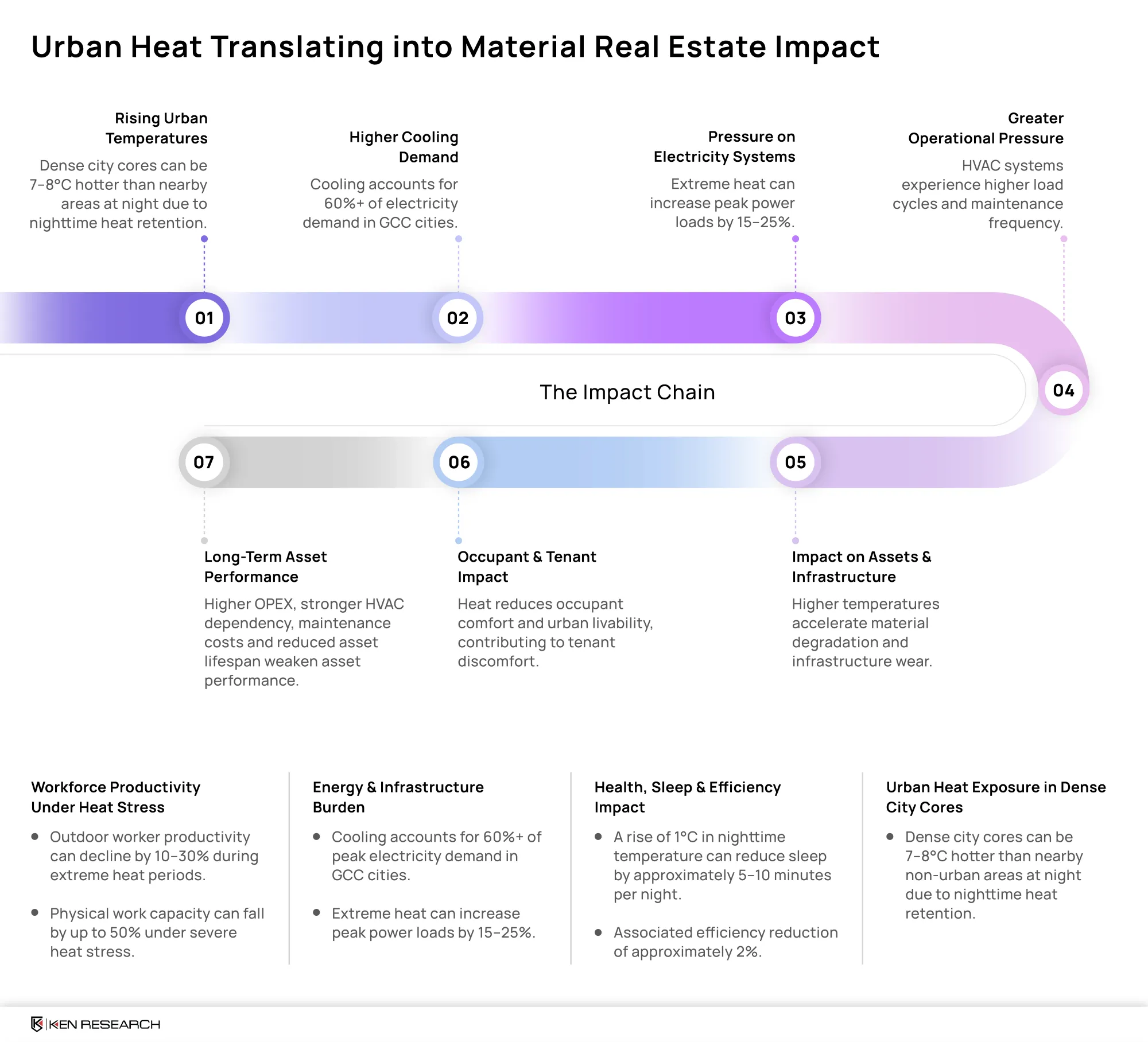
Urban areas can be 1°C to 4°C hotter than their surroundings, while dense city cores may reach 7°C to 8°C above nearby areas, particularly at night. Buildings, roads and paved surfaces absorb heat during the day and release it after sunset, prolonging exposure and sustaining cooling demand.
This changes the nature of the risk. A heatwave is temporary. Urban heat retention is structural. It is embedded in the physical form of the city and continues to affect buildings throughout the cooling cycle.
The effect is strongest where development is dense, surfaces are dark and impermeable, and natural cooling systems have been displaced. Additional heat-absorbing surfaces intensify heat accumulation and reduce the ability of urban areas to cool naturally.
The GCC’s exposure is therefore shaped as much by the configuration of its cities as by the climate itself.
Urban Materials Are Creating Persistent Heat Loads
The materials used across streets, roofs, façades and public spaces directly influence local temperatures.
Asphalt and dark pavements can absorb 80% to 95% of solar radiation. On extreme heat days, exposed surfaces may reach approximately 70°C to 80°C. Asphalt can also raise local temperatures by around 4°C compared with natural ground.
These surfaces behave like heat-storage systems. They absorb solar radiation during the day and re-radiate it after sunset. Buildings located within heavily paved districts therefore face sustained thermal exposure rather than a short daytime peak.
This is why site planning and material specification carry consequences long after construction is complete. What appears to be a design or procurement choice ultimately affects cooling intensity, maintenance requirements and asset resilience.
Where dark pavements, conventional roofs and exposed surfaces dominate the surrounding urban fabric, buildings operate within a local environment that continuously absorbs, stores and releases heat.
How Dense Development Traps Heat and Restricts Cooling
Poorly configured density restricts airflow and prevents heat from dissipating.
Closely spaced buildings can block wind movement, retain radiant heat and reduce night-time cooling. Building spacing, height and orientation determine whether air can circulate through a district or whether heat remains trapped within it.
The problem intensifies where dense building forms, extensive paving and concentrated human activity combine. Buildings, transport systems and air-conditioning equipment add waste heat to the urban environment, creating a reinforcing loop in which rising temperatures drive more cooling, while cooling equipment releases additional heat outdoors.
Heat exposure therefore cannot be assessed only at city level. Districts within the same metropolitan area can experience materially different thermal conditions depending on their built form, surface materials, green cover and airflow.
The relevant question is not simply how hot a city becomes. It is how its urban structure affects heat retention, cooling demand and exposure duration.
Declining Green Cover Is Intensifying Urban Heat
Green space is often treated as an amenity. In hot urban environments, it is also part of the cooling system.
Vegetation reduces heat through shade and evapotranspiration. When natural cover is replaced by roads, roofs and sealed surfaces, both cooling mechanisms decline. Green areas can be approximately 10°C cooler than paved surfaces.
The loss of vegetation therefore has consequences beyond landscaping. It increases surface temperatures, reduces natural cooling and intensifies Urban Heat Island effects.
For real estate, this translates into declining livability, tenant discomfort and a shift in residential demand toward cooler, better-designed assets. A building may maintain acceptable indoor conditions through mechanical cooling, while the surrounding district remains exposed to persistent heat.
The performance of the broader urban environment therefore matters alongside the performance of the individual asset.
GCC Heat Risk Is Concentrated in Specific Urban Areas
Urban heat exposure is not evenly distributed across the GCC. Cities face different combinations of average summer temperature and temperature deviation, producing distinct patterns of emerging and chronic heat exposure.
Selected emerging heat-stress areas include Tabuk, Yanbu, Ras Al Khaimah, Sohar and Muscat. These locations are not uniformly the hottest in the region, but their temperature profiles indicate rising variability and increasing exposure that can place greater pressure on urban infrastructure and building performance.
A separate group faces chronic heat exposure. Madinah, Al Wakrah, Al Rayyan and Umm Salal combine consistently high summer temperatures with comparatively stable heat conditions. This creates a persistent operating burden for cooling systems, public spaces and heat-exposed assets.
The distinction matters because average temperature alone does not explain the full risk. A city with a lower average summer temperature may still face increasing stress when deviation is elevated. Conversely, a consistently hot city may experience sustained operational pressure even when temperature variability is relatively stable.
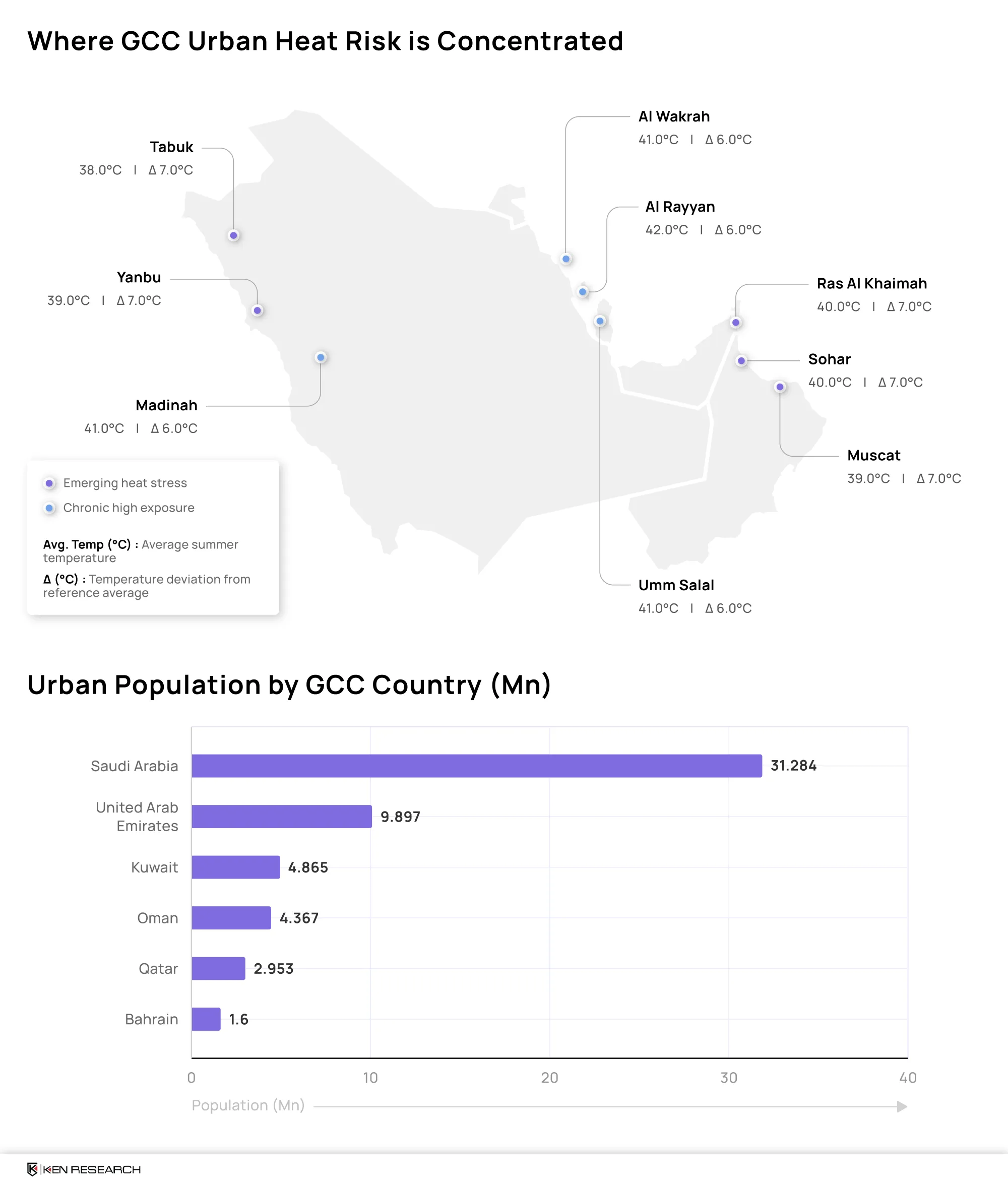
Heat exposure therefore needs to be assessed below the country level. Cities within the same GCC market can face materially different thermal conditions depending on average temperature, temperature deviation, development form, surface materials, airflow and access to natural cooling. For owners and developers, urban heat is a location-specific exposure rather than a uniform regional condition.
Cooling Is Becoming a Structural Cost
The most visible financial effect of urban heat is rising cooling demand.
Cooling can account for more than 60% of peak electricity demand in GCC cities. Extreme heat events can increase peak power loads by 15% to 25%, while cooling demand across the Middle East is expected to rise by two to three times by 2050 according to Ken Research.
For property owners, the impact extends beyond electricity consumption. Higher temperatures increase HVAC load cycles and maintenance frequency. Heat-retaining urban design also increases cooling intensity and lifecycle costs.
As these pressures accumulate, buildings face stronger HVAC dependency, greater pressure on energy efficiency and higher operating expenditure. The effect may be gradual, but it is persistent. Rising cooling and maintenance costs weaken asset performance even when the building remains fully functional.
The relevant question is no longer simply whether an asset can remain cool. It is whether it can maintain that performance without steadily increasing operating and maintenance requirements.
Heat Is Shortening the Maintenance Cycle
The built environment is exposed to continuous thermal stress.
Higher temperatures accelerate material degradation and infrastructure wear. Sustained heat also increases retrofit demand, maintenance costs and pressure on asset lifespan. The risk extends beyond mechanical systems. Buildings and infrastructure that were not designed for prolonged extreme heat face increasing pressure across their operating lifecycle.
For long-term owners, this creates a capital-planning challenge. Higher maintenance intensity and earlier retrofit requirements can weaken performance well before physical failure becomes visible.
The commercial burden is therefore cumulative. Higher OPEX, repeated maintenance and reduced asset life can erode value gradually, often before heat exposure is recognised as the underlying driver.
Extreme Heat Is Eroding Construction Productivity
Urban heat also affects the economics of development.
Outdoor worker productivity can decline by 10% to 30% during extreme heat periods. Under severe heat stress, physical work capacity may fall by up to 50%. These effects contribute to construction delays, higher labour costs and lower efficiency in heat-exposed urban sectors.
This creates a direct link between extreme heat and project delivery. Lower effective labour capacity slows construction activity and increases cost pressure.
The impact is particularly relevant for large urban programmes with extensive outdoor work. Even where heat is managed through operational controls, the underlying productivity loss remains a commercial consideration.
Heat therefore belongs within the project-delivery discussion, not only within site safety. It affects workforce capacity, schedule reliability and the economics of construction.
Urban Heat Is Affecting Livability, Health and Real Estate Demand
Almost 70% of GCC residents live in urban areas exposed to elevated heat stress.
Urban heat is linked with tenant discomfort, declining livability and shifting demand toward cooler, better-designed assets. A 1°C rise in night-time temperature can reduce sleep by approximately five to ten minutes and lower efficiency by around 2%.
These effects matter because heat exposure extends beyond the internal condition of a building. It affects the broader urban environment and the ability of residents and workers to function comfortably.
Trapped heat also intensifies heatwaves, prolongs exposure and increases public-health risks. Cities face the greatest pressure because urban surfaces retain heat and reduce night-time cooling.
For real estate, the commercial relevance lies in occupier preference. Cooler, better-designed assets may gain stronger demand as heat exposure intensifies, while poorly adapted buildings and districts face greater tenant discomfort and weaker livability.
Urban Heat Is Increasing Asset and Operating Cost Pressure
Urban heat is translating into higher operating expenditure, stronger HVAC dependency and greater pressure on building energy efficiency. Higher temperatures are also accelerating material degradation and infrastructure wear, increasing maintenance requirements, retrofit demand and lifecycle costs.
These pressures affect asset performance over time. Buildings exposed to sustained heat may face more frequent HVAC maintenance, higher cooling intensity and a shorter asset lifespan. At the same time, declining livability and tenant discomfort are shifting residential demand toward cooler, better-designed assets.
The result is a widening performance gap between properties that can manage heat efficiently and those that require increasingly intensive cooling, maintenance and retrofit expenditure. In high-exposure urban areas, heat resilience is therefore becoming more closely linked to operating performance, tenant appeal and the risk of asset depreciation.
The Commercial Risk Lies in Accumulation
No single effect defines the urban heat challenge.
The risk comes from accumulation. Heat-retaining materials raise local temperatures. Higher temperatures increase cooling demand. Cooling intensity raises electricity loads and HVAC wear. Sustained exposure accelerates maintenance and material deterioration. Construction productivity declines. Livability weakens. Operating and capital requirements rise together.
Each effect reinforces the next.
For GCC real estate, urban heat now needs to be treated as an asset-performance variable. Heat exposure, cooling demand, building efficiency, infrastructure resilience and asset vulnerability should be considered together rather than as separate operational concerns.
The most exposed assets will not necessarily be those located in the hottest cities. They will be those whose design, systems and surroundings are least able to cope with persistent heat.
The cost of inaction is unlikely to arrive as one large event. It will appear through higher cooling demand, more frequent maintenance, slower construction, weaker livability and greater retrofit requirements. By the time these pressures are fully visible in asset performance, the economic burden may already be significant.
Related tags
Real Estate
Manufacturing and Construction
Get started
We've helped companies around the world future-proof
their businesses - and we can do the same for you.