About the Report
Base Year 2024Australia Green Hydrogen Export Market Overview
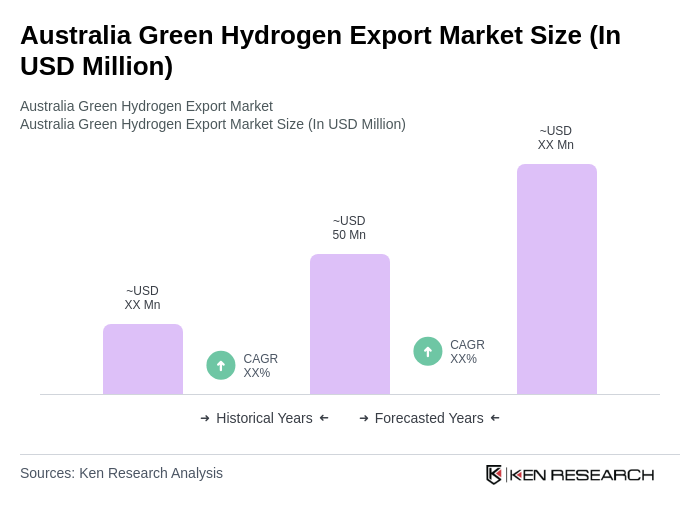
- The Australia Green Hydrogen Export Market is valued at USD 50 million, based on a five-year historical analysis. This growth is primarily driven by increasing investments in renewable energy, government policies promoting hydrogen as a clean fuel, and rising global demand for sustainable energy solutions. The market is witnessing a surge in projects aimed at producing green hydrogen, which is seen as a key component in achieving carbon neutrality.
- Australia is a dominant player in the green hydrogen export market, with key regions including Western Australia and Queensland leading the charge. The country's vast renewable energy resources, particularly solar and wind, provide a competitive advantage in producing green hydrogen. Additionally, Australia's strategic geographic location allows for efficient export to major markets such as Japan and South Korea, which are actively seeking hydrogen to meet their energy needs. Strategic international collaborations with partners in Japan, South Korea, and the European Union are fueling capital inflow for export-oriented hydrogen ventures, with expanding port-based hydrogen hubs enhancing commercial viability.
- The Australian government has implemented comprehensive regulatory frameworks through the Hydrogen Production Tax Incentive, 2024 issued by the Australian Government Treasury. This incentive provides AUD 2 per kilogram of green hydrogen for ten years beginning in 2027, establishing clear production standards and compliance requirements for developers. The framework includes measurable objectives for infrastructure rollout, investment attraction, and technology development, with regulatory bodies establishing standards for green hydrogen production and transport. Federal and state governments have introduced dedicated hydrogen roadmaps with targeted funding programs supporting feasibility studies, demonstration projects, and electrolyzer installations.
Australia Green Hydrogen Export Market Segmentation
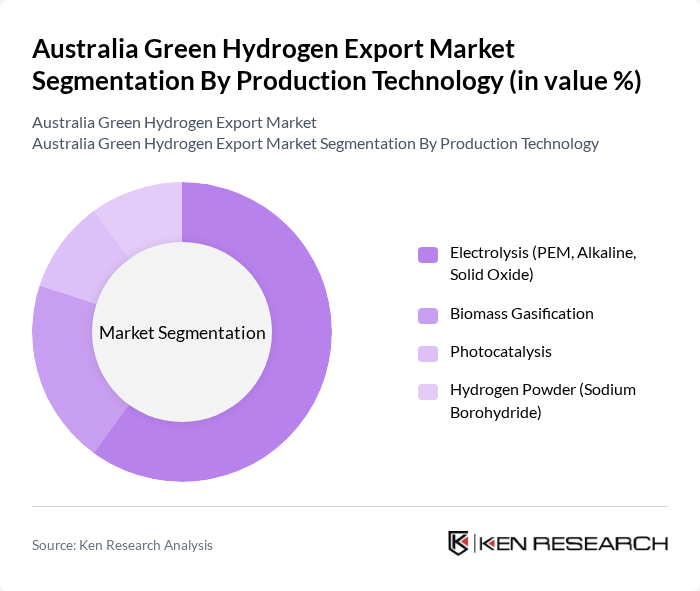
By Production Technology:The production technology segment includes various methods for generating green hydrogen, which are crucial for meeting the growing demand. The subsegments include Electrolysis (PEM, Alkaline, Solid Oxide), Biomass Gasification, Photocatalysis, and Hydrogen Powder (Sodium Borohydride). Among these, Electrolysis, particularly PEM and Alkaline technologies, is dominating the market due to their efficiency and scalability. The increasing focus on renewable energy sources and advancements in electrolyzer technology are driving this trend, with large-scale electrolysis projects expanding rapidly and renewable energy integration becoming standard practice with hydrogen production directly connected to solar and wind farms.
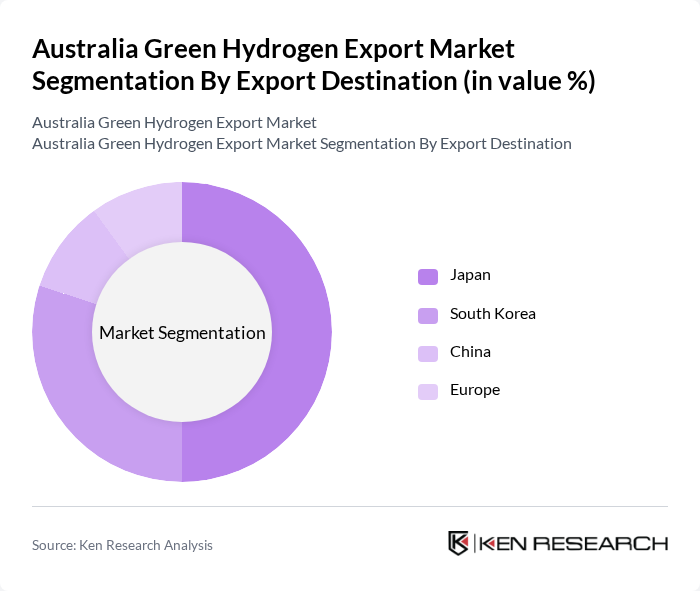
By Export Destination:The export destination segment highlights the key markets for Australian green hydrogen, which include Japan, South Korea, China, and Europe. Japan is currently the leading destination due to its ambitious hydrogen strategy and commitment to reducing carbon emissions. South Korea follows closely, driven by its energy transition policies. The demand from these countries is fueled by their need for clean energy alternatives and the establishment of hydrogen supply chains. Australia is pursuing long-term trade partnerships with these nations, leveraging agreements with Germany, Japan, and South Korea for hydrogen supply chain development, with the International Renewable Energy Agency forecasting Europe as the largest importer globally.
Australia Green Hydrogen Export Market Competitive Landscape
The Australia Green Hydrogen Export Market is characterized by a dynamic mix of regional and international players. Leading participants such as Fortescue Future Industries, Woodside Energy, Origin Energy, ATCO Australia, Hydrogen Utility (H2U), Australian Renewable Energy Agency (ARENA), BOC Limited, AGL Energy, Neoen Australia, CWP Renewables, Murchison Green Hydrogen (Copenhagen Infrastructure Partners), Orica Limited, Velox Energy Materials, Clean Energy Finance Corporation (CEFC), Enel Green Power Australia, Siemens Energy, Linde contribute to innovation, geographic expansion, and service delivery in this space.
Australia Green Hydrogen Export Market Industry Analysis
Growth Drivers
- Increasing Global Demand for Clean Energy:The global clean energy market is projected to reach $1.5 trillion in future, driven by a shift towards sustainable energy sources. Australia, with its abundant renewable resources, is well-positioned to meet this demand. The International Energy Agency (IEA) reported that hydrogen could account for 18% of the global energy mix in future, highlighting the significant opportunity for Australian exports in this growing sector.
- Government Support and Funding Initiatives:The Australian government has committed over AUD 1.5 billion to support hydrogen initiatives, including the National Hydrogen Strategy. This funding aims to facilitate research, development, and commercialization of hydrogen technologies. Additionally, the Clean Energy Finance Corporation (CEFC) has allocated AUD 300 million specifically for green hydrogen projects, fostering a favorable environment for investment and innovation in the sector.
- Technological Advancements in Hydrogen Production:Innovations in electrolysis and carbon capture technologies are reducing the cost of hydrogen production. For instance, the cost of producing green hydrogen is expected to drop to AUD 2.50 per kilogram in future, according to the Australian Renewable Energy Agency (ARENA). These advancements enhance the competitiveness of Australian green hydrogen in international markets, making it a viable alternative to fossil fuels.
Market Challenges
- High Production Costs:Despite technological advancements, the production cost of green hydrogen remains a significant barrier. Current estimates place the cost at approximately AUD 4.00 per kilogram, which is higher than fossil fuel alternatives. This price disparity poses challenges for market penetration, especially in price-sensitive regions. Addressing these costs is crucial for enhancing the competitiveness of Australian hydrogen exports.
- Infrastructure Development Needs:The lack of adequate infrastructure for hydrogen production, storage, and transport is a major challenge. According to the Hydrogen Council, an investment of around AUD 20 billion is required to develop the necessary infrastructure in Australia in future. Without significant investment in pipelines, refueling stations, and storage facilities, the growth of the green hydrogen export market may be hindered.
Australia Green Hydrogen Export Market Future Outlook
The future of the Australia green hydrogen export market appears promising, driven by increasing investments and a global shift towards sustainable energy solutions. In future, the market is expected to witness a surge in partnerships with international firms, enhancing export capabilities. Additionally, the emergence of hydrogen clusters will facilitate innovation and collaboration, positioning Australia as a leader in the green hydrogen sector. The focus on carbon neutrality will further accelerate demand for clean hydrogen solutions, creating a robust export landscape.
Market Opportunities
- Export Potential to Asia-Pacific Markets:The Asia-Pacific region is projected to be a significant market for green hydrogen, with demand expected to reach 10 million tons in future. Countries like Japan and South Korea are actively seeking hydrogen imports to meet their energy needs, presenting a lucrative opportunity for Australian exporters to capitalize on this growing demand.
- Partnerships with International Energy Firms:Collaborations with global energy companies can enhance technology transfer and investment in hydrogen projects. For instance, partnerships with firms in Europe and Asia can facilitate access to advanced technologies and funding, accelerating the development of Australia's hydrogen export capabilities and expanding its market reach.
Scope of the Report
| Segment | Sub-Segments |
|---|---|
| By Production Technology | Electrolysis (PEM, Alkaline, Solid Oxide) Biomass Gasification Photocatalysis Hydrogen Powder (Sodium Borohydride) |
| By Export Destination | Japan South Korea China Europe |
| By Application | Ammonia Production Iron & Steel Manufacturing Power Generation Transportation (Shipping, Heavy Vehicles) |
| By Project Scale | Demonstration Projects Commercial Scale Projects Mega Export Hubs |
| By Ownership Model | Private Sector Public-Private Partnerships Government Initiatives |
| By Funding Source | Domestic Investment Foreign Direct Investment Government Grants & Subsidies |
| By Export Form | Liquefied Hydrogen Hydrogen Derivatives (Ammonia, Methanol) Hydrogen Powder |
Key Target Audience
Investors and Venture Capitalist Firms
Government and Regulatory Bodies (e.g., Clean Energy Regulator, Department of Industry, Science, Energy and Resources)
Manufacturers and Producers of Hydrogen Technologies
Energy Exporters and Importers
Infrastructure Developers and Operators
Environmental NGOs and Advocacy Groups
Energy Market Analysts and Advisors
Utility Companies and Energy Providers
Players Mentioned in the Report:
Fortescue Future Industries
Woodside Energy
Origin Energy
ATCO Australia
Hydrogen Utility (H2U)
Australian Renewable Energy Agency (ARENA)
BOC Limited
AGL Energy
Neoen Australia
CWP Renewables
Murchison Green Hydrogen (Copenhagen Infrastructure Partners)
Orica Limited
Velox Energy Materials
Clean Energy Finance Corporation (CEFC)
Enel Green Power Australia
Siemens Energy
Linde
Table of Contents
Market Assessment Phase
1. Executive Summary and Approach
2. Australia Green Hydrogen Export Market Overview
2.1 Key Insights and Strategic Recommendations
2.2 Australia Green Hydrogen Export Market Overview
2.3 Definition and Scope
2.4 Evolution of Market Ecosystem
2.5 Timeline of Key Regulatory Milestones
2.6 Value Chain & Stakeholder Mapping
2.7 Business Cycle Analysis
2.8 Policy & Incentive Landscape
3. Australia Green Hydrogen Export Market Analysis
3.1 Growth Drivers
3.1.1 Increasing Global Demand for Clean Energy
3.1.2 Government Support and Funding Initiatives
3.1.3 Technological Advancements in Hydrogen Production
3.1.4 Strategic Geographical Advantages of Australia
3.2 Market Challenges
3.2.1 High Production Costs
3.2.2 Infrastructure Development Needs
3.2.3 Competition from Other Renewable Sources
3.2.4 Regulatory and Compliance Hurdles
3.3 Market Opportunities
3.3.1 Export Potential to Asia-Pacific Markets
3.3.2 Partnerships with International Energy Firms
3.3.3 Innovations in Hydrogen Storage and Transport
3.3.4 Development of Localized Production Facilities
3.4 Market Trends
3.4.1 Increasing Investment in Green Hydrogen Projects
3.4.2 Growing Interest in Hydrogen as a Fuel Source
3.4.3 Emergence of Hydrogen Clusters and Hubs
3.4.4 Focus on Sustainability and Carbon Neutrality
3.5 Government Regulation
3.5.1 National Hydrogen Strategy
3.5.2 Renewable Energy Target (RET)
3.5.3 Clean Energy Finance Corporation (CEFC) Initiatives
3.5.4 Environmental Protection Regulations
4. SWOT Analysis
5. Stakeholder Analysis
6. Porter's Five Forces Analysis
7. Australia Green Hydrogen Export Market Market Size, 2019-2024
7.1 By Value
7.2 By Volume
7.3 By Average Selling Price
8. Australia Green Hydrogen Export Market Segmentation
8.1 By Production Technology
8.1.1 Electrolysis (PEM, Alkaline, Solid Oxide)
8.1.2 Biomass Gasification
8.1.3 Photocatalysis
8.1.4 Hydrogen Powder (Sodium Borohydride)
8.2 By Export Destination
8.2.1 Japan
8.2.2 South Korea
8.2.3 China
8.2.4 Europe
8.3 By Application
8.3.1 Ammonia Production
8.3.2 Iron & Steel Manufacturing
8.3.3 Power Generation
8.3.4 Transportation (Shipping, Heavy Vehicles)
8.4 By Project Scale
8.4.1 Demonstration Projects
8.4.2 Commercial Scale Projects
8.4.3 Mega Export Hubs
8.5 By Ownership Model
8.5.1 Private Sector
8.5.2 Public-Private Partnerships
8.5.3 Government Initiatives
8.6 By Funding Source
8.6.1 Domestic Investment
8.6.2 Foreign Direct Investment
8.6.3 Government Grants & Subsidies
8.7 By Export Form
8.7.1 Liquefied Hydrogen
8.7.2 Hydrogen Derivatives (Ammonia, Methanol)
8.7.3 Hydrogen Powder
9. Australia Green Hydrogen Export Market Competitive Analysis
9.1 Market Share of Key Players
9.2 KPIs for Cross Comparison of Key Players
9.2.1 Export Capacity (tonnes/year)
9.2.2 Renewable Power Capacity (MW/GW)
9.2.3 Electrolyser Capacity (MW/GW)
9.2.4 Project Pipeline (Number, Stage, Value)
9.2.5 Offtake Agreements (Volume, Duration, Counterparties)
9.2.6 Levelized Cost of Hydrogen (LCOH, $/kg)
9.2.7 Funding Secured (AUD, USD)
9.2.8 Technology Innovation (Patents, Proprietary Processes)
9.2.9 Strategic Partnerships (Number, Type)
9.2.10 ESG Performance (Carbon Intensity, Water Use, Certifications)
9.3 SWOT Analysis of Top Players
9.4 Pricing Analysis
9.5 Detailed Profile of Major Companies
9.5.1 Fortescue Future Industries
9.5.2 Woodside Energy
9.5.3 Origin Energy
9.5.4 ATCO Australia
9.5.5 Hydrogen Utility (H2U)
9.5.6 Australian Renewable Energy Agency (ARENA)
9.5.7 BOC Limited
9.5.8 AGL Energy
9.5.9 Neoen Australia
9.5.10 CWP Renewables
9.5.11 Murchison Green Hydrogen (Copenhagen Infrastructure Partners)
9.5.12 Orica Limited
9.5.13 Velox Energy Materials
9.5.14 Clean Energy Finance Corporation (CEFC)
9.5.15 Enel Green Power Australia
9.5.16 Siemens Energy
9.5.17 Linde
10. Australia Green Hydrogen Export Market End-User Analysis
10.1 Procurement Behavior of Key Ministries
10.1.1 Energy Procurement Strategies
10.1.2 Budget Allocation for Renewable Projects
10.1.3 Collaboration with Private Sector
10.2 Corporate Spend on Infrastructure & Energy
10.2.1 Investment in Renewable Energy Infrastructure
10.2.2 Budget Trends in Energy Sector
10.2.3 Corporate Sustainability Initiatives
10.3 Pain Point Analysis by End-User Category
10.3.1 Cost of Transition to Green Hydrogen
10.3.2 Reliability of Supply
10.3.3 Regulatory Compliance Challenges
10.4 User Readiness for Adoption
10.4.1 Awareness of Green Hydrogen Benefits
10.4.2 Infrastructure Readiness
10.4.3 Training and Skill Development Needs
10.5 Post-Deployment ROI and Use Case Expansion
10.5.1 Measurement of ROI in Initial Projects
10.5.2 Potential for Scaling Operations
10.5.3 Long-term Sustainability Considerations
11. Australia Green Hydrogen Export Market Future Size, 2025-2030
11.1 By Value
11.2 By Volume
11.3 By Average Selling Price
Go-To-Market Strategy Phase
1. Whitespace Analysis + Business Model Canvas
1.1 Identification of Market Gaps
1.2 Value Proposition Development
1.3 Revenue Streams Analysis
1.4 Cost Structure Evaluation
1.5 Key Partnerships Identification
1.6 Customer Segmentation
1.7 Channels of Distribution
2. Marketing and Positioning Recommendations
2.1 Branding Strategies
2.2 Product USPs
2.3 Target Audience Identification
2.4 Communication Strategies
2.5 Digital Marketing Approaches
3. Distribution Plan
3.1 Urban Retail Strategies
3.2 Rural NGO Tie-ups
3.3 Logistics and Supply Chain Management
3.4 Distribution Partnerships
4. Channel & Pricing Gaps
4.1 Underserved Routes
4.2 Pricing Bands Analysis
4.3 Competitor Pricing Strategies
5. Unmet Demand & Latent Needs
5.1 Category Gaps Identification
5.2 Consumer Segments Analysis
5.3 Future Demand Projections
6. Customer Relationship
6.1 Loyalty Programs
6.2 After-sales Service Strategies
6.3 Customer Feedback Mechanisms
7. Value Proposition
7.1 Sustainability Initiatives
7.2 Integrated Supply Chains
7.3 Competitive Advantages
8. Key Activities
8.1 Regulatory Compliance
8.2 Branding Initiatives
8.3 Distribution Setup
9. Entry Strategy Evaluation
9.1 Domestic Market Entry Strategy
9.1.1 Product Mix Considerations
9.1.2 Pricing Band Strategies
9.1.3 Packaging Innovations
9.2 Export Entry Strategy
9.2.1 Target Countries Identification
9.2.2 Compliance Roadmap Development
10. Entry Mode Assessment
10.1 Joint Ventures
10.2 Greenfield Investments
10.3 Mergers & Acquisitions
10.4 Distributor Model Evaluation
11. Capital and Timeline Estimation
11.1 Capital Requirements Analysis
11.2 Timelines for Market Entry
12. Control vs Risk Trade-Off
12.1 Ownership vs Partnerships
12.2 Risk Management Strategies
13. Profitability Outlook
13.1 Breakeven Analysis
13.2 Long-term Sustainability Considerations
14. Potential Partner List
14.1 Distributors
14.2 Joint Ventures
14.3 Acquisition Targets
15. Execution Roadmap
15.1 Phased Plan for Market Entry
15.1.1 Market Setup
15.1.2 Market Entry
15.1.3 Growth Acceleration
15.1.4 Scale & Stabilize
15.2 Key Activities and Milestones
15.2.1 Milestone Identification
15.2.2 Activity Scheduling
Research Methodology
Phase 1: Approach1
Desk Research
- Analysis of government reports on renewable energy policies and green hydrogen initiatives
- Review of industry publications and market analysis reports on hydrogen production and export trends
- Examination of academic journals and white papers focusing on green hydrogen technology advancements
Primary Research
- Interviews with key stakeholders in the Australian green hydrogen sector, including producers and exporters
- Surveys targeting energy policy experts and environmental consultants to gather insights on market dynamics
- Field interviews with representatives from logistics and transportation companies involved in hydrogen export
Validation & Triangulation
- Cross-validation of findings through comparison with international green hydrogen market data
- Triangulation of insights from primary interviews with secondary data sources to ensure consistency
- Sanity checks conducted through expert panel reviews comprising industry veterans and academic researchers
Phase 2: Market Size Estimation1
Top-down Assessment
- Estimation of the total addressable market for green hydrogen based on national energy consumption statistics
- Segmentation of the market by end-user industries such as transportation, industrial applications, and power generation
- Incorporation of government targets for hydrogen production and export as part of the national energy strategy
Bottom-up Modeling
- Collection of production capacity data from leading green hydrogen facilities in Australia
- Operational cost analysis based on current technology and production methods for hydrogen generation
- Volume and pricing models based on projected demand from key export markets
Forecasting & Scenario Analysis
- Multi-factor regression analysis incorporating variables such as global energy prices and technological advancements
- Scenario modeling based on potential regulatory changes and international trade agreements affecting hydrogen exports
- Development of baseline, optimistic, and pessimistic forecasts for the green hydrogen market through 2035
Phase 3: CATI Sample Composition1
| Scope Item/Segment | Sample Size | Target Respondent Profiles |
|---|---|---|
| Green Hydrogen Producers | 60 | Production Managers, Business Development Executives |
| Export Logistics Providers | 50 | Logistics Coordinators, Supply Chain Managers |
| Energy Policy Experts | 40 | Government Officials, Regulatory Affairs Specialists |
| Industrial End-users | 50 | Procurement Managers, Operations Directors |
| Environmental Consultants | 40 | Sustainability Advisors, Energy Analysts |
Frequently Asked Questions
What is the current value of the Australia Green Hydrogen Export Market?
The Australia Green Hydrogen Export Market is currently valued at approximately USD 50 million. This valuation is based on a five-year historical analysis and reflects the increasing investments in renewable energy and government policies promoting hydrogen as a clean fuel.
Which regions in Australia are leading in green hydrogen production?
What are the key export destinations for Australian green hydrogen?
What government incentives support the green hydrogen sector in Australia?
Other Regional/Country Reports
Indonesia Green Hydrogen Export Market
Malaysia Green Hydrogen Export Market
KSA Green Hydrogen Export Market
Other Adjacent Reports
Egypt Electrolyzer Technology Market
New Zealand Hydrogen Storage Market Size Share Growth Drivers Trends Opportunities & Forecast 2025–2030Brazil Hydrogen Transportation Market
Oman Ammonia Export Market
Vietnam Clean Energy Infrastructure Market
Indonesia Carbon Capture Market
KSA Sustainable Fuels Market
South Africa Energy Transition Consulting Market
Kuwait Industrial Decarbonization Market
Why Buy From Us?

What makes us stand out is that our consultants follow Robust, Refine and Result (RRR) methodology. Robust for clear definitions, approaches and sanity checking, Refine for differentiating respondents' facts and opinions, and Result for presenting data with story.

We have set a benchmark in the industry by offering our clients with syndicated and customized market research reports featuring coverage of entire market as well as meticulous research and analyst insights.

While we don't replace traditional research, we flip the method upside down. Our dual approach of Top Bottom & Bottom Top ensures quality deliverable by not just verifying company fundamentals but also looking at the sector and macroeconomic factors.

With one step in the future, our research team constantly tries to show you the bigger picture. We help with some of the tough questions you may encounter along the way: How is the industry positioned? Best marketing channel? KPI's of competitors? By aligning every element, we help maximize success.

Our report gives you instant access to the answers and sources that other companies might choose to hide. We elaborate each steps of research methodology we have used and showcase you the sample size to earn your trust.

If you need any support, we are here! We pride ourselves on universe strength, data quality, and quick, friendly, and professional service.