About the Report
Base Year 2024Listen to the audio summary
Australia Hyaluronic Acid Based Dermal Fillers Market Overview
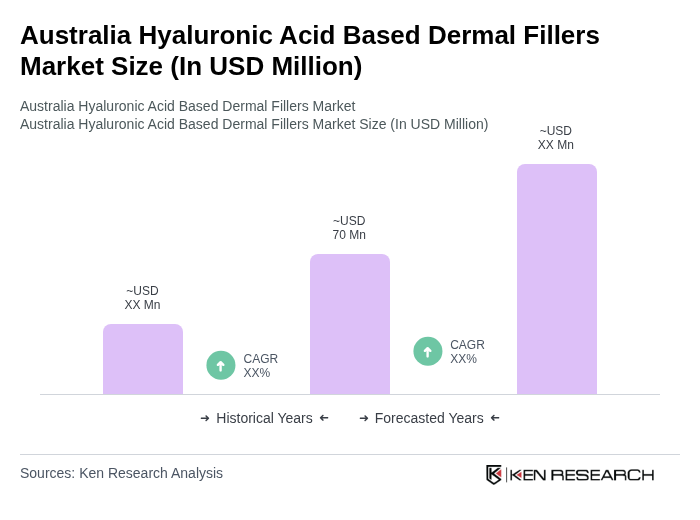
- The Australia Hyaluronic Acid Based Dermal Fillers Market is valued at USD 70 million, based on a five-year historical analysis. This growth is primarily driven by increasing consumer demand for non-surgical aesthetic procedures—particularly minimally invasive injectable treatments—coupled with advancements in hyaluronic acid gel technologies that improve product longevity, safety, and natural-looking outcomes. The rising awareness of aesthetic treatments among the aging population, along with growing acceptance of cosmetic procedures among younger demographics seeking preventive or subtle enhancements, has further fueled market expansion.
- Key cities such as Sydney, Melbourne, and Brisbane dominate the market due to their high concentration of cosmetic and dermatology clinics, medical spas, and specialist aesthetic practices. These urban centers benefit from a larger affluent and urbanized population with higher disposable incomes and stronger aesthetic awareness, which increases willingness to invest in cosmetic procedures, alongside well-developed private healthcare and clinic infrastructure that supports access to a broad portfolio of advanced hyaluronic acid dermal fillers.
- In 2023, the Australian government implemented stricter regulations regarding the use of cosmetic injectables, including dermal fillers, by formally classifying them as cosmetic medical procedures that must be prescribed by a medical practitioner following a consultation (which may be via telehealth under defined conditions) and administered under appropriate clinical oversight. The Guidelines for registered medical practitioners who perform cosmetic medical and surgical procedures, issued by the Medical Board of Australia and enforced by the Australian Health Practitioner Regulation Agency (AHPRA), require practitioners to have suitable training, maintain competence in cosmetic procedures, follow detailed informed-consent, cooling-off, and record-keeping standards, and ensure that non-medical injectors operate under an appropriate prescribing and supervision framework. These measures aim to enhance patient safety, standardize practice quality, and strengthen consumer confidence in the dermal filler market.
Australia Hyaluronic Acid Based Dermal Fillers Market Segmentation
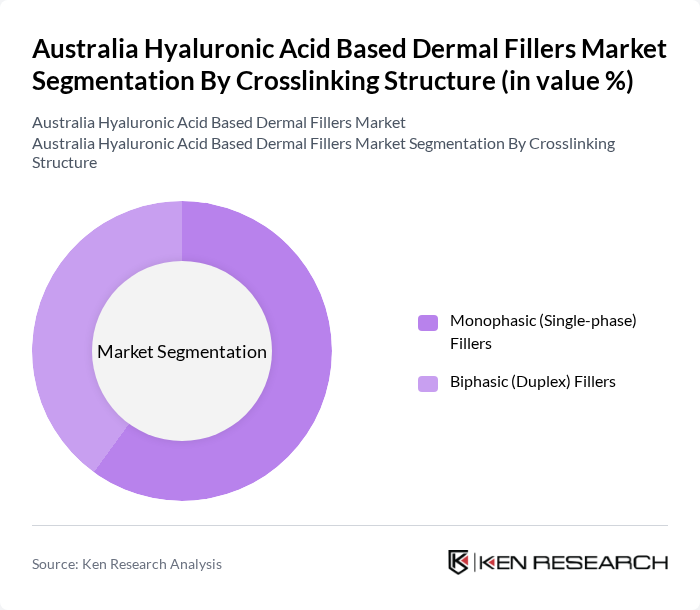
By Crosslinking Structure:The market is segmented into two primary types based on crosslinking structure: monophasic (single-phase) fillers and biphasic (duplex) fillers. Monophasic fillers are known for their smooth, homogenous gel consistency and are often preferred for subtle enhancements, fine line correction, and areas requiring seamless integration with surrounding tissue. Biphasic fillers consist of crosslinked particles suspended in a non-crosslinked carrier, offering a more structured approach that makes them suitable for deeper injections, contouring, and volumizing effects in areas such as cheeks and nasolabial folds. The monophasic segment is currently leading the market due to its versatility, smoother injection characteristics, and broad use in both rejuvenation and beautification indications across diverse patient profiles.
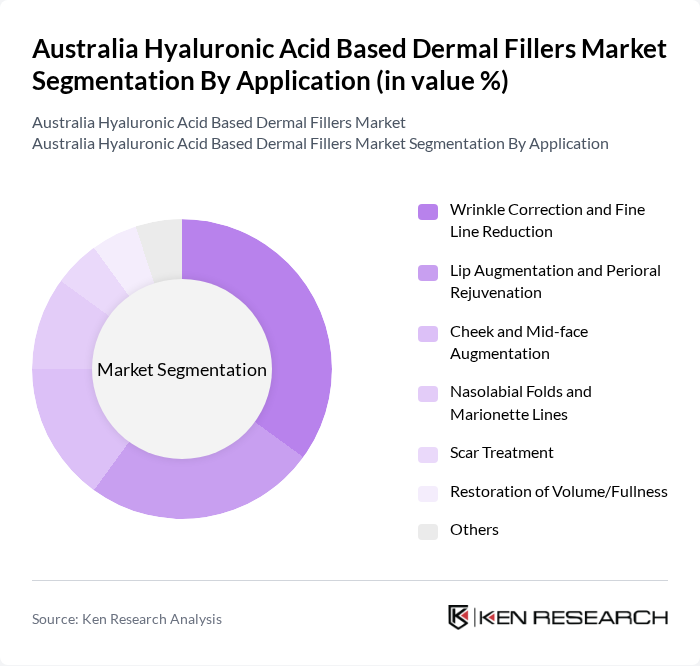
By Application:The application segment includes various uses of hyaluronic acid fillers, such as wrinkle correction and fine line reduction, lip augmentation and perioral rejuvenation, cheek and mid-face augmentation, nasolabial folds and marionette lines, scar treatment, restoration of volume/fullness, and others. Hyaluronic acid fillers are widely used to address age-related volume loss, dynamic and static facial rhytides, and contour deficiencies, owing to their favorable safety profile, reversibility, and immediate visible results. Among these, wrinkle correction and fine line reduction dominate the market, driven by the increasing desire for a youthful appearance, social-media-driven beauty ideals, and the effectiveness of fillers in achieving rapid, minimally invasive rejuvenation with limited downtime.
Australia Hyaluronic Acid Based Dermal Fillers Market Competitive Landscape
The Australia Hyaluronic Acid Based Dermal Fillers Market is characterized by a dynamic mix of regional and international players. Leading participants such as Allergan Aesthetics (AbbVie), Galderma, Merz Aesthetics, Teoxane Laboratories, Prollenium Medical Technologies (Revanesse), LG Chem, Medytox, Ipsen, Suneva Medical, Hugel, Straumann (AQTIS Medical legacy portfolio), Sientra, and other emerging local and regional players contribute to innovation, geographic expansion, portfolio diversification, and injector training and support in this space.
Australia Hyaluronic Acid Based Dermal Fillers Market Industry Analysis
Growth Drivers
- Increasing Demand for Non-Surgical Aesthetic Procedures:The Australian market for non-surgical aesthetic procedures has seen a significant rise, with over 1.6 million procedures performed in future, reflecting a 12% increase from the previous year. This surge is driven by a growing preference for less invasive options, as consumers seek effective yet low-risk treatments. The Australian Society of Aesthetic Plastic Surgeons reported that non-surgical procedures accounted for 72% of all cosmetic treatments, indicating a robust demand for hyaluronic acid-based dermal fillers.
- Rising Awareness About Skincare and Anti-Aging Treatments:The skincare market in Australia is projected to reach AUD 3.8 billion by future, fueled by increasing consumer awareness regarding anti-aging solutions. A survey conducted by the Australian Institute of Health and Welfare revealed that 68% of Australians aged 30-50 are actively seeking skincare products that offer anti-aging benefits. This heightened awareness is driving the demand for hyaluronic acid-based dermal fillers, as consumers prioritize effective solutions for maintaining youthful skin.
- Technological Advancements in Dermal Filler Formulations:Innovations in dermal filler technology have led to the introduction of advanced formulations that enhance efficacy and safety. In future, the Australian market saw the launch of four new hyaluronic acid products with improved longevity and reduced side effects. According to the Therapeutic Goods Administration, these advancements are expected to increase consumer confidence, with 85% of practitioners reporting higher patient satisfaction rates, thereby driving market growth.
Market Challenges
- Regulatory Hurdles and Compliance Issues:The regulatory landscape for cosmetic injectables in Australia is complex, with stringent guidelines set by the Therapeutic Goods Administration (TGA). In future, over 32% of new product applications faced delays due to compliance issues. This regulatory scrutiny can hinder market entry for new players and slow down innovation, posing a significant challenge for companies looking to expand their product offerings in the hyaluronic acid dermal filler market.
- High Cost of Advanced Dermal Fillers:The average cost of premium hyaluronic acid fillers in Australia ranges from AUD 650 to AUD 1,250 per treatment, which can be prohibitive for many consumers. A report from IBISWorld indicates that 42% of potential clients cite cost as a primary barrier to accessing these treatments. This high price point limits market penetration and poses a challenge for companies aiming to attract a broader customer base.
Australia Hyaluronic Acid Based Dermal Fillers Market Future Outlook
The future of the hyaluronic acid-based dermal fillers market in Australia appears promising, driven by evolving consumer preferences and technological advancements. As the demand for natural-looking results continues to rise, practitioners are likely to adopt innovative techniques that enhance treatment outcomes. Additionally, the increasing integration of e-commerce platforms for cosmetic products will facilitate greater accessibility, allowing consumers to explore a wider range of options. This dynamic environment is expected to foster growth and innovation in the sector.
Market Opportunities
- Expansion of Product Offerings in the Market:There is a significant opportunity for companies to diversify their product lines by introducing specialized formulations targeting specific demographics. For instance, products designed for younger consumers focusing on hydration and prevention can capture a new market segment, potentially increasing sales by 18% in future.
- Increasing Popularity of Minimally Invasive Procedures:The trend towards minimally invasive cosmetic procedures is expected to continue, with a projected increase in demand for such treatments by 15% annually. This shift presents an opportunity for hyaluronic acid fillers to gain traction, as they align perfectly with consumer preferences for effective yet less invasive solutions.
Scope of the Report
| Segment | Sub-Segments |
|---|---|
| By Crosslinking Structure | Monophasic (Single-phase) Fillers Biphasic (Duplex) Fillers |
| By Application | Wrinkle Correction and Fine Line Reduction Lip Augmentation and Perioral Rejuvenation Cheek and Mid-face Augmentation Nasolabial Folds and Marionette Lines Scar Treatment Restoration of Volume/Fullness Others |
| By End-User | Specialty & Dermatology Clinics Hospitals & Day Surgery Centers Medical Spas and Aesthetic Centers Others |
| By Distribution Channel | Direct Sales to Clinics and Hospitals Authorized Distributors Online / E-commerce (B2B) Others |
| By Region | New South Wales Victoria Queensland Western Australia South Australia Others (Tasmania, ACT, Northern Territory) |
| By Consumer Demographics | Age Group (20-29, 30-44, 45-60, 60+) Gender (Female, Male, Others) Income Level (Mass, Affluent, High-Net-Worth) Others |
| By Injection Depth / Treatment Area | Superficial / Fine Lines Mid-dermis / Moderate Wrinkles Deep-dermis / Subdermal for Volume Restoration Others |
Key Target Audience
Investors and Venture Capitalist Firms
Government and Regulatory Bodies (e.g., Therapeutic Goods Administration, Australian Competition and Consumer Commission)
Manufacturers and Producers
Distributors and Retailers
Dermatology and Cosmetic Surgery Clinics
Beauty and Aesthetic Service Providers
Industry Associations (e.g., Cosmetic Physicians College of Australasia)
Financial Institutions
Players Mentioned in the Report:
Allergan Aesthetics (AbbVie)
Galderma
Merz Aesthetics
Teoxane Laboratories
Prollenium Medical Technologies (Revanesse)
LG Chem
Medytox
Ipsen
Suneva Medical
Hugel
Straumann (AQTIS Medical legacy portfolio)
Sientra
Other Emerging Local and Regional Players
Table of Contents
Market Assessment Phase
1. Executive Summary and Approach
2. Australia Hyaluronic Acid Based Dermal Fillers Market Overview
2.1 Key Insights and Strategic Recommendations
2.2 Australia Hyaluronic Acid Based Dermal Fillers Market Overview
2.3 Definition and Scope
2.4 Evolution of Market Ecosystem
2.5 Timeline of Key Regulatory Milestones
2.6 Value Chain & Stakeholder Mapping
2.7 Business Cycle Analysis
2.8 Policy & Incentive Landscape
3. Australia Hyaluronic Acid Based Dermal Fillers Market Analysis
3.1 Growth Drivers
3.1.1 Increasing demand for non-surgical aesthetic procedures
3.1.2 Rising awareness about skincare and anti-aging treatments
3.1.3 Technological advancements in dermal filler formulations
3.1.4 Growth in the cosmetic surgery industry
3.2 Market Challenges
3.2.1 Regulatory hurdles and compliance issues
3.2.2 High cost of advanced dermal fillers
3.2.3 Competition from alternative cosmetic treatments
3.2.4 Risk of adverse effects and patient dissatisfaction
3.3 Market Opportunities
3.3.1 Expansion of product offerings in the market
3.3.2 Increasing popularity of minimally invasive procedures
3.3.3 Growth in online retail and e-commerce platforms
3.3.4 Rising disposable income among consumers
3.4 Market Trends
3.4.1 Shift towards natural-looking results in aesthetic treatments
3.4.2 Increasing use of hyaluronic acid in skincare products
3.4.3 Growing trend of personalized aesthetic treatments
3.4.4 Rise in social media influence on beauty standards
3.5 Government Regulation
3.5.1 TGA regulations on cosmetic injectables
3.5.2 Guidelines for advertising and marketing of dermal fillers
3.5.3 Compliance with health and safety standards
3.5.4 Licensing requirements for practitioners
4. SWOT Analysis
5. Stakeholder Analysis
6. Porter's Five Forces Analysis
7. Australia Hyaluronic Acid Based Dermal Fillers Market Market Size, 2019-2024
7.1 By Value
7.2 By Volume
7.3 By Average Selling Price
8. Australia Hyaluronic Acid Based Dermal Fillers Market Segmentation
8.1 By Crosslinking Structure
8.1.1 Monophasic (Single-phase) Fillers
8.1.2 Biphasic (Duplex) Fillers
8.2 By Application
8.2.1 Wrinkle Correction and Fine Line Reduction
8.2.2 Lip Augmentation and Perioral Rejuvenation
8.2.3 Cheek and Mid-face Augmentation
8.2.4 Nasolabial Folds and Marionette Lines
8.2.5 Scar Treatment
8.2.6 Restoration of Volume/Fullness
8.2.7 Others
8.3 By End-User
8.3.1 Specialty & Dermatology Clinics
8.3.2 Hospitals & Day Surgery Centers
8.3.3 Medical Spas and Aesthetic Centers
8.3.4 Others
8.4 By Distribution Channel
8.4.1 Direct Sales to Clinics and Hospitals
8.4.2 Authorized Distributors
8.4.3 Online / E-commerce (B2B)
8.4.4 Others
8.5 By Region
8.5.1 New South Wales
8.5.2 Victoria
8.5.3 Queensland
8.5.4 Western Australia
8.5.5 South Australia
8.5.6 Others (Tasmania, ACT, Northern Territory)
8.6 By Consumer Demographics
8.6.1 Age Group (20-29, 30-44, 45-60, 60+)
8.6.2 Gender (Female, Male, Others)
8.6.3 Income Level (Mass, Affluent, High-Net-Worth)
8.6.4 Others
8.7 By Injection Depth / Treatment Area
8.7.1 Superficial / Fine Lines
8.7.2 Mid-dermis / Moderate Wrinkles
8.7.3 Deep-dermis / Subdermal for Volume Restoration
8.7.4 Others
9. Australia Hyaluronic Acid Based Dermal Fillers Market Competitive Analysis
9.1 Market Share of Key Players
9.2 Cross Comparison of Key Players
9.2.1 Company Name
9.2.2 Group Size (Large, Medium, or Small as per industry convention)
9.2.3 Australia Hyaluronic Acid Filler Revenue (USD Million)
9.2.4 Australia Market Share (%)
9.2.5 3-Year Revenue CAGR (%)
9.2.6 Procedure Volume Served (Number of Injections / Year)
9.2.7 Average Selling Price per Syringe (AUD)
9.2.8 Gross Margin (%)
9.2.9 R&D Intensity (% of Revenue)
9.2.10 New Product Launches in Last 3 Years (Count)
9.2.11 TGA-Approved SKUs in Portfolio (Count)
9.2.12 Geographic Coverage Within Australia (Number of States/Territories)
9.2.13 Key Distribution Partnerships (Count of Major Distributors)
9.2.14 Marketing & Medical Education Spend (% of Revenue)
9.2.15 Brand Awareness / Preference Score
9.3 SWOT Analysis of Top Players
9.4 Pricing Analysis
9.5 Detailed Profile of Major Companies
9.5.1 Allergan Aesthetics (AbbVie)
9.5.2 Galderma
9.5.3 Merz Aesthetics
9.5.4 Teoxane Laboratories
9.5.5 Prollenium Medical Technologies (Revanesse)
9.5.6 LG Chem
9.5.7 Medytox
9.5.8 Ipsen
9.5.9 Suneva Medical
9.5.10 Hugel
9.5.11 Straumann (AQTIS Medical legacy portfolio)
9.5.12 Sientra
9.5.13 Other Emerging Local and Regional Players
10. Australia Hyaluronic Acid Based Dermal Fillers Market End-User Analysis
10.1 Procurement Behavior of Key Ministries
10.1.1 Budget Allocation for Aesthetic Treatments
10.1.2 Decision-Making Process
10.1.3 Preferred Suppliers
10.1.4 Compliance with Health Regulations
10.2 Corporate Spend on Infrastructure & Energy
10.2.1 Investment in Aesthetic Clinics
10.2.2 Spending on Training and Development
10.2.3 Marketing Expenditure
10.2.4 Others
10.3 Pain Point Analysis by End-User Category
10.3.1 Access to Quality Products
10.3.2 Affordability of Treatments
10.3.3 Availability of Skilled Practitioners
10.3.4 Others
10.4 User Readiness for Adoption
10.4.1 Awareness of Hyaluronic Acid Benefits
10.4.2 Willingness to Pay for Treatments
10.4.3 Acceptance of New Technologies
10.4.4 Others
10.5 Post-Deployment ROI and Use Case Expansion
10.5.1 Measurement of Treatment Effectiveness
10.5.2 Customer Feedback and Satisfaction
10.5.3 Opportunities for Upselling
10.5.4 Others
11. Australia Hyaluronic Acid Based Dermal Fillers Market Future Size, 2025-2030
11.1 By Value
11.2 By Volume
11.3 By Average Selling Price
Go-To-Market Strategy Phase
1. Whitespace Analysis + Business Model Canvas
1.1 Market Gaps Identification
1.2 Business Model Development
2. Marketing and Positioning Recommendations
2.1 Branding Strategies
2.2 Product USPs
3. Distribution Plan
3.1 Urban Retail Strategies
3.2 Rural NGO Tie-ups
4. Channel & Pricing Gaps
4.1 Underserved Routes
4.2 Pricing Bands Analysis
5. Unmet Demand & Latent Needs
5.1 Category Gaps
5.2 Consumer Segments
6. Customer Relationship
6.1 Loyalty Programs
6.2 After-sales Service
7. Value Proposition
7.1 Sustainability Initiatives
7.2 Integrated Supply Chains
8. Key Activities
8.1 Regulatory Compliance
8.2 Branding Efforts
8.3 Distribution Setup
9. Entry Strategy Evaluation
9.1 Domestic Market Entry Strategy
9.1.1 Product Mix Considerations
9.1.2 Pricing Band Strategy
9.1.3 Packaging Innovations
9.2 Export Entry Strategy
9.2.1 Target Countries Identification
9.2.2 Compliance Roadmap Development
10. Entry Mode Assessment
10.1 Joint Ventures
10.2 Greenfield Investments
10.3 Mergers & Acquisitions
10.4 Distributor Model Evaluation
11. Capital and Timeline Estimation
11.1 Capital Requirements
11.2 Timelines for Implementation
12. Control vs Risk Trade-Off
12.1 Ownership Considerations
12.2 Partnerships Evaluation
13. Profitability Outlook
13.1 Breakeven Analysis
13.2 Long-term Sustainability Strategies
14. Potential Partner List
14.1 Distributors
14.2 Joint Ventures
14.3 Acquisition Targets
15. Execution Roadmap
15.1 Phased Plan for Market Entry
15.1.1 Market Setup
15.1.2 Market Entry
15.1.3 Growth Acceleration
15.1.4 Scale & Stabilize
15.2 Key Activities and Milestones
15.2.1 Milestone Planning
Research Methodology
Phase 1: Approach1
Desk Research
- Analysis of industry reports from Australian dermatology associations and cosmetic surgery boards
- Review of market trends and consumer behavior studies published in dermatological journals
- Examination of regulatory frameworks and guidelines from the Therapeutic Goods Administration (TGA) regarding dermal fillers
Primary Research
- Interviews with dermatologists and cosmetic surgeons specializing in hyaluronic acid treatments
- Surveys conducted with aesthetic clinics and medical spas offering dermal filler services
- Focus groups with consumers who have undergone hyaluronic acid filler procedures
Validation & Triangulation
- Cross-validation of findings through multiple expert interviews and consumer feedback
- Triangulation of data from clinical studies, market reports, and expert opinions
- Sanity checks through peer reviews and consultations with industry experts
Phase 2: Market Size Estimation1
Top-down Assessment
- Estimation of market size based on national healthcare expenditure on cosmetic procedures
- Segmentation of the market by demographic factors such as age, gender, and geographic location
- Incorporation of growth rates from historical data on hyaluronic acid filler usage
Bottom-up Modeling
- Collection of sales data from leading suppliers and distributors of hyaluronic acid fillers
- Estimation of average treatment costs and frequency of procedures across different regions
- Volume estimates based on the number of procedures performed annually in aesthetic clinics
Forecasting & Scenario Analysis
- Multi-variable forecasting using factors such as aging population and increasing aesthetic awareness
- Scenario analysis based on potential regulatory changes and market entry of new products
- Development of baseline, optimistic, and pessimistic market growth projections through 2030
Phase 3: CATI Sample Composition1
| Scope Item/Segment | Sample Size | Target Respondent Profiles |
|---|---|---|
| Dermatology Clinics | 90 | Dermatologists, Clinic Managers |
| Aesthetic Surgery Centers | 75 | Plastic Surgeons, Medical Directors |
| Consumer Feedback on Treatments | 140 | Patients who have received hyaluronic acid fillers |
| Medical Spas and Beauty Clinics | 65 | Beauty Therapists, Spa Managers |
| Industry Experts and Consultants | 45 | Market Analysts, Cosmetic Industry Experts |
Frequently Asked Questions
What is the current value of the Australia Hyaluronic Acid Based Dermal Fillers Market?
The Australia Hyaluronic Acid Based Dermal Fillers Market is valued at approximately USD 70 million, reflecting a significant growth trend driven by increasing consumer demand for non-surgical aesthetic procedures and advancements in hyaluronic acid gel technologies.
What factors are driving the growth of the hyaluronic acid dermal fillers market in Australia?
Which cities in Australia dominate the hyaluronic acid dermal fillers market?
What are the regulatory changes affecting the use of dermal fillers in Australia?
Other Regional/Country Reports
Other Adjacent Reports
Malaysia Aesthetic Injectables Market
South Africa Anti-Aging Skincare Market
Indonesia Cosmetic Surgery Market
Global Medical Aesthetics Market Size, Share & Forecast, By Product Type, Procedure Type & End User, 2026-2031Singapore Facial Rejuvenation Market
Global Dermatology Devices Market Size, Share & Forecast, By Product Type, Application & End User, 2026–2031Indonesia Beauty Supplements Market Size, Share & Forecast, By Product Type, Price Tier & Distribution Channel, 2026–2032Indonesia Non-Surgical Cosmetics Market
Why Buy From Us?

What makes us stand out is that our consultants follow Robust, Refine and Result (RRR) methodology. Robust for clear definitions, approaches and sanity checking, Refine for differentiating respondents' facts and opinions, and Result for presenting data with story.

We have set a benchmark in the industry by offering our clients with syndicated and customized market research reports featuring coverage of entire market as well as meticulous research and analyst insights.

While we don't replace traditional research, we flip the method upside down. Our dual approach of Top Bottom & Bottom Top ensures quality deliverable by not just verifying company fundamentals but also looking at the sector and macroeconomic factors.

With one step in the future, our research team constantly tries to show you the bigger picture. We help with some of the tough questions you may encounter along the way: How is the industry positioned? Best marketing channel? KPI's of competitors? By aligning every element, we help maximize success.

Our report gives you instant access to the answers and sources that other companies might choose to hide. We elaborate each steps of research methodology we have used and showcase you the sample size to earn your trust.

If you need any support, we are here! We pride ourselves on universe strength, data quality, and quick, friendly, and professional service.