About the Report
Base Year 2024Bahrain Industrial Duct Dust Collection Market Overview
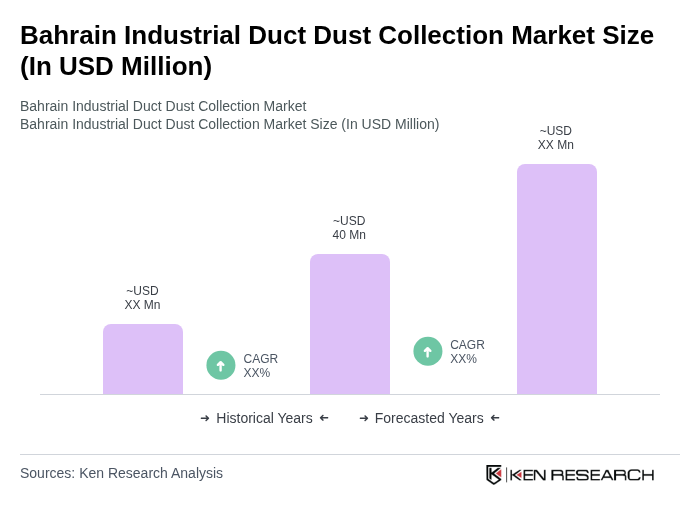
- The Bahrain Industrial Duct Dust Collection Market is valued at USD 40 million, based on a five-year historical analysis and its share within the wider Middle East and Africa industrial dust collector market, which generated revenues of around USD 590 million regionally. This growth is primarily driven by increasing industrial activities in sectors such as metals, cement, chemicals, and logistics, rapid expansion of HVAC and air-duct infrastructure, and a growing focus on indoor air quality and workplace safety in industrial and large commercial facilities. The demand for efficient dust collection systems has surged as industries seek to comply with occupational health, environmental performance, and energy-efficiency objectives while enhancing operational reliability.
- Key demand centers in this market include Manama, the capital city, which serves as a hub for manufacturing, logistics, metal fabrication, and construction-related activities, along with industrial zones such as Bahrain International Investment Park and other designated industrial areas across the Kingdom. The concentration of manufacturing, warehousing, and infrastructure projects in these areas drives the adoption of central ducted and point-source dust collection solutions integrated with HVAC and process ventilation, making these zones pivotal in maintaining air quality and compliance with environmental and occupational standards.
- Industrial dust and fume control requirements in Bahrain are framed under national environmental and occupational health legislation, including the Environment Law promulgated by Legislative Decree No. 21 of 1996 and its implementing regulations issued by the Supreme Council for Environment, which set emission limits for particulate matter from industrial sources and require appropriate pollution control equipment. In parallel, the Labour Law and related ministerial decisions of the Ministry of Labour and Social Development mandate employers to provide safe working environments and manage exposure to hazardous dusts and fumes through engineering controls such as local exhaust ventilation and filtration systems. Together, these instruments drive investment in ducted dust collection and industrial ventilation systems, as businesses prioritize compliance, worker health protection, and long-term operational sustainability.
Bahrain Industrial Duct Dust Collection Market Segmentation
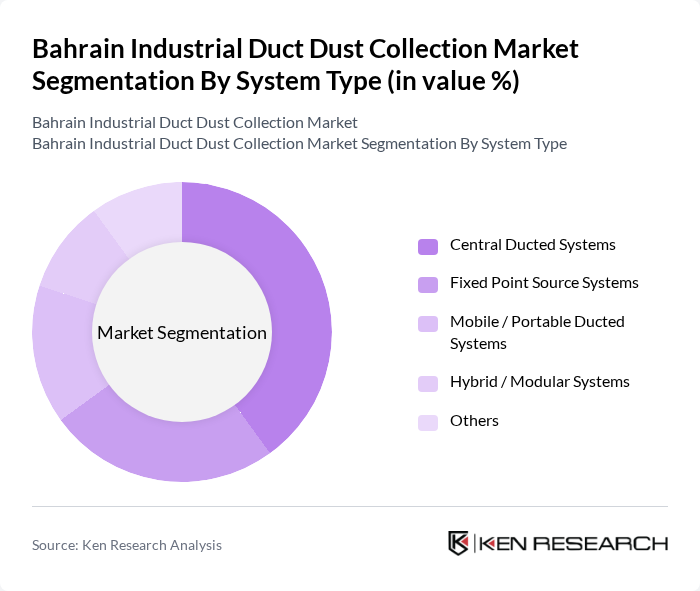
By System Type:The market is segmented into various system types, including Central Ducted Systems, Fixed Point Source Systems, Mobile / Portable Ducted Systems, Hybrid / Modular Systems, and Others. Central Ducted Systems hold a leading share of the installed base, in line with the dominance of fixed dust collectors globally, where fixed systems account for more than sixty percent of deployments in large-scale, continuous operations. These systems are widely used in manufacturing, metalworking, cement, and large warehousing or logistics facilities, where they can handle high airflows and large volumes of dust and particulate matter while integrating with HVAC and process ventilation to help meet stringent air quality and emission requirements. Mobile / portable and hybrid or modular systems are increasingly adopted in smaller workshops, maintenance operations, and applications with frequently changing layouts, reflecting the broader trend toward flexible and scalable dust control solutions.
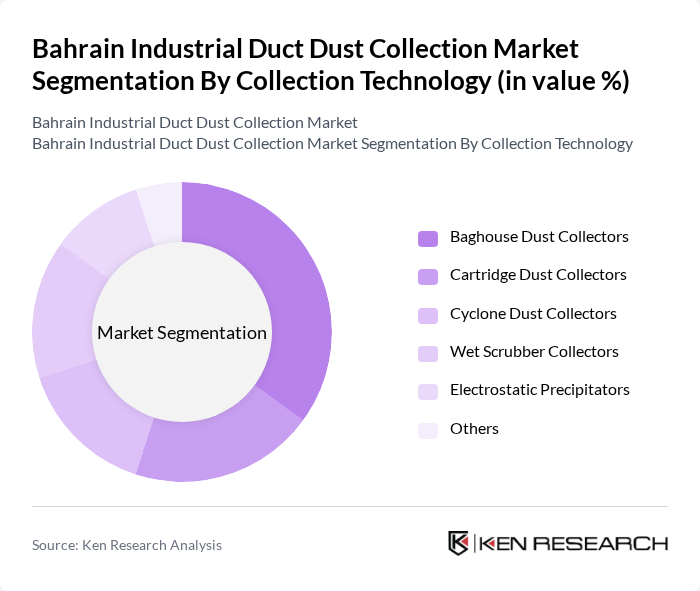
By Collection Technology:The market is also segmented by collection technology, which includes Baghouse Dust Collectors, Cartridge Dust Collectors, Cyclone Dust Collectors, Wet Scrubber Collectors, Electrostatic Precipitators, and Others. Baghouse Dust Collectors are the leading technology segment globally, accounting for the largest share due to their high filtration efficiency and ability to manage both fine and coarse particulate in heavy-duty industrial environments. This pattern is reflected in Bahrain, where baghouse systems are commonly adopted in cement, steel, and bulk material handling operations, while cartridge collectors are favored in applications requiring compact footprints and high efficiency for fine dust, such as metalworking and pharmaceuticals. Cyclone collectors and wet scrubbers are typically used as pre-cleaners or in processes with high dust loading or where dust is sticky or combustible, and electrostatic precipitators are applied selectively in larger combustion and process gas applications.
Bahrain Industrial Duct Dust Collection Market Competitive Landscape
The Bahrain Industrial Duct Dust Collection Market is characterized by a dynamic mix of regional and international players. Leading participants such as Nederman Holding AB, Donaldson Company, Inc., Camfil AB, Parker Hannifin Corporation, Keller Lufttechnik GmbH + Co. KG, AAF International (Daikin Industries, Ltd.), TBK Metal Co., Ltd., Almoayyed Air Conditioning, Zamil Air Conditioners & Industrial Cooling, Trane Technologies plc, Systemair AB, FläktGroup, Johnson Controls International plc, Trox GmbH, Thermax Limited contribute to innovation, geographic expansion, and service delivery in this space.
Bahrain Industrial Duct Dust Collection Market Industry Analysis
Growth Drivers
- Increasing Industrialization in Bahrain:Bahrain's industrial sector has seen a significant boost, with the manufacturing output reaching approximately $3.0 billion in future. This growth is driven by government initiatives aimed at diversifying the economy, which is projected to contribute to a 5% increase in industrial activities in future. As industries expand, the demand for efficient dust collection systems rises, creating a robust market for these solutions.
- Stringent Environmental Regulations:The Bahraini government has implemented strict environmental regulations, including the National Environmental Strategy, which mandates emission reductions. In future, compliance costs for industries are expected to rise by 20%, pushing companies to invest in advanced dust collection systems. This regulatory pressure is a key driver for the adoption of effective dust management solutions, ensuring cleaner air and compliance with international standards.
- Rising Awareness of Workplace Safety:With workplace safety becoming a priority, Bahrain has seen a 25% increase in safety training programs since the previous year. The focus on reducing occupational hazards, particularly in manufacturing and construction, has led to a heightened demand for dust collection systems. In future, companies are expected to allocate an additional $600 million towards safety improvements, further driving the market for dust collection technologies.
Market Challenges
- High Initial Investment Costs:The upfront costs associated with installing industrial dust collection systems can be prohibitive, often exceeding $120,000 for comprehensive setups. Many small to medium-sized enterprises (SMEs) in Bahrain struggle to justify these expenses, especially when operating on tight budgets. This financial barrier limits market penetration and adoption rates, hindering overall growth in the dust collection sector.
- Maintenance and Operational Complexities:The complexity of maintaining advanced dust collection systems poses a significant challenge for many businesses. In future, approximately 35% of companies reported operational downtime due to maintenance issues. This not only affects productivity but also increases operational costs, discouraging investment in new systems. The need for specialized training and skilled personnel further complicates the situation for many industries.
Bahrain Industrial Duct Dust Collection Market Future Outlook
The Bahrain Industrial Duct Dust Collection Market is poised for significant transformation as industries increasingly adopt automated and smart technologies. In future, the integration of IoT in dust management systems is expected to enhance operational efficiency, allowing for real-time monitoring and maintenance. Additionally, the growing emphasis on sustainability will drive innovations in energy-efficient dust collection solutions, aligning with global trends towards greener industrial practices and compliance with stringent environmental regulations.
Market Opportunities
- Expansion of Manufacturing Sectors:The Bahraini government aims to increase the manufacturing sector's contribution to GDP by 15% in future. This expansion presents a significant opportunity for dust collection system providers, as new facilities will require efficient dust management solutions to meet regulatory standards and ensure workplace safety.
- Government Incentives for Pollution Control:In future, the Bahraini government plans to introduce financial incentives for companies investing in pollution control technologies, including dust collection systems. These incentives could reduce installation costs by up to 30%, making it more feasible for businesses to adopt advanced solutions and comply with environmental regulations.
Scope of the Report
| Segment | Sub-Segments |
|---|---|
| By System Type | Central Ducted Systems Fixed Point Source Systems Mobile / Portable Ducted Systems Hybrid / Modular Systems Others |
| By Collection Technology | Baghouse Dust Collectors Cartridge Dust Collectors Cyclone Dust Collectors Wet Scrubber Collectors Electrostatic Precipitators Others |
| By Duct Material | Galvanized Steel Ducts Stainless Steel Ducts Aluminum Ducts PVC / Plastic Ducts Others |
| By Industry Vertical | Metals & Metalworking Cement & Construction Materials Chemicals & Petrochemicals Food & Beverage Processing Pharmaceuticals Woodworking & Furniture Others |
| By Application Environment | Process Dust Extraction Material Handling & Transfer Points Warehouse & Bulk Storage Ventilation Fine Dust / Fume Extraction Others |
| By Mobility | Fixed / Stationary Systems Portable / Mobile Units Skid-Mounted Modular Systems Others |
| By Ownership / Service Model | Capex Purchase Lease / Rental Dust Collection-as-a-Service (DCaaS) Operation & Maintenance Contracts Others |
Key Target Audience
Investors and Venture Capitalist Firms
Government and Regulatory Bodies (e.g., Ministry of Industry and Commerce, Environmental Affairs Authority)
Manufacturers and Producers of Dust Collection Systems
Distributors and Retailers of Industrial Equipment
Construction and Engineering Firms
Facility Management Companies
Industry Associations (e.g., Bahrain Chamber of Commerce and Industry)
Financial Institutions and Banks
Players Mentioned in the Report:
Nederman Holding AB
Donaldson Company, Inc.
Camfil AB
Parker Hannifin Corporation
Keller Lufttechnik GmbH + Co. KG
AAF International (Daikin Industries, Ltd.)
TBK Metal Co., Ltd.
Almoayyed Air Conditioning
Zamil Air Conditioners & Industrial Cooling
Trane Technologies plc
Systemair AB
FlaktGroup
Johnson Controls International plc
Trox GmbH
Thermax Limited
Table of Contents
Market Assessment Phase
1. Executive Summary and Approach
2. Bahrain Industrial Duct Dust Collection Market Overview
2.1 Key Insights and Strategic Recommendations
2.2 Bahrain Industrial Duct Dust Collection Market Overview
2.3 Definition and Scope
2.4 Evolution of Market Ecosystem
2.5 Timeline of Key Regulatory Milestones
2.6 Value Chain & Stakeholder Mapping
2.7 Business Cycle Analysis
2.8 Policy & Incentive Landscape
3. Bahrain Industrial Duct Dust Collection Market Analysis
3.1 Growth Drivers
3.1.1 Increasing industrialization in Bahrain
3.1.2 Stringent environmental regulations
3.1.3 Rising awareness of workplace safety
3.1.4 Technological advancements in dust collection systems
3.2 Market Challenges
3.2.1 High initial investment costs
3.2.2 Limited awareness among small businesses
3.2.3 Maintenance and operational complexities
3.2.4 Competition from alternative solutions
3.3 Market Opportunities
3.3.1 Expansion of manufacturing sectors
3.3.2 Government incentives for pollution control
3.3.3 Adoption of smart dust collection technologies
3.3.4 Growing demand for energy-efficient systems
3.4 Market Trends
3.4.1 Shift towards automated dust collection systems
3.4.2 Integration of IoT in dust management
3.4.3 Increasing focus on sustainability
3.4.4 Customization of solutions for specific industries
3.5 Government Regulation
3.5.1 Emission control standards
3.5.2 Health and safety regulations
3.5.3 Incentives for green technologies
3.5.4 Compliance requirements for industrial operations
4. SWOT Analysis
5. Stakeholder Analysis
6. Porter's Five Forces Analysis
7. Bahrain Industrial Duct Dust Collection Market Size, 2019-2024
7.1 By Value
7.2 By Volume
7.3 By Average Selling Price
8. Bahrain Industrial Duct Dust Collection Market Segmentation
8.1 By System Type
8.1.1 Central Ducted Systems
8.1.2 Fixed Point Source Systems
8.1.3 Mobile / Portable Ducted Systems
8.1.4 Hybrid / Modular Systems
8.1.5 Others
8.2 By Collection Technology
8.2.1 Baghouse Dust Collectors
8.2.2 Cartridge Dust Collectors
8.2.3 Cyclone Dust Collectors
8.2.4 Wet Scrubber Collectors
8.2.5 Electrostatic Precipitators
8.2.6 Others
8.3 By Duct Material
8.3.1 Galvanized Steel Ducts
8.3.2 Stainless Steel Ducts
8.3.3 Aluminum Ducts
8.3.4 PVC / Plastic Ducts
8.3.5 Others
8.4 By Industry Vertical
8.4.1 Metals & Metalworking
8.4.2 Cement & Construction Materials
8.4.3 Chemicals & Petrochemicals
8.4.4 Food & Beverage Processing
8.4.5 Pharmaceuticals
8.4.6 Woodworking & Furniture
8.4.7 Others
8.5 By Application Environment
8.5.1 Process Dust Extraction
8.5.2 Material Handling & Transfer Points
8.5.3 Warehouse & Bulk Storage Ventilation
8.5.4 Fine Dust / Fume Extraction
8.5.5 Others
8.6 By Mobility
8.6.1 Fixed / Stationary Systems
8.6.2 Portable / Mobile Units
8.6.3 Skid-Mounted Modular Systems
8.6.4 Others
8.7 By Ownership / Service Model
8.7.1 Capex Purchase
8.7.2 Lease / Rental
8.7.3 Dust Collection-as-a-Service (DCaaS)
8.7.4 Operation & Maintenance Contracts
8.7.5 Others
9. Bahrain Industrial Duct Dust Collection Market Competitive Analysis
9.1 Market Share of Key Players
9.2 Cross Comparison of Key Players
9.2.1 Company Name
9.2.2 Group Size (Large, Medium, or Small as per industry convention)
9.2.3 Bahrain Industrial Duct Dust Collection Revenue (USD Million)
9.2.4 3-Year Revenue CAGR (%)
9.2.5 EBITDA Margin (%)
9.2.6 Market Share (%)
9.2.7 Installed Base in Bahrain (Number of Systems)
9.2.8 Order Backlog / New Order Intake (Annual, USD Million)
9.2.9 Average Project Ticket Size (USD)
9.2.10 Win Rate in Competitive Bids (%)
9.2.11 R&D / Innovation Spend (% of Revenue)
9.2.12 On-Time Project Delivery Rate (%)
9.2.13 Service Revenue Share (% of Total)
9.2.14 Customer Retention Rate (%)
9.2.15 Net Promoter Score (NPS)
9.3 SWOT Analysis of Top Players
9.4 Pricing Analysis
9.5 Detailed Profile of Major Companies
9.5.1 Nederman Holding AB
9.5.2 Donaldson Company, Inc.
9.5.3 Camfil AB
9.5.4 Parker Hannifin Corporation
9.5.5 Keller Lufttechnik GmbH + Co. KG
9.5.6 AAF International (Daikin Industries, Ltd.)
9.5.7 TBK Metal Co., Ltd.
9.5.8 Almoayyed Air Conditioning
9.5.9 Zamil Air Conditioners & Industrial Cooling
9.5.10 Trane Technologies plc
9.5.11 Systemair AB
9.5.12 FläktGroup
9.5.13 Johnson Controls International plc
9.5.14 Trox GmbH
9.5.15 Thermax Limited
10. Bahrain Industrial Duct Dust Collection Market End-User Analysis
10.1 Procurement Behavior of Key Ministries
10.1.1 Ministry of Industry and Commerce
10.1.2 Ministry of Health
10.1.3 Ministry of Environment
10.1.4 Ministry of Works
10.2 Corporate Spend on Infrastructure & Energy
10.2.1 Investment in Dust Collection Systems
10.2.2 Budget Allocation for Environmental Compliance
10.2.3 Spending on Safety Equipment
10.2.4 Corporate Sustainability Initiatives
10.3 Pain Point Analysis by End-User Category
10.3.1 Manufacturing Sector Challenges
10.3.2 Construction Sector Challenges
10.3.3 Food Processing Sector Challenges
10.3.4 Pharmaceutical Sector Challenges
10.4 User Readiness for Adoption
10.4.1 Awareness of Dust Collection Solutions
10.4.2 Training and Support Needs
10.4.3 Financial Readiness
10.4.4 Technological Readiness
10.5 Post-Deployment ROI and Use Case Expansion
10.5.1 Measurement of ROI
10.5.2 Case Studies of Successful Implementations
10.5.3 Potential for Upscaling Solutions
10.5.4 User Feedback and Improvement Areas
11. Bahrain Industrial Duct Dust Collection Market Future Size, 2025-2030
11.1 By Value
11.2 By Volume
11.3 By Average Selling Price
Go-To-Market Strategy Phase
1. Whitespace Analysis + Business Model Canvas
1.1 Market Gaps Identification
1.2 Business Model Development
2. Marketing and Positioning Recommendations
2.1 Branding Strategies
2.2 Product USPs
3. Distribution Plan
3.1 Urban Retail vs Rural NGO Tie-ups
4. Channel & Pricing Gaps
4.1 Underserved Routes
4.2 Pricing Bands
5. Unmet Demand & Latent Needs
5.1 Category Gaps
5.2 Consumer Segments
6. Customer Relationship
6.1 Loyalty Programs
6.2 After-sales Service
7. Value Proposition
7.1 Sustainability
7.2 Integrated Supply Chains
8. Key Activities
8.1 Regulatory Compliance
8.2 Branding
8.3 Distribution Setup
9. Entry Strategy Evaluation
9.1 Domestic Market Entry Strategy
9.1.1 Product Mix
9.1.2 Pricing Band
9.1.3 Packaging
9.2 Export Entry Strategy
9.2.1 Target Countries
9.2.2 Compliance Roadmap
10. Entry Mode Assessment
10.1 JV
10.2 Greenfield
10.3 M&A
10.4 Distributor Model
11. Capital and Timeline Estimation
11.1 Capital Requirements
11.2 Timelines
12. Control vs Risk Trade-Off
12.1 Ownership vs Partnerships
13. Profitability Outlook
13.1 Breakeven Analysis
13.2 Long-term Sustainability
14. Potential Partner List
14.1 Distributors
14.2 JVs
14.3 Acquisition Targets
15. Execution Roadmap
15.1 Phased Plan for Market Entry
15.1.1 Market Setup
15.1.2 Market Entry
15.1.3 Growth Acceleration
15.1.4 Scale & Stabilize
15.2 Key Activities and Milestones
15.2.1 Milestone Planning
15.2.2 Activity Tracking
Research Methodology
Phase 1: Approach1
Desk Research
- Industry reports from Bahrain's Ministry of Industry and Commerce
- Market analysis publications from local trade associations and chambers of commerce
- Academic journals and white papers focusing on industrial dust collection technologies
Primary Research
- Interviews with facility managers in manufacturing plants across Bahrain
- Surveys targeting environmental compliance officers in industrial sectors
- Field visits to dust collection system installations for firsthand observations
Validation & Triangulation
- Cross-validation of data through multiple industry sources and expert opinions
- Triangulation of findings from primary interviews and secondary data sources
- Sanity checks conducted through expert panel discussions with industry veterans
Phase 2: Market Size Estimation1
Top-down Assessment
- Analysis of Bahrain's industrial output and its correlation with dust collection needs
- Estimation of market size based on national environmental regulations and compliance requirements
- Segmentation of the market by industry verticals such as manufacturing, construction, and food processing
Bottom-up Modeling
- Collection of data on installed dust collection systems from major industrial players
- Estimation of market share based on sales data from leading equipment suppliers
- Cost analysis of dust collection systems including installation and maintenance expenses
Forecasting & Scenario Analysis
- Multi-variable forecasting using economic growth rates and industrial expansion projections
- Scenario analysis based on potential regulatory changes and technological advancements
- Development of baseline, optimistic, and pessimistic market growth scenarios through 2030
Phase 3: CATI Sample Composition1
| Scope Item/Segment | Sample Size | Target Respondent Profiles |
|---|---|---|
| Manufacturing Sector Dust Collection | 100 | Plant Managers, Environmental Compliance Officers |
| Construction Industry Air Quality Management | 60 | Site Supervisors, Safety Managers |
| Food Processing Dust Control Systems | 50 | Quality Assurance Managers, Operations Directors |
| Pharmaceutical Manufacturing Dust Collection | 40 | Production Managers, Regulatory Affairs Specialists |
| Textile Industry Air Filtration Solutions | 70 | Production Supervisors, Environmental Health Officers |
Frequently Asked Questions
What is the current value of the Bahrain Industrial Duct Dust Collection Market?
The Bahrain Industrial Duct Dust Collection Market is valued at approximately USD 40 million, reflecting its share within the broader Middle East and Africa industrial dust collector market, which generates around USD 590 million in revenue.
What are the key drivers of growth in the Bahrain Industrial Duct Dust Collection Market?
Which areas in Bahrain are the primary demand centers for dust collection systems?
What types of dust collection systems are prevalent in Bahrain?
Other Regional/Country Reports
Other Adjacent Reports
Malaysia Industrial Ventilation Market
Egypt Air Pollution Control Equipment Market
Brazil Dust Suppression Systems Market
Belgium Fume Extraction Market
Bahrain Environmental Monitoring Equipment Market
South Korea Occupational Health and Safety Market
Malaysia Filtration Media Market
Philippines Industrial Cleaning Equipment Market
Why Buy From Us?

What makes us stand out is that our consultants follow Robust, Refine and Result (RRR) methodology. Robust for clear definitions, approaches and sanity checking, Refine for differentiating respondents' facts and opinions, and Result for presenting data with story.

We have set a benchmark in the industry by offering our clients with syndicated and customized market research reports featuring coverage of entire market as well as meticulous research and analyst insights.

While we don't replace traditional research, we flip the method upside down. Our dual approach of Top Bottom & Bottom Top ensures quality deliverable by not just verifying company fundamentals but also looking at the sector and macroeconomic factors.

With one step in the future, our research team constantly tries to show you the bigger picture. We help with some of the tough questions you may encounter along the way: How is the industry positioned? Best marketing channel? KPI's of competitors? By aligning every element, we help maximize success.

Our report gives you instant access to the answers and sources that other companies might choose to hide. We elaborate each steps of research methodology we have used and showcase you the sample size to earn your trust.

If you need any support, we are here! We pride ourselves on universe strength, data quality, and quick, friendly, and professional service.