About the Report
Base Year 2024Bahrain Metal Forging Market Overview
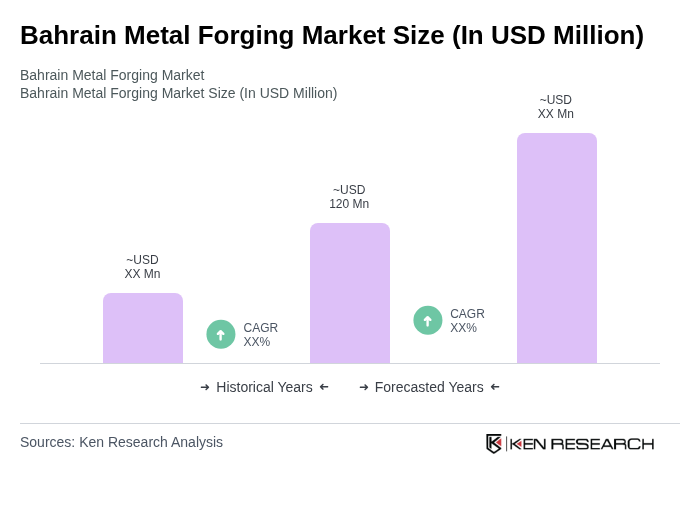
- The Bahrain Metal Forging Market is valued at USD 120 million, based on a five?year historical analysis and Bahrain’s share within the GCC metal forging market, which was valued at about USD 1.19 billion for the wider region. This growth is primarily driven by the increasing demand for forged components in key downstream industries such as automotive and commercial vehicles, construction, and oil and gas, supported by ongoing industrial diversification and infrastructure projects in Bahrain. The market is also supported by advancements in forging technologies, the rising trend of lightweight materials (notably aluminum) in manufacturing processes, and increasing use of forged components in energy, industrial machinery, and marine applications across the GCC.
- Key players in this market include Bahrain Steel B.S.C. (SULB), Aluminum Bahrain B.S.C. (Alba), and GARMCO (Gulf Aluminium Rolling Mill B.S.C.), which operate as major producers of steel and aluminum semi?finished products used as critical inputs for forging and other metalworking activities in Bahrain and the wider GCC. These companies hold a strong position due to their established production capabilities, strong distribution networks, and commitment to quality, serving both local and export markets across the Middle East, Europe, and Asia.
- In 2023, the Bahraini government further reinforced its industrial sustainability agenda through instruments such as the National Energy Efficiency Action Plan and the Kingdom of Bahrain’s Updated Nationally Determined Contribution, alongside implementation of Cabinet Resolution No. 2 of 2022 issuing the Low Carbon Strategy for Bahrain, which together set binding sector?level targets for energy efficiency and greenhouse gas reduction in energy?intensive industries including metals. These policies encourage metal and forging?related companies to adopt energy?efficient technologies, increase the share of cleaner fuels and electricity, and progressively reduce carbon emissions intensity in production, fostering a more environmentally friendly manufacturing environment aligned with Bahrain Economic Vision 2030.
Bahrain Metal Forging Market Segmentation
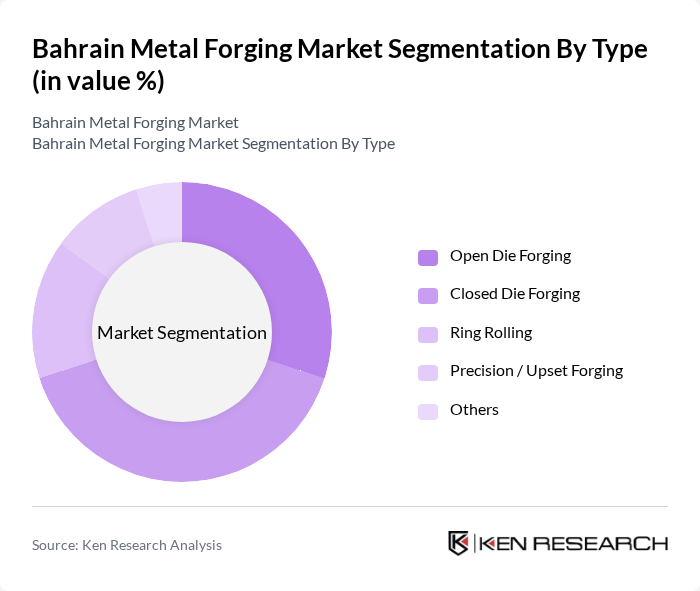
By Type:The market is segmented into various types of forging processes, including Open Die Forging, Closed Die Forging, Ring Rolling, Precision/Upset Forging, and Others. Open Die Forging is widely used due to its versatility and ability to produce large components, particularly for oil and gas, power, and heavy industrial applications where large shafts, rings, and blocks are required. Closed Die Forging is favored for its precision and efficiency in mass production of automotive, machinery, and aerospace parts, where tight tolerances and repeatability are critical. Ring Rolling is gaining traction in industries requiring high-strength, fatigue?resistant components such as bearings, flanges, and gear rings used in energy, petrochemical, and transportation sectors. Precision/Upset Forging is increasingly adopted for its ability to minimize material waste, improve buy?to?fly ratios, and enhance mechanical properties in high?value components for automotive, aerospace, and industrial machinery.
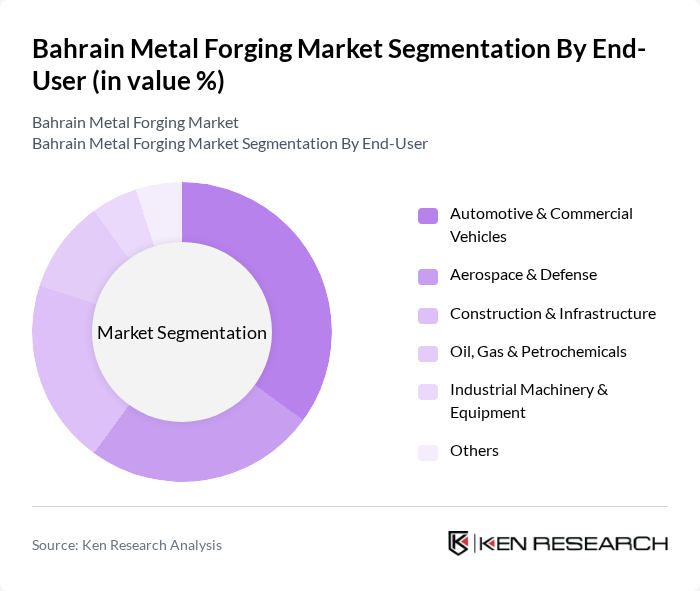
By End-User:The end-user segmentation includes Automotive & Commercial Vehicles, Aerospace & Defense, Construction & Infrastructure, Oil, Gas & Petrochemicals, Industrial Machinery & Equipment, and Others. The automotive and commercial vehicles sector remains a leading consumer of forged components across the GCC, driven by the requirement for lightweight yet durable parts such as crankshafts, connecting rods, and suspension components, and supported by growing vehicle parc and aftermarket demand in the wider region. The aerospace and defense industry also contributes to demand through the use of high?performance forged alloys in landing gear, engine components, and structural parts, reflecting regional investments in aviation fleets and defense capabilities. The construction and infrastructure segment continues to expand in Bahrain and neighboring GCC countries, fueling demand for forged fasteners, fittings, flanges, and structural connection elements used in buildings, industrial facilities, and energy projects, alongside steady requirements from oil, gas and petrochemicals and general industrial machinery.
Bahrain Metal Forging Market Competitive Landscape
The Bahrain Metal Forging Market is characterized by a dynamic mix of regional and international players. Leading participants such as Aluminum Bahrain B.S.C. (Alba), Bahrain Steel B.S.C. (SULB), Bahrain Industrial Investment Company B.S.C. (BIIC), GARMCO (Gulf Aluminium Rolling Mill B.S.C.), MIDAL Cables B.S.C., Balexco (Bahrain Aluminium Extrusion Company B.S.C.), ASRY – Arab Shipbuilding & Repair Yard Company, BFG International W.L.L., Y.K. Almoayyed & Sons B.S.C. (c), Kanoo Industrial & Energy (Yusuf Bin Ahmed Kanoo Group), Kooheji Contractors & Industrial Services, Mohammed Jalal & Sons Group, Dadabhai Group – Industrial & Construction Division, Ahmed Mansoor Al A’Ali Group (AMA Group), Nass Industrial Services – Nass The Group contribute to innovation, geographic expansion, and service delivery in this space.
Bahrain Metal Forging Market Industry Analysis
Growth Drivers
- Increasing Demand from the Automotive Sector:The automotive sector in Bahrain is projected to grow significantly, with vehicle production expected to reach 100,000 units in future. This surge is driven by rising consumer demand and government initiatives to boost local manufacturing. As a result, the demand for forged components, which are critical for vehicle performance and safety, is anticipated to increase, providing a substantial growth opportunity for the metal forging industry.
- Expansion of Construction Activities:Bahrain's construction sector is set to expand, with investments projected to exceed $2.5 billion in future. Major projects include the Bahrain Bay development and the expansion of the Bahrain International Airport. This growth will drive demand for forged metal products used in structural applications, reinforcing the metal forging market's position as a key supplier to the construction industry, thereby enhancing overall market growth.
- Technological Advancements in Forging Processes:The adoption of advanced forging technologies, such as computer numerical control (CNC) and automated forging systems, is expected to enhance production efficiency in Bahrain. In future, investments in these technologies are projected to reach $200 million, leading to improved product quality and reduced lead times. This technological shift will enable local manufacturers to meet the increasing demand for high-precision forged components, further driving market growth.
Market Challenges
- High Energy Costs:Energy costs in Bahrain are among the highest in the region, with industrial electricity prices averaging $0.15 per kWh. This poses a significant challenge for metal forging companies, as energy-intensive processes can lead to increased operational costs. As manufacturers strive to maintain profitability, high energy expenses may hinder their ability to invest in growth and innovation, impacting overall market competitiveness.
- Limited Availability of Skilled Labor:The metal forging industry in Bahrain faces a shortage of skilled labor, with an estimated 25% of positions remaining unfilled due to a lack of qualified candidates. This skills gap is exacerbated by the rapid technological advancements in the sector, which require specialized training. Consequently, the inability to attract and retain skilled workers may impede production capabilities and limit the industry's growth potential.
Bahrain Metal Forging Market Future Outlook
The Bahrain metal forging market is poised for significant transformation, driven by technological advancements and increasing demand from key sectors. As the automotive and construction industries expand, manufacturers are likely to adopt more sustainable practices and automation technologies. This shift will not only enhance efficiency but also align with global trends towards environmentally friendly production. Furthermore, collaboration with tech startups may foster innovation, enabling local firms to remain competitive in a rapidly evolving market landscape.
Market Opportunities
- Growth in Renewable Energy Projects:With Bahrain's commitment to diversifying its energy sources, investments in renewable energy projects are expected to exceed $1.5 billion in future. This growth presents opportunities for the metal forging industry to supply components for wind and solar energy systems, enhancing market prospects and contributing to sustainable development goals.
- Increasing Exports to Neighboring Countries:Bahrain's strategic location allows for easy access to regional markets, with exports of forged products projected to reach $350 million in future. This potential for increased trade with neighboring countries, particularly in the Gulf Cooperation Council (GCC), offers significant growth opportunities for local manufacturers, enhancing their market presence and profitability.
Scope of the Report
| Segment | Sub-Segments |
|---|---|
| By Type | Open Die Forging Closed Die Forging Ring Rolling Precision / Upset Forging Others |
| By End-User | Automotive & Commercial Vehicles Aerospace & Defense Construction & Infrastructure Oil, Gas & Petrochemicals Industrial Machinery & Equipment Others |
| By Material | Carbon & Alloy Steel Stainless Steel Aluminum & Aluminum Alloys Titanium & Nickel Alloys Copper & Other Non?ferrous Metals |
| By Application | Automotive Powertrain & Chassis Components Valves, Flanges & Fittings for Oil & Gas Industrial Machinery & Heavy Equipment Parts Construction & Structural Components Aerospace & Marine Components Others |
| By Process | Hot Forging Cold Forging Warm Forging Others |
| By Distribution Channel | Direct Sales to OEMs Industrial Distributors & Stockists EPC & Project-Based Supply Contracts Online / E?procurement Platforms Others |
| By Region | Capital Governorate Northern Governorate Southern Governorate Muharraq Governorate |
Key Target Audience
Investors and Venture Capitalist Firms
Government and Regulatory Bodies (e.g., Ministry of Industry and Commerce, Bahrain Economic Development Board)
Manufacturers and Producers
Distributors and Retailers
Metal Forging Equipment Suppliers
Industry Associations (e.g., Bahrain Chamber of Commerce and Industry)
Financial Institutions
Construction and Infrastructure Companies
Players Mentioned in the Report:
Aluminum Bahrain B.S.C. (Alba)
Bahrain Steel B.S.C. (SULB)
Bahrain Industrial Investment Company B.S.C. (BIIC)
GARMCO (Gulf Aluminium Rolling Mill B.S.C.)
MIDAL Cables B.S.C.
Balexco (Bahrain Aluminium Extrusion Company B.S.C.)
ASRY Arab Shipbuilding & Repair Yard Company
BFG International W.L.L.
Y.K. Almoayyed & Sons B.S.C. (c)
Kanoo Industrial & Energy (Yusuf Bin Ahmed Kanoo Group)
Kooheji Contractors & Industrial Services
Mohammed Jalal & Sons Group
Dadabhai Group Industrial & Construction Division
Ahmed Mansoor Al AAli Group (AMA Group)
Nass Industrial Services Nass The Group
Table of Contents
Market Assessment Phase
1. Executive Summary and Approach
2. Bahrain Metal Forging Market Overview
2.1 Key Insights and Strategic Recommendations
2.2 Bahrain Metal Forging Market Overview
2.3 Definition and Scope
2.4 Evolution of Market Ecosystem
2.5 Timeline of Key Regulatory Milestones
2.6 Value Chain & Stakeholder Mapping
2.7 Business Cycle Analysis
2.8 Policy & Incentive Landscape
3. Bahrain Metal Forging Market Analysis
3.1 Growth Drivers
3.1.1 Increasing demand from the automotive sector
3.1.2 Expansion of construction activities
3.1.3 Technological advancements in forging processes
3.1.4 Rising investments in infrastructure development
3.2 Market Challenges
3.2.1 High energy costs
3.2.2 Limited availability of skilled labor
3.2.3 Stringent environmental regulations
3.2.4 Fluctuating raw material prices
3.3 Market Opportunities
3.3.1 Growth in renewable energy projects
3.3.2 Increasing exports to neighboring countries
3.3.3 Adoption of automation in manufacturing
3.3.4 Development of lightweight materials
3.4 Market Trends
3.4.1 Shift towards sustainable manufacturing practices
3.4.2 Integration of Industry 4.0 technologies
3.4.3 Customization of forged products
3.4.4 Collaboration with tech startups for innovation
3.5 Government Regulation
3.5.1 Compliance with international quality standards
3.5.2 Incentives for energy-efficient technologies
3.5.3 Regulations on waste management
3.5.4 Import tariffs on raw materials
4. SWOT Analysis
5. Stakeholder Analysis
6. Porter's Five Forces Analysis
7. Bahrain Metal Forging Market Market Size, 2019-2024
7.1 By Value
7.2 By Volume
7.3 By Average Selling Price
8. Bahrain Metal Forging Market Segmentation
8.1 By Type
8.1.1 Open Die Forging
8.1.2 Closed Die Forging
8.1.3 Ring Rolling
8.1.4 Precision / Upset Forging
8.1.5 Others
8.2 By End-User
8.2.1 Automotive & Commercial Vehicles
8.2.2 Aerospace & Defense
8.2.3 Construction & Infrastructure
8.2.4 Oil, Gas & Petrochemicals
8.2.5 Industrial Machinery & Equipment
8.2.6 Others
8.3 By Material
8.3.1 Carbon & Alloy Steel
8.3.2 Stainless Steel
8.3.3 Aluminum & Aluminum Alloys
8.3.4 Titanium & Nickel Alloys
8.3.5 Copper & Other Non?ferrous Metals
8.4 By Application
8.4.1 Automotive Powertrain & Chassis Components
8.4.2 Valves, Flanges & Fittings for Oil & Gas
8.4.3 Industrial Machinery & Heavy Equipment Parts
8.4.4 Construction & Structural Components
8.4.5 Aerospace & Marine Components
8.4.6 Others
8.5 By Process
8.5.1 Hot Forging
8.5.2 Cold Forging
8.5.3 Warm Forging
8.5.4 Others
8.6 By Distribution Channel
8.6.1 Direct Sales to OEMs
8.6.2 Industrial Distributors & Stockists
8.6.3 EPC & Project-Based Supply Contracts
8.6.4 Online / E?procurement Platforms
8.6.5 Others
8.7 By Region
8.7.1 Capital Governorate
8.7.2 Northern Governorate
8.7.3 Southern Governorate
8.7.4 Muharraq Governorate
9. Bahrain Metal Forging Market Competitive Analysis
9.1 Market Share of Key Players
9.2 Cross Comparison of Key Players
9.2.1 Company Name
9.2.2 Ownership Type (Local, Regional, International JV)
9.2.3 Group Size (Large, Medium, or Small as per industry convention)
9.2.4 Bahrain Metal Forging Revenue (USD Million, Latest Year)
9.2.5 3?Year Revenue CAGR in Bahrain Forging Operations
9.2.6 Installed Forging Capacity in Bahrain (Tons/Year)
9.2.7 Capacity Utilization Rate (%)
9.2.8 Share of Exports in Sales (%)
9.2.9 Share of Automotive & Oil & Gas in Revenue (%)
9.2.10 EBITDA Margin from Forging Operations (%)
9.2.11 Average Order Size / Contract Value
9.2.12 Lead Time from Order to Delivery (Days)
9.2.13 On?Time Delivery Rate (%)
9.2.14 Scrap Rate / Yield Loss (%)
9.2.15 Energy Consumption per Ton Forged
9.2.16 Number of Active OEM / EPC Customers in GCC
9.2.17 R&D / Capex Intensity (% of Revenue)
9.2.18 Number of Product / Process Certifications (ISO, API, AS9100, etc.)
9.2.19 Average Selling Price per Ton by Key Product Category
9.2.20 Bahrain Market Share (%)
9.3 SWOT Analysis of Top Players
9.4 Pricing Analysis
9.5 Detailed Profile of Major Companies
9.5.1 Aluminum Bahrain B.S.C. (Alba)
9.5.2 Bahrain Steel B.S.C. (SULB)
9.5.3 Bahrain Industrial Investment Company B.S.C. (BIIC)
9.5.4 GARMCO (Gulf Aluminium Rolling Mill B.S.C.)
9.5.5 MIDAL Cables B.S.C.
9.5.6 Balexco (Bahrain Aluminium Extrusion Company B.S.C.)
9.5.7 ASRY – Arab Shipbuilding & Repair Yard Company
9.5.8 BFG International W.L.L.
9.5.9 Y.K. Almoayyed & Sons B.S.C. (c)
9.5.10 Kanoo Industrial & Energy (Yusuf Bin Ahmed Kanoo Group)
9.5.11 Kooheji Contractors & Industrial Services
9.5.12 Mohammed Jalal & Sons Group
9.5.13 Dadabhai Group – Industrial & Construction Division
9.5.14 Ahmed Mansoor Al A’Ali Group (AMA Group)
9.5.15 Nass Industrial Services – Nass The Group
10. Bahrain Metal Forging Market End-User Analysis
10.1 Procurement Behavior of Key Ministries
10.1.1 Ministry of Works
10.1.2 Ministry of Industry, Commerce and Tourism
10.1.3 Ministry of Oil
10.1.4 Ministry of Housing
10.2 Corporate Spend on Infrastructure & Energy
10.2.1 Investment in construction projects
10.2.2 Expenditure on energy-efficient technologies
10.2.3 Budget allocation for industrial upgrades
10.2.4 Funding for research and development
10.3 Pain Point Analysis by End-User Category
10.3.1 Automotive sector challenges
10.3.2 Construction industry issues
10.3.3 Aerospace sector requirements
10.3.4 Oil & Gas sector demands
10.4 User Readiness for Adoption
10.4.1 Awareness of new technologies
10.4.2 Training and skill development
10.4.3 Financial readiness for investment
10.4.4 Infrastructure support
10.5 Post-Deployment ROI and Use Case Expansion
10.5.1 Measurement of ROI
10.5.2 Case studies of successful implementations
10.5.3 Expansion into new applications
10.5.4 Long-term sustainability assessments
11. Bahrain Metal Forging Market Future Size, 2025-2030
11.1 By Value
11.2 By Volume
11.3 By Average Selling Price
Go-To-Market Strategy Phase
1. Whitespace Analysis + Business Model Canvas
1.1 Market Gaps Identification
1.2 Business Model Development
2. Marketing and Positioning Recommendations
2.1 Branding Strategies
2.2 Product USPs
3. Distribution Plan
3.1 Urban Retail Strategies
3.2 Rural NGO Tie-ups
4. Channel & Pricing Gaps
4.1 Underserved Routes
4.2 Pricing Bands Analysis
5. Unmet Demand & Latent Needs
5.1 Category Gaps
5.2 Consumer Segments
6. Customer Relationship
6.1 Loyalty Programs
6.2 After-sales Service
7. Value Proposition
7.1 Sustainability Initiatives
7.2 Integrated Supply Chains
8. Key Activities
8.1 Regulatory Compliance
8.2 Branding Efforts
8.3 Distribution Setup
9. Entry Strategy Evaluation
9.1 Domestic Market Entry Strategy
9.1.1 Product Mix Considerations
9.1.2 Pricing Band Strategy
9.1.3 Packaging Solutions
9.2 Export Entry Strategy
9.2.1 Target Countries Identification
9.2.2 Compliance Roadmap Development
10. Entry Mode Assessment
10.1 Joint Ventures
10.2 Greenfield Investments
10.3 Mergers & Acquisitions
10.4 Distributor Model Evaluation
11. Capital and Timeline Estimation
11.1 Capital Requirements
11.2 Timelines for Implementation
12. Control vs Risk Trade-Off
12.1 Ownership Considerations
12.2 Partnerships Evaluation
13. Profitability Outlook
13.1 Breakeven Analysis
13.2 Long-term Sustainability Assessment
14. Potential Partner List
14.1 Distributors Identification
14.2 Joint Ventures Opportunities
14.3 Acquisition Targets
15. Execution Roadmap
15.1 Phased Plan for Market Entry
15.1.1 Market Setup
15.1.2 Market Entry
15.1.3 Growth Acceleration
15.1.4 Scale & Stabilize
15.2 Key Activities and Milestones
15.2.1 Milestone Planning
15.2.2 Activity Tracking
Research Methodology
Phase 1: Approach1
Desk Research
- Industry reports from Bahrain's Ministry of Industry and Commerce
- Market analysis publications from regional trade associations
- Statistical data from the Bahrain Economic Development Board
Primary Research
- Interviews with key stakeholders in the metal forging industry, including manufacturers and suppliers
- Surveys targeting engineers and production managers in local forging companies
- Field visits to metal forging plants to gather firsthand insights on operations and challenges
Validation & Triangulation
- Cross-validation of findings through multiple data sources, including trade publications and government reports
- Triangulation of qualitative insights from interviews with quantitative data from surveys
- Sanity checks conducted through expert panel reviews comprising industry veterans
Phase 2: Market Size Estimation1
Top-down Assessment
- Analysis of Bahrain's overall manufacturing output to estimate the share attributed to metal forging
- Segmentation of the market by end-user industries such as automotive, construction, and aerospace
- Incorporation of macroeconomic indicators and government initiatives supporting manufacturing growth
Bottom-up Modeling
- Collection of production volume data from leading metal forging companies in Bahrain
- Estimation of average selling prices for various forged products across different sectors
- Calculation of market size based on production volume multiplied by average selling prices
Forecasting & Scenario Analysis
- Utilization of historical growth rates to project future market trends through 2030
- Scenario analysis based on potential changes in regulatory frameworks and international trade agreements
- Development of best-case, worst-case, and most-likely scenarios to assess market resilience
Phase 3: CATI Sample Composition1
| Scope Item/Segment | Sample Size | Target Respondent Profiles |
|---|---|---|
| Automotive Forging Applications | 60 | Production Managers, Quality Control Engineers |
| Construction Sector Forging Needs | 45 | Project Managers, Procurement Officers |
| Aerospace Component Manufacturing | 40 | Design Engineers, Operations Directors |
| General Industrial Forging | 55 | Manufacturing Supervisors, Supply Chain Managers |
| Forging Technology Innovations | 50 | R&D Managers, Technology Officers |
Frequently Asked Questions
What is the current value of the Bahrain Metal Forging Market?
The Bahrain Metal Forging Market is valued at approximately USD 120 million, reflecting its share within the larger GCC metal forging market, which is valued at around USD 1.19 billion. This valuation is based on a five-year historical analysis.
What are the key drivers of growth in the Bahrain Metal Forging Market?
Which industries are the primary consumers of forged components in Bahrain?
What types of forging processes are prevalent in Bahrain?
Other Regional/Country Reports
Indonesia Metal Forging Market
Malaysia Metal Forging Market
APAC Metal Forging Market
SEA Metal Forging Market
Vietnam Metal Forging Market
Other Adjacent Reports
South Africa Steel Production Market
Thailand Automotive Components Market
Malaysia Aerospace Parts Market
India Construction Materials Market Size, Share & Forecast, By Material Type, Application & End User, 2026-2031Brazil Oil and Gas Equipment Market
Philippines Industrial Machinery Market
Oman Renewable Energy Components Market
Why Buy From Us?

What makes us stand out is that our consultants follow Robust, Refine and Result (RRR) methodology. Robust for clear definitions, approaches and sanity checking, Refine for differentiating respondents' facts and opinions, and Result for presenting data with story.

We have set a benchmark in the industry by offering our clients with syndicated and customized market research reports featuring coverage of entire market as well as meticulous research and analyst insights.

While we don't replace traditional research, we flip the method upside down. Our dual approach of Top Bottom & Bottom Top ensures quality deliverable by not just verifying company fundamentals but also looking at the sector and macroeconomic factors.

With one step in the future, our research team constantly tries to show you the bigger picture. We help with some of the tough questions you may encounter along the way: How is the industry positioned? Best marketing channel? KPI's of competitors? By aligning every element, we help maximize success.

Our report gives you instant access to the answers and sources that other companies might choose to hide. We elaborate each steps of research methodology we have used and showcase you the sample size to earn your trust.

If you need any support, we are here! We pride ourselves on universe strength, data quality, and quick, friendly, and professional service.