About the Report
Base Year 2024Listen to the audio summary
Brazil Electric Two-Wheelers Market Overview
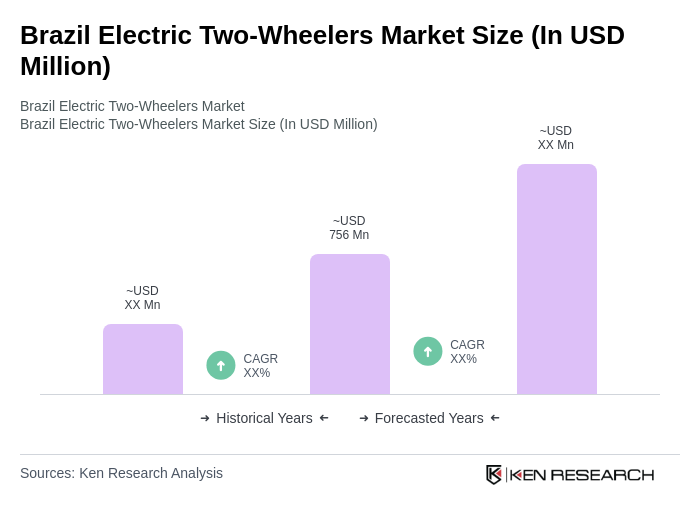
- The Brazil Electric Two-Wheelers Market is valued at USD 756 million, based on a five-year historical analysis. This growth is primarily driven by increasing urbanization, government incentives for electric vehicles, and rising consumer awareness regarding environmental sustainability. The shift towards electric mobility is further supported by advancements in battery technology, improvements in vehicle range and affordability, and the expansion of charging infrastructure across the country. Rising fuel prices and the economic appeal of lower operating costs compared to conventional motorcycles are also significant drivers, particularly in urban centers where daily commuting is prevalent.
- Key cities such as São Paulo and Rio de Janeiro dominate the market due to their high population density and traffic congestion, which make electric two-wheelers an attractive alternative for commuting. These urban centers have seen investments in exclusive bike lanes and charging points, creating a more conducive environment for electric two-wheeler adoption. Rio de Janeiro, in particular, is highlighted as a major market due to its high motorcycle density and efficient commuting, accounting for about seven to nine percent of national sales.
- The Brazilian government has implemented measures to promote electric mobility, including subsidies, tax reductions, and relaxed regulations for electric two-wheelers, which lower costs and make them more appealing compared to gasoline-powered alternatives. While no single, comprehensive federal regulation exclusively for electric two-wheelers is cited in the latest sources, these incentives are part of broader national efforts to align with international climate agreements and reduce urban air pollution. The government’s support is operationalized through fiscal incentives at the federal and municipal levels, though specific binding instruments with titles, issuing authorities, and years are not detailed in the available sources.
Brazil Electric Two-Wheelers Market Segmentation
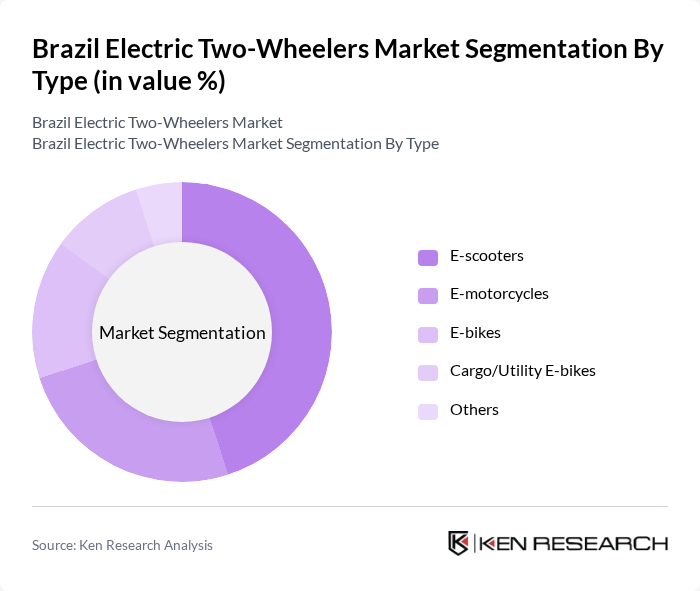
By Type:The market is segmented into various types of electric two-wheelers, including E-scooters, E-motorcycles, E-bikes, Cargo/Utility E-bikes, and Others. E-scooters have emerged as a popular segment due to their affordability, ease of use, and suitability for urban commuting, supported by the growth of shared mobility services. E-motorcycles and E-bikes are also gaining traction, particularly among enthusiasts and those seeking eco-friendly alternatives for longer commutes. Advances in battery technology have improved the performance and appeal of these segments, though the overall market share of electric two-wheelers remains modest compared to traditional motorcycles.
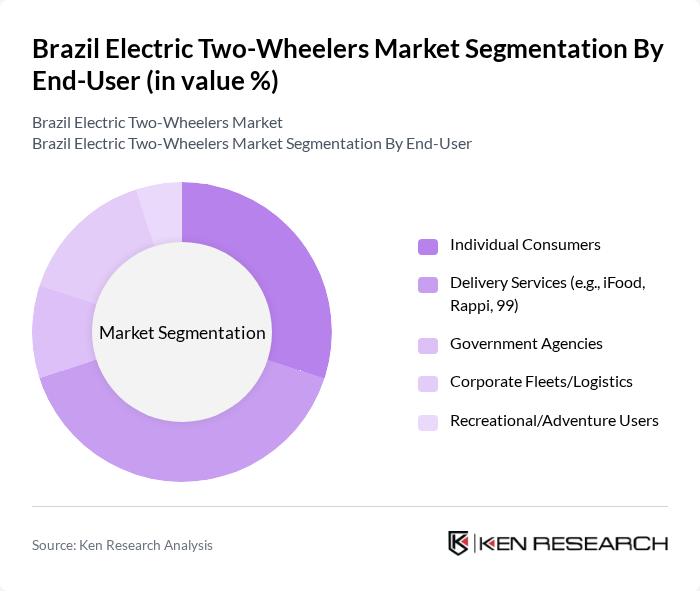
By End-User:The electric two-wheelers market is segmented by end-user into Individual Consumers, Delivery Services (e.g., iFood, Rappi, 99), Government Agencies, Corporate Fleets/Logistics, and Recreational/Adventure Users. The Delivery Services segment is currently leading the market, driven by the rapid growth of e-commerce and food delivery services in Brazil. Companies are increasingly adopting electric two-wheelers for their fleets to reduce operational costs and meet sustainability goals. Individual consumers are also showing a growing interest in electric two-wheelers for personal use, particularly in urban areas, reflecting broader trends in environmental awareness and the search for cost-effective urban mobility solutions.
Brazil Electric Two-Wheelers Market Competitive Landscape
The Brazil Electric Two-Wheelers Market is characterized by a dynamic mix of regional and international players. Leading participants such as Voltz Motors, BYD Brasil, Shineray do Brasil, Honda Motor Co., Ltd., Yamaha Motor Co., Ltd., iFood (Fleet/Delivery Integration), Riba Brasil, Super Soco, Niu Technologies, BMW Motorrad, Gogoro Inc., Energica Motor Company S.p.A., Zero Motorcycles, Inc., Lifan Industry Group, Kymco contribute to innovation, geographic expansion, and service delivery in this space.
Brazil Electric Two-Wheelers Market Industry Analysis
Growth Drivers
- Increasing Environmental Awareness:The Brazilian population is becoming increasingly aware of environmental issues, with 70% of citizens expressing concern about climate change, according to a 2023 survey by the Brazilian Institute of Geography and Statistics (IBGE). This awareness is driving demand for electric two-wheelers, which produce zero emissions. The government’s commitment to reducing greenhouse gas emissions by 37% by 2025 further supports this trend, encouraging consumers to opt for eco-friendly transportation alternatives.
- Government Incentives for Electric Vehicles:The Brazilian government has implemented various incentives to promote electric vehicle adoption, including tax exemptions and subsidies. In future, the government allocated approximately BRL 500 million (USD 100 million) for electric vehicle incentives, which includes electric two-wheelers. These financial incentives significantly lower the effective purchase price, making electric two-wheelers more accessible to a broader audience, thus stimulating market growth.
- Rising Fuel Prices:Fuel prices in Brazil have surged, with gasoline prices reaching an average of BRL 6.50 per liter in future, a 15% increase from the previous year. This rise in fuel costs is prompting consumers to seek alternative transportation options, such as electric two-wheelers, which offer lower operational costs. The average cost of electricity for charging an electric two-wheeler is approximately BRL 0.50 per charge, making it a more economical choice for daily commuting.
Market Challenges
- High Initial Costs:Despite the long-term savings, the initial purchase price of electric two-wheelers remains a significant barrier. The average cost of an electric two-wheeler in Brazil is around BRL 15,000 (USD 3,000), which is approximately 30% higher than traditional gasoline-powered models. This price disparity can deter potential buyers, especially in a market where the average monthly income is about BRL 2,500 (USD 500), making affordability a critical challenge.
- Limited Charging Infrastructure:The lack of a robust charging infrastructure poses a significant challenge to the growth of electric two-wheelers in Brazil. As of future, there are only about 1,200 public charging stations across the country, primarily concentrated in major urban areas. This limited availability creates range anxiety among potential users, hindering widespread adoption. The government aims to increase this number to 5,000 by 2025, but current infrastructure remains inadequate for mass market penetration.
Brazil Electric Two-Wheelers Market Future Outlook
The future of the electric two-wheeler market in Brazil appears promising, driven by increasing environmental consciousness and supportive government policies. As urbanization continues, the demand for efficient and sustainable transportation solutions will likely rise. Additionally, advancements in battery technology and the expansion of charging networks are expected to enhance the appeal of electric two-wheelers. With a growing focus on sustainability, the market is poised for significant growth, attracting both consumers and investors in the coming years.
Market Opportunities
- Expansion of Charging Networks:The Brazilian government’s initiative to increase the number of charging stations to 5,000 by 2025 presents a significant opportunity. This expansion will alleviate range anxiety and encourage more consumers to adopt electric two-wheelers, potentially increasing market penetration by 20% in urban areas, according to industry estimates.
- Technological Advancements in Battery Life:Innovations in battery technology are expected to enhance the performance and lifespan of electric two-wheelers. With new battery solutions potentially increasing range by up to 50% by 2025, manufacturers can offer more competitive products, attracting a broader customer base and driving sales growth in the electric two-wheeler segment.
Scope of the Report
| Segment | Sub-Segments |
|---|---|
| By Type | E-scooters E-motorcycles E-bikes Cargo/Utility E-bikes Others |
| By End-User | Individual Consumers Delivery Services (e.g., iFood, Rappi, 99) Government Agencies Corporate Fleets/Logistics Recreational/Adventure Users |
| By Sales Channel | Online Retail Dealerships Direct Sales Rental/Subscription Services Others |
| By Battery Type | Lithium-ion Lead-acid Nickel-metal Hydride Swappable Battery Systems Others |
| By Price Range | Budget Mid-range Premium Others |
| By Usage | Daily Commuting Recreational Commercial/Delivery Cargo/Utility Others |
| By Region | Southeast Brazil (São Paulo, Rio de Janeiro) South Brazil North Brazil Northeast Brazil Central-West Brazil Others |
Key Target Audience
Investors and Venture Capitalist Firms
Government and Regulatory Bodies (e.g., Agência Nacional de Transportes Terrestres, Ministério da Infraestrutura)
Manufacturers and Producers
Distributors and Retailers
Electric Vehicle Charging Infrastructure Providers
Industry Associations (e.g., Associação Brasileira do Veículo Elétrico)
Financial Institutions
Logistics and Delivery Companies
Players Mentioned in the Report:
Voltz Motors
BYD Brasil
Shineray do Brasil
Honda Motor Co., Ltd.
Yamaha Motor Co., Ltd.
iFood (Fleet/Delivery Integration)
Riba Brasil
Super Soco
Niu Technologies
BMW Motorrad
Gogoro Inc.
Energica Motor Company S.p.A.
Zero Motorcycles, Inc.
Lifan Industry Group
Kymco
Table of Contents
Market Assessment Phase
1. Executive Summary and Approach
2. Brazil Electric Two-Wheelers Market Overview
2.1 Key Insights and Strategic Recommendations
2.2 Brazil Electric Two-Wheelers Market Overview
2.3 Definition and Scope
2.4 Evolution of Market Ecosystem
2.5 Timeline of Key Regulatory Milestones
2.6 Value Chain & Stakeholder Mapping
2.7 Business Cycle Analysis
2.8 Policy & Incentive Landscape
3. Brazil Electric Two-Wheelers Market Analysis
3.1 Growth Drivers
3.1.1 Increasing Environmental Awareness
3.1.2 Government Incentives for Electric Vehicles
3.1.3 Rising Fuel Prices
3.1.4 Urbanization and Traffic Congestion
3.2 Market Challenges
3.2.1 High Initial Costs
3.2.2 Limited Charging Infrastructure
3.2.3 Consumer Perception and Awareness
3.2.4 Regulatory Hurdles
3.3 Market Opportunities
3.3.1 Expansion of Charging Networks
3.3.2 Technological Advancements in Battery Life
3.3.3 Partnerships with Ride-Sharing Services
3.3.4 Growth in E-commerce Deliveries
3.4 Market Trends
3.4.1 Shift Towards Shared Mobility Solutions
3.4.2 Integration of Smart Technologies
3.4.3 Focus on Sustainability and Green Initiatives
3.4.4 Increasing Popularity of E-scooters
3.5 Government Regulation
3.5.1 Emission Standards for Two-Wheelers
3.5.2 Incentives for Electric Vehicle Purchases
3.5.3 Regulations on Battery Disposal
3.5.4 Safety Standards for Electric Two-Wheelers
4. SWOT Analysis
5. Stakeholder Analysis
6. Porter's Five Forces Analysis
7. Brazil Electric Two-Wheelers Market Market Size, 2019-2024
7.1 By Value
7.2 By Volume
7.3 By Average Selling Price
8. Brazil Electric Two-Wheelers Market Segmentation
8.1 By Type
8.1.1 E-scooters
8.1.2 E-motorcycles
8.1.3 E-bikes
8.1.4 Cargo/Utility E-bikes
8.1.5 Others
8.2 By End-User
8.2.1 Individual Consumers
8.2.2 Delivery Services (e.g., iFood, Rappi, 99)
8.2.3 Government Agencies
8.2.4 Corporate Fleets/Logistics
8.2.5 Recreational/Adventure Users
8.3 By Sales Channel
8.3.1 Online Retail
8.3.2 Dealerships
8.3.3 Direct Sales
8.3.4 Rental/Subscription Services
8.3.5 Others
8.4 By Battery Type
8.4.1 Lithium-ion
8.4.2 Lead-acid
8.4.3 Nickel-metal Hydride
8.4.4 Swappable Battery Systems
8.4.5 Others
8.5 By Price Range
8.5.1 Budget
8.5.2 Mid-range
8.5.3 Premium
8.5.4 Others
8.6 By Usage
8.6.1 Daily Commuting
8.6.2 Recreational
8.6.3 Commercial/Delivery
8.6.4 Cargo/Utility
8.6.5 Others
8.7 By Region
8.7.1 Southeast Brazil (São Paulo, Rio de Janeiro)
8.7.2 South Brazil
8.7.3 North Brazil
8.7.4 Northeast Brazil
8.7.5 Central-West Brazil
8.7.6 Others
9. Brazil Electric Two-Wheelers Market Competitive Analysis
9.1 Market Share of Key Players
9.2 Cross Comparison of Key Players
9.2.1 Company Name
9.2.2 Group Size (Large, Medium, or Small as per industry convention)
9.2.3 Revenue Growth Rate (Brazil Electric Two-Wheelers Segment)
9.2.4 Market Penetration Rate (Units Sold/Market Share in Brazil)
9.2.5 Installed Base (Active Electric Two-Wheelers in Operation)
9.2.6 Distribution Network Coverage (Cities/Dealerships/Online Presence)
9.2.7 Product Portfolio Breadth (Number of Models/Variants)
9.2.8 Battery Technology Leadership (e.g., Swappable, Fast-Charge)
9.2.9 Local Manufacturing/Assembly Presence
9.2.10 Strategic Partnerships (e.g., with delivery platforms, energy providers)
9.2.11 Customer Satisfaction Index
9.2.12 After-Sales Service Network
9.2.13 Pricing Strategy
9.2.14 Brand Recognition
9.3 SWOT Analysis of Top Players
9.4 Pricing Analysis
9.5 Detailed Profile of Major Companies
9.5.1 Voltz Motors
9.5.2 BYD Brasil
9.5.3 Shineray do Brasil
9.5.4 Honda Motor Co., Ltd.
9.5.5 Yamaha Motor Co., Ltd.
9.5.6 iFood (Fleet/Delivery Integration)
9.5.7 Riba Brasil
9.5.8 Super Soco
9.5.9 Niu Technologies
9.5.10 BMW Motorrad
9.5.11 Gogoro Inc.
9.5.12 Energica Motor Company S.p.A.
9.5.13 Zero Motorcycles, Inc.
9.5.14 Lifan Industry Group
9.5.15 Kymco
10. Brazil Electric Two-Wheelers Market End-User Analysis
10.1 Procurement Behavior of Key Ministries
10.1.1 Government Fleet Purchases
10.1.2 Budget Allocation for Electric Vehicles
10.1.3 Sustainability Initiatives
10.1.4 Procurement Policies
10.2 Corporate Spend on Infrastructure & Energy
10.2.1 Investment in Charging Stations
10.2.2 Budget for Electric Fleet
10.2.3 Partnerships with Energy Providers
10.2.4 Sustainability Goals
10.3 Pain Point Analysis by End-User Category
10.3.1 Cost of Ownership
10.3.2 Maintenance Issues
10.3.3 Charging Accessibility
10.3.4 Performance Concerns
10.4 User Readiness for Adoption
10.4.1 Awareness Levels
10.4.2 Financial Incentives
10.4.3 Infrastructure Availability
10.4.4 Cultural Acceptance
10.5 Post-Deployment ROI and Use Case Expansion
10.5.1 Cost Savings Analysis
10.5.2 Performance Metrics
10.5.3 User Feedback Mechanisms
10.5.4 Future Use Cases
11. Brazil Electric Two-Wheelers Market Future Size, 2025-2030
11.1 By Value
11.2 By Volume
11.3 By Average Selling Price
Go-To-Market Strategy Phase
1. Whitespace Analysis + Business Model Canvas
1.1 Market Gaps Identification
1.2 Value Proposition Development
1.3 Revenue Streams
1.4 Cost Structure Analysis
1.5 Key Partnerships
1.6 Customer Segments
1.7 Channels
2. Marketing and Positioning Recommendations
2.1 Branding Strategies
2.2 Product USPs
2.3 Target Audience Identification
2.4 Communication Strategies
3. Distribution Plan
3.1 Urban Retail Strategies
3.2 Rural NGO Tie-ups
3.3 Online Sales Channels
3.4 Partnerships with Local Dealers
4. Channel & Pricing Gaps
4.1 Underserved Routes
4.2 Pricing Bands Analysis
4.3 Competitor Pricing Strategies
4.4 Consumer Price Sensitivity
5. Unmet Demand & Latent Needs
5.1 Category Gaps
5.2 Consumer Segments
5.3 Product Development Opportunities
5.4 Market Entry Strategies
6. Customer Relationship
6.1 Loyalty Programs
6.2 After-sales Service
6.3 Customer Feedback Mechanisms
6.4 Community Engagement
7. Value Proposition
7.1 Sustainability Initiatives
7.2 Integrated Supply Chains
7.3 Customer-Centric Innovations
7.4 Competitive Advantages
8. Key Activities
8.1 Regulatory Compliance
8.2 Branding Initiatives
8.3 Distribution Setup
8.4 Market Research Activities
9. Entry Strategy Evaluation
9.1 Domestic Market Entry Strategy
9.1.1 Product Mix
9.1.2 Pricing Band
9.1.3 Packaging
9.2 Export Entry Strategy
9.2.1 Target Countries
9.2.2 Compliance Roadmap
10. Entry Mode Assessment
10.1 Joint Ventures
10.2 Greenfield Investments
10.3 Mergers & Acquisitions
10.4 Distributor Model
11. Capital and Timeline Estimation
11.1 Capital Requirements
11.2 Timelines
12. Control vs Risk Trade-Off
12.1 Ownership vs Partnerships
13. Profitability Outlook
13.1 Breakeven Analysis
13.2 Long-term Sustainability
14. Potential Partner List
14.1 Distributors
14.2 Joint Ventures
14.3 Acquisition Targets
15. Execution Roadmap
15.1 Phased Plan for Market Entry
15.1.1 Market Setup
15.1.2 Market Entry
15.1.3 Growth Acceleration
15.1.4 Scale & Stabilize
15.2 Key Activities and Milestones
15.2.1 Activity Planning
15.2.2 Milestone Tracking
Research Methodology
Phase 1: Approach1
Desk Research
- Analysis of government reports on electric vehicle adoption in Brazil
- Review of industry publications and market analysis reports specific to electric two-wheelers
- Examination of statistical data from the Brazilian Institute of Geography and Statistics (IBGE) related to transportation trends
Primary Research
- Interviews with key stakeholders in the electric two-wheeler manufacturing sector
- Surveys conducted with consumers to understand purchasing behavior and preferences
- Focus group discussions with urban commuters to gauge perceptions of electric two-wheelers
Validation & Triangulation
- Cross-validation of findings through multiple data sources including sales data and consumer feedback
- Triangulation of insights from industry experts and market analysts
- Sanity checks through comparative analysis with similar markets in Latin America
Phase 2: Market Size Estimation1
Top-down Assessment
- Estimation of market size based on national electric vehicle sales data and growth rates
- Segmentation of the market by urban vs. rural adoption rates of electric two-wheelers
- Incorporation of government incentives and subsidies for electric vehicle purchases
Bottom-up Modeling
- Collection of sales data from major electric two-wheeler manufacturers operating in Brazil
- Estimation of average selling prices and market penetration rates
- Analysis of distribution channels and their impact on overall market volume
Forecasting & Scenario Analysis
- Development of forecasting models based on historical sales trends and economic indicators
- Scenario analysis considering factors such as regulatory changes and technological advancements
- Projections of market growth under different adoption scenarios through 2030
Phase 3: CATI Sample Composition1
| Scope Item/Segment | Sample Size | Target Respondent Profiles |
|---|---|---|
| Consumer Preferences for Electric Two-Wheelers | 120 | Urban Commuters, First-time Buyers |
| Manufacturer Insights on Production Trends | 60 | Production Managers, R&D Heads |
| Retailer Perspectives on Market Demand | 50 | Dealership Owners, Sales Managers |
| Government Policy Impact Assessment | 40 | Policy Makers, Regulatory Affairs Specialists |
| Environmental Impact Awareness | 45 | Sustainability Advocates, Environmental Researchers |
Frequently Asked Questions
What is the current value of the Brazil Electric Two-Wheelers Market?
The Brazil Electric Two-Wheelers Market is valued at approximately USD 756 million, reflecting a significant growth trend driven by urbanization, government incentives, and increased consumer awareness of environmental sustainability.
What factors are driving the growth of electric two-wheelers in Brazil?
Which cities in Brazil are leading in electric two-wheeler adoption?
What government incentives exist for electric two-wheelers in Brazil?
Other Regional/Country Reports
Malaysia Electric Two-Wheelers Market
KSA Electric Two-Wheelers Market
APAC Electric Two-Wheelers Market
Vietnam Electric Two-Wheelers Market
Other Adjacent Reports
Philippines Urban Mobility Solutions Market
Singapore Sustainable Transportation Market
Singapore E-Commerce Delivery Services Market
Singapore Electric Bicycle Market
Kuwait Motorcycle Battery Market
Indonesia Green Energy Incentives Market
UK Fleet Management Software Market Size, Share & Forecast, By Solution Type, Deployment Model & Enterprise Size, 2026-2031Philippines Renewable Energy Storage Market
Why Buy From Us?

What makes us stand out is that our consultants follow Robust, Refine and Result (RRR) methodology. Robust for clear definitions, approaches and sanity checking, Refine for differentiating respondents' facts and opinions, and Result for presenting data with story.

We have set a benchmark in the industry by offering our clients with syndicated and customized market research reports featuring coverage of entire market as well as meticulous research and analyst insights.

While we don't replace traditional research, we flip the method upside down. Our dual approach of Top Bottom & Bottom Top ensures quality deliverable by not just verifying company fundamentals but also looking at the sector and macroeconomic factors.

With one step in the future, our research team constantly tries to show you the bigger picture. We help with some of the tough questions you may encounter along the way: How is the industry positioned? Best marketing channel? KPI's of competitors? By aligning every element, we help maximize success.

Our report gives you instant access to the answers and sources that other companies might choose to hide. We elaborate each steps of research methodology we have used and showcase you the sample size to earn your trust.

If you need any support, we are here! We pride ourselves on universe strength, data quality, and quick, friendly, and professional service.