About the Report
Base Year 2024GCC Active Backpack Market Overview
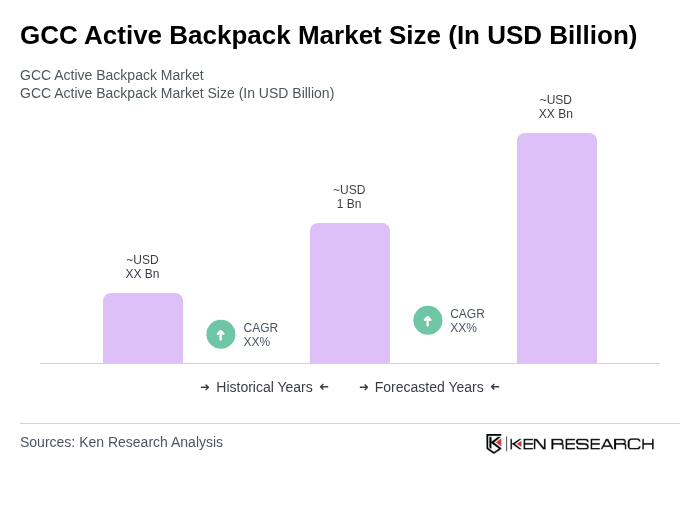
- The GCC Active Backpack Market is valued at USD 1 billion, based on a five-year historical analysis. This growth is primarily driven by increasing participation in outdoor activities such as hiking, trekking, and sports, alongside rising disposable incomes and a burgeoning travel culture in the region. Infrastructure developments further promote active lifestyles, enhancing the demand for active backpacks.
- Key players in this market include the United Arab Emirates and Saudi Arabia, which dominate due to their strong government investments in outdoor and fitness infrastructure. These countries have established a culture that encourages active lifestyle participation, supported by a growing number of recreational facilities and events that attract both locals and tourists.
- In 2024, the Dubai government implemented Executive Council Resolution No. (13) of 2022, which regulates the use of cycles and promotes the establishment of dedicated cycle lanes. This initiative aims to enhance active transport infrastructure, thereby increasing the demand for active gear, including backpacks, among cyclists and outdoor enthusiasts.
GCC Active Backpack Market Segmentation
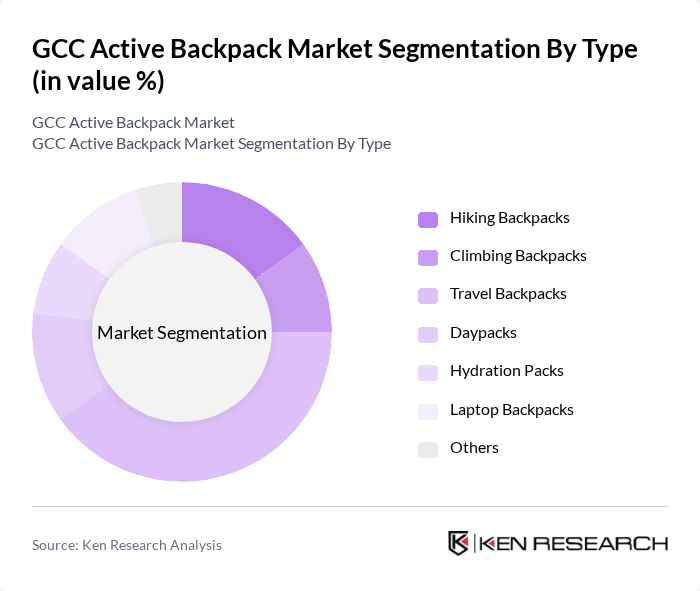
By Type:The market is segmented into various types of active backpacks, each catering to specific consumer needs and preferences. Hiking backpacks are particularly popular due to the region's diverse landscapes, while travel backpacks cater to the growing tourism sector. Daypacks and hydration packs are favored for their convenience and functionality, especially among urban dwellers. Laptop backpacks are increasingly in demand as remote work and education rise, while tactical backpacks appeal to outdoor enthusiasts and professionals. The "Others" category includes niche products that cater to specialized activities.
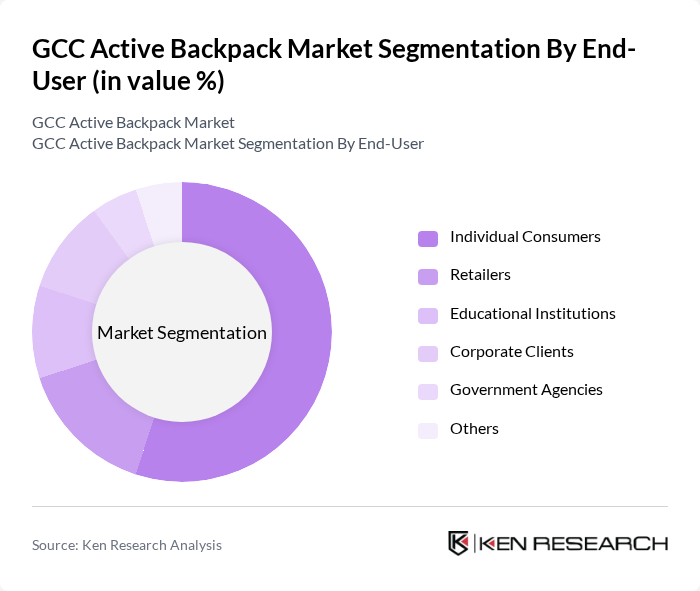
By End-User:The end-user segmentation includes individual consumers, educational institutions, the corporate sector, government agencies, and non-profit organizations. Individual consumers dominate the market, driven by a growing interest in outdoor activities and fitness. Educational institutions are increasingly adopting active backpacks for students involved in outdoor education programs. The corporate sector also contributes significantly, as companies provide backpacks for employees engaged in outdoor team-building activities. Government agencies and non-profit organizations utilize these products for various initiatives, further expanding the market.
GCC Active Backpack Market Competitive Landscape
The GCC Active Backpack Market is characterized by a dynamic mix of regional and international players. Leading participants such as The North Face, Osprey Packs, Deuter, Columbia Sportswear, Patagonia, REI Co-op, Arc'teryx, Salomon, Black Diamond Equipment, Gregory Mountain Products, Mammut, Fjällräven, Kelty, Teton Sports, and Mountain Hardwear contribute to innovation, geographic expansion, and service delivery in this space.
GCC Active Backpack Market Industry Analysis
Growth Drivers
- High Disposable Income per Capita:The GCC household disposable income per capita is projected to reach USD 16,000 by the future, reflecting trends from the previous year. This robust income level supports consumer spending on premium lifestyle products, including active backpacks. As disposable income rises, consumers are more inclined to invest in high-quality outdoor gear, driving demand in the active backpack segment. This trend is crucial for brands targeting affluent consumers in the region.
- Robust GCC Sports Equipment Market Size:The total revenue for the sports equipment market in the GCC is estimated at USD 1.85 billion by the future. This substantial market size indicates a strong demand for sports-related accessories, including active backpacks. The growth in sports participation and outdoor activities among the population is expected to further enhance the market for active backpacks, as consumers seek products that complement their active lifestyles.
- High-Income Economic Status:The GNI per capita for GCC countries is projected to exceed USD 14,500 in the future, categorizing the region as high-income. This economic status translates to increased purchasing power, allowing consumers to spend on discretionary goods such as active backpacks. The affluent demographic is likely to prioritize quality and brand reputation, creating opportunities for premium backpack offerings in the market.
Market Challenges
- Market Definition Uncertainty:There is a notable lack of specific USD-level data for the active backpack sub-segment, which complicates market sizing and strategic planning. This uncertainty can hinder investment decisions and marketing strategies, as companies may struggle to identify target demographics and appropriate pricing strategies. The absence of clear metrics can lead to misallocation of resources in product development and marketing efforts.
- Potential Inflation Constraints:Inflation rates in the GCC are projected to impact consumer spending, with Kuwait's inflation estimated at 3.5% and Bahrain's at 1.2% in the future. Elevated inflation can reduce disposable income and consumer willingness to spend on non-essential items like active backpacks. This economic pressure may lead consumers to prioritize essential goods over discretionary purchases, posing a challenge for market growth in the active backpack segment.
GCC Active Backpack Market Future Outlook
The GCC active backpack market is poised for growth driven by increasing health consciousness and outdoor activities among consumers. The expansion of digital retail channels will facilitate access to a broader audience, enhancing sales opportunities. Additionally, the trend towards premiumization suggests that consumers are willing to invest in high-quality, feature-rich backpacks. As urban youth populations grow, brands can capitalize on this demographic by offering tailored products that meet their active lifestyle needs, ensuring sustained market relevance.
Market Opportunities
- Growth in Digital Channels:The average revenue per user (ARPU) in the GCC sports equipment market is expected to reach USD 60.00 by the future. This figure indicates significant potential for high-value sales through online platforms, allowing brands to effectively reach consumers interested in active backpacks. The increasing penetration of e-commerce in the region presents a lucrative opportunity for brands to enhance their market presence.
- Underserved Urban Youth Segments:While specific data is lacking, the urbanization and growth of the youth population in the GCC create latent demand for active lifestyle products. Targeting this demographic with innovative and stylish active backpacks can unlock new market segments. Brands that focus on customization and personalization are likely to resonate well with younger consumers, driving sales and brand loyalty.
Scope of the Report
| Segment | Sub-Segments |
|---|---|
| By Type | Hiking Backpacks Travel Backpacks Daypacks Hydration Packs Laptop Backpacks Tactical Backpacks Others |
| By End-User | Individual Consumers Educational Institutions Corporate Sector Government Agencies Non-Profit Organizations Others |
| By Gender | Male Female Unisex |
| By Material | Nylon Polyester Canvas Leather Eco-friendly Materials Others |
| By Price Range | Budget Mid-range Premium Luxury |
| By Distribution Channel | Online Retail Offline Retail Direct Sales Wholesale Others |
| By Region | United Arab Emirates Saudi Arabia Qatar Kuwait Oman Bahrain Others |
Key Target Audience
Investors and Venture Capitalist Firms
Government and Regulatory Bodies (e.g., Ministry of Economy, Ministry of Commerce and Industry)
Manufacturers and Producers
Distributors and Retailers
Outdoor and Sports Equipment Brands
Logistics and Supply Chain Companies
Industry Associations (e.g., Outdoor Industry Association)
Financial Institutions
Players Mentioned in the Report:
The North Face
Osprey Packs
Deuter
Columbia Sportswear
Patagonia
REI Co-op
Arc'teryx
Salomon
Black Diamond Equipment
Gregory Mountain Products
Mammut
Fjallraven
Kelty
Teton Sports
Mountain Hardwear
Table of Contents
Market Assessment Phase
1. Executive Summary and Approach
2. GCC Active Backpack Market Overview
2.1 Key Insights and Strategic Recommendations
2.2 GCC Active Backpack Market Overview
2.3 Definition and Scope
2.4 Evolution of Market Ecosystem
2.5 Timeline of Key Regulatory Milestones
2.6 Value Chain & Stakeholder Mapping
2.7 Business Cycle Analysis
2.8 Policy & Incentive Landscape
3. GCC Active Backpack Market Analysis
3.1 Growth Drivers
3.1.1 Increasing Outdoor Activities
3.1.2 Rising Health Consciousness
3.1.3 Growth in E-commerce
3.1.4 Technological Advancements in Materials
3.2 Market Challenges
3.2.1 Intense Competition
3.2.2 Price Sensitivity Among Consumers
3.2.3 Supply Chain Disruptions
3.2.4 Environmental Regulations
3.3 Market Opportunities
3.3.1 Expansion into Emerging Markets
3.3.2 Customization and Personalization Trends
3.3.3 Collaborations with Fitness Brands
3.3.4 Sustainable Product Development
3.4 Market Trends
3.4.1 Growth of Smart Backpacks
3.4.2 Increasing Demand for Eco-friendly Materials
3.4.3 Rise of Multi-functional Backpacks
3.4.4 Popularity of Online Shopping Platforms
3.5 Government Regulation
3.5.1 Import Tariffs on Outdoor Gear
3.5.2 Safety Standards for Backpack Materials
3.5.3 Environmental Compliance Regulations
3.5.4 Consumer Protection Laws
4. SWOT Analysis
5. Stakeholder Analysis
6. Porter's Five Forces Analysis
7. GCC Active Backpack Market Market Size, 2019-2024
7.1 By Value
7.2 By Volume
7.3 By Average Selling Price
8. GCC Active Backpack Market Segmentation
8.1 By Type
8.1.1 Hiking Backpacks
8.1.2 Travel Backpacks
8.1.3 Daypacks
8.1.4 Hydration Packs
8.1.5 Laptop Backpacks
8.1.6 Tactical Backpacks
8.1.7 Others
8.2 By End-User
8.2.1 Individual Consumers
8.2.2 Educational Institutions
8.2.3 Corporate Sector
8.2.4 Government Agencies
8.2.5 Non-Profit Organizations
8.2.6 Others
8.3 By Gender
8.3.1 Male
8.3.2 Female
8.3.3 Unisex
8.4 By Material
8.4.1 Nylon
8.4.2 Polyester
8.4.3 Canvas
8.4.4 Leather
8.4.5 Eco-friendly Materials
8.4.6 Others
8.5 By Price Range
8.5.1 Budget
8.5.2 Mid-range
8.5.3 Premium
8.5.4 Luxury
8.6 By Distribution Channel
8.6.1 Online Retail
8.6.2 Offline Retail
8.6.3 Direct Sales
8.6.4 Wholesale
8.6.5 Others
8.7 By Region
8.7.1 United Arab Emirates
8.7.2 Saudi Arabia
8.7.3 Qatar
8.7.4 Kuwait
8.7.5 Oman
8.7.6 Bahrain
8.7.7 Others
9. GCC Active Backpack Market Competitive Analysis
9.1 Market Share of Key Players
9.2 Cross Comparison of Key Players
9.2.1 Company Name
9.2.2 Group Size (Large, Medium, or Small as per industry convention)
9.2.3 Revenue Growth Rate
9.2.4 Market Penetration Rate
9.2.5 Customer Retention Rate
9.2.6 Product Return Rate
9.2.7 Pricing Strategy
9.2.8 Brand Awareness Level
9.2.9 Distribution Efficiency
9.2.10 Customer Satisfaction Score
9.3 SWOT Analysis of Top Players
9.4 Pricing Analysis
9.5 Detailed Profile of Major Companies
9.5.1 The North Face
9.5.2 Osprey Packs
9.5.3 Deuter
9.5.4 Columbia Sportswear
9.5.5 Patagonia
9.5.6 REI Co-op
9.5.7 Arc'teryx
9.5.8 Salomon
9.5.9 Black Diamond Equipment
9.5.10 Gregory Mountain Products
9.5.11 Mammut
9.5.12 Fjällräven
9.5.13 Kelty
9.5.14 Teton Sports
9.5.15 Mountain Hardwear
10. GCC Active Backpack Market End-User Analysis
10.1 Procurement Behavior of Key Ministries
10.1.1 Budget Allocation Trends
10.1.2 Preferred Suppliers
10.1.3 Procurement Processes
10.1.4 Contract Duration Preferences
10.2 Corporate Spend on Infrastructure & Energy
10.2.1 Investment Trends
10.2.2 Key Corporate Players
10.2.3 Spending Priorities
10.2.4 Impact of Economic Conditions
10.3 Pain Point Analysis by End-User Category
10.3.1 Quality Concerns
10.3.2 Availability of Products
10.3.3 Pricing Issues
10.3.4 After-sales Support
10.4 User Readiness for Adoption
10.4.1 Awareness Levels
10.4.2 Training Needs
10.4.3 Adoption Barriers
10.4.4 Feedback Mechanisms
10.5 Post-Deployment ROI and Use Case Expansion
10.5.1 Performance Metrics
10.5.2 User Satisfaction Levels
10.5.3 Opportunities for Upselling
10.5.4 Long-term Usage Trends
11. GCC Active Backpack Market Future Size, 2025-2030
11.1 By Value
11.2 By Volume
11.3 By Average Selling Price
Go-To-Market Strategy Phase
1. Whitespace Analysis + Business Model Canvas
1.1 Market Gaps Identification
1.2 Value Proposition Development
1.3 Revenue Streams
1.4 Cost Structure Analysis
1.5 Key Partnerships
1.6 Customer Segments
1.7 Channels
2. Marketing and Positioning Recommendations
2.1 Branding Strategies
2.2 Product USPs
3. Distribution Plan
3.1 Urban Retail vs Rural NGO Tie-ups
4. Channel & Pricing Gaps
4.1 Underserved Routes
4.2 Pricing Bands
5. Unmet Demand & Latent Needs
5.1 Category Gaps
5.2 Consumer Segments
6. Customer Relationship
6.1 Loyalty Programs
6.2 After-sales Service
7. Value Proposition
7.1 Sustainability
7.2 Integrated Supply Chains
8. Key Activities
8.1 Regulatory Compliance
8.2 Branding
8.3 Distribution Setup
9. Entry Strategy Evaluation
9.1 Domestic Market Entry Strategy
9.1.1 Product Mix
9.1.2 Pricing Band
9.1.3 Packaging
9.2 Export Entry Strategy
9.2.1 Target Countries
9.2.2 Compliance Roadmap
10. Entry Mode Assessment
10.1 JV
10.2 Greenfield
10.3 M&A
10.4 Distributor Model
11. Capital and Timeline Estimation
11.1 Capital Requirements
11.2 Timelines
12. Control vs Risk Trade-Off
12.1 Ownership vs Partnerships
13. Profitability Outlook
13.1 Breakeven Analysis
13.2 Long-term Sustainability
14. Potential Partner List
14.1 Distributors
14.2 JVs
14.3 Acquisition Targets
15. Execution Roadmap
15.1 Phased Plan for Market Entry
15.1.1 Market Setup
15.1.2 Market Entry
15.1.3 Growth Acceleration
15.1.4 Scale & Stabilize
15.2 Key Activities and Milestones
15.2.1 Activity Timeline
15.2.2 Milestone Tracking
Research Methodology
Phase 1: Approach1
Desk Research
- Market reports from industry associations and trade publications specific to the GCC region
- Analysis of import/export data related to active backpacks from customs and trade databases
- Review of consumer behavior studies and lifestyle trends impacting outdoor activities in the GCC
Primary Research
- Interviews with brand managers from leading outdoor gear companies operating in the GCC
- Surveys conducted with retailers specializing in outdoor and sports equipment
- Focus groups with consumers who frequently engage in outdoor activities and travel
Validation & Triangulation
- Cross-validation of findings through multiple data sources, including sales data and consumer feedback
- Triangulation of insights from primary interviews with secondary data trends
- Sanity checks through expert panels comprising industry veterans and market analysts
Phase 2: Market Size Estimation1
Top-down Assessment
- Estimation of total market size based on overall outdoor equipment sales in the GCC
- Segmentation of the market by product type, including hiking, travel, and sports backpacks
- Incorporation of demographic data to assess potential market growth among youth and adventure travelers
Bottom-up Modeling
- Collection of sales data from key retailers and e-commerce platforms in the GCC
- Estimation of average selling prices and volume sold for various backpack categories
- Analysis of consumer purchasing patterns and frequency of backpack purchases
Forecasting & Scenario Analysis
- Multi-factor regression analysis considering tourism growth, outdoor activity participation rates, and economic factors
- Scenario modeling based on potential shifts in consumer preferences towards sustainability and eco-friendly products
- Development of baseline, optimistic, and pessimistic market forecasts through 2030
Phase 3: CATI Sample Composition1
| Scope Item/Segment | Sample Size | Target Respondent Profiles |
|---|---|---|
| Retail Sales of Active Backpacks | 150 | Store Managers, Sales Associates |
| Consumer Preferences in Outdoor Gear | 200 | Outdoor Enthusiasts, Casual Travelers |
| Market Trends in E-commerce for Backpacks | 100 | E-commerce Managers, Digital Marketing Specialists |
| Feedback on Backpack Features and Innovations | 80 | Product Designers, Brand Strategists |
| Insights from Outdoor Event Participants | 120 | Event Organizers, Participants in Outdoor Activities |
Frequently Asked Questions
What is the current value of the GCC Active Backpack Market?
The GCC Active Backpack Market is valued at approximately USD 1 billion, driven by increased participation in outdoor activities, rising disposable incomes, and a growing travel culture in the region.
Which countries dominate the GCC Active Backpack Market?
What types of active backpacks are popular in the GCC region?
Who are the primary end-users of active backpacks in the GCC?
Other Regional/Country Reports
Indonesia Active Backpack Market
Malaysia Active Backpack Market
KSA Active Backpack Market
APAC Active Backpack Market
SEA Active Backpack Market
Vietnam Active Backpack Market
Other Adjacent Reports
Indonesia Travel Luggage Market
Bahrain Hiking Gear Market
SEA Camping Equipment MarketOman Cycling Accessories Market
Thailand Fitness Gear Market
Bahrain Tactical Gear Market
Qatar Hydration Products Market
South Korea Adventure Gear Market
Why Buy From Us?

What makes us stand out is that our consultants follow Robust, Refine and Result (RRR) methodology. Robust for clear definitions, approaches and sanity checking, Refine for differentiating respondents' facts and opinions, and Result for presenting data with story.

We have set a benchmark in the industry by offering our clients with syndicated and customized market research reports featuring coverage of entire market as well as meticulous research and analyst insights.

While we don't replace traditional research, we flip the method upside down. Our dual approach of Top Bottom & Bottom Top ensures quality deliverable by not just verifying company fundamentals but also looking at the sector and macroeconomic factors.

With one step in the future, our research team constantly tries to show you the bigger picture. We help with some of the tough questions you may encounter along the way: How is the industry positioned? Best marketing channel? KPI's of competitors? By aligning every element, we help maximize success.

Our report gives you instant access to the answers and sources that other companies might choose to hide. We elaborate each steps of research methodology we have used and showcase you the sample size to earn your trust.

If you need any support, we are here! We pride ourselves on universe strength, data quality, and quick, friendly, and professional service.