About the Report
Base Year 2024GCC Wealth Management for Family Offices Market Overview
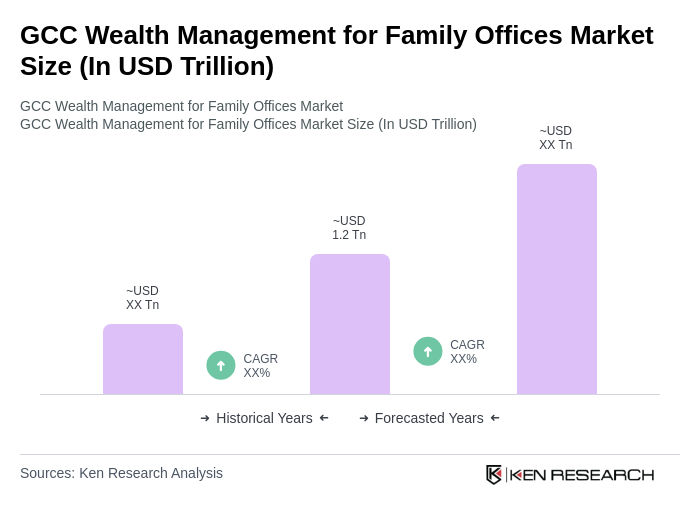
- The GCC Wealth Management for Family Offices Market is valued at USD 1.2 trillion, based on a five-year historical analysis. This growth is primarily driven by the increasing number of high-net-worth individuals (HNWIs) in the region, alongside a rising demand for personalized financial services that cater to the unique needs of family offices. The market is also supported by favorable economic conditions and a growing focus on wealth preservation and growth strategies.
- Key players in this market are concentrated in major cities such as Dubai, Abu Dhabi, and Riyadh. These cities dominate due to their status as financial hubs, offering a robust infrastructure, a favorable regulatory environment, and access to a diverse range of investment opportunities. The presence of numerous family offices and wealth management firms in these locations further enhances their market dominance.
- In 2023, the UAE government implemented a new regulatory framework aimed at enhancing transparency and compliance in the wealth management sector. This framework includes stricter guidelines for family offices regarding asset reporting and risk management practices, ensuring that they adhere to international standards and best practices in financial management.
GCC Wealth Management for Family Offices Market Segmentation
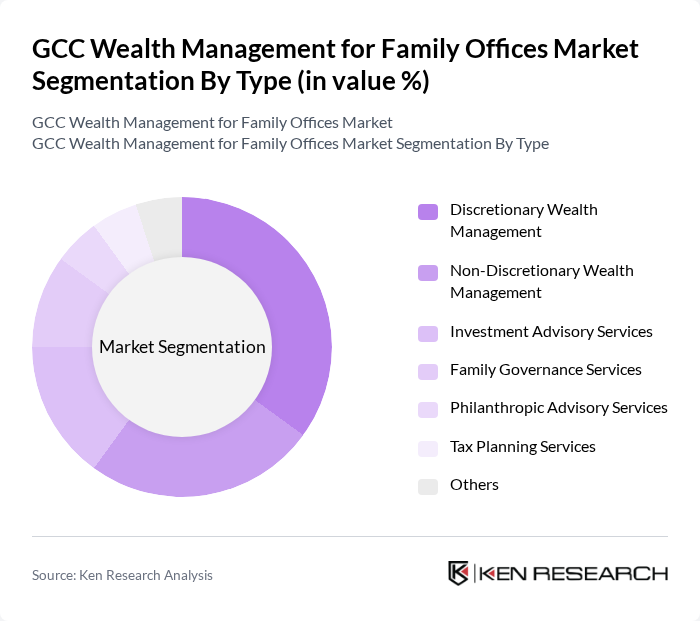
By Type:The market is segmented into various types of wealth management services, including discretionary and non-discretionary wealth management, investment advisory services, family governance services, philanthropic advisory services, tax planning services, and others. Each of these sub-segments caters to different client needs and preferences, with discretionary wealth management being particularly popular among clients seeking comprehensive management of their assets.
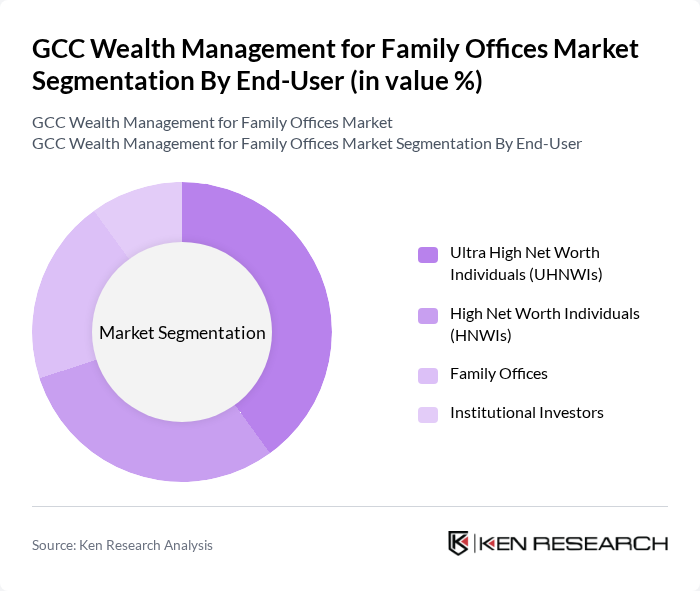
By End-User:The end-user segmentation includes ultra-high-net-worth individuals (UHNWIs), high-net-worth individuals (HNWIs), family offices, and institutional investors. Each group has distinct financial goals and investment strategies, with UHNWIs typically seeking more personalized and comprehensive wealth management solutions compared to HNWIs and family offices.
GCC Wealth Management for Family Offices Market Competitive Landscape
The GCC Wealth Management for Family Offices Market is characterized by a dynamic mix of regional and international players. Leading participants such as UBS Group AG, Credit Suisse Group AG, Julius Baer Group, HSBC Holdings plc, BNP Paribas Wealth Management, Citigroup Inc., Deutsche Bank AG, Standard Chartered PLC, Morgan Stanley, Goldman Sachs Group, Inc., Pictet Group, Lombard Odier Group, Northern Trust Corporation, BMO Wealth Management, Raymond James Financial, Inc. contribute to innovation, geographic expansion, and service delivery in this space.
GCC Wealth Management for Family Offices Market Industry Analysis
Growth Drivers
- Increasing High Net Worth Individuals (HNWIs):The GCC region has witnessed a significant rise in HNWIs, with the number reaching approximately 1.1 million in the future, according to the Wealth Report by Knight Frank. This growth is driven by economic diversification and increased investment in sectors like technology and real estate. The total wealth held by HNWIs in the GCC is estimated at around $3 trillion, creating a robust demand for tailored wealth management services that cater to their unique financial needs.
- Demand for Customized Financial Solutions:Family offices in the GCC are increasingly seeking bespoke financial solutions to manage their wealth effectively. A report by Deloitte indicates that 70% of family offices prioritize personalized investment strategies. This trend is fueled by the desire for tailored asset allocation, risk management, and succession planning, which are essential for preserving wealth across generations. The growing complexity of financial markets further necessitates customized approaches to wealth management.
- Rise in Alternative Investments:The GCC wealth management landscape is experiencing a notable shift towards alternative investments, with allocations increasing by 15% in the future, as reported by Preqin. Family offices are diversifying their portfolios to include private equity, real estate, and hedge funds, driven by the search for higher returns and reduced market volatility. This trend is supported by a growing number of investment platforms and funds focusing on alternative assets, enhancing accessibility for family offices.
Market Challenges
- Regulatory Compliance Complexity:Navigating the regulatory landscape in the GCC poses significant challenges for family offices. The introduction of stringent regulations, such as the Economic Substance Regulations and Anti-Money Laundering (AML) laws, has increased compliance costs. According to the Financial Action Task Force (FATF), non-compliance can lead to penalties exceeding $1 million, making it crucial for family offices to invest in compliance frameworks to mitigate risks and ensure adherence to evolving regulations.
- Competition from Global Wealth Management Firms:Family offices in the GCC face intense competition from established global wealth management firms, which are expanding their presence in the region. These firms often have more resources and advanced technology, making it challenging for local family offices to compete effectively. A report by PwC highlights that over 60% of family offices feel pressured to enhance their service offerings to retain clients, necessitating strategic innovations to differentiate themselves in a crowded market.
GCC Wealth Management for Family Offices Market Future Outlook
The future of the GCC wealth management market for family offices appears promising, driven by technological advancements and evolving client expectations. As digital transformation accelerates, family offices are likely to adopt innovative fintech solutions to enhance service delivery and operational efficiency. Additionally, the increasing focus on sustainable investments will shape investment strategies, aligning with global trends towards responsible investing. This dynamic environment presents opportunities for growth and adaptation in wealth management practices across the region.
Market Opportunities
- Digital Transformation in Wealth Management:The ongoing digital transformation presents a significant opportunity for family offices to leverage technology for improved client engagement and operational efficiency. By adopting advanced analytics and AI-driven tools, family offices can enhance decision-making processes and tailor services to meet the unique needs of HNWIs, ultimately driving client satisfaction and retention.
- Growing Interest in Sustainable Investments:There is a rising interest in sustainable investments among family offices, with a reported 30% increase in ESG-focused portfolios in the future. This trend reflects a broader societal shift towards responsible investing, providing family offices with the opportunity to align their investment strategies with ethical considerations while potentially achieving competitive returns in the long term.
Scope of the Report
| Segment | Sub-Segments |
|---|---|
| By Type | Discretionary Wealth Management Non-Discretionary Wealth Management Investment Advisory Services Family Governance Services Philanthropic Advisory Services Tax Planning Services Others |
| By End-User | Ultra High Net Worth Individuals (UHNWIs) High Net Worth Individuals (HNWIs) Family Offices Institutional Investors |
| By Service Model | Full-Service Wealth Management Boutique Wealth Management Online Wealth Management |
| By Investment Strategy | Active Management Passive Management Tactical Asset Allocation |
| By Asset Class | Equities Fixed Income Real Estate Alternative Investments |
| By Geographic Focus | Domestic Investments International Investments |
| By Client Relationship Model | One-on-One Advisory Group Advisory Sessions Digital Advisory Platforms |
Key Target Audience
Investors and Venture Capitalist Firms
Government and Regulatory Bodies (e.g., Central Bank of the UAE, Saudi Arabian Monetary Authority)
Family Office Executives and Managers
Private Banks and Wealth Management Firms
Investment Advisors and Financial Planners
Real Estate Investment Trusts (REITs)
Insurance Companies
Trust and Estate Planning Services
Players Mentioned in the Report:
UBS Group AG
Credit Suisse Group AG
Julius Baer Group
HSBC Holdings plc
BNP Paribas Wealth Management
Citigroup Inc.
Deutsche Bank AG
Standard Chartered PLC
Morgan Stanley
Goldman Sachs Group, Inc.
Pictet Group
Lombard Odier Group
Northern Trust Corporation
BMO Wealth Management
Raymond James Financial, Inc.
Table of Contents
Market Assessment Phase
1. Executive Summary and Approach
2. GCC Wealth Management for Family Offices Market Overview
2.1 Key Insights and Strategic Recommendations
2.2 GCC Wealth Management for Family Offices Market Overview
2.3 Definition and Scope
2.4 Evolution of Market Ecosystem
2.5 Timeline of Key Regulatory Milestones
2.6 Value Chain & Stakeholder Mapping
2.7 Business Cycle Analysis
2.8 Policy & Incentive Landscape
3. GCC Wealth Management for Family Offices Market Analysis
3.1 Growth Drivers
3.1.1 Increasing High Net Worth Individuals (HNWIs)
3.1.2 Demand for Customized Financial Solutions
3.1.3 Rise in Alternative Investments
3.1.4 Regulatory Support for Wealth Management Services
3.2 Market Challenges
3.2.1 Regulatory Compliance Complexity
3.2.2 Competition from Global Wealth Management Firms
3.2.3 Economic Volatility in the Region
3.2.4 Limited Awareness Among Family Offices
3.3 Market Opportunities
3.3.1 Digital Transformation in Wealth Management
3.3.2 Expansion of Family Office Services
3.3.3 Strategic Partnerships with Financial Institutions
3.3.4 Growing Interest in Sustainable Investments
3.4 Market Trends
3.4.1 Increased Focus on ESG Investments
3.4.2 Adoption of Fintech Solutions
3.4.3 Personalized Wealth Management Services
3.4.4 Shift Towards Multi-Generational Wealth Planning
3.5 Government Regulation
3.5.1 Enhanced Regulatory Framework for Family Offices
3.5.2 Tax Incentives for Wealth Management Services
3.5.3 Compliance with Anti-Money Laundering (AML) Laws
3.5.4 Licensing Requirements for Wealth Managers
4. SWOT Analysis
5. Stakeholder Analysis
6. Porter's Five Forces Analysis
7. GCC Wealth Management for Family Offices Market Market Size, 2019-2024
7.1 By Value
7.2 By Volume
7.3 By Average Selling Price
8. GCC Wealth Management for Family Offices Market Segmentation
8.1 By Type
8.1.1 Discretionary Wealth Management
8.1.2 Non-Discretionary Wealth Management
8.1.3 Investment Advisory Services
8.1.4 Family Governance Services
8.1.5 Philanthropic Advisory Services
8.1.6 Tax Planning Services
8.1.7 Others
8.2 By End-User
8.2.1 Ultra High Net Worth Individuals (UHNWIs)
8.2.2 High Net Worth Individuals (HNWIs)
8.2.3 Family Offices
8.2.4 Institutional Investors
8.3 By Service Model
8.3.1 Full-Service Wealth Management
8.3.2 Boutique Wealth Management
8.3.3 Online Wealth Management
8.4 By Investment Strategy
8.4.1 Active Management
8.4.2 Passive Management
8.4.3 Tactical Asset Allocation
8.5 By Asset Class
8.5.1 Equities
8.5.2 Fixed Income
8.5.3 Real Estate
8.5.4 Alternative Investments
8.6 By Geographic Focus
8.6.1 Domestic Investments
8.6.2 International Investments
8.7 By Client Relationship Model
8.7.1 One-on-One Advisory
8.7.2 Group Advisory Sessions
8.7.3 Digital Advisory Platforms
9. GCC Wealth Management for Family Offices Market Competitive Analysis
9.1 Market Share of Key Players
9.2 Cross Comparison of Key Players
9.2.1 Company Name
9.2.2 Group Size (Large, Medium, or Small as per industry convention)
9.2.3 Revenue Growth Rate
9.2.4 Client Retention Rate
9.2.5 Assets Under Management (AUM)
9.2.6 Number of Active Clients
9.2.7 Pricing Strategy
9.2.8 Service Diversification Index
9.2.9 Market Penetration Rate
9.2.10 Customer Satisfaction Score
9.3 SWOT Analysis of Top Players
9.4 Pricing Analysis
9.5 Detailed Profile of Major Companies
9.5.1 UBS Group AG
9.5.2 Credit Suisse Group AG
9.5.3 Julius Baer Group
9.5.4 HSBC Holdings plc
9.5.5 BNP Paribas Wealth Management
9.5.6 Citigroup Inc.
9.5.7 Deutsche Bank AG
9.5.8 Standard Chartered PLC
9.5.9 Morgan Stanley
9.5.10 Goldman Sachs Group, Inc.
9.5.11 Pictet Group
9.5.12 Lombard Odier Group
9.5.13 Northern Trust Corporation
9.5.14 BMO Wealth Management
9.5.15 Raymond James Financial, Inc.
10. GCC Wealth Management for Family Offices Market End-User Analysis
10.1 Procurement Behavior of Key Ministries
10.1.1 Budget Allocation Trends
10.1.2 Decision-Making Processes
10.1.3 Preferred Service Providers
10.2 Corporate Spend on Infrastructure & Energy
10.2.1 Investment Priorities
10.2.2 Spending Patterns
10.2.3 Impact of Economic Conditions
10.3 Pain Point Analysis by End-User Category
10.3.1 Lack of Customization
10.3.2 High Fees and Costs
10.3.3 Limited Access to Alternative Investments
10.4 User Readiness for Adoption
10.4.1 Technology Adoption Rates
10.4.2 Training and Support Needs
10.5 Post-Deployment ROI and Use Case Expansion
10.5.1 Measurement of Success
10.5.2 Future Investment Plans
11. GCC Wealth Management for Family Offices Market Future Size, 2025-2030
11.1 By Value
11.2 By Volume
11.3 By Average Selling Price
Go-To-Market Strategy Phase
1. Whitespace Analysis + Business Model Canvas
1.1 Market Gaps Identification
1.2 Value Proposition Development
1.3 Revenue Streams Analysis
1.4 Cost Structure Evaluation
1.5 Key Partnerships Exploration
1.6 Customer Segmentation
1.7 Channels of Distribution
2. Marketing and Positioning Recommendations
2.1 Branding Strategies
2.2 Product USPs
2.3 Target Market Identification
2.4 Communication Strategies
3. Distribution Plan
3.1 Urban Retail Strategies
3.2 Rural NGO Tie-Ups
3.3 Online Distribution Channels
3.4 Partnership with Financial Institutions
4. Channel & Pricing Gaps
4.1 Underserved Routes
4.2 Pricing Bands Analysis
4.3 Competitor Pricing Strategies
5. Unmet Demand & Latent Needs
5.1 Category Gaps
5.2 Consumer Segments Analysis
5.3 Emerging Trends Identification
6. Customer Relationship
6.1 Loyalty Programs
6.2 After-Sales Service
6.3 Customer Feedback Mechanisms
7. Value Proposition
7.1 Sustainability Initiatives
7.2 Integrated Supply Chains
7.3 Unique Selling Points
8. Key Activities
8.1 Regulatory Compliance
8.2 Branding Efforts
8.3 Distribution Setup
9. Entry Strategy Evaluation
9.1 Domestic Market Entry Strategy
9.1.1 Product Mix Considerations
9.1.2 Pricing Band Strategy
9.1.3 Packaging Options
9.2 Export Entry Strategy
9.2.1 Target Countries
9.2.2 Compliance Roadmap
10. Entry Mode Assessment
10.1 Joint Ventures
10.2 Greenfield Investments
10.3 Mergers & Acquisitions
10.4 Distributor Model
11. Capital and Timeline Estimation
11.1 Capital Requirements
11.2 Timelines for Implementation
12. Control vs Risk Trade-Off
12.1 Ownership Considerations
12.2 Partnerships Evaluation
13. Profitability Outlook
13.1 Breakeven Analysis
13.2 Long-Term Sustainability
14. Potential Partner List
14.1 Distributors
14.2 Joint Ventures
14.3 Acquisition Targets
15. Execution Roadmap
15.1 Phased Plan for Market Entry
15.1.1 Market Setup
15.1.2 Market Entry
15.1.3 Growth Acceleration
15.1.4 Scale & Stabilize
15.2 Key Activities and Milestones
15.2.1 Milestone Planning
15.2.2 Activity Tracking
Research Methodology
Phase 1: Approach1
Desk Research
- Analysis of market reports from financial institutions and consultancy firms focusing on family office wealth management
- Review of regulatory frameworks and compliance guidelines relevant to family offices in the GCC region
- Examination of industry publications, white papers, and case studies on wealth management trends and strategies
Primary Research
- In-depth interviews with family office executives and wealth managers to gather qualitative insights
- Surveys targeting financial advisors and consultants specializing in family office services
- Focus groups with high-net-worth individuals to understand their expectations and preferences in wealth management
Validation & Triangulation
- Cross-validation of findings through multiple data sources, including financial reports and expert opinions
- Triangulation of qualitative insights with quantitative data from market surveys
- Sanity checks conducted through expert panel reviews comprising industry veterans and thought leaders
Phase 2: Market Size Estimation1
Top-down Assessment
- Estimation of total wealth held by family offices in the GCC based on regional economic indicators
- Segmentation of wealth management services by asset class and service type
- Incorporation of growth rates derived from historical data and projected economic trends in the GCC
Bottom-up Modeling
- Collection of data on average assets under management (AUM) per family office
- Estimation of service fees and revenue generation models from wealth management firms
- Analysis of client demographics and their investment preferences to refine market size estimates
Forecasting & Scenario Analysis
- Development of forecasting models based on macroeconomic indicators and family office growth trends
- Scenario analysis considering varying levels of market volatility and regulatory changes
- Projections of market growth through 2030 under different economic conditions and investment climates
Phase 3: CATI Sample Composition1
| Scope Item/Segment | Sample Size | Target Respondent Profiles |
|---|---|---|
| Family Office Wealth Management Strategies | 100 | Family Office Executives, Wealth Managers |
| Investment Preferences of High-Net-Worth Individuals | 80 | High-Net-Worth Individuals, Financial Advisors |
| Regulatory Compliance in Wealth Management | 60 | Compliance Officers, Legal Advisors |
| Trends in Alternative Investments | 70 | Investment Analysts, Portfolio Managers |
| Client Satisfaction and Service Quality | 90 | Client Relationship Managers, Family Office Directors |
Frequently Asked Questions
What is the current value of the GCC Wealth Management for Family Offices Market?
The GCC Wealth Management for Family Offices Market is valued at approximately USD 1.2 trillion, reflecting significant growth driven by an increasing number of high-net-worth individuals (HNWIs) and a rising demand for personalized financial services tailored to family offices.
What factors are driving growth in the GCC Wealth Management market?
Which cities dominate the GCC Wealth Management for Family Offices Market?
What regulatory changes have impacted the GCC Wealth Management sector in 2023?
Other Regional/Country Reports
Indonesia Wealth Management for Family Offices Market
Malaysia Wealth Management for Family Offices Market
KSA Wealth Management for Family Offices Market
APAC Wealth Management for Family Offices Market
SEA Wealth Management for Family Offices Market
Vietnam Wealth Management for Family Offices Market
Other Adjacent Reports
South Africa Investment Advisory Services Market
Egypt Family Governance Services Market
UAE Philanthropic Advisory Services Market
South Africa Tax Planning Services Market
Thailand Alternative Investments Market
KSA Sustainable Investments Market
Thailand Fintech Wealth Management Market
Japan Real Estate Investment Market
Saudi Arabia Private Equity MarketWhy Buy From Us?

What makes us stand out is that our consultants follow Robust, Refine and Result (RRR) methodology. Robust for clear definitions, approaches and sanity checking, Refine for differentiating respondents' facts and opinions, and Result for presenting data with story.

We have set a benchmark in the industry by offering our clients with syndicated and customized market research reports featuring coverage of entire market as well as meticulous research and analyst insights.

While we don't replace traditional research, we flip the method upside down. Our dual approach of Top Bottom & Bottom Top ensures quality deliverable by not just verifying company fundamentals but also looking at the sector and macroeconomic factors.

With one step in the future, our research team constantly tries to show you the bigger picture. We help with some of the tough questions you may encounter along the way: How is the industry positioned? Best marketing channel? KPI's of competitors? By aligning every element, we help maximize success.

Our report gives you instant access to the answers and sources that other companies might choose to hide. We elaborate each steps of research methodology we have used and showcase you the sample size to earn your trust.

If you need any support, we are here! We pride ourselves on universe strength, data quality, and quick, friendly, and professional service.