About the Report
Base Year 2024Listen to the audio summary
Global Airport Passenger Boarding Bridge Market Overview
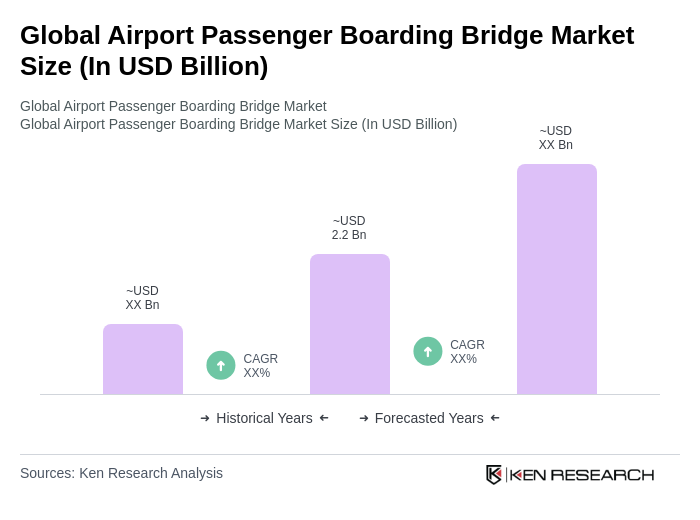
- The Global Airport Passenger Boarding Bridge Market is valued at approximately USD 2.2 billion, based on a five-year historical analysis. This value aligns with recent industry analyses indicating the market around the low-USD two billion range, supported by continuous airport capacity additions and retrofit cycles that emphasize operational efficiency and passenger safety .
- Key demand centers are anchored by large hub airports in regions such as North America, Europe, and the Middle East—areas that host high-traffic international gateways with ongoing terminal expansions and modernization programs. Market influence is tied to airport projects and procurement, not city “players”; demand concentration reflects major hub investments (e.g., North American and European hubs, and Gulf hubs) and the presence of leading manufacturers with global delivery and service footprints .
- Policy drivers in Europe emphasize energy efficiency and decarbonization in airport infrastructure, including ground power, pre-conditioned air, and airside electrification. While there is no single EU regulation in 2023 mandating energy?efficient passenger boarding bridges specifically, EU climate frameworks (such as the European Green Deal, Fit for 55, and airport sustainability programs) are pushing airports to adopt more energy?efficient, automated PBBs and related gate equipment to reduce emissions and improve environmental performance .
Global Airport Passenger Boarding Bridge Market Segmentation
By Type:The market can be segmented into four types: Apron Drive Bridges, Nose-Loader Bridges, T-Bridge (T-Loader) / Commuter Bridges, and Dual-Bridge and A380-Compatible Bridges. Each type serves different operational needs and aircraft specifications, influencing their adoption rates across various airports.
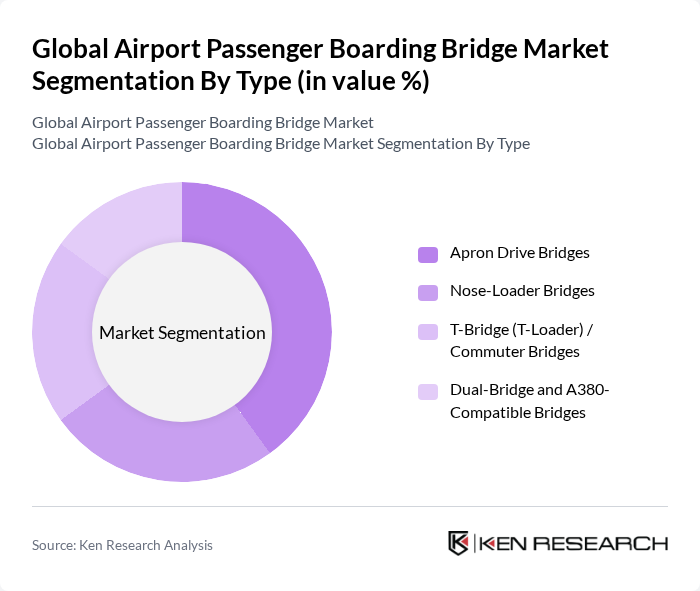
The Apron Drive Bridges segment is currently dominating the market due to their versatility and ability to accommodate various aircraft types, including larger models. Their design allows for efficient passenger boarding and deboarding, which is crucial for maintaining airport schedules. Additionally, the increasing number of airports upgrading their facilities to handle larger aircraft has further propelled the demand for apron drive bridges, making them the preferred choice among airport operators. Technology trends such as automated docking, enhanced safety systems, and glass-walled designs in premium terminals also support adoption of versatile apron-drive configurations at high-traffic gates .
By End-User:The market can be segmented into four end-user categories: Commercial Airports (Hub, Regional), Private/Business Aviation Terminals (FBOs), Military Airbases, and Seaport Passenger Terminals (Cruise/Ferry PBB). Each end-user category has distinct requirements and preferences for boarding bridge types.
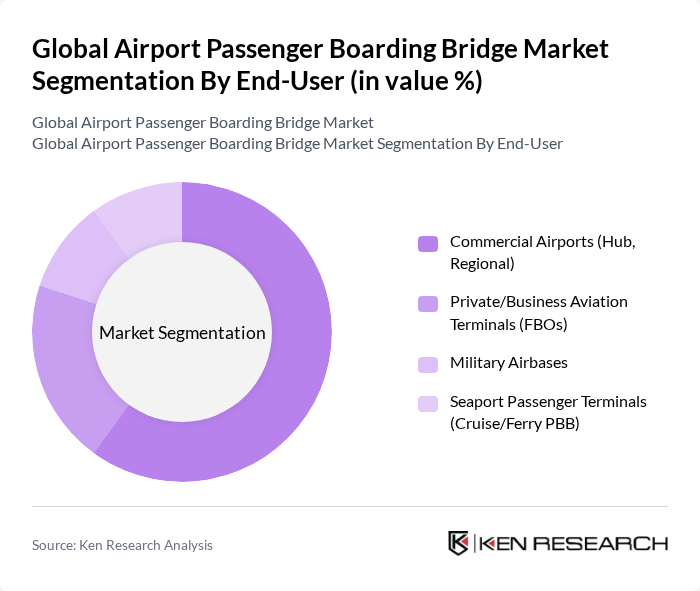
Commercial Airports, particularly hub and regional airports, are the leading end-users of passenger boarding bridges. This dominance is attributed to the high volume of passenger traffic and the need for efficient boarding processes. As air travel continues to grow, these airports are investing in modern boarding solutions to enhance operational efficiency and improve passenger experience, solidifying their position in the market. Airports also prioritize reducing aircraft turnaround times and improving safety, which directly sustains demand for modern PBBs with automation and energy?efficient features .
Global Airport Passenger Boarding Bridge Market Competitive Landscape
The Global Airport Passenger Boarding Bridge Market is characterized by a dynamic mix of regional and international players. Leading participants such as thyssenkrupp Airport Solutions (formerly ThyssenKrupp AG Airport Systems), JBT AeroTech (John Bean Technologies), ADELTE Group, FMT Aircraft Gate Support Systems, CIMC-Tianda Holdings (CIMC Airport Facilities), ShinMaywa Industries, Ltd., Deerns Airport Systems, DABICO Airport Solutions, TLD Group (Alvest Group), MHI Passenger Boarding Bridge (Mitsubishi Heavy Industries), Airport Equipment Ltd., Mallaghan, Guangxi Nanning Baling Technology Co., Ltd., Goldhofer (for integrated docking/GSE interfaces), AERO Specialties, Inc. contribute to innovation, geographic expansion, and service delivery in this space. Automation, safety systems, and energy?efficiency upgrades are common differentiators in recent offerings and retrofit programs at major hubs globally .
Global Airport Passenger Boarding Bridge Market Industry Analysis
Growth Drivers
- Increasing Air Travel Demand:The global air passenger traffic is projected to reach approximately 4.7 billion by the future, according to the International Air Transport Association (IATA). This surge in air travel is driven by rising disposable incomes and a growing middle class, particularly in emerging markets. As more passengers travel, airports are compelled to enhance their infrastructure, including the installation of advanced passenger boarding bridges to accommodate increased foot traffic efficiently.
- Technological Advancements in Boarding Bridge Design:Innovations in boarding bridge technology, such as automated systems and enhanced safety features, are transforming airport operations. For instance, the integration of smart technologies can reduce boarding times by up to 30%, as reported by industry experts. These advancements not only improve operational efficiency but also enhance passenger experience, driving airports to invest in modern boarding solutions to stay competitive.
- Expansion of Airport Infrastructure:The global airport infrastructure investment is expected to exceed approximately $1.2 trillion by the future, as per the Airports Council International (ACI). This expansion includes the construction of new terminals and the upgrading of existing facilities, which necessitates the installation of additional boarding bridges. As airports expand to accommodate growing passenger volumes, the demand for efficient boarding solutions will continue to rise, fueling market growth.
Market Challenges
- High Initial Investment Costs:The cost of acquiring and installing a passenger boarding bridge can range from approximately $1 million to $3.5 million, depending on the specifications and technology involved. This significant upfront investment poses a barrier for many airports, particularly in developing regions where budget constraints are prevalent. As a result, some airports may delay or forgo necessary upgrades, hindering market growth in those areas.
- Maintenance and Operational Complexities:The maintenance of passenger boarding bridges requires specialized knowledge and resources, which can be a challenge for airport operators. According to industry reports, maintenance costs can account for up to 15% of the total operational budget for airports. This complexity can deter investment in new technologies and lead to operational inefficiencies, impacting overall airport performance and passenger satisfaction.
Global Airport Passenger Boarding Bridge Market Future Outlook
The future of the airport passenger boarding bridge market is poised for significant transformation, driven by technological advancements and a growing emphasis on sustainability. Airports are increasingly adopting automated boarding solutions to enhance efficiency and reduce wait times. Additionally, the focus on eco-friendly designs is expected to shape new product developments, aligning with global environmental goals. As passenger volumes continue to rise, the demand for innovative and efficient boarding solutions will remain strong, fostering a dynamic market landscape.
Market Opportunities
- Growth in Emerging Markets:Emerging markets, particularly in Asia and Africa, are experiencing rapid urbanization and increased air travel demand. With airport passenger traffic expected to grow by approximately 6% annually in these regions, there is a substantial opportunity for boarding bridge manufacturers to expand their presence and cater to the evolving needs of these markets.
- Adoption of Eco-Friendly Boarding Solutions:The rising focus on sustainability is driving airports to seek eco-friendly boarding solutions. Innovations such as solar-powered boarding bridges and energy-efficient designs are gaining traction. This shift not only meets regulatory requirements but also appeals to environmentally conscious travelers, presenting a lucrative opportunity for manufacturers to develop and market sustainable products.
Scope of the Report
| Segment | Sub-Segments |
|---|---|
| By Type | Apron Drive Bridges Nose-Loader Bridges T-Bridge (T-Loader) / Commuter Bridges Dual-Bridge and A380-Compatible Bridges |
| By End-User | Commercial Airports (Hub, Regional) Private/Business Aviation Terminals (FBOs) Military Airbases Seaport Passenger Terminals (Cruise/Ferry PBB) |
| By Application | Narrow-Body Aircraft (e.g., A320/B737 families) Wide-Body Aircraft (e.g., A350/B787/B777) Regional Jets & Turboprops Code F & Superjumbo Operations (e.g., A380) |
| By Material | Steel Aluminum & Aluminum-Alloy Glass/Glass-Walled Structures Composite & Fiberglass Components |
| By Design/Structure | Telescopic Bridges (Two-/Three-Tunnel) Fixed Pedestal Bridges Elevation System: Hydraulic Elevation System: Electro-Mechanical |
| By Point of Sale | OEM (New Installations) Aftermarket (Retrofit, Refurbishment, MRO) Long-term O&M/Service Contracts Spares & Upgrades (Auto-Docking, PCAir, GPUs Integration) |
| By Region | North America Europe Asia-Pacific Latin America Middle East & Africa ASEAN Focus Markets |
Key Target Audience
Investors and Venture Capitalist Firms
Government and Regulatory Bodies (e.g., Federal Aviation Administration, European Union Aviation Safety Agency)
Airport Operators and Authorities
Manufacturers and Producers of Boarding Bridges
Airline Companies
Infrastructure Development Firms
Airport Construction and Engineering Firms
Maintenance and Service Providers for Airport Equipment
Players Mentioned in the Report:
thyssenkrupp Airport Solutions (formerly ThyssenKrupp AG Airport Systems)
JBT AeroTech (John Bean Technologies)
ADELTE Group
FMT Aircraft Gate Support Systems
CIMC-Tianda Holdings (CIMC Airport Facilities)
ShinMaywa Industries, Ltd.
Deerns Airport Systems
DABICO Airport Solutions
TLD Group (Alvest Group)
MHI Passenger Boarding Bridge (Mitsubishi Heavy Industries)
Airport Equipment Ltd.
Mallaghan
Guangxi Nanning Baling Technology Co., Ltd.
Goldhofer (for integrated docking/GSE interfaces)
AERO Specialties, Inc.
Table of Contents
Market Assessment Phase
1. Executive Summary and Approach
2. Global Airport Passenger Boarding Bridge Market Overview
2.1 Key Insights and Strategic Recommendations
2.2 Global Airport Passenger Boarding Bridge Market Overview
2.3 Definition and Scope
2.4 Evolution of Market Ecosystem
2.5 Timeline of Key Regulatory Milestones
2.6 Value Chain & Stakeholder Mapping
2.7 Business Cycle Analysis
2.8 Policy & Incentive Landscape
3. Global Airport Passenger Boarding Bridge Market Analysis
3.1 Growth Drivers
3.1.1 Increasing air travel demand
3.1.2 Technological advancements in boarding bridge design
3.1.3 Expansion of airport infrastructure
3.1.4 Rising focus on passenger experience
3.2 Market Challenges
3.2.1 High initial investment costs
3.2.2 Maintenance and operational complexities
3.2.3 Regulatory compliance issues
3.2.4 Competition from alternative boarding solutions
3.3 Market Opportunities
3.3.1 Growth in emerging markets
3.3.2 Adoption of eco-friendly boarding solutions
3.3.3 Integration of smart technologies
3.3.4 Partnerships with airport operators
3.4 Market Trends
3.4.1 Increasing automation in boarding processes
3.4.2 Customization of boarding bridges
3.4.3 Focus on sustainability and energy efficiency
3.4.4 Enhanced safety features in design
3.5 Government Regulation
3.5.1 Compliance with international aviation standards
3.5.2 Environmental regulations on emissions
3.5.3 Safety regulations for passenger boarding
3.5.4 Incentives for infrastructure development
4. SWOT Analysis
5. Stakeholder Analysis
6. Porter's Five Forces Analysis
7. Global Airport Passenger Boarding Bridge Market Market Size, 2019-2024
7.1 By Value
7.2 By Volume
7.3 By Average Selling Price
8. Global Airport Passenger Boarding Bridge Market Segmentation
8.1 By Type
8.1.1 Apron Drive Bridges
8.1.2 Nose-Loader Bridges
8.1.3 T-Bridge (T-Loader) / Commuter Bridges
8.1.4 Dual-Bridge and A380-Compatible Bridges
8.2 By End-User
8.2.1 Commercial Airports (Hub, Regional)
8.2.2 Private/Business Aviation Terminals (FBOs)
8.2.3 Military Airbases
8.2.4 Seaport Passenger Terminals (Cruise/Ferry PBB)
8.3 By Application
8.3.1 Narrow-Body Aircraft (e.g., A320/B737 families)
8.3.2 Wide-Body Aircraft (e.g., A350/B787/B777)
8.3.3 Regional Jets & Turboprops
8.3.4 Code F & Superjumbo Operations (e.g., A380)
8.4 By Material
8.4.1 Steel
8.4.2 Aluminum & Aluminum-Alloy
8.4.3 Glass/Glass-Walled Structures
8.4.4 Composite & Fiberglass Components
8.5 By Design/Structure
8.5.1 Telescopic Bridges (Two-/Three-Tunnel)
8.5.2 Fixed Pedestal Bridges
8.5.3 Elevation System: Hydraulic
8.5.4 Elevation System: Electro-Mechanical
8.6 By Point of Sale
8.6.1 OEM (New Installations)
8.6.2 Aftermarket (Retrofit, Refurbishment, MRO)
8.6.3 Long-term O&M/Service Contracts
8.6.4 Spares & Upgrades (Auto-Docking, PCAir, GPUs Integration)
8.7 By Region
8.7.1 North America
8.7.2 Europe
8.7.3 Asia-Pacific
8.7.4 Latin America
8.7.5 Middle East & Africa
8.7.6 ASEAN Focus Markets
9. Global Airport Passenger Boarding Bridge Market Competitive Analysis
9.1 Market Share of Key Players
9.2 Cross Comparison of Key Players
9.2.1 Company Name
9.2.2 Installed Base (Number of PBBs in Operation)
9.2.3 New Orders/Backlog (Units, Value)
9.2.4 Geographic Footprint (Regions/Countries Served)
9.2.5 Product Portfolio Breadth (Apron Drive, Nose-Loader, A380 Dual, Seaport-PBB)
9.2.6 Technology & Automation (Auto-Docking, Anti-Collision, Digital Twin/IoT)
9.2.7 Aftermarket & Service Revenues (Share of Total)
9.2.8 Delivery Lead Time (Avg. Months)
9.2.9 Project Execution Performance (On-time %, Warranty Claims Rate)
9.2.10 Certifications & Compliance (ICAO/FAA/EASA, CE, ISO)
9.2.11 Sustainability Metrics (Energy Efficiency, Materials, LCA)
9.2.12 Price Positioning (USD per bridge, typical configuration)
9.3 SWOT Analysis of Top Players
9.4 Pricing Analysis
9.5 Detailed Profile of Major Companies
9.5.1 thyssenkrupp Airport Solutions (formerly ThyssenKrupp AG Airport Systems)
9.5.2 JBT AeroTech (John Bean Technologies)
9.5.3 ADELTE Group
9.5.4 FMT Aircraft Gate Support Systems
9.5.5 CIMC-Tianda Holdings (CIMC Airport Facilities)
9.5.6 ShinMaywa Industries, Ltd.
9.5.7 Deerns Airport Systems
9.5.8 DABICO Airport Solutions
9.5.9 TLD Group (Alvest Group)
9.5.10 MHI Passenger Boarding Bridge (Mitsubishi Heavy Industries)
9.5.11 Airport Equipment Ltd.
9.5.12 Mallaghan
9.5.13 Guangxi Nanning Baling Technology Co., Ltd.
9.5.14 Goldhofer (for integrated docking/GSE interfaces)
9.5.15 AERO Specialties, Inc.
10. Global Airport Passenger Boarding Bridge Market End-User Analysis
10.1 Procurement Behavior of Key Ministries
10.1.1 Government procurement policies
10.1.2 Budget allocation for airport infrastructure
10.1.3 Collaboration with private sectors
10.2 Corporate Spend on Infrastructure & Energy
10.2.1 Investment trends in airport facilities
10.2.2 Funding sources for airport projects
10.2.3 Cost management strategies
10.3 Pain Point Analysis by End-User Category
10.3.1 Delays in boarding processes
10.3.2 Safety concerns during boarding
10.3.3 Maintenance issues with existing bridges
10.4 User Readiness for Adoption
10.4.1 Training requirements for staff
10.4.2 Infrastructure readiness
10.4.3 User feedback mechanisms
10.5 Post-Deployment ROI and Use Case Expansion
10.5.1 Performance metrics post-deployment
10.5.2 Expansion into new airport projects
10.5.3 Long-term maintenance contracts
11. Global Airport Passenger Boarding Bridge Market Future Size, 2025-2030
11.1 By Value
11.2 By Volume
11.3 By Average Selling Price
Go-To-Market Strategy Phase
1. Whitespace Analysis + Business Model Canvas
1.1 Market gaps identification
1.2 Value proposition development
1.3 Revenue model exploration
1.4 Customer segmentation analysis
1.5 Competitive landscape overview
2. Marketing and Positioning Recommendations
2.1 Branding strategies
2.2 Product USPs
2.3 Target audience identification
2.4 Communication strategies
3. Distribution Plan
3.1 Urban retail vs rural NGO tie-ups
3.2 Distribution channel optimization
3.3 Partnership opportunities
4. Channel & Pricing Gaps
4.1 Underserved routes
4.2 Pricing bands
4.3 Competitive pricing analysis
5. Unmet Demand & Latent Needs
5.1 Category gaps
5.2 Consumer segments
5.3 Emerging trends analysis
6. Customer Relationship
6.1 Loyalty programs
6.2 After-sales service
6.3 Customer engagement strategies
7. Value Proposition
7.1 Sustainability
7.2 Integrated supply chains
7.3 Unique selling points
8. Key Activities
8.1 Regulatory compliance
8.2 Branding
8.3 Distribution setup
9. Entry Strategy Evaluation
9.1 Domestic Market Entry Strategy
9.1.1 Product mix
9.1.2 Pricing band
9.1.3 Packaging
9.2 Export Entry Strategy
9.2.1 Target countries
9.2.2 Compliance roadmap
10. Entry Mode Assessment
10.1 JV
10.2 Greenfield
10.3 M&A
10.4 Distributor Model
11. Capital and Timeline Estimation
11.1 Capital requirements
11.2 Timelines
12. Control vs Risk Trade-Off
12.1 Ownership vs Partnerships
13. Profitability Outlook
13.1 Breakeven analysis
13.2 Long-term sustainability
14. Potential Partner List
14.1 Distributors
14.2 JVs
14.3 Acquisition targets
15. Execution Roadmap
15.1 Phased Plan for Market Entry
15.1.1 Market Setup
15.1.2 Market Entry
15.1.3 Growth Acceleration
15.1.4 Scale & Stabilize
15.2 Key Activities and Milestones
15.2.1 Milestone tracking
15.2.2 Activity scheduling
Research Methodology
Phase 1: Approach1
Desk Research
- Industry reports from aviation authorities and airport management organizations
- Market analysis publications from aviation consultancy firms
- Statistical data from global airport infrastructure databases
Primary Research
- Interviews with airport operations managers and facility planners
- Surveys with manufacturers of passenger boarding bridges
- Field interviews with airport maintenance and engineering teams
Validation & Triangulation
- Cross-validation of data from multiple industry sources and reports
- Triangulation of insights from primary interviews and secondary data
- Sanity checks through expert panel discussions and feedback sessions
Phase 2: Market Size Estimation1
Top-down Assessment
- Analysis of global air traffic growth trends and passenger forecasts
- Breakdown of market size by geographical regions and airport categories
- Incorporation of government investments in airport infrastructure
Bottom-up Modeling
- Volume estimates based on the number of airports and boarding bridges per airport
- Cost analysis derived from pricing models of leading manufacturers
- Estimation of replacement cycles and maintenance costs for existing bridges
Forecasting & Scenario Analysis
- Multi-factor regression analysis considering air travel recovery post-pandemic
- Scenario modeling based on technological advancements and regulatory changes
- Baseline, optimistic, and pessimistic projections through 2035
Phase 3: CATI Sample Composition1
| Scope Item/Segment | Sample Size | Target Respondent Profiles |
|---|---|---|
| Airport Operations Management | 100 | Operations Managers, Airport Directors |
| Passenger Boarding Bridge Manufacturers | 80 | Product Development Managers, Sales Directors |
| Airport Infrastructure Planning | 70 | Facility Planners, Civil Engineers |
| Maintenance and Engineering Teams | 60 | Maintenance Supervisors, Engineering Managers |
| Regulatory and Compliance Officers | 50 | Compliance Managers, Safety Officers |
Frequently Asked Questions
What is the current value of the Global Airport Passenger Boarding Bridge Market?
The Global Airport Passenger Boarding Bridge Market is valued at approximately USD 2.2 billion, reflecting a historical analysis that aligns with industry trends emphasizing airport capacity additions and operational efficiency improvements.
What are the key demand centers for passenger boarding bridges?
What types of passenger boarding bridges are available in the market?
Who are the leading manufacturers in the Global Airport Passenger Boarding Bridge Market?
Other Regional/Country Reports
Indonesia Airport Passenger Boarding Bridge Market
Malaysia Airport Passenger Boarding Bridge Market
APAC Airport Passenger Boarding Bridge Market
SEA Airport Passenger Boarding Bridge Market
Why Buy From Us?

What makes us stand out is that our consultants follow Robust, Refine and Result (RRR) methodology. Robust for clear definitions, approaches and sanity checking, Refine for differentiating respondents' facts and opinions, and Result for presenting data with story.

We have set a benchmark in the industry by offering our clients with syndicated and customized market research reports featuring coverage of entire market as well as meticulous research and analyst insights.

While we don't replace traditional research, we flip the method upside down. Our dual approach of Top Bottom & Bottom Top ensures quality deliverable by not just verifying company fundamentals but also looking at the sector and macroeconomic factors.

With one step in the future, our research team constantly tries to show you the bigger picture. We help with some of the tough questions you may encounter along the way: How is the industry positioned? Best marketing channel? KPI's of competitors? By aligning every element, we help maximize success.

Our report gives you instant access to the answers and sources that other companies might choose to hide. We elaborate each steps of research methodology we have used and showcase you the sample size to earn your trust.

If you need any support, we are here! We pride ourselves on universe strength, data quality, and quick, friendly, and professional service.