About the Report
Base Year 2024Listen to the audio summary
Global Aquaponics Market Overview
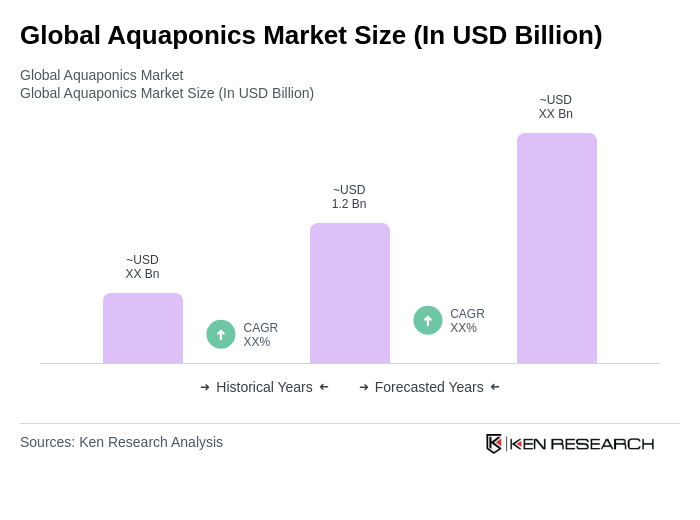
- The Global Aquaponics Market is valued at USD 1.2 billion, based on a five-year historical analysis. This growth is primarily driven by the increasing demand for sustainable agricultural practices, urban farming, and the need for efficient food production systems. The integration of aquaculture and hydroponics has gained traction, leading to innovative farming solutions that optimize resource use and reduce environmental impact.
- Key players in this market include the United States, Canada, and several European countries. The dominance of these regions can be attributed to advanced technological infrastructure, strong investment in research and development, and a growing consumer preference for locally sourced and organic produce. Additionally, government support and initiatives promoting sustainable agriculture have further solidified their market position.
- Aquaponics is commonly supported under broader controlled-environment agriculture and sustainable agriculture research initiatives, grants, and extension programs, which collectively encourage innovation and commercialization.
Global Aquaponics Market Segmentation
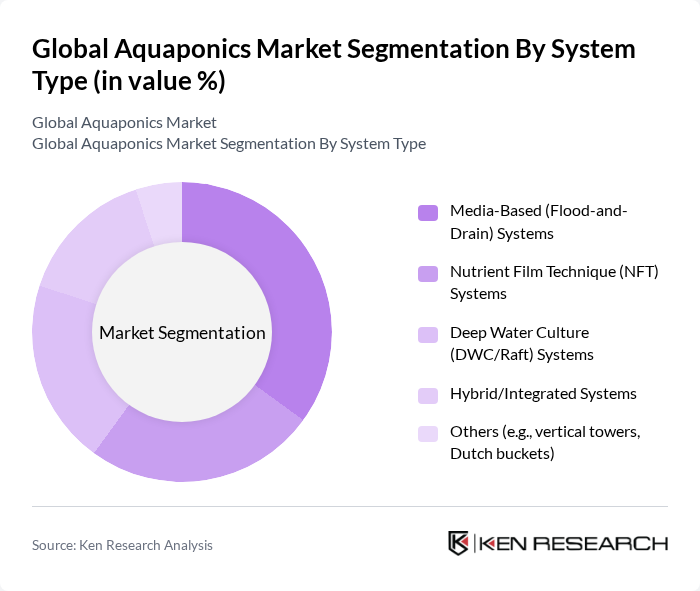
By System Type:The aquaponics market can be segmented into various system types, including Media-Based (Flood-and-Drain) Systems, Nutrient Film Technique (NFT) Systems, Deep Water Culture (DWC/Raft) Systems, Hybrid/Integrated Systems, and Others (e.g., vertical towers, Dutch buckets). Among these, Media-Based Systems are particularly popular due to their simplicity and effectiveness in supporting plant growth while maintaining fish health.
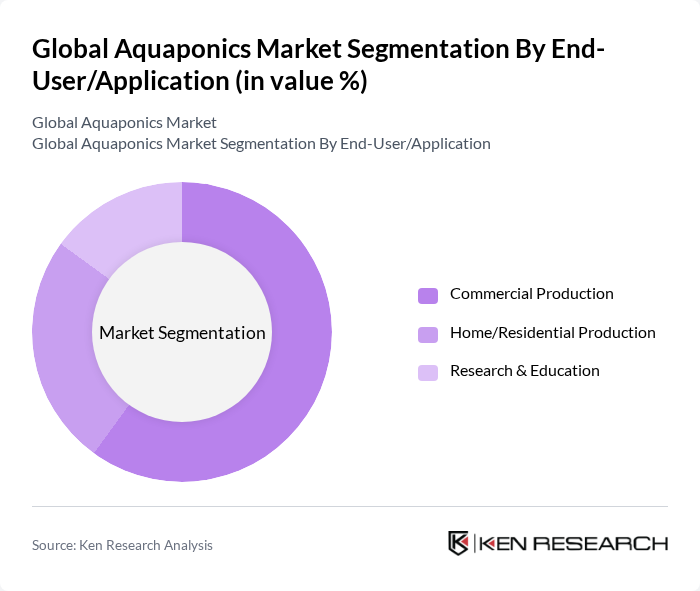
By End-User/Application:The market is also segmented by end-user applications, which include Commercial Production, Home/Residential Production, and Research & Education. Commercial Production is the leading segment, driven by the increasing demand for fresh produce and fish in urban areas, as well as the need for sustainable farming solutions in the face of climate change.
Global Aquaponics Market Competitive Landscape
The Global Aquaponics Market is characterized by a dynamic mix of regional and international players. Leading participants such as Nelson and Pade, Inc., The Aquaponic Source (AquaBundance), Pentair Aquatic Eco-Systems (Pentair AES), Aquaponics AI, FarmedHere (legacy/defunct, case reference), Superior Fresh LLC, Ouroboros Farms, Upward Farms (formerly Edenworks), GreenSky Growers, ECF Farmsystems GmbH (ECF Farm Berlin), Urban Organics (legacy assets under Pentair/Stark), AquaBioTech Group, Aquaponik Manufaktur GmbH, Aquaponic Lynx LLC, Back to the Roots contribute to innovation, geographic expansion, and service delivery in this space.
Global Aquaponics Market Industry Analysis
Growth Drivers
- Increasing Demand for Sustainable Food Production:The global population is projected to reachabout 9.7 billion by 2050, intensifying the need for sustainable food sources. Aquaponics, which combines aquaculture and hydroponics, offers a resource-efficient method of food production. In future, the demand for organic produce is expected to increase by 12% annually, driven by consumer preferences for environmentally friendly farming practices. This trend is supported by the World Bank's report indicating that sustainable agriculture can significantly reduce food insecurity.
- Technological Advancements in Aquaponics Systems:The aquaponics sector is witnessing rapid technological innovations, with investments in automation and IoT solutions projected to exceedUSD 1.5 billion in future. These advancements enhance system efficiency and reduce operational costs. For instance, smart sensors can monitor water quality and nutrient levels, leading to improved crop yields. The integration of AI in aquaponics is expected to optimize resource management, making systems more accessible and appealing to urban farmers.
- Government Support and Funding for Aquaponics Initiatives:Governments worldwide are increasingly recognizing the potential of aquaponics in achieving food security and sustainability goals. In future, funding for aquaponics projects is anticipated to reachUSD 500 million, with initiatives aimed at promoting local food production. For example, the U.S. Department of Agriculture has allocatedUSD 100 millionfor research and development in sustainable farming practices, including aquaponics, which is expected to stimulate growth in this sector.
Market Challenges
- High Initial Investment Costs:The establishment of aquaponics systems requires significant upfront capital, often exceedingUSD 100,000for commercial setups. This financial barrier can deter potential investors and small-scale farmers. Additionally, the costs associated with purchasing equipment, seeds, and fish can be prohibitive. According to industry reports, many new entrants struggle to secure funding, limiting the growth potential of aquaponics in various regions.
- Technical Complexity of Aquaponics Systems:The intricate nature of aquaponics systems poses a challenge for new users. Managing the balance between fish and plant needs requires specialized knowledge and skills. In future, it is estimated that60%of aquaponics projects fail within the first two years due to mismanagement and lack of expertise. This high failure rate highlights the need for comprehensive training programs and support systems to ensure successful implementation.
Global Aquaponics Market Future Outlook
The future of the aquaponics market appears promising, driven by increasing urbanization and a growing emphasis on local food production. As cities expand, the demand for sustainable agricultural practices will likely rise, leading to more urban aquaponics initiatives. Furthermore, the integration of smart technologies will enhance operational efficiency, making aquaponics more attractive to a broader audience. Collaborative efforts between governments, educational institutions, and private sectors will also play a crucial role in advancing research and development in this field.
Market Opportunities
- Expansion into Urban Areas for Local Food Production:Urban aquaponics presents a significant opportunity, with cities investing in local food systems. In future, urban areas are expected to account for70%of global food consumption, creating a demand for innovative farming solutions. This trend can lead to reduced transportation costs and fresher produce for urban populations.
- Integration with Smart Farming Technologies:The convergence of aquaponics with smart farming technologies offers substantial growth potential. In future, the market for smart agriculture is projected to reachUSD 20 billion, with aquaponics systems benefiting from advancements in data analytics and automation. This integration can enhance productivity and sustainability, attracting tech-savvy entrepreneurs to the sector.
Scope of the Report
| Segment | Sub-Segments |
|---|---|
| By System Type | Media-Based (Flood-and-Drain) Systems Nutrient Film Technique (NFT) Systems Deep Water Culture (DWC/Raft) Systems Hybrid/Integrated Systems Others (e.g., vertical towers, Dutch buckets) |
| By End-User/Application | Commercial Production Home/Residential Production Research & Education |
| By Produce | Fish (e.g., tilapia, catfish, trout) Fruits & Vegetables (leafy greens, herbs, tomatoes) Others (ornamental fish, specialty crops) |
| By Facility Type | Greenhouse Building-Based Indoor Farms Outdoor/Hoop House |
| By Components | Rearing Tank Settling/Clarifier Basin Biofilters Sump Tanks Grow Beds/Channels |
| By Equipment | Pumps & Valves Aeration Systems Grow Lights Water Heaters/Chillers Water Quality Testing & Control Fish Purge & Harvest Systems |
| By Region | North America Europe Asia Pacific Latin America Middle East & Africa |
Key Target Audience
Investors and Venture Capitalist Firms
Government and Regulatory Bodies (e.g., Food and Agriculture Organization, Environmental Protection Agency)
Manufacturers and Producers
Distributors and Retailers
Agricultural Technology Companies
Non-Governmental Organizations (NGOs) focused on sustainable agriculture
Food Safety and Quality Assurance Agencies
Financial Institutions and Banks specializing in agricultural investments
Players Mentioned in the Report:
Nelson and Pade, Inc.
The Aquaponic Source (AquaBundance)
Pentair Aquatic Eco-Systems (Pentair AES)
Aquaponics AI
FarmedHere (legacy/defunct, case reference)
Superior Fresh LLC
Ouroboros Farms
Upward Farms (formerly Edenworks)
GreenSky Growers
ECF Farmsystems GmbH (ECF Farm Berlin)
Urban Organics (legacy assets under Pentair/Stark)
AquaBioTech Group
Aquaponik Manufaktur GmbH
Aquaponic Lynx LLC
Back to the Roots
Table of Contents
Market Assessment Phase
1. Executive Summary and Approach
2. Global Aquaponics Market Overview
2.1 Key Insights and Strategic Recommendations
2.2 Global Aquaponics Market Overview
2.3 Definition and Scope
2.4 Evolution of Market Ecosystem
2.5 Timeline of Key Regulatory Milestones
2.6 Value Chain & Stakeholder Mapping
2.7 Business Cycle Analysis
2.8 Policy & Incentive Landscape
3. Global Aquaponics Market Analysis
3.1 Growth Drivers
3.1.1 Increasing Demand for Sustainable Food Production
3.1.2 Technological Advancements in Aquaponics Systems
3.1.3 Rising Awareness of Organic Farming Practices
3.1.4 Government Support and Funding for Aquaponics Initiatives
3.2 Market Challenges
3.2.1 High Initial Investment Costs
3.2.2 Technical Complexity of Aquaponics Systems
3.2.3 Limited Awareness Among Potential Users
3.2.4 Regulatory Hurdles in Different Regions
3.3 Market Opportunities
3.3.1 Expansion into Urban Areas for Local Food Production
3.3.2 Development of Modular Aquaponics Systems
3.3.3 Integration with Smart Farming Technologies
3.3.4 Collaboration with Educational Institutions for Research
3.4 Market Trends
3.4.1 Growth of Vertical Farming Techniques
3.4.2 Increasing Consumer Preference for Locally Sourced Produce
3.4.3 Adoption of Renewable Energy in Aquaponics
3.4.4 Rise of Community-Based Aquaponics Projects
3.5 Government Regulation
3.5.1 Standards for Organic Certification
3.5.2 Regulations on Water Usage and Quality
3.5.3 Guidelines for Waste Management in Aquaponics
3.5.4 Incentives for Sustainable Agricultural Practices
4. SWOT Analysis
5. Stakeholder Analysis
6. Porter's Five Forces Analysis
7. Global Aquaponics Market Market Size, 2019-2024
7.1 By Value
7.2 By Volume
7.3 By Average Selling Price
8. Global Aquaponics Market Segmentation
8.1 By System Type
8.1.1 Media-Based (Flood-and-Drain) Systems
8.1.2 Nutrient Film Technique (NFT) Systems
8.1.3 Deep Water Culture (DWC/Raft) Systems
8.1.4 Hybrid/Integrated Systems
8.1.5 Others (e.g., vertical towers, Dutch buckets)
8.2 By End-User/Application
8.2.1 Commercial Production
8.2.2 Home/Residential Production
8.2.3 Research & Education
8.3 By Produce
8.3.1 Fish (e.g., tilapia, catfish, trout)
8.3.2 Fruits & Vegetables (leafy greens, herbs, tomatoes)
8.3.3 Others (ornamental fish, specialty crops)
8.4 By Facility Type
8.4.1 Greenhouse
8.4.2 Building-Based Indoor Farms
8.4.3 Outdoor/Hoop House
8.5 By Components
8.5.1 Rearing Tank
8.5.2 Settling/Clarifier Basin
8.5.3 Biofilters
8.5.4 Sump Tanks
8.5.5 Grow Beds/Channels
8.6 By Equipment
8.6.1 Pumps & Valves
8.6.2 Aeration Systems
8.6.3 Grow Lights
8.6.4 Water Heaters/Chillers
8.6.5 Water Quality Testing & Control
8.6.6 Fish Purge & Harvest Systems
8.7 By Region
8.7.1 North America
8.7.2 Europe
8.7.3 Asia Pacific
8.7.4 Latin America
8.7.5 Middle East & Africa
9. Global Aquaponics Market Competitive Analysis
9.1 Market Share of Key Players
9.2 Cross Comparison of Key Players
9.2.1 Company Name
9.2.2 Group Size (Startup, SME, or Large)
9.2.3 Revenue Growth Rate (YoY, %)
9.2.4 Installed Capacity (m² of grow area and/or tonnes fish/year)
9.2.5 Market Footprint (number of operational sites/regions)
9.2.6 Customer Retention/Repeat Contract Rate (%)
9.2.7 Average System Ticket Size (USD per install)
9.2.8 Product/Service Mix (% equipment vs. produce vs. consulting)
9.2.9 CAPEX per m² (USD) and OPEX per kg produce (USD)
9.2.10 Yield Performance (kg/m²/year plants; FCR for fish)
9.2.11 Water/Energy Intensity (L/kg; kWh/kg)
9.2.12 R&D and IP Indicators (patents, pilots, collaborations)
9.2.13 Certification & Compliance (organic, GAP, HACCP)
9.3 SWOT Analysis of Top Players
9.4 Pricing Analysis
9.5 Detailed Profile of Major Companies
9.5.1 Nelson and Pade, Inc.
9.5.2 The Aquaponic Source (AquaBundance)
9.5.3 Pentair Aquatic Eco-Systems (Pentair AES)
9.5.4 Aquaponics AI
9.5.5 FarmedHere (legacy/defunct, case reference)
9.5.6 Superior Fresh LLC
9.5.7 Ouroboros Farms
9.5.8 Upward Farms (formerly Edenworks)
9.5.9 GreenSky Growers
9.5.10 ECF Farmsystems GmbH (ECF Farm Berlin)
9.5.11 Urban Organics (legacy assets under Pentair/Stark)
9.5.12 AquaBioTech Group
9.5.13 Aquaponik Manufaktur GmbH
9.5.14 Aquaponic Lynx LLC
9.5.15 Back to the Roots
10. Global Aquaponics Market End-User Analysis
10.1 Procurement Behavior of Key Ministries
10.1.1 Government Initiatives for Sustainable Agriculture
10.1.2 Budget Allocations for Aquaponics Projects
10.1.3 Collaboration with Private Sector
10.2 Corporate Spend on Infrastructure & Energy
10.2.1 Investment in Aquaponics Infrastructure
10.2.2 Energy Efficiency Measures
10.2.3 Funding for Research and Development
10.3 Pain Point Analysis by End-User Category
10.3.1 Cost of Setup and Maintenance
10.3.2 Technical Support and Training Needs
10.3.3 Market Access and Distribution Challenges
10.4 User Readiness for Adoption
10.4.1 Awareness of Aquaponics Benefits
10.4.2 Availability of Resources and Training
10.4.3 Perceived ROI from Aquaponics Systems
10.5 Post-Deployment ROI and Use Case Expansion
10.5.1 Evaluation of Initial Investment Returns
10.5.2 Opportunities for Scaling Operations
10.5.3 Long-term Sustainability Assessments
11. Global Aquaponics Market Future Size, 2025-2030
11.1 By Value
11.2 By Volume
11.3 By Average Selling Price
Go-To-Market Strategy Phase
1. Whitespace Analysis + Business Model Canvas
1.1 Market Gaps and Opportunities
1.2 Value Proposition Development
1.3 Revenue Streams Identification
1.4 Key Partnerships and Resources
1.5 Customer Segmentation
1.6 Cost Structure Analysis
1.7 Channels for Delivery
2. Marketing and Positioning Recommendations
2.1 Branding Strategies
2.2 Product USPs
2.3 Target Audience Identification
2.4 Communication Strategies
2.5 Digital Marketing Approaches
3. Distribution Plan
3.1 Urban Retail Strategies
3.2 Rural NGO Tie-ups
3.3 Online Distribution Channels
3.4 Partnerships with Local Farmers
4. Channel & Pricing Gaps
4.1 Underserved Routes
4.2 Pricing Bands Analysis
4.3 Competitor Pricing Strategies
4.4 Customer Willingness to Pay
5. Unmet Demand & Latent Needs
5.1 Category Gaps in Product Offerings
5.2 Consumer Segments with High Potential
5.3 Emerging Trends in Consumer Preferences
6. Customer Relationship
6.1 Loyalty Programs
6.2 After-sales Service Enhancements
6.3 Customer Feedback Mechanisms
7. Value Proposition
7.1 Sustainability Initiatives
7.2 Integrated Supply Chains
7.3 Community Engagement Strategies
8. Key Activities
8.1 Regulatory Compliance
8.2 Branding Efforts
8.3 Distribution Setup
9. Entry Strategy Evaluation
9.1 Domestic Market Entry Strategy
9.1.1 Product Mix Considerations
9.1.2 Pricing Band Analysis
9.1.3 Packaging Strategies
9.2 Export Entry Strategy
9.2.1 Target Countries Identification
9.2.2 Compliance Roadmap Development
10. Entry Mode Assessment
10.1 Joint Ventures
10.2 Greenfield Investments
10.3 Mergers & Acquisitions
10.4 Distributor Model Evaluation
11. Capital and Timeline Estimation
11.1 Capital Requirements
11.2 Timelines for Implementation
12. Control vs Risk Trade-Off
12.1 Ownership vs Partnerships
13. Profitability Outlook
13.1 Breakeven Analysis
13.2 Long-term Sustainability Considerations
14. Potential Partner List
14.1 Distributors
14.2 Joint Ventures
14.3 Acquisition Targets
15. Execution Roadmap
15.1 Phased Plan for Market Entry
15.1.1 Market Setup
15.1.2 Market Entry
15.1.3 Growth Acceleration
15.1.4 Scale & Stabilize
15.2 Key Activities and Milestones
15.2.1 Milestone Planning
15.2.2 Activity Tracking
Research Methodology
Phase 1: Approach1
Desk Research
- Analysis of industry reports from aquaponics associations and agricultural organizations
- Review of academic journals and publications focusing on aquaponics technology and market trends
- Examination of government publications and policy documents related to sustainable agriculture and aquaponics
Primary Research
- Interviews with aquaponics farm operators and managers to gather insights on operational challenges
- Surveys targeting suppliers of aquaponics systems and components to understand market dynamics
- Field visits to aquaponics facilities to observe practices and gather qualitative data
Validation & Triangulation
- Cross-validation of findings through multiple data sources, including trade publications and market surveys
- Triangulation of data from primary interviews and secondary research to ensure consistency
- Sanity checks conducted through expert panel reviews comprising industry veterans and academic experts
Phase 2: Market Size Estimation1
Top-down Assessment
- Estimation of the global aquaponics market size based on agricultural output and aquaculture statistics
- Segmentation of the market by region, product type, and application to identify growth areas
- Incorporation of trends in sustainable farming practices and consumer demand for organic produce
Bottom-up Modeling
- Collection of data on the number of operational aquaponics systems and their average production capacity
- Cost analysis of aquaponics setups, including initial investment and operational expenses
- Revenue projections based on yield estimates and market prices for aquaponically grown products
Forecasting & Scenario Analysis
- Multi-factor regression analysis incorporating variables such as technological advancements and regulatory changes
- Scenario modeling based on varying levels of consumer adoption and market penetration rates
- Development of baseline, optimistic, and pessimistic forecasts through 2030
Phase 3: CATI Sample Composition1
| Scope Item/Segment | Sample Size | Target Respondent Profiles |
|---|---|---|
| Aquaponics Farm Operators | 100 | Farm Owners, Operations Managers |
| Aquaponics System Suppliers | 80 | Sales Managers, Product Development Leads |
| Research Institutions Focused on Aquaponics | 50 | Researchers, Academic Professors |
| Government Agricultural Policy Makers | 60 | Policy Analysts, Agricultural Advisors |
| Consumers of Aquaponically Grown Products | 90 | Health-Conscious Consumers, Organic Food Buyers |
Frequently Asked Questions
What is the current value of the Global Aquaponics Market?
The Global Aquaponics Market is valued at approximately USD 1.2 billion, reflecting a growing interest in sustainable agricultural practices and efficient food production systems that integrate aquaculture and hydroponics.
What are the main drivers of growth in the aquaponics market?
Which regions are leading in the aquaponics market?
What are the different system types in aquaponics?
Other Regional/Country Reports
Indonesia Aquaponics Market
Malaysia Aquaponics Market
APAC Aquaponics Market
Why Buy From Us?

What makes us stand out is that our consultants follow Robust, Refine and Result (RRR) methodology. Robust for clear definitions, approaches and sanity checking, Refine for differentiating respondents' facts and opinions, and Result for presenting data with story.

We have set a benchmark in the industry by offering our clients with syndicated and customized market research reports featuring coverage of entire market as well as meticulous research and analyst insights.

While we don't replace traditional research, we flip the method upside down. Our dual approach of Top Bottom & Bottom Top ensures quality deliverable by not just verifying company fundamentals but also looking at the sector and macroeconomic factors.

With one step in the future, our research team constantly tries to show you the bigger picture. We help with some of the tough questions you may encounter along the way: How is the industry positioned? Best marketing channel? KPI's of competitors? By aligning every element, we help maximize success.

Our report gives you instant access to the answers and sources that other companies might choose to hide. We elaborate each steps of research methodology we have used and showcase you the sample size to earn your trust.

If you need any support, we are here! We pride ourselves on universe strength, data quality, and quick, friendly, and professional service.