About the Report
Base Year 2024Listen to the audio summary
Saudi Arabia Aquaponics Market Overview
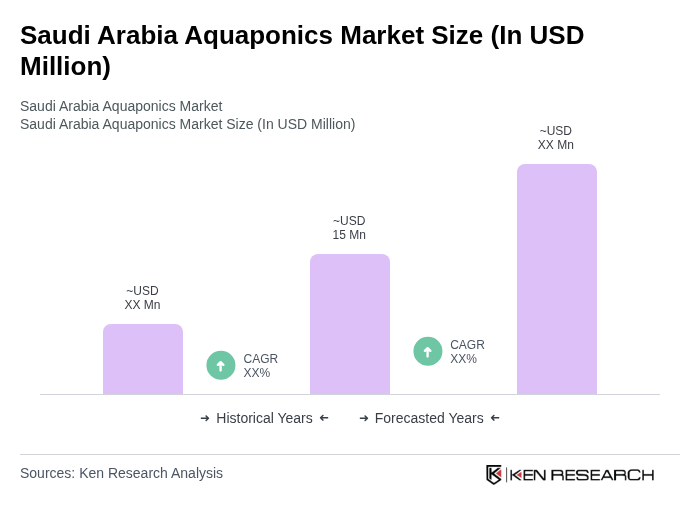
- The Saudi Arabia Aquaponics Market is valued at USD 15 million, based on a five-year historical analysis. This growth is primarily driven by the increasing demand for sustainable agricultural practices, rising food security concerns, and the need for efficient water usage in arid regions. The integration of aquaculture and hydroponics has gained traction, leading to innovative farming solutions that optimize resource utilization .
- Key players in this market include Riyadh, Jeddah, and Dammam, which dominate due to their strategic locations, access to technology, and government support for agricultural innovation. These cities are also home to a growing number of aquaponics farms and research institutions, fostering collaboration and knowledge sharing within the industry .
- In 2023, the Saudi government implemented the National Aquaculture Strategy, issued by the Ministry of Environment, Water and Agriculture. This strategy aims to enhance local aquaculture production and promote sustainable practices. The initiative includes investments in research and development, infrastructure improvements, and training programs for farmers, thereby supporting the growth of the aquaponics sector .
Saudi Arabia Aquaponics Market Segmentation
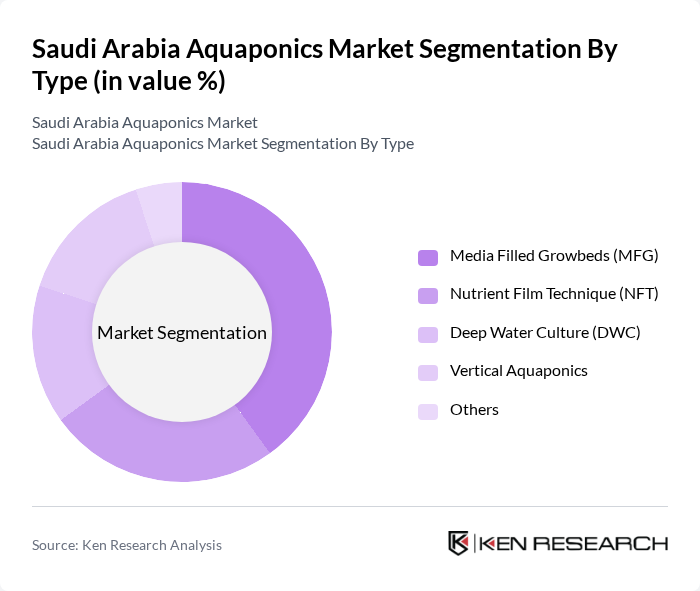
By Type:The aquaponics market can be segmented into various types, including Media Filled Growbeds (MFG), Nutrient Film Technique (NFT), Deep Water Culture (DWC), Vertical Aquaponics, and Others. Among these, Media Filled Growbeds (MFG) is the most popular due to its simplicity and effectiveness in growing a variety of plants. The Nutrient Film Technique (NFT) is also gaining traction for its efficiency in nutrient delivery. The market is witnessing a trend towards vertical aquaponics, driven by urbanization and space constraints .
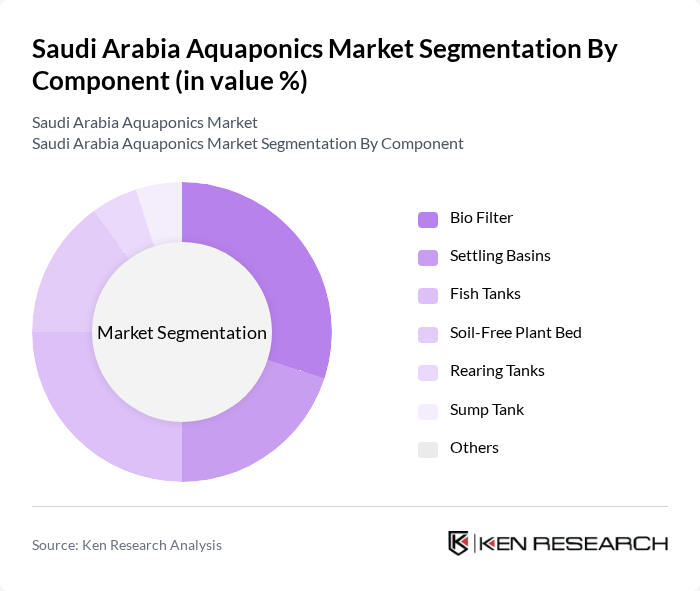
By Component:This segment includes various components essential for aquaponics systems, such as Bio Filters, Settling Basins, Fish Tanks, Soil-Free Plant Beds, Rearing Tanks, Sump Tanks, and Others. The Bio Filter is crucial for maintaining water quality, while Fish Tanks are vital for aquaculture. The demand for Soil-Free Plant Beds is increasing as more growers seek efficient growing mediums. The market is also seeing innovations in Sump Tanks and Settling Basins to enhance system efficiency .
Saudi Arabia Aquaponics Market Competitive Landscape
The Saudi Arabia Aquaponics Market is characterized by a dynamic mix of regional and international players. Leading participants such as Mowreq Specialized Agriculture, Balwara Technology, Green Oasis Farms, Pure Harvest Smart Farms, NAQUA (National Aquaculture Group), Aqua Bridge Farm Co., Hebco, Oasis Aquaponics, Greenlife Aquaponics, UrbanKisaan Saudi, Agrona, The Aquaponic Source, Pentair PLC, Hydrofarm Holdings Group Inc., Nelson and Pade contribute to innovation, geographic expansion, and service delivery in this space.
Saudi Arabia Aquaponics Market Industry Analysis
Growth Drivers
- Increasing Demand for Sustainable Food Sources:The Saudi Arabian population is projected to reach 40 million in the future, driving the demand for sustainable food sources. With a significant portion of the population increasingly concerned about food security, aquaponics offers a viable solution. The global organic food market is expected to reach $400 billion in the future, indicating a shift towards sustainable practices. This trend is mirrored in Saudi Arabia, where local initiatives aim to enhance food production sustainably, thus boosting aquaponics adoption.
- Government Support for Agricultural Innovation:The Saudi government has allocated approximately $2 billion to support agricultural innovation as part of its Vision 2030 initiative. This funding is aimed at enhancing food security and promoting sustainable practices. The Ministry of Environment, Water, and Agriculture is actively encouraging aquaponics through grants and subsidies, which are expected to increase the number of aquaponics farms from 200 in the future to over 600 in the future, fostering growth in this sector.
- Technological Advancements in Aquaponics Systems:The integration of advanced technologies in aquaponics systems is revolutionizing food production in Saudi Arabia. Innovations such as automated monitoring systems and IoT applications are enhancing efficiency and yield. The market for smart agriculture technologies is projected to reach $15 billion in the future in the Middle East, with aquaponics being a significant beneficiary. This technological shift is expected to lower operational costs and improve productivity, driving market growth.
Market Challenges
- High Initial Investment Costs:The initial setup costs for aquaponics systems can be substantial, often exceeding $150,000 for commercial operations. This financial barrier can deter potential investors and farmers from entering the market. Additionally, the need for specialized equipment and technology further escalates these costs. As a result, many small-scale farmers may find it challenging to adopt aquaponics, limiting market growth and innovation in the sector.
- Limited Consumer Awareness:Despite the benefits of aquaponics, consumer awareness remains low in Saudi Arabia. A survey conducted in the future indicated that only 35% of consumers were familiar with aquaponics and its advantages. This lack of knowledge can hinder market penetration and acceptance of aquaponics products. To overcome this challenge, educational campaigns and outreach programs are essential to inform consumers about the benefits of aquaponics, thereby increasing demand.
Saudi Arabia Aquaponics Market Future Outlook
The future of the aquaponics market in Saudi Arabia appears promising, driven by increasing urbanization and a growing focus on sustainable agriculture. As cities expand, the demand for locally sourced food will rise, making aquaponics an attractive solution. Furthermore, advancements in technology will likely enhance system efficiency and reduce costs, making aquaponics more accessible. Collaborative efforts between the government and private sector will also play a crucial role in fostering innovation and expanding market reach, ensuring a sustainable food supply for the future.
Market Opportunities
- Expansion into Urban Areas:Urban areas in Saudi Arabia are experiencing rapid growth, creating a significant opportunity for aquaponics. With limited space for traditional farming, aquaponics can utilize vertical farming techniques to maximize yield. The urban population is expected to reach 35 million in the future, providing a substantial market for locally grown produce, which can be met through aquaponics systems.
- Partnerships with Local Businesses:Collaborating with local businesses can enhance the distribution and marketing of aquaponics products. By forming partnerships with restaurants and grocery stores, aquaponics producers can ensure a steady demand for their products. This strategy not only increases market visibility but also promotes the consumption of locally sourced, sustainable food, aligning with the growing consumer preference for organic produce.
Scope of the Report
| Segment | Sub-Segments |
|---|---|
| By Type | Media Filled Growbeds (MFG) Nutrient Film Technique (NFT) Deep Water Culture (DWC) Vertical Aquaponics Others |
| By Component | Bio Filter Settling Basins Fish Tanks Soil-Free Plant Bed Rearing Tanks Sump Tank Others |
| By Equipment | Pumps & Valves Grow Lights Water Heaters Aeration Systems Water Quality Testing Systems Fish Purge Systems Others |
| By Produce | Vegetables Herbs Fruits Flowers Fish Others |
| By End-User | Commercial Growers Home Growers Research & Education Others |
| By Facility Type | Greenhouse Building-Based Indoor Farms Others |
| By Application | Freshwater Fish Production Vegetable Production Ornamental Fish Production Research & Education Others |
| By Investment Source | Private Investments Government Grants International Funding Others |
| By Policy Support | Research Grants Tax Incentives Training Programs Others |
Key Target Audience
Investors and Venture Capitalist Firms
Government and Regulatory Bodies (e.g., Ministry of Environment, Water and Agriculture)
Manufacturers and Producers of Aquaponics Systems
Distributors and Retailers of Aquaponics Products
Technology Providers for Aquaponics Solutions
Industry Associations (e.g., Saudi Aquaculture Society)
Financial Institutions and Banks
Non-Governmental Organizations (NGOs) focused on Sustainable Agriculture
Players Mentioned in the Report:
Mowreq Specialized Agriculture
Balwara Technology
Green Oasis Farms
Pure Harvest Smart Farms
NAQUA (National Aquaculture Group)
Aqua Bridge Farm Co.
Hebco
Oasis Aquaponics
Greenlife Aquaponics
UrbanKisaan Saudi
Agrona
The Aquaponic Source
Pentair PLC
Hydrofarm Holdings Group Inc.
Nelson and Pade
Table of Contents
Market Assessment Phase
1. Executive Summary and Approach
2. Saudi Arabia Aquaponics Market Overview
2.1 Key Insights and Strategic Recommendations
2.2 Saudi Arabia Aquaponics Market Overview
2.3 Definition and Scope
2.4 Evolution of Market Ecosystem
2.5 Timeline of Key Regulatory Milestones
2.6 Value Chain & Stakeholder Mapping
2.7 Business Cycle Analysis
2.8 Policy & Incentive Landscape
3. Saudi Arabia Aquaponics Market Analysis
3.1 Growth Drivers
3.1.1 Increasing demand for sustainable food sources
3.1.2 Government support for agricultural innovation
3.1.3 Rising awareness of environmental sustainability
3.1.4 Technological advancements in aquaponics systems
3.2 Market Challenges
3.2.1 High initial investment costs
3.2.2 Limited consumer awareness
3.2.3 Regulatory hurdles
3.2.4 Competition from traditional farming methods
3.3 Market Opportunities
3.3.1 Expansion into urban areas
3.3.2 Development of educational programs
3.3.3 Partnerships with local businesses
3.3.4 Export potential of aquaponics products
3.4 Market Trends
3.4.1 Growth of vertical farming
3.4.2 Integration of IoT in aquaponics
3.4.3 Shift towards organic produce
3.4.4 Increased investment in research and development
3.5 Government Regulation
3.5.1 Subsidies for sustainable agriculture
3.5.2 Standards for aquaponics systems
3.5.3 Water usage regulations
3.5.4 Import/export regulations for aquaponics products
4. SWOT Analysis
5. Stakeholder Analysis
6. Porter's Five Forces Analysis
7. Saudi Arabia Aquaponics Market Market Size, 2019-2024
7.1 By Value
7.2 By Volume
7.3 By Average Selling Price
8. Saudi Arabia Aquaponics Market Segmentation
8.1 By Type
8.1.1 Media Filled Growbeds (MFG)
8.1.2 Nutrient Film Technique (NFT)
8.1.3 Deep Water Culture (DWC)
8.1.4 Vertical Aquaponics
8.1.5 Others
8.2 By Component
8.2.1 Bio Filter
8.2.2 Settling Basins
8.2.3 Fish Tanks
8.2.4 Soil-Free Plant Bed
8.2.5 Rearing Tanks
8.2.6 Sump Tank
8.2.7 Others
8.3 By Equipment
8.3.1 Pumps & Valves
8.3.2 Grow Lights
8.3.3 Water Heaters
8.3.4 Aeration Systems
8.3.5 Water Quality Testing Systems
8.3.6 Fish Purge Systems
8.3.7 Others
8.4 By Produce
8.4.1 Vegetables
8.4.2 Herbs
8.4.3 Fruits
8.4.4 Flowers
8.4.5 Fish
8.4.6 Others
8.5 By End-User
8.5.1 Commercial Growers
8.5.2 Home Growers
8.5.3 Research & Education
8.5.4 Others
8.6 By Facility Type
8.6.1 Greenhouse
8.6.2 Building-Based Indoor Farms
8.6.3 Others
8.7 By Application
8.7.1 Freshwater Fish Production
8.7.2 Vegetable Production
8.7.3 Ornamental Fish Production
8.7.4 Research & Education
8.7.5 Others
8.8 By Investment Source
8.8.1 Private Investments
8.8.2 Government Grants
8.8.3 International Funding
8.8.4 Others
8.9 By Policy Support
8.9.1 Research Grants
8.9.2 Tax Incentives
8.9.3 Training Programs
8.9.4 Others
9. Saudi Arabia Aquaponics Market Competitive Analysis
9.1 Market Share of Key Players
9.2 Cross Comparison of Key Players
9.2.1 Company Name
9.2.2 Facility Type (Greenhouse, Indoor Farm, etc.)
9.2.3 Group Size (Large, Medium, Small)
9.2.4 Revenue (USD Million)
9.2.5 Revenue Growth Rate (%)
9.2.6 Market Penetration Rate (%)
9.2.7 Production Capacity (Tons/Year)
9.2.8 Number of Operational Sites
9.2.9 Product Portfolio Breadth (No. of Crops/Fish)
9.2.10 Technology Adoption Level (Basic/Advanced/Automated)
9.2.11 Sustainability Index (Water/Energy Use Efficiency)
9.2.12 Certifications (Organic, GlobalG.A.P., etc.)
9.2.13 Customer Segments Served
9.2.14 Brand Recognition Score
9.3 SWOT Analysis of Top Players
9.4 Pricing Analysis
9.5 Detailed Profile of Major Companies
9.5.1 Mowreq Specialized Agriculture
9.5.2 Balwara Technology
9.5.3 Green Oasis Farms
9.5.4 Pure Harvest Smart Farms
9.5.5 NAQUA (National Aquaculture Group)
9.5.6 Aqua Bridge Farm Co.
9.5.7 Hebco
9.5.8 Oasis Aquaponics
9.5.9 Greenlife Aquaponics
9.5.10 UrbanKisaan Saudi
9.5.11 Agrona
9.5.12 The Aquaponic Source
9.5.13 Pentair PLC
9.5.14 Hydrofarm Holdings Group Inc.
9.5.15 Nelson and Pade
10. Saudi Arabia Aquaponics Market End-User Analysis
10.1 Procurement Behavior of Key Ministries
10.1.1 Ministry of Agriculture
10.1.2 Ministry of Environment
10.1.3 Ministry of Commerce
10.1.4 Others
10.2 Corporate Spend on Infrastructure & Energy
10.2.1 Investment in Aquaponics Facilities
10.2.2 Energy Consumption Patterns
10.2.3 Infrastructure Development Costs
10.2.4 Others
10.3 Pain Point Analysis by End-User Category
10.3.1 Cost of Technology
10.3.2 Access to Resources
10.3.3 Market Competition
10.3.4 Others
10.4 User Readiness for Adoption
10.4.1 Awareness Levels
10.4.2 Training Needs
10.4.3 Financial Readiness
10.4.4 Others
10.5 Post-Deployment ROI and Use Case Expansion
10.5.1 ROI Measurement Techniques
10.5.2 Use Case Development
10.5.3 Long-term Sustainability Plans
10.5.4 Others
11. Saudi Arabia Aquaponics Market Future Size, 2025-2030
11.1 By Value
11.2 By Volume
11.3 By Average Selling Price
Go-To-Market Strategy Phase
1. Whitespace Analysis + Business Model Canvas
1.1 Market Gaps Identification
1.2 Business Model Development
2. Marketing and Positioning Recommendations
2.1 Branding Strategies
2.2 Product USPs
3. Distribution Plan
3.1 Urban Retail Strategies
3.2 Rural NGO Tie-ups
4. Channel & Pricing Gaps
4.1 Underserved Routes
4.2 Pricing Bands
5. Unmet Demand & Latent Needs
5.1 Category Gaps
5.2 Consumer Segments
6. Customer Relationship
6.1 Loyalty Programs
6.2 After-sales Service
7. Value Proposition
7.1 Sustainability Initiatives
7.2 Integrated Supply Chains
8. Key Activities
8.1 Regulatory Compliance
8.2 Branding Efforts
8.3 Distribution Setup
9. Entry Strategy Evaluation
9.1 Domestic Market Entry Strategy
9.1.1 Product Mix
9.1.2 Pricing Band
9.1.3 Packaging
9.2 Export Entry Strategy
9.2.1 Target Countries
9.2.2 Compliance Roadmap
10. Entry Mode Assessment
10.1 Joint Ventures
10.2 Greenfield Investments
10.3 Mergers & Acquisitions
10.4 Distributor Model
11. Capital and Timeline Estimation
11.1 Capital Requirements
11.2 Timelines
12. Control vs Risk Trade-Off
12.1 Ownership vs Partnerships
13. Profitability Outlook
13.1 Breakeven Analysis
13.2 Long-term Sustainability
14. Potential Partner List
14.1 Distributors
14.2 Joint Ventures
14.3 Acquisition Targets
15. Execution Roadmap
15.1 Phased Plan for Market Entry
15.1.1 Market Setup
15.1.2 Market Entry
15.1.3 Growth Acceleration
15.1.4 Scale & Stabilize
15.2 Key Activities and Milestones
15.2.1 Milestone Planning
15.2.2 Activity Tracking
Research Methodology
Phase 1: Approach1
Desk Research
- Analysis of existing market reports and publications on aquaponics in Saudi Arabia
- Review of government publications and agricultural policies related to sustainable farming
- Examination of academic journals and case studies focusing on aquaponics technology and its applications
Primary Research
- Interviews with aquaponics farm operators and managers across various regions in Saudi Arabia
- Surveys conducted with agricultural experts and consultants specializing in sustainable farming practices
- Focus group discussions with consumers to understand market demand and preferences for aquaponics products
Validation & Triangulation
- Cross-validation of findings through multiple data sources, including trade associations and market surveys
- Triangulation of qualitative insights from interviews with quantitative data from market reports
- Sanity checks through expert panel reviews involving agronomists and market analysts
Phase 2: Market Size Estimation1
Top-down Assessment
- Estimation of market size based on national agricultural output and aquaponics' share
- Analysis of growth trends in organic produce and consumer preferences for sustainable food sources
- Incorporation of government initiatives promoting aquaponics as part of food security strategies
Bottom-up Modeling
- Collection of data on production capacities and operational costs from leading aquaponics farms
- Estimation of market potential based on average yield per square meter in aquaponics systems
- Volume and pricing analysis of aquaponics products in comparison to traditional farming outputs
Forecasting & Scenario Analysis
- Multi-factor regression analysis incorporating population growth, urbanization, and dietary shifts
- Scenario modeling based on potential regulatory changes and technological advancements in aquaponics
- Development of baseline, optimistic, and pessimistic market projections through 2030
Phase 3: CATI Sample Composition1
| Scope Item/Segment | Sample Size | Target Respondent Profiles |
|---|---|---|
| Aquaponics Farm Operators | 80 | Farm Owners, Operations Managers |
| Agricultural Experts and Consultants | 60 | Agronomists, Sustainability Consultants |
| Consumers of Aquaponics Products | 120 | Health-Conscious Consumers, Organic Food Buyers |
| Retailers of Aquaponics Produce | 50 | Grocery Store Managers, Specialty Food Retailers |
| Government and Policy Makers | 40 | Agricultural Policy Advisors, Food Security Officials |
Frequently Asked Questions
What is the current value of the Saudi Arabia Aquaponics Market?
The Saudi Arabia Aquaponics Market is valued at approximately USD 15 million, reflecting a growing interest in sustainable agricultural practices and efficient water usage in arid regions.
What factors are driving the growth of the aquaponics market in Saudi Arabia?
Which cities are leading in the Saudi Arabia Aquaponics Market?
What is the National Aquaculture Strategy in Saudi Arabia?
Other Regional/Country Reports
Indonesia Aquaponics Market
Malaysia Aquaponics Market
APAC Aquaponics Market
Other Adjacent Reports
South Korea Controlled Environment Agriculture Market
Oman Sustainable Agriculture Market
Singapore Organic Farming Market
Bahrain Water Recycling Systems Market
Germany Fish Feed Market
Japan Greenhouse Technology Market
KSA Agri-Tech Market
Why Buy From Us?

What makes us stand out is that our consultants follow Robust, Refine and Result (RRR) methodology. Robust for clear definitions, approaches and sanity checking, Refine for differentiating respondents' facts and opinions, and Result for presenting data with story.

We have set a benchmark in the industry by offering our clients with syndicated and customized market research reports featuring coverage of entire market as well as meticulous research and analyst insights.

While we don't replace traditional research, we flip the method upside down. Our dual approach of Top Bottom & Bottom Top ensures quality deliverable by not just verifying company fundamentals but also looking at the sector and macroeconomic factors.

With one step in the future, our research team constantly tries to show you the bigger picture. We help with some of the tough questions you may encounter along the way: How is the industry positioned? Best marketing channel? KPI's of competitors? By aligning every element, we help maximize success.

Our report gives you instant access to the answers and sources that other companies might choose to hide. We elaborate each steps of research methodology we have used and showcase you the sample size to earn your trust.

If you need any support, we are here! We pride ourselves on universe strength, data quality, and quick, friendly, and professional service.