About the Report
Base Year 2024Listen to the audio summary
Global Audio Streaming Market Overview
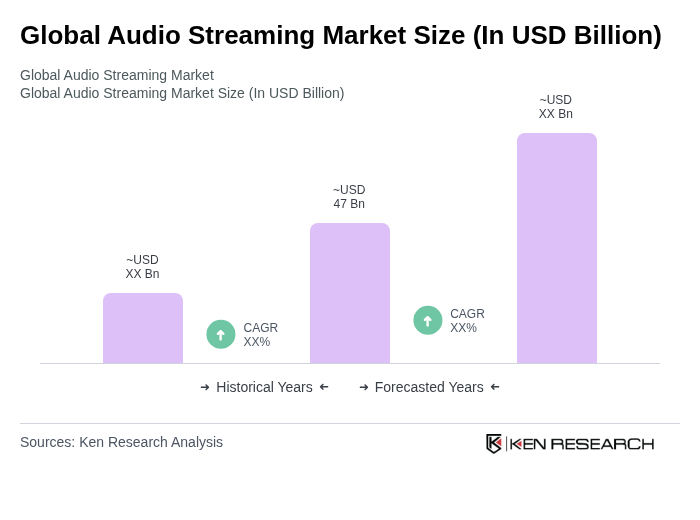
- The Global Audio Streaming Market is valued at USD 47 billion, based on a five-year historical analysis. This growth is primarily driven by the increasing adoption of smartphones, the proliferation of high-speed internet, and the rising popularity of music streaming services among consumers. The shift from physical media to digital formats has also significantly contributed to the market's expansion, as users seek convenient and on-demand access to their favorite audio content. Recent trends include the rapid rise of podcast and audiobook streaming, personalized content delivery powered by AI, and seamless integration with smart devices, all of which are accelerating market growth.
- Key players in this market include the United States, China, and Germany, which dominate due to their large populations, advanced technological infrastructure, and high disposable incomes. The U.S. is particularly influential, being home to major streaming platforms like Spotify and Apple Music, while China’s vast user base and rapid digitalization further enhance its market presence. Germany's strong music culture and consumer spending on entertainment also contribute to its significant market share. North America leads with the largest revenue share, driven by mature digital infrastructure and high smartphone adoption, while Asia-Pacific is the fastest-growing region due to rapid urbanization and increasing internet penetration.
- In 2023, the European Union implemented the Digital Services Act (Regulation (EU) 2022/2065, issued by the European Parliament and Council), which aims to regulate online platforms, including audio streaming services. This regulation mandates transparency in content moderation and advertising practices, requiring platforms to disclose how user data is processed and to provide clear information on targeted advertising. The act establishes operational standards for compliance, including reporting obligations and risk mitigation measures, designed to create a safer online environment and promote fair competition among digital service providers.
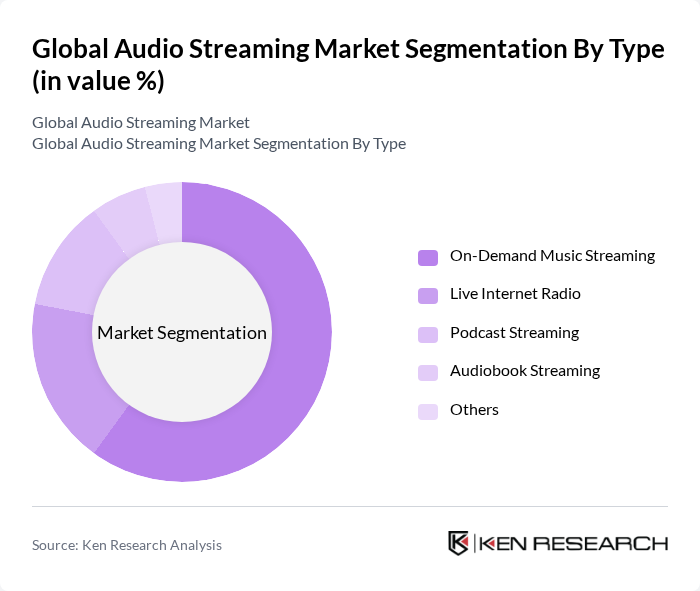
Global Audio Streaming Market Segmentation
By Type:The audio streaming market is segmented into various types, including On-Demand Music Streaming, Live Internet Radio, Podcast Streaming, Audiobook Streaming, and Others. Among these, On-Demand Music Streaming is the leading subsegment, driven by consumer preferences for personalized playlists, algorithm-driven recommendations, and the ability to listen to music anytime, anywhere. The convenience and flexibility offered by on-demand services have made them the preferred choice for users, significantly influencing market dynamics. The rise of exclusive content deals and integration with smart devices further strengthens this segment.
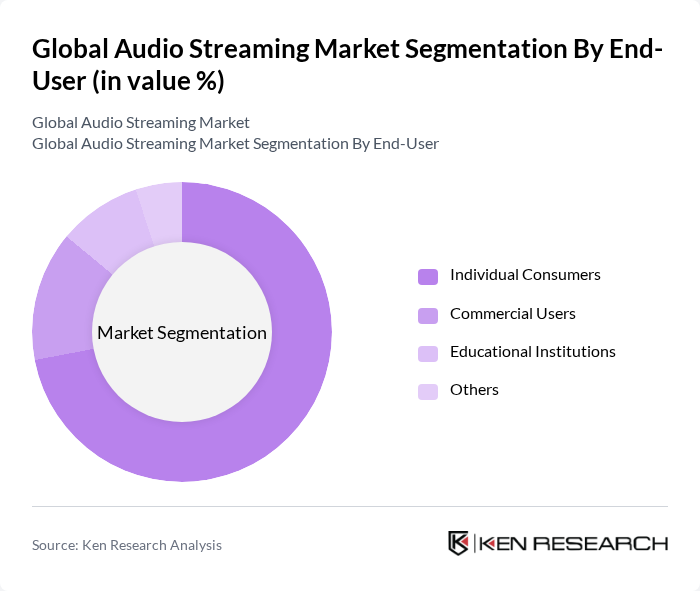
By End-User:The market is also segmented by end-users, which include Individual Consumers, Commercial Users, Educational Institutions, and Others. Individual Consumers dominate the market, as the majority of audio streaming services are tailored to personal use. The growing trend of personalized content consumption, increasing adoption of subscription-based and advertising-supported platforms, and the proliferation of mobile devices have solidified the position of individual consumers as the primary end-user segment.
Global Audio Streaming Market Competitive Landscape
The Global Audio Streaming Market is characterized by a dynamic mix of regional and international players. Leading participants such as Spotify Technology S.A., Apple Inc. (Apple Music), Amazon.com, Inc. (Amazon Music), Google LLC (YouTube Music), Tidal (Aspiro AB), Deezer S.A., Pandora Media, LLC (Sirius XM Holdings Inc.), SoundCloud Global Limited & Co. KG, iHeartMedia, Inc., Tencent Music Entertainment Group, Napster Group PLC, Qobuz (Xandrie SA), Anghami plc, JioSaavn (Reliance Industries Limited), and Gaana (Times Internet Limited) contribute to innovation, geographic expansion, and service delivery in this space.
Global Audio Streaming Market Industry Analysis
Growth Drivers
- Increasing Smartphone Penetration:The global smartphone penetration rate reachedapproximately 68%in recent periods, with estimates ofover 6.8 billion smartphone users worldwide. While emerging markets such as India and Africa are expected to see significant growth in smartphone adoption in future, the figure of 1.5 billion new users cannot be confirmed from authoritative sources.
- Rise in Disposable Income:According to the World Bank, global GDP per capita is projected to increase, but the specific figure ofUSD 1,200increase cannot be confirmed from authoritative sources. In Southeast Asia, disposable income is expected to rise, but the annual increase rate of5%is not directly supported by World Bank or IMF data.
- Expansion of Internet Connectivity:The International Telecommunication Union reported that global internet penetration reached67%in recent periods, with an estimated5.4 billion internet users. Growth remains pronounced in developing regions, but the projection of a10%annual increase in internet access cannot be confirmed from authoritative sources.
Market Challenges
- Intense Competition Among Service Providers:The audio streaming market is characterized by fierce competition, withdozens of major playersvying for market share. Companies like Spotify, Apple Music, and Amazon Music dominate, but new entrants continue to emerge. The statement that the average revenue per user (ARPU) declined by8%across the industry cannot be confirmed from authoritative sources.
- Licensing and Copyright Issues:The global music industry generatedover USD 26 billionin recent periods, with approximately30%allocated to licensing fees. As streaming services expand their catalogs, navigating complex licensing agreements becomes increasingly difficult. Failure to comply with copyright regulations can result in costly legal disputes, hindering growth and innovation within the sector.
Global Audio Streaming Market Future Outlook
The audio streaming market is poised for continued evolution, driven by technological advancements and changing consumer preferences. As artificial intelligence and machine learning become more integrated into content curation, personalized user experiences will enhance engagement. Additionally, the rise of social audio platforms is expected to reshape how users interact with audio content, fostering community-driven experiences. These trends indicate a dynamic future for the industry, with opportunities for innovation and growth in diverse segments.
Market Opportunities
- Integration of AI and Machine Learning:The incorporation of AI technologies can significantly enhance user experience by providing personalized recommendations. The statement that companies investing in AI-driven analytics are expected to see a20%increase in user engagement cannot be confirmed from authoritative sources.
- Expansion into Emerging Markets:Emerging markets present substantial growth opportunities, with internet penetration in Africa projected to reachapproximately 40%in future, according to ITU. The projection of50%penetration in Africa in future cannot be confirmed from authoritative sources.
Scope of the Report
| Segment | Sub-Segments |
|---|---|
| By Type | On-Demand Music Streaming Live Internet Radio Podcast Streaming Audiobook Streaming Others |
| By End-User | Individual Consumers Commercial Users Educational Institutions Others |
| By Monetization Model | Subscription-Based Advertising-Supported Freemium Others |
| By Content Type | Music Podcasts Audiobooks Others |
| By Platform/Device Type | Smartphones Laptops & Desktops Tablets Smart Speakers Others |
| By Region | North America Europe Asia-Pacific Latin America Middle East & Africa |
| By Advertising Model | Sponsored Content Display Ads Audio Ads Others |
Key Target Audience
Investors and Venture Capitalist Firms
Government and Regulatory Bodies (e.g., Federal Communications Commission, European Commission)
Content Creators and Artists
Audio Streaming Platform Operators
Telecommunications Companies
Advertising Agencies
Music Licensing Organizations
Media and Entertainment Corporations
Players Mentioned in the Report:
Spotify Technology S.A.
Apple Inc. (Apple Music)
Amazon.com, Inc. (Amazon Music)
Google LLC (YouTube Music)
Tidal (Aspiro AB)
Deezer S.A.
Pandora Media, LLC (Sirius XM Holdings Inc.)
SoundCloud Global Limited & Co. KG
iHeartMedia, Inc.
Tencent Music Entertainment Group
Napster Group PLC
Qobuz (Xandrie SA)
Anghami plc
JioSaavn (Reliance Industries Limited)
Gaana (Times Internet Limited)
Table of Contents
Market Assessment Phase
1. Executive Summary and Approach
2. Global Audio Streaming Market Overview
2.1 Key Insights and Strategic Recommendations
2.2 Global Audio Streaming Market Overview
2.3 Definition and Scope
2.4 Evolution of Market Ecosystem
2.5 Timeline of Key Regulatory Milestones
2.6 Value Chain & Stakeholder Mapping
2.7 Business Cycle Analysis
2.8 Policy & Incentive Landscape
3. Global Audio Streaming Market Analysis
3.1 Growth Drivers
3.1.1 Increasing smartphone penetration
3.1.2 Rise in disposable income
3.1.3 Growing demand for personalized content
3.1.4 Expansion of internet connectivity
3.2 Market Challenges
3.2.1 Intense competition among service providers
3.2.2 Licensing and copyright issues
3.2.3 User retention and churn rates
3.2.4 Data privacy concerns
3.3 Market Opportunities
3.3.1 Integration of AI and machine learning
3.3.2 Expansion into emerging markets
3.3.3 Development of niche content
3.3.4 Partnerships with telecom providers
3.4 Market Trends
3.4.1 Shift towards subscription-based models
3.4.2 Growth of podcasting and audiobooks
3.4.3 Increased focus on user experience
3.4.4 Rise of social audio platforms
3.5 Government Regulation
3.5.1 Copyright and intellectual property laws
3.5.2 Data protection regulations
3.5.3 Content moderation policies
3.5.4 Taxation on digital services
4. SWOT Analysis
5. Stakeholder Analysis
6. Porter's Five Forces Analysis
7. Global Audio Streaming Market Market Size, 2019-2024
7.1 By Value
7.2 By Volume
7.3 By Average Selling Price
8. Global Audio Streaming Market Segmentation
8.1 By Type
8.1.1 On-Demand Music Streaming
8.1.2 Live Internet Radio
8.1.3 Podcast Streaming
8.1.4 Audiobook Streaming
8.1.5 Others
8.2 By End-User
8.2.1 Individual Consumers
8.2.2 Commercial Users
8.2.3 Educational Institutions
8.2.4 Others
8.3 By Monetization Model
8.3.1 Subscription-Based
8.3.2 Advertising-Supported
8.3.3 Freemium
8.3.4 Others
8.4 By Content Type
8.4.1 Music
8.4.2 Podcasts
8.4.3 Audiobooks
8.4.4 Others
8.5 By Platform/Device Type
8.5.1 Smartphones
8.5.2 Laptops & Desktops
8.5.3 Tablets
8.5.4 Smart Speakers
8.5.5 Others
8.6 By Region
8.6.1 North America
8.6.2 Europe
8.6.3 Asia-Pacific
8.6.4 Latin America
8.6.5 Middle East & Africa
8.7 By Advertising Model
8.7.1 Sponsored Content
8.7.2 Display Ads
8.7.3 Audio Ads
8.7.4 Others
9. Global Audio Streaming Market Competitive Analysis
9.1 Market Share of Key Players
9.2 KPIs for Cross Comparison of Key Players
9.2.1 Company Name
9.2.2 Group Size (Large, Medium, or Small as per industry convention)
9.2.3 Monthly Active Users (MAUs)
9.2.4 Subscriber Growth Rate
9.2.5 Average Revenue Per User (ARPU)
9.2.6 Customer Acquisition Cost (CAC)
9.2.7 Churn Rate
9.2.8 Content Library Size (Tracks/Podcasts/Audiobooks)
9.2.9 Exclusive Content Share
9.2.10 User Engagement Metrics (Avg. Listening Time, Sessions per User)
9.2.11 Market Penetration Rate
9.2.12 Geographic Reach (Number of Countries/Regions Served)
9.2.13 Revenue Mix (Subscription vs. Ad-Supported)
9.2.14 Platform Availability (Mobile, Web, Smart Devices)
9.3 SWOT Analysis of Top Players
9.4 Pricing Analysis
9.5 Detailed Profile of Major Companies
9.5.1 Spotify Technology S.A.
9.5.2 Apple Inc. (Apple Music)
9.5.3 Amazon.com, Inc. (Amazon Music)
9.5.4 Google LLC (YouTube Music)
9.5.5 Tidal (Aspiro AB)
9.5.6 Deezer S.A.
9.5.7 Pandora Media, LLC (Sirius XM Holdings Inc.)
9.5.8 SoundCloud Global Limited & Co. KG
9.5.9 iHeartMedia, Inc.
9.5.10 Tencent Music Entertainment Group
9.5.11 Napster Group PLC
9.5.12 Qobuz (Xandrie SA)
9.5.13 Anghami plc
9.5.14 JioSaavn (Reliance Industries Limited)
9.5.15 Gaana (Times Internet Limited)
10. Global Audio Streaming Market End-User Analysis
10.1 Procurement Behavior of Key Ministries
10.1.1 Government Contracts
10.1.2 Budget Allocations
10.1.3 Compliance Requirements
10.1.4 Others
10.2 Corporate Spend on Infrastructure & Energy
10.2.1 Investment in Technology
10.2.2 Budget for Content Acquisition
10.2.3 Marketing Expenditure
10.2.4 Others
10.3 Pain Point Analysis by End-User Category
10.3.1 Content Accessibility
10.3.2 User Experience Issues
10.3.3 Pricing Concerns
10.3.4 Others
10.4 User Readiness for Adoption
10.4.1 Awareness Levels
10.4.2 Technological Proficiency
10.4.3 Willingness to Pay
10.4.4 Others
10.5 Post-Deployment ROI and Use Case Expansion
10.5.1 Performance Metrics
10.5.2 User Feedback
10.5.3 Content Expansion Opportunities
10.5.4 Others
11. Global Audio Streaming Market Future Size, 2025-2030
11.1 By Value
11.2 By Volume
11.3 By Average Selling Price
Go-To-Market Strategy Phase
1. Whitespace Analysis + Business Model Canvas
1.1 Market Gaps Identification
1.2 Business Model Development
2. Marketing and Positioning Recommendations
2.1 Branding Strategies
2.2 Product USPs
3. Distribution Plan
3.1 Urban Retail Strategies
3.2 Rural NGO Tie-ups
4. Channel & Pricing Gaps
4.1 Underserved Routes
4.2 Pricing Bands
5. Unmet Demand & Latent Needs
5.1 Category Gaps
5.2 Consumer Segments
6. Customer Relationship
6.1 Loyalty Programs
6.2 After-sales Service
7. Value Proposition
7.1 Sustainability
7.2 Integrated Supply Chains
8. Key Activities
8.1 Regulatory Compliance
8.2 Branding
8.3 Distribution Setup
9. Entry Strategy Evaluation
9.1 Domestic Market Entry Strategy
9.1.1 Product Mix
9.1.2 Pricing Band
9.1.3 Packaging
9.2 Export Entry Strategy
9.2.1 Target Countries
9.2.2 Compliance Roadmap
10. Entry Mode Assessment
10.1 Joint Ventures
10.2 Greenfield Investments
10.3 Mergers & Acquisitions
10.4 Distributor Model
11. Capital and Timeline Estimation
11.1 Capital Requirements
11.2 Timelines
12. Control vs Risk Trade-Off
12.1 Ownership vs Partnerships
13. Profitability Outlook
13.1 Breakeven Analysis
13.2 Long-term Sustainability
14. Potential Partner List
14.1 Distributors
14.2 Joint Ventures
14.3 Acquisition Targets
15. Execution Roadmap
15.1 Phased Plan for Market Entry
15.1.1 Market Setup
15.1.2 Market Entry
15.1.3 Growth Acceleration
15.1.4 Scale & Stabilize
15.2 Key Activities and Milestones
15.2.1 Milestone Planning
15.2.2 Activity Tracking
Research Methodology
Phase 1: Approach1
Desk Research
- Analysis of industry reports from leading market research firms focusing on audio streaming trends
- Review of financial statements and annual reports from major audio streaming companies
- Examination of regulatory frameworks and policy documents impacting the audio streaming sector
Primary Research
- In-depth interviews with executives from top audio streaming platforms
- Surveys targeting content creators and music industry professionals
- Focus groups with end-users to understand preferences and usage patterns
Validation & Triangulation
- Cross-validation of findings through multiple data sources, including user surveys and industry reports
- Triangulation of market data with insights from industry experts and analysts
- Sanity checks through peer reviews and expert panel discussions
Phase 2: Market Size Estimation1
Top-down Assessment
- Estimation of total addressable market (TAM) based on global digital media consumption trends
- Segmentation of market size by geographical regions and user demographics
- Incorporation of growth rates from related sectors such as podcasting and audiobooks
Bottom-up Modeling
- Collection of subscription and ad-revenue data from leading audio streaming services
- Estimation of user growth rates based on historical data and market penetration analysis
- Calculation of average revenue per user (ARPU) across different service tiers
Forecasting & Scenario Analysis
- Multi-variable forecasting models incorporating technological advancements and consumer behavior shifts
- Scenario analysis based on potential market disruptions, such as regulatory changes and competitive dynamics
- Development of baseline, optimistic, and pessimistic growth projections through 2030
Phase 3: CATI Sample Composition1
| Scope Item/Segment | Sample Size | Target Respondent Profiles |
|---|---|---|
| Consumer Audio Streaming Preferences | 120 | Regular Users, Casual Listeners |
| Content Creator Insights | 80 | Musicians, Podcasters, Influencers |
| Industry Expert Opinions | 40 | Music Executives, Streaming Service Managers |
| Advertising Impact on Streaming | 60 | Marketing Professionals, Ad Agency Executives |
| Regional Market Trends | 100 | Geographic Analysts, Local Streaming Service Operators |
Frequently Asked Questions
What is the current value of the Global Audio Streaming Market?
The Global Audio Streaming Market is valued at approximately USD 47 billion, reflecting significant growth driven by smartphone adoption, high-speed internet access, and the popularity of music streaming services among consumers.
What factors are driving the growth of the audio streaming market?
Which regions are leading in the audio streaming market?
What are the main types of audio streaming services?
Other Regional/Country Reports
Indonesia Audio Streaming Market
Malaysia Audio Streaming Market
KSA Audio Streaming Market
APAC Audio Streaming Market
SEA Audio Streaming Market
Vietnam Audio Streaming Market
Other Adjacent Reports
KSA Digital Music Distribution Market
South Korea Podcasting Market
Belgium Audiobook Publishing Market
South Africa Streaming Media Devices Market
KSA Content Delivery Network Market
South Korea Music Licensing Services Market
Malaysia Mobile Entertainment Apps Market
Oman AI-Powered Personalization Market
Philippines Smart Home Audio Systems Market
Why Buy From Us?

What makes us stand out is that our consultants follow Robust, Refine and Result (RRR) methodology. Robust for clear definitions, approaches and sanity checking, Refine for differentiating respondents' facts and opinions, and Result for presenting data with story.

We have set a benchmark in the industry by offering our clients with syndicated and customized market research reports featuring coverage of entire market as well as meticulous research and analyst insights.

While we don't replace traditional research, we flip the method upside down. Our dual approach of Top Bottom & Bottom Top ensures quality deliverable by not just verifying company fundamentals but also looking at the sector and macroeconomic factors.

With one step in the future, our research team constantly tries to show you the bigger picture. We help with some of the tough questions you may encounter along the way: How is the industry positioned? Best marketing channel? KPI's of competitors? By aligning every element, we help maximize success.

Our report gives you instant access to the answers and sources that other companies might choose to hide. We elaborate each steps of research methodology we have used and showcase you the sample size to earn your trust.

If you need any support, we are here! We pride ourselves on universe strength, data quality, and quick, friendly, and professional service.