About the Report
Base Year 2024Listen to the audio summary
Global Automotive Steering Wheel Market Overview
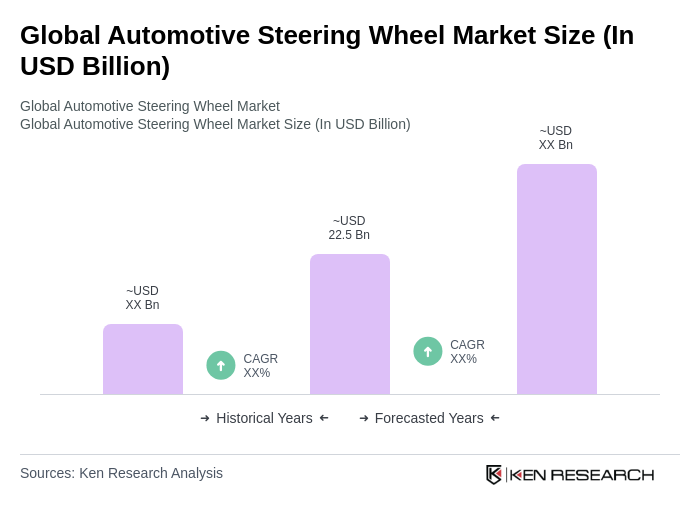
- The Global Automotive Steering Wheel Market is valued at approximately USD 22.5 billion, based on a five-year analysis. Recent industry reports place the market near the low-to-mid USD 20 billion range in the latest reported period, reflecting recovery in global auto production and content-per-vehicle uplift from multifunction HMI, heating, and airbag integration .
- Key players in this market include countries like Germany, Japan, and the United States, which dominate due to their strong automotive manufacturing bases, extensive supplier ecosystems, and leadership in interior/HMI and safety integration for steering modules .
- In 2023, the European Union advanced safety regulations that reinforce integration of steering wheel systems with restraint and driver-assistance functions, including requirements tied to intelligent speed assistance, lane keeping, driver drowsiness/attention monitoring, and event data recorders under the General Safety Regulation framework. These mandates are influencing steering wheel design due to HMI controls, airbag modules, and sensor interfaces becoming standard across new vehicles .
Global Automotive Steering Wheel Market Segmentation
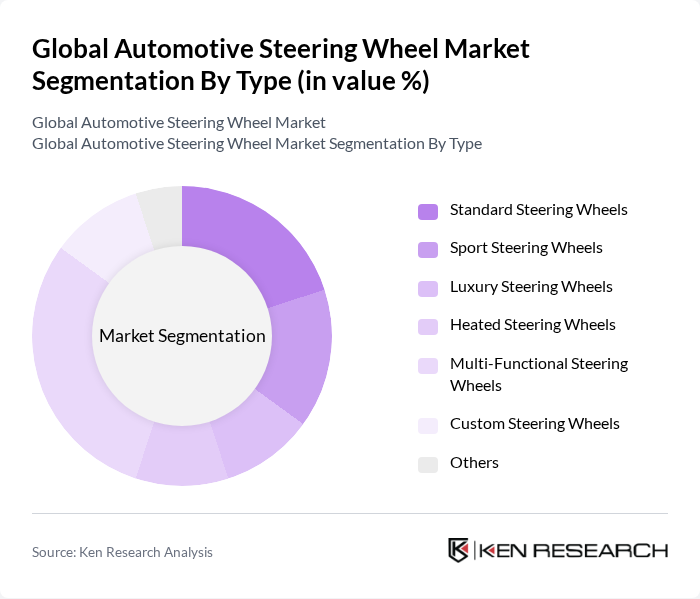
By Type:The market is segmented into various types of steering wheels, each catering to different consumer preferences and vehicle requirements. The subsegments include Standard Steering Wheels, Sport Steering Wheels, Luxury Steering Wheels, Heated Steering Wheels, Multi-Functional Steering Wheels, Custom Steering Wheels, and Others. Among these,Multi-Functional Steering Wheelsare gaining significant traction due to the increasing demand for integrated controls and enhanced user experience. Automakers are embedding audio, telephony, ADAS toggles, and capacitive touch/illumination into wheels to support safety and comfort feature adoption across mass-market trims .
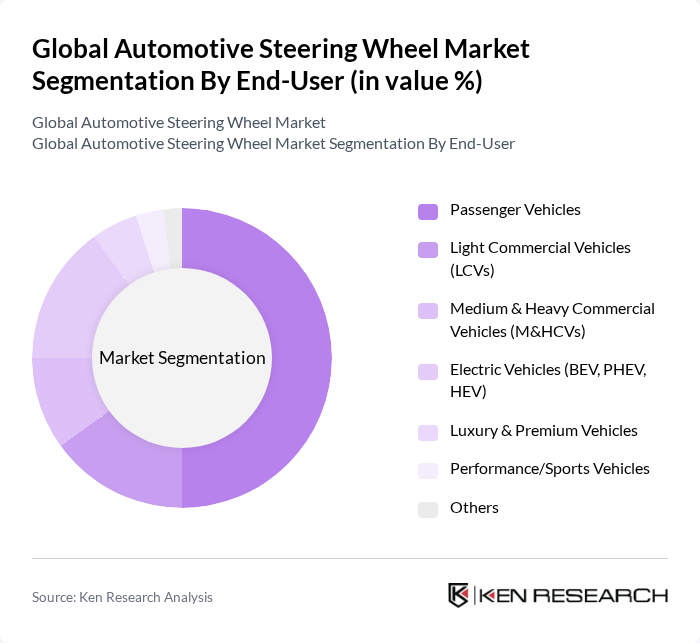
By End-User:The end-user segmentation includes Passenger Vehicles, Light Commercial Vehicles (LCVs), Medium & Heavy Commercial Vehicles (M&HCVs), Electric Vehicles (BEV, PHEV, HEV), Luxury & Premium Vehicles, Performance/Sports Vehicles, and Others. ThePassenger Vehiclessegment is the largest, supported by high global passenger car production and higher fitment rates of multifunction/heated wheels in mainstream models; passenger vehicles account for the clear majority of steering wheel demand by volume . Additionally, rising electric vehicle adoption is contributing to premium HMI and control integration at the wheel to support ADAS and infotainment features .
Global Automotive Steering Wheel Market Competitive Landscape
The Global Automotive Steering Wheel Market is characterized by a dynamic mix of regional and international players. Leading participants such as Autoliv Inc., Joyson Safety Systems, Tokai Rika Co., Ltd., Nihon Plast Co., Ltd., Toyoda Gosei Co., Ltd., Hyundai Mobis Co., Ltd., Motherson Sumi Systems Ltd. (Motherson Group), Yanfeng Automotive Interiors, Neaton Auto Products Manufacturing, Inc., Nardi Srl, MOMO Srl, Grant Products, Takata Corporation (legacy programs; assets integrated into Joyson), Key Safety Systems (KSS) (legacy; now Joyson Safety Systems), Superior Industries (steering components and heritage) contribute to innovation, geographic expansion, and service delivery in this space.
Global Automotive Steering Wheel Market Industry Analysis
Growth Drivers
- Increasing Demand for Vehicle Safety Features:The global automotive industry is witnessing a surge in demand for enhanced safety features, with the market for advanced driver-assistance systems (ADAS) projected to reach $83 billion in future. This growth is driven by rising consumer awareness and regulatory pressures, as governments worldwide implement stricter safety standards. In future, the U.S. National Highway Traffic Safety Administration reported a 10% increase in vehicle safety recalls, emphasizing the importance of safety in steering wheel design and technology.
- Growth in Automotive Production and Sales:The automotive production sector is expected to produce approximately 90 million vehicles globally in future, reflecting a 5% increase from the previous period. This growth is fueled by recovering consumer demand post-pandemic and increased investments in manufacturing capabilities. The International Organization of Motor Vehicle Manufacturers reported that global vehicle sales reached 78 million units in the previous period, indicating a robust market environment that directly benefits the automotive steering wheel segment.
- Advancements in Steering Wheel Technology:Innovations in steering wheel technology, such as the integration of haptic feedback and touch-sensitive controls, are transforming user experiences. The global market for smart steering wheels is projected to grow significantly, with an estimated value of $1.5 billion in future. This trend is supported by the increasing adoption of electric and autonomous vehicles, which require advanced steering solutions to enhance driver interaction and vehicle control.
Market Challenges
- Fluctuating Raw Material Prices:The automotive steering wheel market faces challenges due to volatile raw material prices, particularly for plastics and metals. In future, the price of polypropylene surged by 15%, impacting production costs. This fluctuation can lead to increased manufacturing expenses, forcing companies to either absorb costs or pass them onto consumers, potentially affecting market competitiveness and profit margins.
- Stringent Regulatory Requirements:Compliance with stringent safety and environmental regulations poses a significant challenge for manufacturers. In future, the European Union is set to enforce new regulations that require all automotive components, including steering wheels, to meet enhanced safety standards. This regulatory landscape necessitates substantial investment in research and development, which can strain resources for smaller manufacturers and impact their market positioning.
Global Automotive Steering Wheel Market Future Outlook
The automotive steering wheel market is poised for transformative growth, driven by technological advancements and evolving consumer preferences. As electric vehicle adoption accelerates, manufacturers will increasingly focus on integrating smart technologies into steering systems. Additionally, the trend towards lightweight materials will enhance fuel efficiency and performance. Collaborations with tech companies will further innovate steering solutions, ensuring that the market remains dynamic and responsive to emerging trends in vehicle design and functionality.
Market Opportunities
- Expansion in Emerging Markets:Emerging markets, particularly in Asia-Pacific, present significant growth opportunities for automotive steering wheel manufacturers. With vehicle ownership rates projected to increase by 20% in these regions in future, companies can capitalize on rising demand for affordable and safe vehicles, driving innovation in steering technologies tailored to local preferences.
- Integration of Smart Technologies:The integration of smart technologies into steering wheels, such as connectivity features and adaptive controls, offers a lucrative opportunity. As the global market for connected vehicles is expected to reach $200 billion in future, steering wheel manufacturers can leverage this trend to enhance user experience and differentiate their products in a competitive landscape.
Scope of the Report
| Segment | Sub-Segments |
|---|---|
| By Type | Standard Steering Wheels Sport Steering Wheels Luxury Steering Wheels Heated Steering Wheels Multi-Functional Steering Wheels Custom Steering Wheels Others |
| By End-User | Passenger Vehicles Light Commercial Vehicles (LCVs) Medium & Heavy Commercial Vehicles (M&HCVs) Electric Vehicles (BEV, PHEV, HEV) Luxury & Premium Vehicles Performance/Sports Vehicles Others |
| By Material | Leather-wrapped PU/Plastic (Polyurethane/TPO) Wood & Wood Veneer Magnesium/Aluminum Alloys Carbon Fiber & Composite Materials Sustainable/Bio-based Materials Others |
| By Design | Two-spoke Three-spoke Four-spoke Flat-bottom (D-shape) Yoke/Non-circular Others |
| By Functionality | Non-heated, Non-electrified Heated Steering Wheels Control-embedded/Multifunction (switches, haptics) ADAS/HMI-integrated (hands-on detection, driver monitoring) Steer-by-Wire Ready/Columnless Concepts Others |
| By Sales Channel | OEMs Aftermarket Online Sales Retail Stores Others |
| By Price Range | Budget Mid-Range Premium Luxury Others |
Key Target Audience
Investors and Venture Capitalist Firms
Government and Regulatory Bodies (e.g., National Highway Traffic Safety Administration, Environmental Protection Agency)
Automotive Manufacturers
Tier 1 and Tier 2 Suppliers
Automotive Aftermarket Companies
Automotive Design and Engineering Firms
Trade Associations (e.g., Automotive Industry Action Group)
Insurance Companies and Risk Assessment Firms
Players Mentioned in the Report:
Autoliv Inc.
Joyson Safety Systems
Tokai Rika Co., Ltd.
Nihon Plast Co., Ltd.
Toyoda Gosei Co., Ltd.
Hyundai Mobis Co., Ltd.
Motherson Sumi Systems Ltd. (Motherson Group)
Yanfeng Automotive Interiors
Neaton Auto Products Manufacturing, Inc.
Nardi Srl
MOMO Srl
Grant Products
Takata Corporation (legacy programs; assets integrated into Joyson)
Key Safety Systems (KSS) (legacy; now Joyson Safety Systems)
Superior Industries (steering components and heritage)
Table of Contents
Market Assessment Phase
1. Executive Summary and Approach
2. Global Automotive Steering Wheel Market Overview
2.1 Key Insights and Strategic Recommendations
2.2 Global Automotive Steering Wheel Market Overview
2.3 Definition and Scope
2.4 Evolution of Market Ecosystem
2.5 Timeline of Key Regulatory Milestones
2.6 Value Chain & Stakeholder Mapping
2.7 Business Cycle Analysis
2.8 Policy & Incentive Landscape
3. Global Automotive Steering Wheel Market Analysis
3.1 Growth Drivers
3.1.1 Increasing demand for vehicle safety features
3.1.2 Growth in automotive production and sales
3.1.3 Advancements in steering wheel technology
3.1.4 Rising consumer preference for customization
3.2 Market Challenges
3.2.1 Fluctuating raw material prices
3.2.2 Stringent regulatory requirements
3.2.3 Competition from alternative steering technologies
3.2.4 Supply chain disruptions
3.3 Market Opportunities
3.3.1 Expansion in emerging markets
3.3.2 Integration of smart technologies
3.3.3 Increasing electric vehicle adoption
3.3.4 Collaborations with tech companies
3.4 Market Trends
3.4.1 Shift towards lightweight materials
3.4.2 Growth of autonomous vehicles
3.4.3 Customization and personalization trends
3.4.4 Focus on sustainability and eco-friendly materials
3.5 Government Regulation
3.5.1 Safety standards for automotive components
3.5.2 Emission regulations impacting vehicle design
3.5.3 Incentives for electric vehicle production
3.5.4 Regulations on material sourcing and recycling
4. SWOT Analysis
5. Stakeholder Analysis
6. Porter's Five Forces Analysis
7. Global Automotive Steering Wheel Market Market Size, 2019-2024
7.1 By Value
7.2 By Volume
7.3 By Average Selling Price
8. Global Automotive Steering Wheel Market Segmentation
8.1 By Type
8.1.1 Standard Steering Wheels
8.1.2 Sport Steering Wheels
8.1.3 Luxury Steering Wheels
8.1.4 Heated Steering Wheels
8.1.5 Multi-Functional Steering Wheels
8.1.6 Custom Steering Wheels
8.1.7 Others
8.2 By End-User
8.2.1 Passenger Vehicles
8.2.2 Light Commercial Vehicles (LCVs)
8.2.3 Medium & Heavy Commercial Vehicles (M&HCVs)
8.2.4 Electric Vehicles (BEV, PHEV, HEV)
8.2.5 Luxury & Premium Vehicles
8.2.6 Performance/Sports Vehicles
8.2.7 Others
8.3 By Material
8.3.1 Leather-wrapped
8.3.2 PU/Plastic (Polyurethane/TPO)
8.3.3 Wood & Wood Veneer
8.3.4 Magnesium/Aluminum Alloys
8.3.5 Carbon Fiber & Composite Materials
8.3.6 Sustainable/Bio-based Materials
8.3.7 Others
8.4 By Design
8.4.1 Two-spoke
8.4.2 Three-spoke
8.4.3 Four-spoke
8.4.4 Flat-bottom (D-shape)
8.4.5 Yoke/Non-circular
8.4.6 Others
8.5 By Functionality
8.5.1 Non-heated, Non-electrified
8.5.2 Heated Steering Wheels
8.5.3 Control-embedded/Multifunction (switches, haptics)
8.5.4 ADAS/HMI-integrated (hands-on detection, driver monitoring)
8.5.5 Steer-by-Wire Ready/Columnless Concepts
8.5.6 Others
8.6 By Sales Channel
8.6.1 OEMs
8.6.2 Aftermarket
8.6.3 Online Sales
8.6.4 Retail Stores
8.6.5 Others
8.7 By Price Range
8.7.1 Budget
8.7.2 Mid-Range
8.7.3 Premium
8.7.4 Luxury
8.7.5 Others
9. Global Automotive Steering Wheel Market Competitive Analysis
9.1 Market Share of Key Players
9.2 Cross Comparison of Key Players
9.2.1 Company Name
9.2.2 Product Mix Coverage (multifunction, heated, ADAS/HMI-integrated)
9.2.3 OEM Program Count (active vehicle platforms)
9.2.4 Global Manufacturing Footprint (plants/regions)
9.2.5 Revenue from Steering Wheels (USD, latest FY)
9.2.6 YoY Revenue Growth (Steering segment)
9.2.7 Average Content per Vehicle (steering wheel ASP)
9.2.8 Patent Portfolio Strength (HOD, haptics, SBW)
9.2.9 Quality/PPM and Warranty Claims Rate
9.2.10 On-time Delivery/OTD and Program Launch Performance
9.2.11 Strategic Partnerships with OEMs/Tier-1s
9.2.12 Sustainability Metrics (recycled content, CO2/part)
9.3 SWOT Analysis of Top Players
9.4 Pricing Analysis
9.5 Detailed Profile of Major Companies
9.5.1 Autoliv Inc.
9.5.2 Joyson Safety Systems
9.5.3 Tokai Rika Co., Ltd.
9.5.4 Nihon Plast Co., Ltd.
9.5.5 Toyoda Gosei Co., Ltd.
9.5.6 Hyundai Mobis Co., Ltd.
9.5.7 Motherson Sumi Systems Ltd. (Motherson Group)
9.5.8 Yanfeng Automotive Interiors
9.5.9 Neaton Auto Products Manufacturing, Inc.
9.5.10 Nardi Srl
9.5.11 MOMO Srl
9.5.12 Grant Products
9.5.13 Takata Corporation (legacy programs; assets integrated into Joyson)
9.5.14 Key Safety Systems (KSS) (legacy; now Joyson Safety Systems)
9.5.15 Superior Industries (steering components and heritage)
10. Global Automotive Steering Wheel Market End-User Analysis
10.1 Procurement Behavior of Key Ministries
10.1.1 Government vehicle procurement policies
10.1.2 Budget allocation for automotive purchases
10.1.3 Preference for local manufacturers
10.1.4 Sustainability considerations in procurement
10.2 Corporate Spend on Infrastructure & Energy
10.2.1 Investment in electric vehicle infrastructure
10.2.2 Corporate fleet management strategies
10.2.3 Budgeting for vehicle upgrades
10.2.4 Energy efficiency initiatives
10.3 Pain Point Analysis by End-User Category
10.3.1 Cost of high-quality steering wheels
10.3.2 Availability of customized options
10.3.3 Durability and maintenance issues
10.3.4 Compliance with safety regulations
10.4 User Readiness for Adoption
10.4.1 Awareness of new technologies
10.4.2 Training and support for new systems
10.4.3 Financial readiness for upgrades
10.4.4 Acceptance of smart steering solutions
10.5 Post-Deployment ROI and Use Case Expansion
10.5.1 Measurement of performance improvements
10.5.2 Expansion into new vehicle models
10.5.3 Long-term cost savings analysis
10.5.4 User feedback for future enhancements
11. Global Automotive Steering Wheel Market Future Size, 2025-2030
11.1 By Value
11.2 By Volume
11.3 By Average Selling Price
Go-To-Market Strategy Phase
1. Whitespace Analysis + Business Model Canvas
1.1 Market gaps and opportunities
1.2 Business model components
1.3 Value proposition analysis
1.4 Revenue streams identification
1.5 Cost structure evaluation
1.6 Key partnerships and resources
1.7 Customer segments and relationships
2. Marketing and Positioning Recommendations
2.1 Branding strategies
2.2 Product USPs
2.3 Target market identification
2.4 Communication strategies
2.5 Digital marketing initiatives
2.6 Customer engagement tactics
3. Distribution Plan
3.1 Urban retail strategies
3.2 Rural NGO tie-ups
3.3 Online distribution channels
3.4 Partnerships with automotive dealers
3.5 Logistics and supply chain management
4. Channel & Pricing Gaps
4.1 Underserved routes
4.2 Pricing bands analysis
4.3 Competitor pricing strategies
4.4 Customer willingness to pay
4.5 Value-based pricing models
5. Unmet Demand & Latent Needs
5.1 Category gaps identification
5.2 Consumer segments analysis
5.3 Emerging trends and preferences
5.4 Product development opportunities
6. Customer Relationship
6.1 Loyalty programs
6.2 After-sales service strategies
6.3 Customer feedback mechanisms
6.4 Community engagement initiatives
7. Value Proposition
7.1 Sustainability initiatives
7.2 Integrated supply chains
7.3 Innovation in product offerings
7.4 Customer-centric solutions
8. Key Activities
8.1 Regulatory compliance
8.2 Branding efforts
8.3 Distribution setup
8.4 Market research and analysis
9. Entry Strategy Evaluation
9.1 Domestic Market Entry Strategy
9.1.1 Product mix considerations
9.1.2 Pricing band strategies
9.1.3 Packaging options
9.2 Export Entry Strategy
9.2.1 Target countries analysis
9.2.2 Compliance roadmap development
10. Entry Mode Assessment
10.1 Joint Ventures
10.2 Greenfield investments
10.3 Mergers & Acquisitions
10.4 Distributor Model evaluation
11. Capital and Timeline Estimation
11.1 Capital requirements analysis
11.2 Timelines for market entry
12. Control vs Risk Trade-Off
12.1 Ownership vs Partnerships
13. Profitability Outlook
13.1 Breakeven analysis
13.2 Long-term sustainability strategies
14. Potential Partner List
14.1 Distributors
14.2 Joint Ventures
14.3 Acquisition targets
15. Execution Roadmap
15.1 Phased Plan for Market Entry
15.1.1 Market Setup
15.1.2 Market Entry
15.1.3 Growth Acceleration
15.1.4 Scale & Stabilize
15.2 Key Activities and Milestones
15.2.1 Milestone tracking
15.2.2 Activity scheduling
Research Methodology
Phase 1: Approach1
Desk Research
- Industry reports from automotive associations and market research firms
- Analysis of trade publications and automotive market journals
- Government publications on automotive regulations and safety standards
Primary Research
- Interviews with design engineers and product managers at automotive OEMs
- Surveys with automotive suppliers and steering wheel manufacturers
- Focus groups with automotive industry experts and analysts
Validation & Triangulation
- Cross-validation of data from multiple industry sources and reports
- Triangulation of insights from primary interviews and secondary data
- Sanity checks through expert panel discussions and feedback sessions
Phase 2: Market Size Estimation1
Top-down Assessment
- Analysis of global automotive production statistics and steering wheel demand
- Segmentation by vehicle type (passenger cars, commercial vehicles, etc.)
- Incorporation of trends in electric vehicle adoption and steering technology
Bottom-up Modeling
- Volume estimates based on production data from leading automotive manufacturers
- Cost analysis of steering wheel components and assembly processes
- Market share calculations based on sales data from key players
Forecasting & Scenario Analysis
- Multi-variable forecasting using historical growth rates and market trends
- Scenario modeling based on economic conditions and consumer preferences
- Baseline, optimistic, and pessimistic forecasts through 2030
Phase 3: CATI Sample Composition1
| Scope Item/Segment | Sample Size | Target Respondent Profiles |
|---|---|---|
| Passenger Vehicle Steering Wheel Manufacturers | 100 | Product Development Managers, Quality Assurance Leads |
| Commercial Vehicle Steering Wheel Suppliers | 80 | Supply Chain Managers, Procurement Specialists |
| Automotive Design and Engineering Firms | 70 | Design Engineers, R&D Directors |
| Aftermarket Steering Wheel Retailers | 60 | Sales Managers, Marketing Directors |
| Automotive Safety Regulatory Bodies | 50 | Compliance Officers, Safety Engineers |
Frequently Asked Questions
What is the current value of the Global Automotive Steering Wheel Market?
The Global Automotive Steering Wheel Market is valued at approximately USD 22.5 billion, reflecting a recovery in global auto production and an increase in content per vehicle due to multifunction HMI, heating, and airbag integration.
Which countries dominate the Global Automotive Steering Wheel Market?
What are the key trends influencing steering wheel design in 2023?
What types of steering wheels are available in the market?
Other Regional/Country Reports
Indonesia Automotive Steering Wheel Market
Malaysia Automotive Steering Wheel Market
APAC Automotive Steering Wheel Market
SEA Automotive Steering Wheel Market
Why Buy From Us?

What makes us stand out is that our consultants follow Robust, Refine and Result (RRR) methodology. Robust for clear definitions, approaches and sanity checking, Refine for differentiating respondents' facts and opinions, and Result for presenting data with story.

We have set a benchmark in the industry by offering our clients with syndicated and customized market research reports featuring coverage of entire market as well as meticulous research and analyst insights.

While we don't replace traditional research, we flip the method upside down. Our dual approach of Top Bottom & Bottom Top ensures quality deliverable by not just verifying company fundamentals but also looking at the sector and macroeconomic factors.

With one step in the future, our research team constantly tries to show you the bigger picture. We help with some of the tough questions you may encounter along the way: How is the industry positioned? Best marketing channel? KPI's of competitors? By aligning every element, we help maximize success.

Our report gives you instant access to the answers and sources that other companies might choose to hide. We elaborate each steps of research methodology we have used and showcase you the sample size to earn your trust.

If you need any support, we are here! We pride ourselves on universe strength, data quality, and quick, friendly, and professional service.