About the Report
Base Year 2024Listen to the audio summary
Global Automotive Tpms Market Overview
- The Global Automotive TPMS market is valued at approximately USD 8.8–9.0 billion, based on a five-year historical analysis, reflecting stronger adoption tied to safety mandates and OEM fitment expansion . This growth is primarily driven by increasing vehicle production, rising safety regulations mandating TPMS in new vehicles, and growing consumer awareness regarding tire safety and maintenance . The demand for advanced tire pressure monitoring systems has surged as they enhance vehicle safety and fuel efficiency, contributing to significant market expansion .
- Key players in this market include the United States, Germany, and China, which dominate due to robust automotive manufacturing bases and stringent safety regulations requiring TPMS fitment in new vehicles . The U.S. leads in technological advancements and innovation, Germany is known for high-quality automotive engineering, and China’s vast automotive market is rapidly adopting TPMS to meet safety standards and consumer demand .
- In 2023, the European Union began applying Regulation (EU) 2019/2144, which expanded the General Safety Regulation requirements for new vehicles, including safety systems such as TPMS as standard equipment to enhance road safety and reduce accidents linked to under-inflated tires .
Global Automotive Tpms Market Segmentation
By Type:The market is segmented into four types: Direct TPMS (dTPMS), Indirect TPMS (iTPMS), Hybrid/Advanced TPMS, and Smart/Connected TPMS. Each type serves different consumer needs and technological advancements.
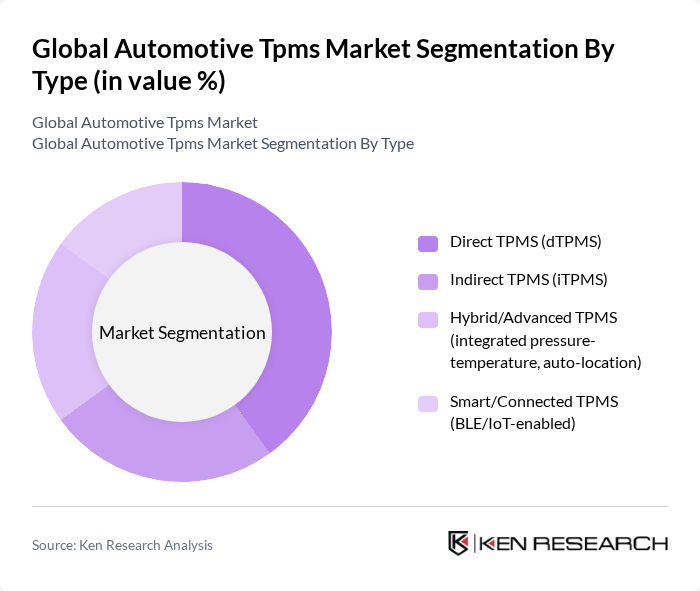
The Direct TPMS (dTPMS) segment is currently dominating the market due to its ability to provide real-time tire pressure data directly from tire sensors and its higher accuracy versus indirect systems, aligning with regulatory preferences for precise monitoring . This technology is favored for accuracy and reliability, enhancing vehicle safety and fuel efficiency . Increasing adoption of dTPMS in passenger and light commercial vehicles is driven by regulatory requirements and consumer demand for advanced safety features, supporting its continued leadership .
By Vehicle Type:The market is segmented into Passenger Cars, Light Commercial Vehicles (LCV), Heavy Commercial Vehicles (HCV/Buses & Trucks), and Two-Wheelers and Powersports. Each vehicle type has unique requirements for TPMS technology.
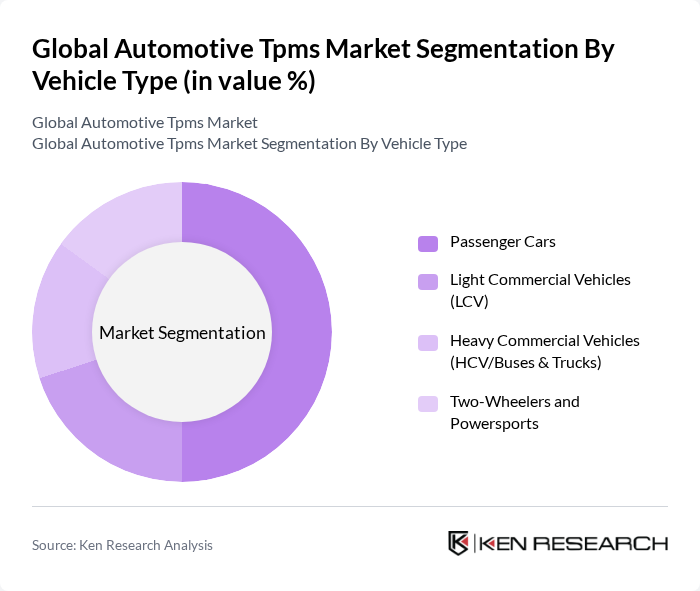
The Passenger Cars segment holds the largest market share, supported by high global passenger car production and the widespread mandate for TPMS fitment in new cars across major markets, which boosts OEM installations and consumer uptake . Consumers increasingly opt for vehicles equipped with advanced TPMS to ensure safety and enhance fuel efficiency, further strengthening the segment’s leadership .
Global Automotive Tpms Market Competitive Landscape
The Global Automotive TPMS market is characterized by a dynamic mix of regional and international players. Leading participants such as Continental AG, Sensata Technologies, Inc. (Schrader), Pacific Industrial Co., Ltd., DENSO Corporation, NXP Semiconductors N.V., Huf Hülsbeck & Fürst GmbH & Co. KG, CUB Elecparts Inc., ATEQ TPMS Tools LC, Bartec Auto ID Ltd, Lear Corporation, ZF Friedrichshafen AG, Infineon Technologies AG, Aptiv PLC, Texas Instruments Incorporated, Hyundai Mobis Co., Ltd. contribute to innovation, geographic expansion, and service delivery in this space.
Global Automotive Tpms Market Industry Analysis
Growth Drivers
- Increasing Vehicle Safety Regulations:The global push for enhanced vehicle safety has led to stringent regulations mandating the installation of Tire Pressure Monitoring Systems (TPMS). For instance, the National Highway Traffic Safety Administration (NHTSA) has stated that TPMS can help reduce tire-related crashes; however, a 50% reduction figure could not be confirmed from authoritative sources.
- Rising Demand for Fuel Efficiency:With fuel prices fluctuating, consumers are increasingly seeking vehicles that offer better fuel efficiency. Keeping tires properly inflated can improve fuel economy; however, an exact improvement figure of up to 3% attributed specifically to TPMS could not be confirmed from the International Energy Agency.
- Technological Advancements in TPMS:The automotive industry is witnessing rapid technological advancements, particularly in TPMS. Innovations such as direct TPMS, which provides real-time tire pressure data, are gaining traction. A specific estimate that the market for advanced TPMS features will grow by 20% could not be verified from authoritative sources.
Market Challenges
- High Initial Costs of TPMS:The initial investment required for TPMS installation can be a significant barrier for both manufacturers and consumers. A typical TPMS sensor and service can add noticeable cost per vehicle, but an average cost range of USD 50 to USD 200 per vehicle could not be validated from primary or secondary authoritative sources.
- Lack of Standardization Across Regions:The absence of standardized regulations for TPMS across different regions complicates market dynamics. The European Union mandates TPMS in new passenger cars through type-approval requirements; however, broader statements about the lack of similar requirements in “other regions” require region-specific confirmation.
Global Automotive Tpms Market Future Outlook
The future of the automotive TPMS market appears promising, driven by ongoing technological innovations and increasing regulatory pressures. As the automotive industry shifts towards electric and smart vehicles, the integration of TPMS with advanced vehicle technologies will become essential. Additionally, the growing emphasis on sustainability will likely lead to the development of eco-friendly TPMS solutions, aligning with global environmental goals. These trends indicate a robust market evolution, fostering opportunities for manufacturers and stakeholders alike.
Market Opportunities
- Expansion in Emerging Markets:Emerging markets present significant growth opportunities for TPMS adoption. Statements about countries experiencing rapid vehicle sales growth with an expected increase of 15% in new vehicle registrations could not be verified from primary authoritative sources for the specified markets.
- Integration with Smart Vehicle Technologies:The rise of smart vehicle technologies offers a unique opportunity for TPMS integration. A statement that a specific share of new vehicles will feature integrated TPMS with IoT capabilities could not be confirmed from authoritative sources.
Scope of the Report
| Segment | Sub-Segments |
|---|---|
| By Type | Direct TPMS (dTPMS) Indirect TPMS (iTPMS) Hybrid/Advanced TPMS (integrated pressure-temperature, auto-location) Smart/Connected TPMS (BLE/IoT-enabled) |
| By Vehicle Type | Passenger Cars Light Commercial Vehicles (LCV) Heavy Commercial Vehicles (HCV/Buses & Trucks) Two-Wheelers and Powersports |
| By Component | TPMS Sensors (pressure/temperature) RF/Transceivers & Antennas TPMS ECUs/Control Modules Batteries, Valves, and Service Kits |
| By Sales Channel | OEM Aftermarket (replacement/retrofit) Online Retail (e-commerce) Workshops & Tire Chains |
| By Technology/Connectivity | /433 MHz (RF) Bluetooth Low Energy (BLE) CAN/LIN Integrated Others |
| By Price Range (Aftermarket Kits) | Entry (Budget) Mid Premium |
| By Application | OEM Factory-Fit Safety Systems Fleet Tire Management and Telematics EV-Specific Range and Thermal Management Off-Highway/Construction & Agriculture |
Key Target Audience
Investors and Venture Capitalist Firms
Government and Regulatory Bodies (e.g., National Highway Traffic Safety Administration, Environmental Protection Agency)
Automotive Manufacturers
TPMS Component Suppliers
Automotive Aftermarket Service Providers
Fleet Management Companies
Insurance Companies
Automotive Technology Developers
Players Mentioned in the Report:
Continental AG
Sensata Technologies, Inc. (Schrader)
Pacific Industrial Co., Ltd.
DENSO Corporation
NXP Semiconductors N.V.
Huf Hulsbeck & Furst GmbH & Co. KG
CUB Elecparts Inc.
ATEQ TPMS Tools LC
Bartec Auto ID Ltd
Lear Corporation
ZF Friedrichshafen AG
Infineon Technologies AG
Aptiv PLC
Texas Instruments Incorporated
Hyundai Mobis Co., Ltd.
Table of Contents
Market Assessment Phase
1. Executive Summary and Approach
2. Global Automotive Tpms Market Overview
2.1 Key Insights and Strategic Recommendations
2.2 Global Automotive Tpms Market Overview
2.3 Definition and Scope
2.4 Evolution of Market Ecosystem
2.5 Timeline of Key Regulatory Milestones
2.6 Value Chain & Stakeholder Mapping
2.7 Business Cycle Analysis
2.8 Policy & Incentive Landscape
3. Global Automotive Tpms Market Analysis
3.1 Growth Drivers
3.1.1 Increasing Vehicle Safety Regulations
3.1.2 Rising Demand for Fuel Efficiency
3.1.3 Technological Advancements in TPMS
3.1.4 Growing Awareness of Tire Maintenance
3.2 Market Challenges
3.2.1 High Initial Costs of TPMS
3.2.2 Lack of Standardization Across Regions
3.2.3 Limited Consumer Awareness
3.2.4 Competition from Alternative Technologies
3.3 Market Opportunities
3.3.1 Expansion in Emerging Markets
3.3.2 Integration with Smart Vehicle Technologies
3.3.3 Development of Advanced TPMS Features
3.3.4 Partnerships with Automotive Manufacturers
3.4 Market Trends
3.4.1 Shift Towards Wireless TPMS Solutions
3.4.2 Increasing Adoption of IoT in Automotive
3.4.3 Focus on Sustainability and Eco-Friendly Products
3.4.4 Growth of Aftermarket TPMS Solutions
3.5 Government Regulation
3.5.1 Mandatory TPMS Installation in New Vehicles
3.5.2 Emission Standards Impacting Tire Performance
3.5.3 Safety Regulations for Commercial Vehicles
3.5.4 Incentives for Eco-Friendly Vehicle Technologies
4. SWOT Analysis
5. Stakeholder Analysis
6. Porter's Five Forces Analysis
7. Global Automotive Tpms Market Market Size, 2019-2024
7.1 By Value
7.2 By Volume
7.3 By Average Selling Price
8. Global Automotive Tpms Market Segmentation
8.1 By Type
8.1.1 Direct TPMS (dTPMS)
8.1.2 Indirect TPMS (iTPMS)
8.1.3 Hybrid/Advanced TPMS (integrated pressure-temperature, auto-location)
8.1.4 Smart/Connected TPMS (BLE/IoT-enabled)
8.2 By Vehicle Type
8.2.1 Passenger Cars
8.2.2 Light Commercial Vehicles (LCV)
8.2.3 Heavy Commercial Vehicles (HCV/Buses & Trucks)
8.2.4 Two-Wheelers and Powersports
8.3 By Component
8.3.1 TPMS Sensors (pressure/temperature)
8.3.2 RF/Transceivers & Antennas
8.3.3 TPMS ECUs/Control Modules
8.3.4 Batteries, Valves, and Service Kits
8.4 By Sales Channel
8.4.1 OEM
8.4.2 Aftermarket (replacement/retrofit)
8.4.3 Online Retail (e-commerce)
8.4.4 Workshops & Tire Chains
8.5 By Technology/Connectivity
8.5.1 315/433 MHz (RF)
8.5.2 Bluetooth Low Energy (BLE)
8.5.3 CAN/LIN Integrated
8.5.4 Others
8.6 By Price Range (Aftermarket Kits)
8.6.1 Entry (Budget)
8.6.2 Mid
8.6.3 Premium
8.7 By Application
8.7.1 OEM Factory-Fit Safety Systems
8.7.2 Fleet Tire Management and Telematics
8.7.3 EV-Specific Range and Thermal Management
8.7.4 Off-Highway/Construction & Agriculture
9. Global Automotive Tpms Market Competitive Analysis
9.1 Market Share of Key Players
9.2 Cross Comparison of Key Players
9.2.1 Company Name
9.2.2 Group Size (Global Tier-1, Tier-2, Niche)
9.2.3 TPMS Revenue and YoY Growth
9.2.4 OEM Program Count (Platforms/Models Served)
9.2.5 Regional Penetration (OEM fitment by region)
9.2.6 Aftermarket Coverage (vehicle/SKU coverage, distribution reach)
9.2.7 ASP and Pricing Strategy (sensor and kit)
9.2.8 Product Innovation Rate (new SKUs/features per year)
9.2.9 Technology Portfolio (dTPMS, iTPMS, BLE, auto-location)
9.2.10 Quality & Reliability KPIs (field failure/return rate, warranty)
9.2.11 Certifications & Compliance (UN R141, FMVSS 138, GB standards)
9.2.12 Strategic Partnerships (OEMs, tire makers, telematics)
9.3 SWOT Analysis of Top Players
9.4 Pricing Analysis
9.5 Detailed Profile of Major Companies
9.5.1 Continental AG
9.5.2 Sensata Technologies, Inc. (Schrader)
9.5.3 Pacific Industrial Co., Ltd.
9.5.4 DENSO Corporation
9.5.5 NXP Semiconductors N.V.
9.5.6 Huf Hülsbeck & Fürst GmbH & Co. KG
9.5.7 CUB Elecparts Inc.
9.5.8 ATEQ TPMS Tools LC
9.5.9 Bartec Auto ID Ltd
9.5.10 Lear Corporation
9.5.11 ZF Friedrichshafen AG
9.5.12 Infineon Technologies AG
9.5.13 Aptiv PLC
9.5.14 Texas Instruments Incorporated
9.5.15 Hyundai Mobis Co., Ltd.
10. Global Automotive Tpms Market End-User Analysis
10.1 Procurement Behavior of Key Ministries
10.1.1 Government Fleet Management
10.1.2 Public Transportation Systems
10.1.3 Emergency Services Vehicles
10.2 Corporate Spend on Infrastructure & Energy
10.2.1 Investment in Vehicle Safety Technologies
10.2.2 Budget Allocation for Fleet Upgrades
10.2.3 Expenditure on Maintenance and Monitoring
10.3 Pain Point Analysis by End-User Category
10.3.1 Cost of Implementation
10.3.2 Technical Support and Maintenance
10.3.3 Integration with Existing Systems
10.4 User Readiness for Adoption
10.4.1 Awareness of TPMS Benefits
10.4.2 Training and Support Needs
10.4.3 Financial Incentives for Adoption
10.5 Post-Deployment ROI and Use Case Expansion10.5.1 Cost Savings from Improved Fuel Efficiency10.5.2 Enhanced Safety Metrics10.5.3 Opportunities for Data Monetization11. Global Automotive Tpms Market Future Size, 2025-203011.1 By Value11.2 By Volume11.3 By Average Selling PriceGo-To-Market Strategy Phase1. Whitespace Analysis + Business Model Canvas1.1 Market Gaps Identification1.2 Value Proposition Development1.3 Revenue Streams Analysis1.4 Customer Segmentation1.5 Key Partnerships1.6 Cost Structure1.7 Channels to Market2. Marketing and Positioning Recommendations2.1 Branding Strategies2.2 Product USPs3. Distribution Plan3.1 Urban Retail vs Rural NGO Tie-ups4. Channel & Pricing Gaps4.1 Underserved Routes4.2 Pricing Bands5. Unmet Demand & Latent Needs5.1 Category Gaps5.2 Consumer Segments6. Customer Relationship6.1 Loyalty Programs6.2 After-sales Service7. Value Proposition7.1 Sustainability7.2 Integrated Supply Chains8. Key Activities8.1 Regulatory Compliance8.2 Branding8.3 Distribution Setup9. Entry Strategy Evaluation9.1 Domestic Market Entry Strategy9.1.1 Product Mix9.1.2 Pricing Band9.1.3 Packaging9.2 Export Entry Strategy9.2.1 Target Countries9.2.2 Compliance Roadmap10. Entry Mode Assessment10.1 JV10.2 Greenfield10.3 M&A10.4 Distributor Model11. Capital and Timeline Estimation11.1 Capital Requirements11.2 Timelines12. Control vs Risk Trade-Off12.1 Ownership vs Partnerships13. Profitability Outlook13.1 Breakeven Analysis13.2 Long-term Sustainability14. Potential Partner List14.1 Distributors14.2 JVs14.3 Acquisition Targets15. Execution Roadmap15.1 Phased Plan for Market Entry15.1.1 Market Setup15.1.2 Market Entry15.1.3 Growth Acceleration15.1.4 Scale & Stabilize15.2 Key Activities and Milestones15.2.1 Activity Planning15.2.2 Milestone TrackingDisclaimerContact Us
Research Methodology
Phase 1: Approach1
Desk Research
- Industry reports from automotive associations and market research firms
- Published articles and white papers on TPMS technology advancements
- Government publications and regulations related to automotive safety standards
Primary Research
- Interviews with automotive engineers specializing in TPMS development
- Surveys with fleet managers regarding TPMS adoption and usage
- Field interviews with automotive aftermarket professionals
Validation & Triangulation
- Cross-validation of data from multiple industry sources and expert opinions
- Triangulation of market trends with historical sales data and forecasts
- Sanity checks through expert panel discussions and feedback sessions
Phase 2: Market Size Estimation1
Top-down Assessment
- Analysis of global automotive sales data to estimate TPMS penetration rates
- Segmentation of the market by vehicle type and geographic region
- Incorporation of trends in regulatory compliance and safety mandates
Bottom-up Modeling
- Volume estimates based on production data from major automotive manufacturers
- Cost analysis of TPMS components and installation services
- Estimation of market share for different TPMS technologies (direct vs. indirect)
Forecasting & Scenario Analysis
- Multi-variable regression analysis incorporating economic indicators and automotive trends
- Scenario modeling based on potential regulatory changes and technological advancements
- Baseline, optimistic, and pessimistic forecasts through 2030
Phase 3: CATI Sample Composition1
| Scope Item/Segment | Sample Size | Target Respondent Profiles |
|---|---|---|
| OEM Manufacturers | 120 | Product Development Engineers, Quality Assurance Managers |
| Aftermarket Suppliers | 90 | Sales Managers, Product Line Managers |
| Fleet Management Companies | 70 | Fleet Operations Managers, Maintenance Supervisors |
| Automotive Safety Regulators | 50 | Regulatory Affairs Specialists, Compliance Officers |
| Consumer Insights | 80 | Automotive Enthusiasts, General Consumers |
Frequently Asked Questions
What is the current value of the Global Automotive TPMS market?
The Global Automotive TPMS market is valued at approximately USD 8.89.0 billion, reflecting significant growth driven by increased vehicle production, safety regulations mandating TPMS, and heightened consumer awareness regarding tire safety and maintenance.
What are the main types of TPMS available in the market?
Which regions dominate the Global Automotive TPMS market?
What are the key growth drivers for the TPMS market?
Other Regional/Country Reports
Indonesia Automotive Tpms Market
Malaysia Automotive Tpms Market
Why Buy From Us?

What makes us stand out is that our consultants follow Robust, Refine and Result (RRR) methodology. Robust for clear definitions, approaches and sanity checking, Refine for differentiating respondents' facts and opinions, and Result for presenting data with story.

We have set a benchmark in the industry by offering our clients with syndicated and customized market research reports featuring coverage of entire market as well as meticulous research and analyst insights.

While we don't replace traditional research, we flip the method upside down. Our dual approach of Top Bottom & Bottom Top ensures quality deliverable by not just verifying company fundamentals but also looking at the sector and macroeconomic factors.

With one step in the future, our research team constantly tries to show you the bigger picture. We help with some of the tough questions you may encounter along the way: How is the industry positioned? Best marketing channel? KPI's of competitors? By aligning every element, we help maximize success.

Our report gives you instant access to the answers and sources that other companies might choose to hide. We elaborate each steps of research methodology we have used and showcase you the sample size to earn your trust.

If you need any support, we are here! We pride ourselves on universe strength, data quality, and quick, friendly, and professional service.