About the Report
Base Year 2024Listen to the audio summary
Global Book Services Market Overview
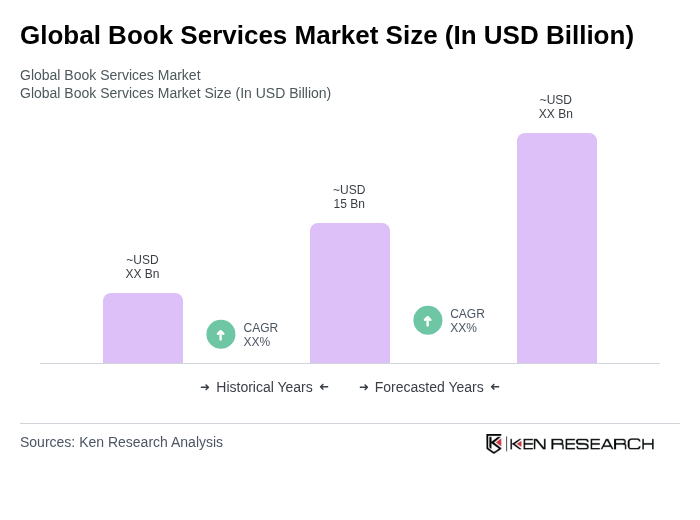
- The Global Book Services Market is valued at USD 15 billion, based on a five-year historical analysis. This growth is primarily driven by the increasing adoption of digital reading platforms, including e-books and audiobooks, alongside advancements in technology that enhance publishing workflows, such as automated typesetting and print-on-demand services. These factors collectively streamline production processes and reduce costs, thereby expanding market reach.
- Key players in this market include North America, which dominates due to its robust digital infrastructure, high levels of digital literacy, and a strong publishing ecosystem. The region's advanced education systems and the presence of major tech companies and publishing houses contribute significantly to its leadership in the global book services landscape.
- In recent years, various governments have implemented regulations to promote digital literacy and access to educational resources. For instance, initiatives aimed at enhancing digital learning infrastructure in emerging markets have led to increased demand for localized book services, thereby fostering growth in the sector.
Global Book Services Market Segmentation
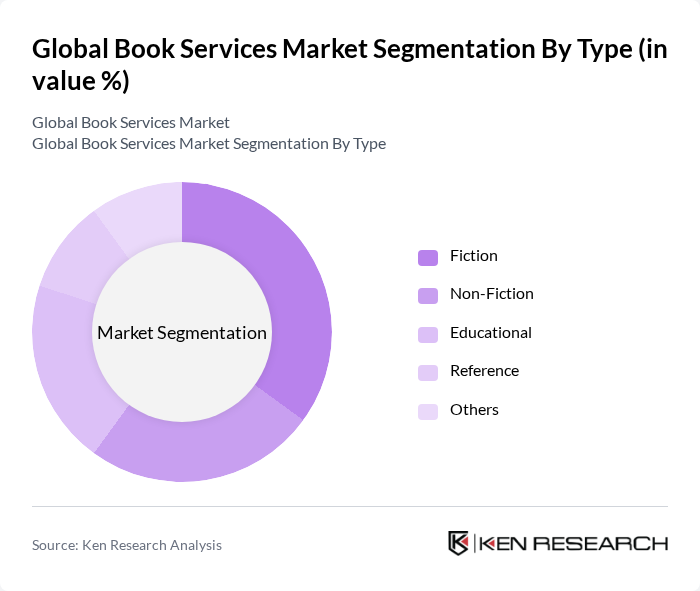
By Type:The market is segmented into various types, including Fiction, Non-Fiction, Educational, Reference, and Others. Among these, the Fiction segment is currently leading due to its broad appeal and the increasing popularity of genres such as fantasy and romance. The rise of digital platforms has also facilitated easier access to a diverse range of fiction titles, driving consumer interest and sales.
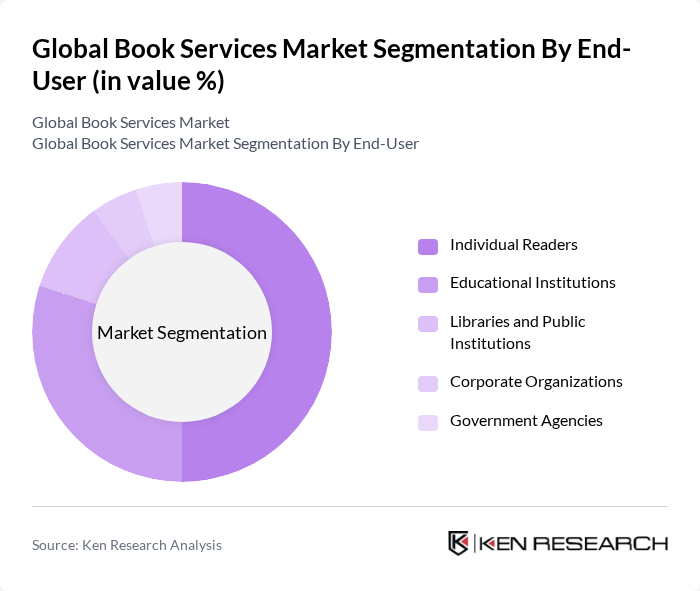
By End-User:This segmentation includes Individual Readers, Educational Institutions, Libraries, Corporates, and Others. The Individual Readers segment is the most significant, driven by the growing trend of personal reading and the convenience of accessing books through digital platforms. The rise of e-readers and mobile applications has made it easier for casual and avid readers to engage with literature.
Global Book Services Market Competitive Landscape
The Global Book Services Market is characterized by a dynamic mix of regional and international players. Leading participants such as Penguin Random House, HarperCollins Publishers, Simon & Schuster, Hachette Book Group, Wiley, Macmillan Publishers, Scholastic Corporation, Bloomsbury Publishing, Springer Nature, Elsevier, Oxford University Press, Cambridge University Press, Ingram Content Group, BookBaby, Lulu Press contribute to innovation, geographic expansion, and service delivery in this space.
Global Book Services Market Industry Analysis
Growth Drivers
- US Publishing Industry Revenue:The U.S. book publishing revenue reached USD 33.0 billion in future, showcasing a robust market that supports global book services. This revenue reflects the strength of both print and digital formats, indicating a healthy demand for publishing services. The growth in revenue is driven by increased consumer spending on books, which is projected to continue as digitalization in publishing expands. Source: U.S. Association of American Publishers (AAP) StatShot report.
- Trade Books Revenue:In future, revenue from consumer (trade) books amounted to USD 21.5 billion, representing a significant portion of the overall publishing market. This segment's growth is crucial for logistics, marketing, and distribution services, as it drives demand for various book services. The increasing popularity of trade books among consumers indicates a stable market environment, fostering opportunities for service providers. Source: AAP StatShot.
- Digital Audio Growth:The digital audio segment, particularly audiobooks, generated USD 2.5 billion in future, marking it as the fastest-growing revenue stream in the publishing industry. This growth reflects a shift in consumer preferences towards audio formats, necessitating enhanced digital service infrastructure. The rise in audiobook consumption is expected to continue, providing opportunities for service providers to innovate and expand their offerings. Source: AAP StatShot.
Market Challenges
- Decline of Mass Market Paperback Sales:Mass market paperback sales fell to USD 210 million in future, indicating a shrinking segment that poses challenges for associated production and distribution services. This decline may lead to reduced profitability for publishers and service providers, as fewer resources are allocated to this format. The shift in consumer preferences towards digital formats exacerbates this challenge, impacting overall market dynamics. Source: AAP full-year report.
- Employment Decline in Publishing:The number of people employed in U.S. book publishing dropped to 54,000 in future, reflecting a trend of workforce reduction due to consolidation and automation. This decline poses challenges for service providers, as a smaller workforce may limit capacity and innovation in the industry. The shrinking labor pool can also affect the quality of services offered, impacting overall market competitiveness. Source: Publishers Weekly analysis.
Global Book Services Market Future Outlook
The future of the book services market is poised for transformation, driven by emerging trends such as hybrid publishing models and the integration of AI technologies. As authors increasingly seek co-investment opportunities for higher royalties, service providers will need to adapt to flexible platforms and print-on-demand systems. Additionally, AI-enhanced audiobook and e-book services are expected to reshape content production, offering innovative solutions that cater to evolving consumer preferences and enhancing reader engagement.
Market Opportunities
- Physical Books Worldwide:The U.S. share of the projected global physical book market is expected to reach USD 15.5 billion in future. This substantial base presents significant opportunities for expansion in print and distribution services, allowing providers to tap into a growing market. The demand for physical books remains strong, indicating a stable revenue stream for service providers. Source: Statista forecast.
- Library Digital Checkouts:Libraries recorded 740 million digital checkouts in future, highlighting a growing area for licensing and platform services. This trend represents a significant opportunity for service providers to develop infrastructure that supports digital lending, enhancing access to books and expanding their market reach. The increasing reliance on digital resources in libraries indicates a shift in consumer behavior that can be capitalized on. Source: Amra & Elma statistics.
Scope of the Report
| Segment | Sub-Segments |
|---|---|
| By Type | Fiction Non-Fiction Educational Reference Others |
| By End-User | Individual Readers Educational Institutions Libraries Corporates Others |
| By Format | Print Books E-books Audiobooks Interactive Books Others |
| By Distribution Channel | Online Retail Brick-and-Mortar Stores Direct Sales Subscription Services Others |
| By Region | North America Europe Asia-Pacific Latin America Others |
| By Customer Type | Casual Readers Avid Readers Academic Readers Professional Readers Others |
| By Pricing Model | Pay-Per-Book Subscription-Based Freemium Bundled Offers Others |
Key Target Audience
Investors and Venture Capitalist Firms
Government and Regulatory Bodies (e.g., Federal Trade Commission, National Endowment for the Arts)
Publishers and Publishing Houses
Distributors and Wholesalers
Retail Chains and Bookstores
Library Systems and Associations
Content Aggregators and Digital Platforms
Trade Associations and Industry Groups
Players Mentioned in the Report:
Penguin Random House
HarperCollins Publishers
Simon & Schuster
Hachette Book Group
Wiley
Macmillan Publishers
Scholastic Corporation
Bloomsbury Publishing
Springer Nature
Elsevier
Oxford University Press
Cambridge University Press
Ingram Content Group
BookBaby
Lulu Press
Table of Contents
Market Assessment Phase
1. Executive Summary and Approach
2. Global Book Services Market Overview
2.1 Key Insights and Strategic Recommendations
2.2 Global Book Services Market Overview
2.3 Definition and Scope
2.4 Evolution of Market Ecosystem
2.5 Timeline of Key Regulatory Milestones
2.6 Value Chain & Stakeholder Mapping
2.7 Business Cycle Analysis
2.8 Policy & Incentive Landscape
3. Global Book Services Market Analysis
3.1 Growth Drivers
3.1.1 Increasing Digitalization in Publishing
3.1.2 Rising Demand for E-books and Audiobooks
3.1.3 Growth of Self-Publishing Platforms
3.1.4 Expansion of Online Retail Channels
3.2 Market Challenges
3.2.1 Intense Competition from Free Content
3.2.2 Copyright and Intellectual Property Issues
3.2.3 Fluctuating Consumer Preferences
3.2.4 Supply Chain Disruptions
3.3 Market Opportunities
3.3.1 Emerging Markets for Book Services
3.3.2 Integration of AI in Content Creation
3.3.3 Collaborations with Educational Institutions
3.3.4 Development of Subscription Models
3.4 Market Trends
3.4.1 Growth of Audiobook Consumption
3.4.2 Rise of Interactive and Multimedia Books
3.4.3 Increased Focus on Sustainability in Publishing
3.4.4 Personalization in Reader Engagement
3.5 Government Regulation
3.5.1 Copyright Law Revisions
3.5.2 Digital Content Accessibility Guidelines
3.5.3 Tax Incentives for Publishing Companies
3.5.4 Regulations on E-commerce Platforms
4. SWOT Analysis
5. Stakeholder Analysis
6. Porter's Five Forces Analysis
7. Global Book Services Market Market Size, 2019-2024
7.1 By Value
7.2 By Volume
7.3 By Average Selling Price
8. Global Book Services Market Segmentation
8.1 By Type
8.1.1 Fiction
8.1.2 Non-Fiction
8.1.3 Educational
8.1.4 Reference
8.1.5 Others
8.2 By End-User
8.2.1 Individual Readers
8.2.2 Educational Institutions
8.2.3 Libraries
8.2.4 Corporates
8.2.5 Others
8.3 By Format
8.3.1 Print Books
8.3.2 E-books
8.3.3 Audiobooks
8.3.4 Interactive Books
8.3.5 Others
8.4 By Distribution Channel
8.4.1 Online Retail
8.4.2 Brick-and-Mortar Stores
8.4.3 Direct Sales
8.4.4 Subscription Services
8.4.5 Others
8.5 By Region
8.5.1 North America
8.5.2 Europe
8.5.3 Asia-Pacific
8.5.4 Latin America
8.5.5 Others
8.6 By Customer Type
8.6.1 Casual Readers
8.6.2 Avid Readers
8.6.3 Academic Readers
8.6.4 Professional Readers
8.6.5 Others
8.7 By Pricing Model
8.7.1 Pay-Per-Book
8.7.2 Subscription-Based
8.7.3 Freemium
8.7.4 Bundled Offers
8.7.5 Others
9. Global Book Services Market Competitive Analysis
9.1 Market Share of Key Players
9.2 Cross Comparison of Key Players
9.2.1 Company Name
9.2.2 Group Size (Large, Medium, or Small as per industry convention)
9.2.3 Revenue Growth Rate
9.2.4 Customer Acquisition Cost
9.2.5 Market Penetration Rate
9.2.6 Customer Retention Rate
9.2.7 Pricing Strategy
9.2.8 Average Order Value
9.2.9 Return on Marketing Investment
9.2.10 Digital Engagement Metrics
9.3 SWOT Analysis of Top Players
9.4 Pricing Analysis
9.5 Detailed Profile of Major Companies
9.5.1 Penguin Random House
9.5.2 HarperCollins Publishers
9.5.3 Simon & Schuster
9.5.4 Hachette Book Group
9.5.5 Wiley
9.5.6 Macmillan Publishers
9.5.7 Scholastic Corporation
9.5.8 Bloomsbury Publishing
9.5.9 Springer Nature
9.5.10 Elsevier
9.5.11 Oxford University Press
9.5.12 Cambridge University Press
9.5.13 Ingram Content Group
9.5.14 BookBaby
9.5.15 Lulu Press
10. Global Book Services Market End-User Analysis
10.1 Procurement Behavior of Key Ministries
10.1.1 Budget Allocation for Educational Materials
10.1.2 Preference for Local vs. International Publishers
10.1.3 Evaluation Criteria for Book Services
10.1.4 Frequency of Procurement Cycles
10.2 Corporate Spend on Infrastructure & Energy
10.2.1 Investment in Digital Learning Resources
10.2.2 Budget for Employee Training Materials
10.2.3 Expenditure on Subscription Services
10.2.4 Allocation for Research and Development Publications
10.3 Pain Point Analysis by End-User Category
10.3.1 Accessibility of Content
10.3.2 Quality of Educational Materials
10.3.3 Cost of Acquisition
10.3.4 Timeliness of Delivery
10.4 User Readiness for Adoption
10.4.1 Familiarity with Digital Formats
10.4.2 Training Needs for New Technologies
10.4.3 Willingness to Pay for Premium Content
10.4.4 Feedback Mechanisms for Content Improvement
10.5 Post-Deployment ROI and Use Case Expansion
10.5.1 Measurement of User Engagement
10.5.2 Analysis of Content Utilization Rates
10.5.3 Expansion into New Content Areas
10.5.4 Long-term Value Assessment
11. Global Book Services Market Future Size, 2025-2030
11.1 By Value
11.2 By Volume
11.3 By Average Selling Price
Go-To-Market Strategy Phase
1. Whitespace Analysis + Business Model Canvas
1.1 Market Gaps Identification
1.2 Value Proposition Development
1.3 Revenue Streams Analysis
1.4 Cost Structure Evaluation
1.5 Key Partnerships Exploration
1.6 Customer Segmentation Insights
1.7 Channels for Distribution
2. Marketing and Positioning Recommendations
2.1 Branding Strategies
2.2 Product USPs
2.3 Target Audience Engagement
2.4 Digital Marketing Tactics
2.5 Content Marketing Approaches
2.6 Social Media Strategies
2.7 Influencer Collaborations
3. Distribution Plan
3.1 Urban Retail Strategies
3.2 Rural NGO Tie-ups
3.3 Online Distribution Channels
3.4 Partnerships with Educational Institutions
3.5 Direct-to-Consumer Approaches
3.6 Logistics and Supply Chain Management
3.7 Inventory Management Solutions
4. Channel & Pricing Gaps
4.1 Underserved Routes
4.2 Pricing Bands Analysis
4.3 Competitor Pricing Strategies
4.4 Customer Willingness to Pay
4.5 Bundling Opportunities
4.6 Discounting Strategies
4.7 Value-Based Pricing Models
5. Unmet Demand & Latent Needs
5.1 Category Gaps Identification
5.2 Consumer Segments Analysis
5.3 Emerging Trends in Consumer Behavior
5.4 Feedback Collection Mechanisms
5.5 Product Development Opportunities
5.6 Market Entry Strategies for New Segments
5.7 Innovation in Content Delivery
6. Customer Relationship
6.1 Loyalty Programs
6.2 After-sales Service
6.3 Customer Feedback Systems
6.4 Community Engagement Initiatives
6.5 Personalization of Services
6.6 Customer Support Channels
6.7 Retention Strategies
7. Value Proposition
7.1 Sustainability Initiatives
7.2 Integrated Supply Chains
7.3 Unique Selling Points
7.4 Customer-Centric Innovations
7.5 Competitive Advantages
7.6 Brand Positioning Strategies
7.7 Value-Added Services
8. Key Activities
8.1 Regulatory Compliance
8.2 Branding Initiatives
8.3 Distribution Setup
8.4 Market Research Activities
8.5 Training and Development Programs
8.6 Technology Integration
8.7 Performance Monitoring
9. Entry Strategy Evaluation
9.1 Domestic Market Entry Strategy
9.1.1 Product Mix Considerations
9.1.2 Pricing Band Analysis
9.1.3 Packaging Strategies
9.2 Export Entry Strategy
9.2.1 Target Countries Identification
9.2.2 Compliance Roadmap Development
10. Entry Mode Assessment
10.1 Joint Ventures
10.2 Greenfield Investments
10.3 Mergers & Acquisitions
10.4 Distributor Model Evaluation
10.5 Risk Assessment
10.6 Strategic Partnerships
10.7 Market Adaptation Strategies
11. Capital and Timeline Estimation
11.1 Capital Requirements
11.2 Timelines for Implementation
11.3 Financial Projections
11.4 Funding Sources
11.5 Budget Allocation
11.6 Cost-Benefit Analysis
12. Control vs Risk Trade-Off
12.1 Ownership vs Partnerships
12.2 Risk Mitigation Strategies
12.3 Control Mechanisms
12.4 Partnership Evaluation Criteria
12.5 Long-term Strategic Planning
12.6 Flexibility in Operations
13. Profitability Outlook
13.1 Breakeven Analysis
13.2 Long-term Sustainability
13.3 Profit Margin Projections
13.4 Revenue Growth Forecasts
13.5 Cost Management Strategies
13.6 Financial Health Indicators
14. Potential Partner List
14.1 Distributors
14.2 Joint Ventures
14.3 Acquisition Targets
14.4 Strategic Alliances
14.5 Collaborative Opportunities
14.6 Network Expansion Strategies
15. Execution Roadmap
15.1 Phased Plan for Market Entry
15.1.1 Market Setup
15.1.2 Market Entry
15.1.3 Growth Acceleration
15.1.4 Scale & Stabilize
15.2 Key Activities and Milestones
15.2.1 Timeline for Key Activities
15.2.2 Milestone Tracking
15.2.3 Performance Metrics
Research Methodology
Phase 1: Approach1
Desk Research
- Industry reports from global publishing associations and market research firms
- Analysis of sales data from major book retailers and e-commerce platforms
- Review of consumer behavior studies and reading trends from academic journals
Primary Research
- Interviews with publishers, authors, and literary agents to gather insights on market dynamics
- Surveys targeting librarians and educators to understand book acquisition and usage patterns
- Focus groups with readers to explore preferences and emerging trends in book consumption
Validation & Triangulation
- Cross-validation of findings through multiple data sources, including sales and demographic data
- Triangulation of insights from primary interviews with secondary research findings
- Sanity checks conducted through expert panel reviews comprising industry veterans
Phase 2: Market Size Estimation1
Top-down Assessment
- Estimation of total market size based on global book sales and growth rates
- Segmentation by format (print, digital, audiobooks) and geographical regions
- Incorporation of trends in self-publishing and independent authorship
Bottom-up Modeling
- Volume estimates derived from sales data of leading publishers and distributors
- Cost analysis based on production, distribution, and marketing expenses
- Revenue projections based on average selling prices across different book formats
Forecasting & Scenario Analysis
- Multi-factor regression analysis incorporating factors like digital adoption and demographic shifts
- Scenario modeling based on potential impacts of economic conditions and technological advancements
- Baseline, optimistic, and pessimistic forecasts through 2030, considering market disruptions
Phase 3: CATI Sample Composition1
| Scope Item/Segment | Sample Size | Target Respondent Profiles |
|---|---|---|
| Trade Publishers | 100 | Publishing Executives, Marketing Directors |
| Independent Bookstores | 80 | Store Owners, Inventory Managers |
| Online Retail Platforms | 90 | eCommerce Managers, Product Listing Specialists |
| Library Systems | 70 | Library Directors, Collection Development Librarians |
| Self-Publishing Authors | 60 | Independent Authors, Marketing Consultants |
Frequently Asked Questions
What is the current value of the Global Book Services Market?
The Global Book Services Market is valued at approximately USD 15 billion, reflecting a robust growth trajectory driven by the increasing adoption of digital reading platforms and advancements in publishing technology.
What factors are driving growth in the Global Book Services Market?
Which region dominates the Global Book Services Market?
What are the key segments in the Global Book Services Market?
Other Regional/Country Reports
Indonesia Book Services Market
Malaysia Book Services Market
KSA Book Services Market
APAC Book Services Market
SEA Book Services Market
Vietnam Book Services Market
Other Adjacent Reports
Malaysia Digital Publishing Market
Kuwait Audiobook Market
Indonesia E-Book Market
Brazil Educational Technology Market
Qatar Library Services Market
Philippines Print-on-Demand Market
Qatar Publishing Software Market
Egypt Content Distribution Market
Saudi Arabia Digital Media Market Outlook to 2030UK Online Retail Market Outlook to 2025Why Buy From Us?

What makes us stand out is that our consultants follow Robust, Refine and Result (RRR) methodology. Robust for clear definitions, approaches and sanity checking, Refine for differentiating respondents' facts and opinions, and Result for presenting data with story.

We have set a benchmark in the industry by offering our clients with syndicated and customized market research reports featuring coverage of entire market as well as meticulous research and analyst insights.

While we don't replace traditional research, we flip the method upside down. Our dual approach of Top Bottom & Bottom Top ensures quality deliverable by not just verifying company fundamentals but also looking at the sector and macroeconomic factors.

With one step in the future, our research team constantly tries to show you the bigger picture. We help with some of the tough questions you may encounter along the way: How is the industry positioned? Best marketing channel? KPI's of competitors? By aligning every element, we help maximize success.

Our report gives you instant access to the answers and sources that other companies might choose to hide. We elaborate each steps of research methodology we have used and showcase you the sample size to earn your trust.

If you need any support, we are here! We pride ourselves on universe strength, data quality, and quick, friendly, and professional service.