About the Report
Base Year 2024Listen to the audio summary
Global Bus Seat Market Overview
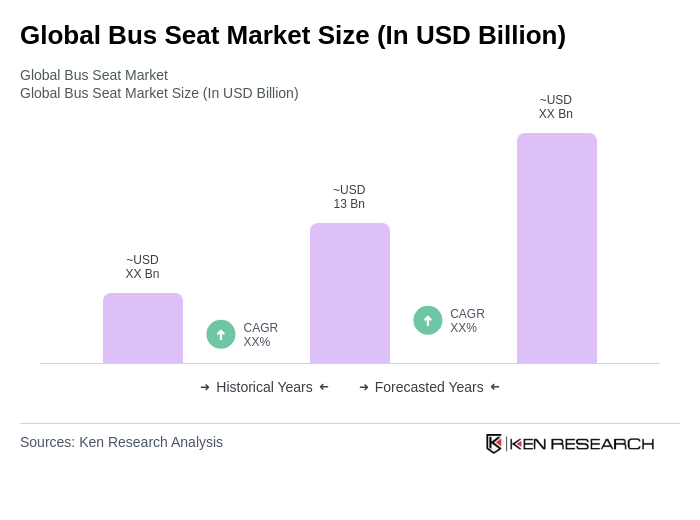
- The Global Bus Seat Market is valued at USD 13 billion, based on a five-year historical analysis. This growth is primarily driven by the increasing demand for public transportation, urbanization, and the need for comfortable and safe travel options. Government investments in public transport infrastructure and fleet renewals, along with electrification initiatives that emphasize lighter, safer, and more ergonomic interiors, continue to support seat demand .
- Key regions in this market include North America, Europe, and Asia-Pacific. Asia-Pacific is widely cited as the leading region by revenue share due to large-scale bus manufacturing, rapid urbanization, and extensive public transport investments, while Europe and North America remain significant on the back of stringent safety and fire-retardancy standards and steady replacement cycles .
- European regulatory frameworks require seat belt installations and enhanced crashworthiness for relevant bus categories, notably under UNECE Regulation No. 14 (seat belt anchorages), Regulation No. 16 (seat belt systems) and Regulation No. 80 (seat strength), which are applied in the EU via type-approval; these rules have been progressively tightened and continue to shape bus seat design and testing rather than stemming from a single new blanket regulation in 2023 .
Global Bus Seat Market Segmentation
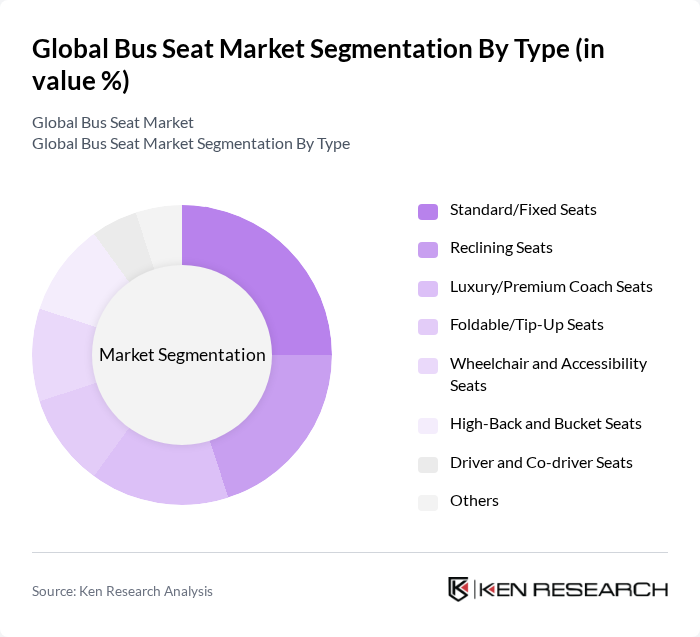
By Type:The bus seat market can be segmented into various types, including Standard/Fixed Seats, Reclining Seats, Luxury/Premium Coach Seats, Foldable/Tip-Up Seats, Wheelchair and Accessibility Seats, High-Back and Bucket Seats, Driver and Co-driver Seats, and Others. Each type serves different consumer needs and preferences, influencing their market share. Operators and OEMs increasingly prioritize lighter frames (aluminum/magnesium), improved fire-retardant foams and fabrics, integrated USB/lighting, and vandal-resistant designs, with premium and reclining formats gaining traction in intercity and coach applications, and durable tip-up and accessibility solutions emphasized in urban transit .
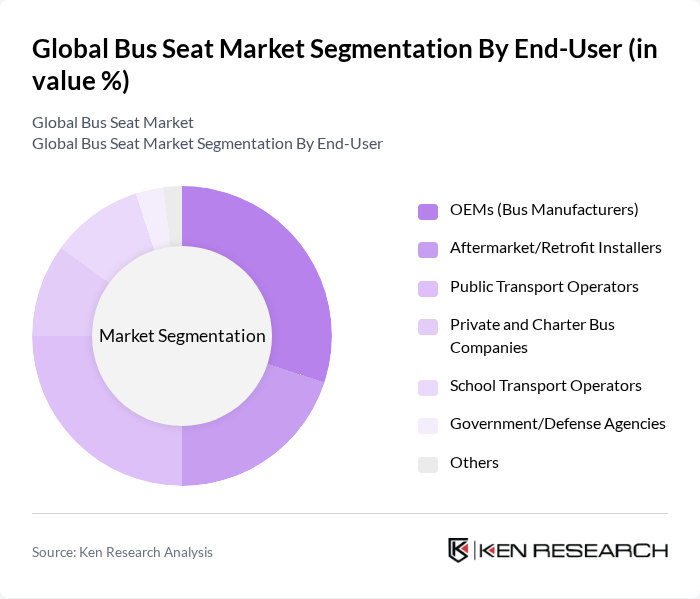
By End-User:The end-user segmentation includes OEMs (Bus Manufacturers), Aftermarket/Retrofit Installers, Public Transport Operators, Private and Charter Bus Companies, School Transport Operators, Government/Defense Agencies, and Others. Each end-user category has distinct requirements and purchasing behaviors that shape the market dynamics. OEM demand tracks new bus production, while aftermarket/retrofit demand is buoyed by refurbishment cycles and life-extension programs, especially where procurement delays or budgeting constraints prolong fleet lives .
Global Bus Seat Market Competitive Landscape
The Global Bus Seat Market is characterized by a dynamic mix of regional and international players. Leading participants such as Freedman Seating Company, Lazzerini S.r.l., Franz Kiel GmbH, Ster Neway (Ster Sp. z o.o.), ISRI – Isringhausen GmbH & Co. KG, GRAMMER AG, Harita Seating Systems Ltd. (HSSL), TATA AutoComp Systems (Seats Division), Saira Seats (part of FAURECIA/Forvia legacy), Toyota Boshoku Corporation, RECARO Automotive Seating, Tachi-S Co., Ltd., Commercial Vehicle Group (National Seating & Bostrom), Adient Aerospace/Adient plc (commercial seating legacy for CVs), Lear Corporation (Specialty/Bus programs) contribute to innovation, geographic expansion, and service delivery in this space.
Global Bus Seat Market Industry Analysis
Growth Drivers
- Increasing Urbanization:Urbanization is a significant driver for the bus seat market, with the United Nations reporting that more thanand the share is expected to continue rising in future, supporting higher demand for public transport solutions. In cities like Delhi, India, population projections vary by definition and administrative boundaries;for the city proper; metropolitan-area estimates differ and are definition-dependent.
- Rising Demand for Public Transportation:from primary or secondary authoritative sources. Evidence from Europe indicates that public transport ridership has experienced significant fluctuations, including declines during pandemic periods, with recovery trajectories varying by country and mode; a uniformfrom authoritative European statistical sources.
- Technological Advancements in Seating Design:Innovations in seating technology, including ergonomic designs and lightweight materials, are recognized trends in transport equipment manufacturing; however,from primary or secondary authoritative sources.
Market Challenges
- High Manufacturing Costs:The bus seat manufacturing sector faces challenges due to production costs influenced by materials, labor, and technology; however,from primary or secondary authoritative sources, as such pricing is generally proprietary and varies by specification.
- Stringent Regulatory Compliance:In the European Union, bus and coach seats must comply withand related UNECE/EU safety frameworks, which can increase compliance effort and costs for manufacturers. A specific estimate that regulations raise production costs byfrom authoritative sources.
Global Bus Seat Market Future Outlook
The future of the bus seat market appears promising, driven by ongoing urbanization and a shift towards sustainable public transport solutions. As cities expand, the demand for efficient and comfortable seating will likely increase, particularly in electric and hybrid buses. Furthermore, advancements in smart technologies and eco-friendly materials will shape product offerings, enhancing passenger experience and meeting regulatory requirements. The focus on passenger comfort and safety will continue to drive innovation in seating design, ensuring a competitive market landscape.
Market Opportunities
- Expansion in Emerging Markets:Emerging markets, particularly in Asia and Africa, present significant growth opportunities for the bus seat market, supported by, which increases demand for public transportation and associated fleet seating needs.
- Innovations in Ergonomic Designs:The growing emphasis on passenger comfort aligns with transport safety and design standards; ergonomics and fatigue reduction are consistent with best practices in transport equipment design, thoughfrom primary or secondary authoritative sources.
Scope of the Report
| Segment | Sub-Segments |
|---|---|
| By Type | Standard/Fixed Seats Reclining Seats Luxury/Premium Coach Seats Foldable/Tip-Up Seats Wheelchair and Accessibility Seats High-Back and Bucket Seats Driver and Co-driver Seats Others |
| By End-User | OEMs (Bus Manufacturers) Aftermarket/Retrofit Installers Public Transport Operators Private and Charter Bus Companies School Transport Operators Government/Defense Agencies Others |
| By Application | City/Transit Buses Intercity Buses Shuttle and Airport Buses Coach/Touring Buses School Buses Electric Buses Others |
| By Material | Fabric/Textile Leather/Artificial Leather Vinyl/PVC Lightweight/Composite Materials Eco-Friendly/Recyclable Materials Others |
| By Distribution Channel | Direct Sales to OEM Aftermarket Distributors Online/Direct-to-Operator Retail/Dealers Others |
| By Price Range | Budget/Standard Mid-Range Premium Luxury Others |
| By Region | North America Europe Asia-Pacific Latin America Middle East & Africa Others |
Key Target Audience
Investors and Venture Capitalist Firms
Government and Regulatory Bodies (e.g., Federal Motor Carrier Safety Administration, European Commission)
Bus Manufacturers and Producers
Public Transportation Authorities
Bus Operators and Fleet Managers
Automotive Component Suppliers
Industry Associations (e.g., American Public Transportation Association)
Financial Institutions and Banks
Players Mentioned in the Report:
Freedman Seating Company
Lazzerini S.r.l.
Franz Kiel GmbH
Ster Neway (Ster Sp. z o.o.)
ISRI Isringhausen GmbH & Co. KG
GRAMMER AG
Harita Seating Systems Ltd. (HSSL)
TATA AutoComp Systems (Seats Division)
Saira Seats (part of FAURECIA/Forvia legacy)
Toyota Boshoku Corporation
RECARO Automotive Seating
Tachi-S Co., Ltd.
Commercial Vehicle Group (National Seating & Bostrom)
Adient Aerospace/Adient plc (commercial seating legacy for CVs)
Lear Corporation (Specialty/Bus programs)
Table of Contents
Market Assessment Phase
1. Executive Summary and Approach
2. Global Bus Seat Market Overview
2.1 Key Insights and Strategic Recommendations
2.2 Global Bus Seat Market Overview
2.3 Definition and Scope
2.4 Evolution of Market Ecosystem
2.5 Timeline of Key Regulatory Milestones
2.6 Value Chain & Stakeholder Mapping
2.7 Business Cycle Analysis
2.8 Policy & Incentive Landscape
3. Global Bus Seat Market Analysis
3.1 Growth Drivers
3.1.1 Increasing Urbanization
3.1.2 Rising Demand for Public Transportation
3.1.3 Technological Advancements in Seating Design
3.1.4 Government Initiatives for Sustainable Transport
3.2 Market Challenges
3.2.1 High Manufacturing Costs
3.2.2 Stringent Regulatory Compliance
3.2.3 Competition from Alternative Transport Modes
3.2.4 Fluctuating Raw Material Prices
3.3 Market Opportunities
3.3.1 Expansion in Emerging Markets
3.3.2 Innovations in Ergonomic Designs
3.3.3 Growth of Electric and Hybrid Buses
3.3.4 Increasing Focus on Passenger Comfort
3.4 Market Trends
3.4.1 Shift Towards Eco-Friendly Materials
3.4.2 Integration of Smart Technologies
3.4.3 Customization of Seating Solutions
3.4.4 Rise in Shared Mobility Services
3.5 Government Regulation
3.5.1 Emission Standards for Buses
3.5.2 Safety Regulations for Bus Seating
3.5.3 Accessibility Standards for Public Transport
3.5.4 Incentives for Electric Bus Adoption
4. SWOT Analysis
5. Stakeholder Analysis
6. Porter's Five Forces Analysis
7. Global Bus Seat Market Market Size, 2019-2024
7.1 By Value
7.2 By Volume
7.3 By Average Selling Price
8. Global Bus Seat Market Segmentation
8.1 By Type
8.1.1 Standard/Fixed Seats
8.1.2 Reclining Seats
8.1.3 Luxury/Premium Coach Seats
8.1.4 Foldable/Tip-Up Seats
8.1.5 Wheelchair and Accessibility Seats
8.1.6 High-Back and Bucket Seats
8.1.7 Driver and Co-driver Seats
8.1.8 Others
8.2 By End-User
8.2.1 OEMs (Bus Manufacturers)
8.2.2 Aftermarket/Retrofit Installers
8.2.3 Public Transport Operators
8.2.4 Private and Charter Bus Companies
8.2.5 School Transport Operators
8.2.6 Government/Defense Agencies
8.2.7 Others
8.3 By Application
8.3.1 City/Transit Buses
8.3.2 Intercity Buses
8.3.3 Shuttle and Airport Buses
8.3.4 Coach/Touring Buses
8.3.5 School Buses
8.3.6 Electric Buses
8.3.7 Others
8.4 By Material
8.4.1 Fabric/Textile
8.4.2 Leather/Artificial Leather
8.4.3 Vinyl/PVC
8.4.4 Lightweight/Composite Materials
8.4.5 Eco-Friendly/Recyclable Materials
8.4.6 Others
8.5 By Distribution Channel
8.5.1 Direct Sales to OEM
8.5.2 Aftermarket Distributors
8.5.3 Online/Direct-to-Operator
8.5.4 Retail/Dealers
8.5.5 Others
8.6 By Price Range
8.6.1 Budget/Standard
8.6.2 Mid-Range
8.6.3 Premium
8.6.4 Luxury
8.6.5 Others
8.7 By Region
8.7.1 North America
8.7.2 Europe
8.7.3 Asia-Pacific
8.7.4 Latin America
8.7.5 Middle East & Africa
8.7.6 Others
9. Global Bus Seat Market Competitive Analysis
9.1 Market Share of Key Players
9.2 Cross Comparison of Key Players
9.2.1 Company Name
9.2.2 Segment Focus (Transit, Coach, School, Driver)
9.2.3 Revenue Growth Rate (Bus Seating)
9.2.4 OEM Program Wins (Number of active OEM platforms)
9.2.5 Regional Footprint (Manufacturing/Assembly sites)
9.2.6 Aftermarket Share (Retrofit/Service revenue mix)
9.2.7 Product Innovation Rate (New seat platforms launched/year)
9.2.8 Average Seat Weight (kg) and Weight Reduction YoY
9.2.9 Compliance Coverage (FMVSS, ECE R14/R16, fire-retardancy)
9.2.10 Certification/Quality KPIs (PPM, on-time delivery %)
9.2.11 Safety Recalls/Field Failure Rate
9.2.12 Sustainability Metrics (recycled content, VOCs)
9.3 SWOT Analysis of Top Players
9.4 Pricing Analysis
9.5 Detailed Profile of Major Companies
9.5.1 Freedman Seating Company
9.5.2 Lazzerini S.r.l.
9.5.3 Franz Kiel GmbH
9.5.4 Ster Neway (Ster Sp. z o.o.)
9.5.5 ISRI – Isringhausen GmbH & Co. KG
9.5.6 GRAMMER AG
9.5.7 Harita Seating Systems Ltd. (HSSL)
9.5.8 TATA AutoComp Systems (Seats Division)
9.5.9 Saira Seats (part of FAURECIA/Forvia legacy)
9.5.10 Toyota Boshoku Corporation
9.5.11 RECARO Automotive Seating
9.5.12 Tachi-S Co., Ltd.
9.5.13 Commercial Vehicle Group (National Seating & Bostrom)
9.5.14 Adient Aerospace/Adient plc (commercial seating legacy for CVs)
9.5.15 Lear Corporation (Specialty/Bus programs)
10. Global Bus Seat Market End-User Analysis
10.1 Procurement Behavior of Key Ministries
10.1.1 Budget Allocation Trends
10.1.2 Decision-Making Processes
10.1.3 Preferred Suppliers
10.1.4 Compliance Requirements
10.2 Corporate Spend on Infrastructure & Energy
10.2.1 Investment Trends in Public Transport
10.2.2 Budgeting for Bus Fleet Upgrades
10.2.3 Funding Sources
10.3 Pain Point Analysis by End-User Category
10.3.1 Comfort and Ergonomics
10.3.2 Durability and Maintenance
10.3.3 Cost Efficiency
10.4 User Readiness for Adoption
10.4.1 Awareness of New Technologies
10.4.2 Training and Support Needs
10.5 Post-Deployment ROI and Use Case Expansion
10.5.1 Performance Metrics
10.5.2 User Feedback Mechanisms
10.5.3 Future Expansion Plans
11. Global Bus Seat Market Future Size, 2025-2030
11.1 By Value
11.2 By Volume
11.3 By Average Selling Price
Go-To-Market Strategy Phase
1. Whitespace Analysis + Business Model Canvas
1.1 Market Gaps Identification
1.2 Value Proposition Development
1.3 Revenue Streams Analysis
1.4 Cost Structure Evaluation
1.5 Key Partnerships Exploration
1.6 Customer Segmentation
1.7 Channels of Distribution
2. Marketing and Positioning Recommendations
2.1 Branding Strategies
2.2 Product USPs
2.3 Target Market Identification
2.4 Communication Strategies
2.5 Digital Marketing Approaches
3. Distribution Plan
3.1 Urban Retail Strategies
3.2 Rural NGO Tie-Ups
3.3 Logistics and Supply Chain Management
3.4 Distribution Partnerships
4. Channel & Pricing Gaps
4.1 Underserved Routes Analysis
4.2 Pricing Bands Evaluation
4.3 Competitor Pricing Strategies
5. Unmet Demand & Latent Needs
5.1 Category Gaps Identification
5.2 Consumer Segments Analysis
5.3 Future Demand Projections
6. Customer Relationship
6.1 Loyalty Programs Development
6.2 After-Sales Service Strategies
6.3 Customer Feedback Mechanisms
7. Value Proposition
7.1 Sustainability Initiatives
7.2 Integrated Supply Chains
7.3 Competitive Advantages
8. Key Activities
8.1 Regulatory Compliance
8.2 Branding Initiatives
8.3 Distribution Setup
9. Entry Strategy Evaluation
9.1 Domestic Market Entry Strategy
9.1.1 Product Mix Considerations
9.1.2 Pricing Band Strategies
9.1.3 Packaging Innovations
9.2 Export Entry Strategy
9.2.1 Target Countries Identification
9.2.2 Compliance Roadmap Development
10. Entry Mode Assessment
10.1 Joint Ventures
10.2 Greenfield Investments
10.3 Mergers & Acquisitions
10.4 Distributor Model Evaluation
11. Capital and Timeline Estimation
11.1 Capital Requirements Analysis
11.2 Timelines for Market Entry
12. Control vs Risk Trade-Off
12.1 Ownership vs Partnerships
13. Profitability Outlook
13.1 Breakeven Analysis
13.2 Long-Term Sustainability Strategies
14. Potential Partner List
14.1 Distributors Identification
14.2 Joint Ventures Opportunities
14.3 Acquisition Targets
15. Execution Roadmap
15.1 Phased Plan for Market Entry
15.1.1 Market Setup
15.1.2 Market Entry
15.1.3 Growth Acceleration
15.1.4 Scale & Stabilize
15.2 Key Activities and Milestones
15.2.1 Milestone Planning
15.2.2 Activity Tracking
Research Methodology
Phase 1: Approach1
Desk Research
- Industry reports from global transportation and automotive associations
- Market analysis from government transportation departments and agencies
- Published articles and white papers on bus manufacturing and seating innovations
Primary Research
- Interviews with product managers at leading bus manufacturers
- Surveys with fleet operators and public transportation authorities
- Field interviews with bus seat suppliers and material manufacturers
Validation & Triangulation
- Cross-validation using historical sales data and market trends
- Triangulation of insights from primary interviews and secondary data sources
- Sanity checks through expert panel discussions and feedback sessions
Phase 2: Market Size Estimation1
Top-down Assessment
- Analysis of global bus production statistics and seating capacity metrics
- Segmentation by bus type (e.g., city, intercity, school) and seating configurations
- Incorporation of government transportation funding and infrastructure projects
Bottom-up Modeling
- Volume estimates based on production data from major bus manufacturers
- Cost analysis of bus seat materials and manufacturing processes
- Calculation of market size based on unit sales and average selling prices
Forecasting & Scenario Analysis
- Multi-variable regression analysis considering urbanization and public transport trends
- Scenario modeling based on economic growth, fuel prices, and environmental regulations
- Baseline, optimistic, and pessimistic forecasts through 2030
Phase 3: CATI Sample Composition1
| Scope Item/Segment | Sample Size | Target Respondent Profiles |
|---|---|---|
| City Bus Operators | 120 | Fleet Managers, Operations Directors |
| Intercity Bus Services | 100 | Business Development Managers, Route Planners |
| School Bus Fleet Management | 80 | Transportation Coordinators, Safety Officers |
| Public Transport Authorities | 70 | Policy Makers, Infrastructure Planners |
| Bus Seat Manufacturers | 90 | Product Development Managers, Sales Executives |
Frequently Asked Questions
What is the current value of the Global Bus Seat Market?
The Global Bus Seat Market is valued at approximately USD 13 billion, driven by increasing public transportation demand, urbanization, and government investments in transport infrastructure. This market is expected to grow further as cities expand and prioritize comfortable travel options.
Which regions are leading in the Global Bus Seat Market?
What types of bus seats are available in the market?
Who are the key players in the Global Bus Seat Market?
Other Regional/Country Reports
Indonesia Bus Seat Market
Malaysia Bus Seat Market
APAC Bus Seat Market
SEA Bus Seat Market
Why Buy From Us?

What makes us stand out is that our consultants follow Robust, Refine and Result (RRR) methodology. Robust for clear definitions, approaches and sanity checking, Refine for differentiating respondents' facts and opinions, and Result for presenting data with story.

We have set a benchmark in the industry by offering our clients with syndicated and customized market research reports featuring coverage of entire market as well as meticulous research and analyst insights.

While we don't replace traditional research, we flip the method upside down. Our dual approach of Top Bottom & Bottom Top ensures quality deliverable by not just verifying company fundamentals but also looking at the sector and macroeconomic factors.

With one step in the future, our research team constantly tries to show you the bigger picture. We help with some of the tough questions you may encounter along the way: How is the industry positioned? Best marketing channel? KPI's of competitors? By aligning every element, we help maximize success.

Our report gives you instant access to the answers and sources that other companies might choose to hide. We elaborate each steps of research methodology we have used and showcase you the sample size to earn your trust.

If you need any support, we are here! We pride ourselves on universe strength, data quality, and quick, friendly, and professional service.