About the Report
Base Year 2024Listen to the audio summary
Global Electric Motors for Electric Vehicle Market Overview
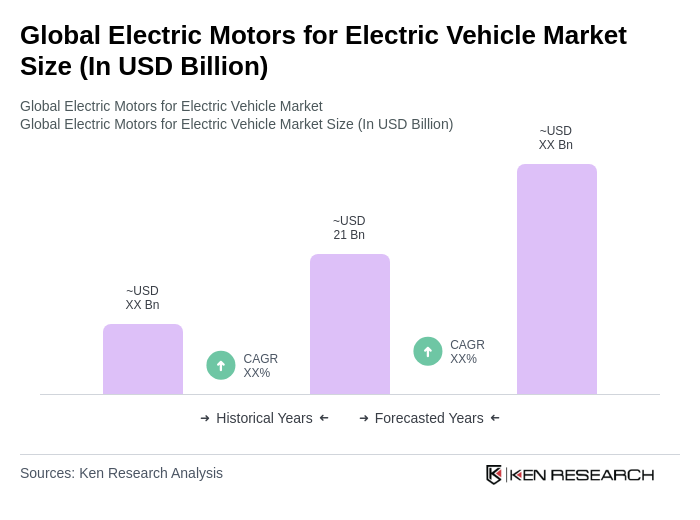
- The Global Electric Motors for Electric Vehicle Market is valued at USD 21 billion, based on a five-year historical analysis. This growth is primarily driven by the increasing adoption of electric vehicles (EVs) worldwide, supported by advancements in battery technology, expansion of charging infrastructure, and a growing emphasis on reducing carbon emissions. The shift towards sustainable transportation solutions, coupled with rising investments in EV manufacturing and government incentives, has led to a surge in demand for electric motors, which are essential for the efficient operation of EVs.
- Countries such as China, the United States, and Germany dominate the electric motors market due to their robust automotive industries and significant investments in electric vehicle infrastructure. China, in particular, has emerged as a leader in EV production and sales, driven by government policies promoting electric mobility and a strong domestic manufacturing base. The United States and Germany also benefit from established automotive manufacturers transitioning to electric models, as well as increased consumer demand for sustainable vehicles.
- In 2023, the European Union implemented stringent regulations aimed at reducing greenhouse gas emissions from vehicles, mandating that all new cars sold must meet specific emissions standards. The Regulation (EU) 2019/631, issued by the European Parliament and the Council, sets CO2 emission performance standards for new passenger cars and for new light commercial vehicles, as part of the EU's broader Green Deal initiative to achieve climate neutrality by 2050. This regulatory framework accelerates the transition to electric vehicles and increases the demand for electric motors by requiring automakers to meet defined fleet-wide emission targets or face financial penalties.
Global Electric Motors for Electric Vehicle Market Segmentation
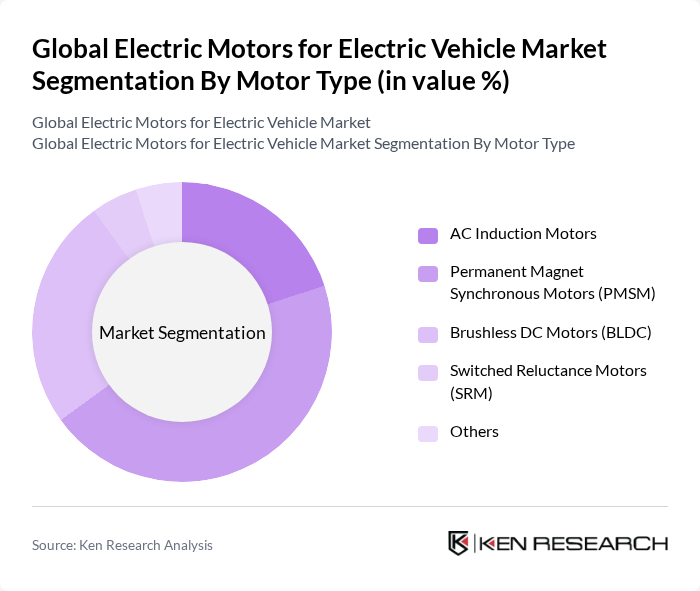
By Motor Type:The electric motors for electric vehicles can be categorized into several types, including AC Induction Motors, Permanent Magnet Synchronous Motors (PMSM), Brushless DC Motors (BLDC), Switched Reluctance Motors (SRM), and others. Among these, Permanent Magnet Synchronous Motors (PMSM) are gaining significant traction due to their high efficiency, compact design, and superior torque characteristics, making them ideal for modern electric vehicles. The demand for PMSM is driven by their ability to provide better performance and energy efficiency compared to traditional motor types, and their widespread adoption by leading EV manufacturers.
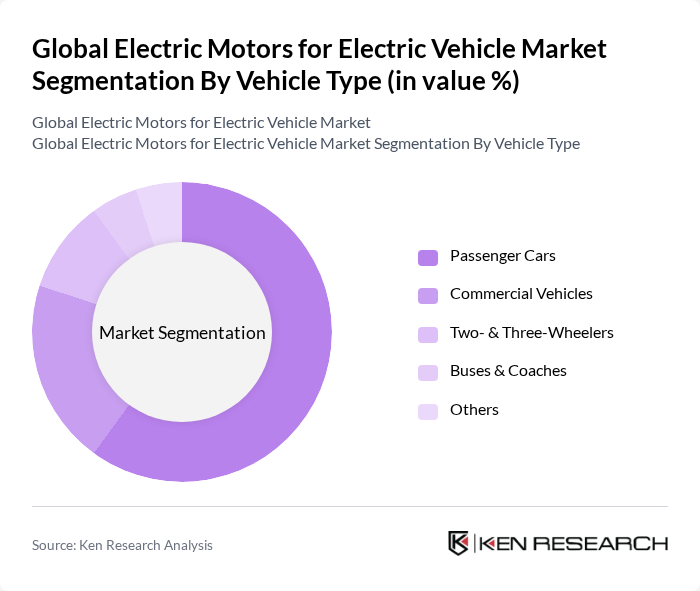
By Vehicle Type:Electric motors are utilized across various vehicle types, including passenger cars, commercial vehicles, two- and three-wheelers, buses and coaches, and others. The passenger car segment is the largest, driven by the increasing consumer preference for electric vehicles, the growing availability of models from various manufacturers, and the expansion of charging networks. This segment's growth is further supported by government incentives, stricter emission regulations, and a shift in consumer attitudes towards sustainable transportation.
Global Electric Motors for Electric Vehicle Market Competitive Landscape
The Global Electric Motors for Electric Vehicle Market is characterized by a dynamic mix of regional and international players. Leading participants such as Tesla, Inc., Siemens AG, Robert Bosch GmbH, Nidec Corporation, General Electric Company, Mitsubishi Electric Corporation, Continental AG, ZF Friedrichshafen AG, Hitachi, Ltd., Parker Hannifin Corporation, ABB Ltd., Yaskawa Electric Corporation, Hyundai Mobis Co., Ltd., Valeo SA, and Aisin Corporation contribute to innovation, geographic expansion, and service delivery in this space.
Global Electric Motors for Electric Vehicle Market Industry Analysis
Growth Drivers
- Increasing Demand for Electric Vehicles:The global electric vehicle (EV) market is projected to reach 23 million units sold in future, driven by consumer preference for sustainable transportation. This surge is supported by a 15% increase in EV sales in future, reflecting a growing shift towards electric mobility. Additionally, the International Energy Agency (IEA) reported that EVs accounted for 14% of total vehicle sales in future, indicating a robust demand that directly influences the electric motor market.
- Technological Advancements in Motor Efficiency:Innovations in electric motor technology have led to efficiency improvements, with new designs achieving up to 95% efficiency. The development of permanent magnet synchronous motors (PMSMs) has been particularly impactful, reducing energy consumption significantly. According to the U.S. Department of Energy, advancements in motor technology could save approximately 1.5 billion kWh annually in future, enhancing the appeal of electric vehicles and driving motor demand.
- Government Incentives for EV Adoption:Governments worldwide are implementing substantial incentives to promote electric vehicle adoption. For instance, the U.S. federal tax credit for EV purchases can reach up to USD 7,500, while countries like Norway offer exemptions from VAT and tolls. In future, over USD 10 billion was allocated globally for EV infrastructure development, which is expected to bolster electric motor demand as more consumers transition to electric vehicles.
Market Challenges
- High Initial Costs of Electric Motors:The upfront costs associated with electric motors remain a significant barrier to widespread adoption. For example, the average cost of an electric motor for EVs can range from USD 1,000 to USD 3,000, depending on specifications. This high initial investment can deter potential buyers, especially in regions where consumers are price-sensitive. As of in future, approximately 40% of consumers cited cost as a primary concern when considering electric vehicles.
- Limited Charging Infrastructure:The lack of adequate charging infrastructure poses a challenge for electric vehicle adoption. As of in future, there are only about 100,000 public charging stations in the U.S., which is insufficient to support the growing number of EVs. The U.S. Department of Energy estimates that a minimum of 500,000 charging stations will be needed in future to meet demand, highlighting the urgent need for infrastructure development to facilitate electric motor market growth.
Global Electric Motors for Electric Vehicle Market Future Outlook
The future of the electric motors market for electric vehicles appears promising, driven by ongoing technological advancements and increasing consumer acceptance. As manufacturers focus on enhancing motor efficiency and integrating renewable energy sources, the market is expected to witness significant growth. Additionally, the rise of autonomous electric vehicles will further stimulate demand for advanced electric motors, creating a dynamic landscape that encourages innovation and investment in sustainable technologies.
Market Opportunities
- Expansion into Emerging Markets:Emerging markets present a significant opportunity for electric motor manufacturers. Countries like India and Brazil are experiencing rapid urbanization, with electric vehicle sales projected to increase by 30% annually. This growth is driven by government initiatives aimed at reducing pollution and promoting sustainable transport, creating a favorable environment for electric motor adoption.
- Development of Advanced Motor Technologies:The ongoing research and development in electric motor technologies, such as the use of silicon carbide (SiC) semiconductors, is expected to enhance performance and reduce costs. In future, the adoption of these advanced technologies could lead to a 20% reduction in manufacturing costs, making electric motors more accessible and appealing to a broader consumer base.
Scope of the Report
| Segment | Sub-Segments |
|---|---|
| By Motor Type | AC Induction Motors Permanent Magnet Synchronous Motors (PMSM) Brushless DC Motors (BLDC) Switched Reluctance Motors (SRM) Others |
| By Vehicle Type | Passenger Cars Commercial Vehicles Two- & Three-Wheelers Buses & Coaches Others |
| By Application | Propulsion Motors Auxiliary Motors (HVAC, Power Steering, etc.) Others |
| By Power Rating | < 100 kW –200 kW > 200 kW Others |
| By Sales Channel | OEMs Aftermarket Others |
| By Region | North America Europe Asia Pacific Rest of World |
Key Target Audience
Investors and Venture Capitalist Firms
Government and Regulatory Bodies (e.g., U.S. Department of Energy, European Commission)
Automotive Manufacturers
Electric Vehicle Charging Infrastructure Providers
Battery Manufacturers
Electric Motor Manufacturers
Energy Providers and Utilities
Automotive Industry Associations
Players Mentioned in the Report:
Tesla, Inc.
Siemens AG
Robert Bosch GmbH
Nidec Corporation
General Electric Company
Mitsubishi Electric Corporation
Continental AG
ZF Friedrichshafen AG
Hitachi, Ltd.
Parker Hannifin Corporation
ABB Ltd.
Yaskawa Electric Corporation
Hyundai Mobis Co., Ltd.
Valeo SA
Aisin Corporation
Table of Contents
Market Assessment Phase
1. Executive Summary and Approach
2. Global Electric Motors for Electric Vehicle Market Overview
2.1 Key Insights and Strategic Recommendations
2.2 Global Electric Motors for Electric Vehicle Market Overview
2.3 Definition and Scope
2.4 Evolution of Market Ecosystem
2.5 Timeline of Key Regulatory Milestones
2.6 Value Chain & Stakeholder Mapping
2.7 Business Cycle Analysis
2.8 Policy & Incentive Landscape
3. Global Electric Motors for Electric Vehicle Market Analysis
3.1 Growth Drivers
3.1.1 Increasing Demand for Electric Vehicles
3.1.2 Technological Advancements in Motor Efficiency
3.1.3 Government Incentives for EV Adoption
3.1.4 Rising Environmental Concerns
3.2 Market Challenges
3.2.1 High Initial Costs of Electric Motors
3.2.2 Limited Charging Infrastructure
3.2.3 Supply Chain Disruptions
3.2.4 Competition from Traditional Internal Combustion Engines
3.3 Market Opportunities
3.3.1 Expansion into Emerging Markets
3.3.2 Development of Advanced Motor Technologies
3.3.3 Collaborations with Automotive Manufacturers
3.3.4 Growth in Renewable Energy Integration
3.4 Market Trends
3.4.1 Shift Towards Sustainable Manufacturing Practices
3.4.2 Increasing Use of AI in Motor Design
3.4.3 Rise of Autonomous Electric Vehicles
3.4.4 Focus on Lightweight Materials
3.5 Government Regulation
3.5.1 Emission Standards for Electric Vehicles
3.5.2 Incentives for EV Manufacturing
3.5.3 Regulations on Battery Recycling
3.5.4 Safety Standards for Electric Motors
4. SWOT Analysis
5. Stakeholder Analysis
6. Porter's Five Forces Analysis
7. Global Electric Motors for Electric Vehicle Market Market Size, 2019-2024
7.1 By Value
7.2 By Volume
7.3 By Average Selling Price
8. Global Electric Motors for Electric Vehicle Market Segmentation
8.1 By Motor Type
8.1.1 AC Induction Motors
8.1.2 Permanent Magnet Synchronous Motors (PMSM)
8.1.3 Brushless DC Motors (BLDC)
8.1.4 Switched Reluctance Motors (SRM)
8.1.5 Others
8.2 By Vehicle Type
8.2.1 Passenger Cars
8.2.2 Commercial Vehicles
8.2.3 Two- & Three-Wheelers
8.2.4 Buses & Coaches
8.2.5 Others
8.3 By Application
8.3.1 Propulsion Motors
8.3.2 Auxiliary Motors (HVAC, Power Steering, etc.)
8.3.3 Others
8.4 By Power Rating
8.4.1 < 100 kW
8.4.2 100–200 kW
8.4.3 > 200 kW
8.4.4 Others
8.5 By Sales Channel
8.5.1 OEMs
8.5.2 Aftermarket
8.5.3 Others
8.6 By Region
8.6.1 North America
8.6.2 Europe
8.6.3 Asia Pacific
8.6.4 Rest of World
9. Global Electric Motors for Electric Vehicle Market Competitive Analysis
9.1 Market Share of Key Players
9.2 Cross Comparison of Key Players
9.2.1 Company Name
9.2.2 Company Size (Large, Medium, Small)
9.2.3 Revenue from EV Motor Segment
9.2.4 Global Market Share (%)
9.2.5 R&D Expenditure (% of Revenue)
9.2.6 Number of Patents Filed (EV Motors)
9.2.7 Production Capacity (Units/Year)
9.2.8 Geographic Presence (No. of Countries/Regions)
9.2.9 Key OEM Partnerships
9.2.10 Product Portfolio Breadth (Motor Types Supported)
9.2.11 Supply Chain Integration Level
9.2.12 Sustainability Initiatives (e.g., CO? Reduction, Recycling)
9.2.13 Aftermarket Support & Service Network
9.3 SWOT Analysis of Top Players
9.4 Pricing Analysis
9.5 Detailed Profile of Major Companies
9.5.1 Tesla, Inc.
9.5.2 Siemens AG
9.5.3 Robert Bosch GmbH
9.5.4 Nidec Corporation
9.5.5 General Electric Company
9.5.6 Mitsubishi Electric Corporation
9.5.7 Continental AG
9.5.8 ZF Friedrichshafen AG
9.5.9 Hitachi, Ltd.
9.5.10 Parker Hannifin Corporation
9.5.11 ABB Ltd.
9.5.12 Yaskawa Electric Corporation
9.5.13 Hyundai Mobis Co., Ltd.
9.5.14 Valeo SA
9.5.15 Aisin Corporation
10. Global Electric Motors for Electric Vehicle Market End-User Analysis
10.1 Procurement Behavior of Key Ministries
10.1.1 Government Procurement Policies
10.1.2 Budget Allocations for EV Initiatives
10.1.3 Collaboration with Private Sector
10.2 Corporate Spend on Infrastructure & Energy
10.2.1 Investment in Charging Infrastructure
10.2.2 Funding for R&D in Electric Motors
10.2.3 Partnerships with Energy Providers
10.3 Pain Point Analysis by End-User Category
10.3.1 Cost of Ownership
10.3.2 Availability of Charging Stations
10.3.3 Performance and Reliability Concerns
10.4 User Readiness for Adoption
10.4.1 Awareness of Electric Vehicle Benefits
10.4.2 Perceived Barriers to Adoption
10.4.3 Readiness for Infrastructure Changes
10.5 Post-Deployment ROI and Use Case Expansion
10.5.1 Evaluation of Cost Savings
10.5.2 Expansion into New Applications
10.5.3 Long-term Performance Metrics
11. Global Electric Motors for Electric Vehicle Market Future Size, 2025-2030
11.1 By Value
11.2 By Volume
11.3 By Average Selling Price
Go-To-Market Strategy Phase
1. Whitespace Analysis + Business Model Canvas
1.1 Market Gaps Identification
1.2 Value Proposition Development
1.3 Revenue Streams Analysis
1.4 Customer Segmentation
1.5 Key Partnerships
1.6 Cost Structure
1.7 Channels of Distribution
2. Marketing and Positioning Recommendations
2.1 Branding Strategies
2.2 Product USPs
3. Distribution Plan
3.1 Urban Retail vs Rural NGO Tie-ups
4. Channel & Pricing Gaps
4.1 Underserved Routes
4.2 Pricing Bands
5. Unmet Demand & Latent Needs
5.1 Category Gaps
5.2 Consumer Segments
6. Customer Relationship
6.1 Loyalty Programs
6.2 After-sales Service
7. Value Proposition
7.1 Sustainability
7.2 Integrated Supply Chains
8. Key Activities
8.1 Regulatory Compliance
8.2 Branding
8.3 Distribution Setup
9. Entry Strategy Evaluation
9.1 Domestic Market Entry Strategy
9.1.1 Product Mix
9.1.2 Pricing Band
9.1.3 Packaging
9.2 Export Entry Strategy
9.2.1 Target Countries
9.2.2 Compliance Roadmap
10. Entry Mode Assessment
10.1 JV
10.2 Greenfield
10.3 M&A
10.4 Distributor Model
11. Capital and Timeline Estimation
11.1 Capital Requirements
11.2 Timelines
12. Control vs Risk Trade-Off
12.1 Ownership vs Partnerships
13. Profitability Outlook
13.1 Breakeven Analysis
13.2 Long-term Sustainability
14. Potential Partner List
14.1 Distributors
14.2 JVs
14.3 Acquisition Targets
15. Execution Roadmap
15.1 Phased Plan for Market Entry
15.1.1 Market Setup
15.1.2 Market Entry
15.1.3 Growth Acceleration
15.1.4 Scale & Stabilize
15.2 Key Activities and Milestones
15.2.1 Milestone Planning
15.2.2 Activity Tracking
Research Methodology
Phase 1: Approach1
Desk Research
- Industry reports from automotive and electric vehicle associations
- Market analysis publications from energy and transportation research firms
- Government publications on electric vehicle adoption and infrastructure development
Primary Research
- Interviews with engineers and product managers at electric motor manufacturers
- Surveys with automotive OEMs regarding electric vehicle production plans
- Field interviews with industry experts and consultants in electric mobility
Validation & Triangulation
- Cross-validation of data from multiple industry sources and reports
- Triangulation of market trends with sales data and regulatory frameworks
- Sanity checks through expert panel discussions and feedback sessions
Phase 2: Market Size Estimation1
Top-down Assessment
- Analysis of global electric vehicle sales data to estimate motor demand
- Segmentation of the market by vehicle type (passenger, commercial, etc.)
- Incorporation of regional growth trends and government incentives for EVs
Bottom-up Modeling
- Estimation of electric motor units produced by leading manufacturers
- Cost analysis based on material and production expenses for electric motors
- Volume x cost calculations for different motor types and applications
Forecasting & Scenario Analysis
- Multi-variable regression analysis incorporating EV adoption rates and technology advancements
- Scenario modeling based on potential regulatory changes and market disruptions
- Baseline, optimistic, and pessimistic forecasts through 2035
Phase 3: CATI Sample Composition1
| Scope Item/Segment | Sample Size | Target Respondent Profiles |
|---|---|---|
| Passenger Electric Vehicles | 120 | Product Managers, R&D Engineers |
| Commercial Electric Vehicles | 90 | Fleet Managers, Procurement Specialists |
| Electric Motor Manufacturers | 60 | Operations Managers, Technical Directors |
| Battery Technology Providers | 50 | Business Development Managers, Engineers |
| Charging Infrastructure Developers | 40 | Project Managers, Policy Advisors |
Frequently Asked Questions
What is the current value of the Global Electric Motors for Electric Vehicle Market?
The Global Electric Motors for Electric Vehicle Market is valued at approximately USD 21 billion, driven by the increasing adoption of electric vehicles, advancements in battery technology, and a focus on reducing carbon emissions.
Which countries are leading in the electric motors market for electric vehicles?
What are the main types of electric motors used in electric vehicles?
What factors are driving the growth of the electric motors market for electric vehicles?
Other Regional/Country Reports
Indonesia Electric Motors for Electric Vehicle Market
Malaysia Electric Motors for Electric Vehicle Market
APAC Electric Motors for Electric Vehicle Market
SEA Electric Motors for Electric Vehicle Market
Why Buy From Us?

What makes us stand out is that our consultants follow Robust, Refine and Result (RRR) methodology. Robust for clear definitions, approaches and sanity checking, Refine for differentiating respondents' facts and opinions, and Result for presenting data with story.

We have set a benchmark in the industry by offering our clients with syndicated and customized market research reports featuring coverage of entire market as well as meticulous research and analyst insights.

While we don't replace traditional research, we flip the method upside down. Our dual approach of Top Bottom & Bottom Top ensures quality deliverable by not just verifying company fundamentals but also looking at the sector and macroeconomic factors.

With one step in the future, our research team constantly tries to show you the bigger picture. We help with some of the tough questions you may encounter along the way: How is the industry positioned? Best marketing channel? KPI's of competitors? By aligning every element, we help maximize success.

Our report gives you instant access to the answers and sources that other companies might choose to hide. We elaborate each steps of research methodology we have used and showcase you the sample size to earn your trust.

If you need any support, we are here! We pride ourselves on universe strength, data quality, and quick, friendly, and professional service.