About the Report
Base Year 2024Global Feminine Intimate Care Market Overview
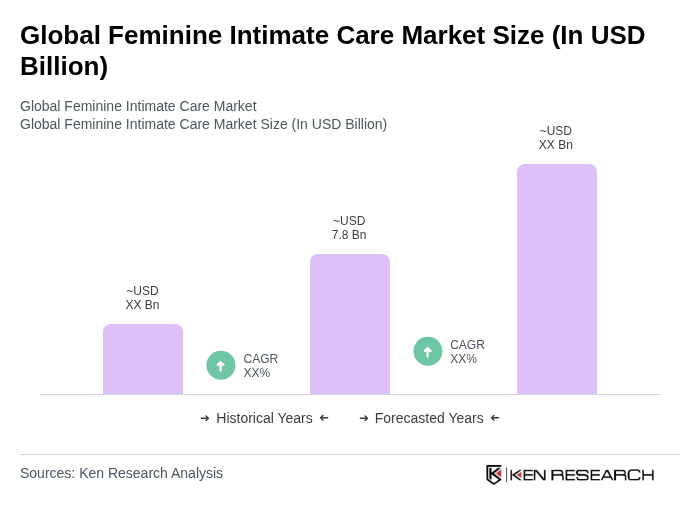
- The Global Feminine Intimate Care Market is valued at USD 7.8 billion, based on a five-year historical analysis. This growth is primarily driven by increasing awareness of personal hygiene, rising disposable incomes, and a growing emphasis on women's health and wellness, particularly in emerging economies. The market has seen a surge in demand for products that promote comfort and hygiene, including pH-balanced, dermatologically tested, and natural/organic formulations, reflecting a shift in consumer attitudes towards intimate care.
- Key regional markets in this space include North America, Europe, and Asia-Pacific. North America, led by the United States, holds a significant share owing to strong awareness of women’s health, advanced retail and e-commerce infrastructure, and high consumer spending on personal care products. Major European markets such as Germany benefit from stringent quality and safety standards and a mature personal care industry. Asia-Pacific, with countries including India, is witnessing rapid growth due to increasing urbanization, rising disposable incomes, growing female workforce participation, and evolving cultural perceptions regarding feminine hygiene.
- In the European Union, feminine hygiene and intimate care products are governed by a combination of the Regulation (EC) No 1223/2009 on cosmetic products issued by the European Parliament and of the Council, and Regulation (EU) 2017/745 on medical devices where applicable, which set binding requirements on product safety, permissible ingredients, labelling, and claims. These frameworks drive the industry toward the use of ingredients that meet defined safety assessments, restrict or ban certain harmful substances, and require manufacturers to ensure products are assessed for potential sensitization and irritation, supporting a broader shift toward gentler and more natural formulations in intimate care.
Global Feminine Intimate Care Market Segmentation
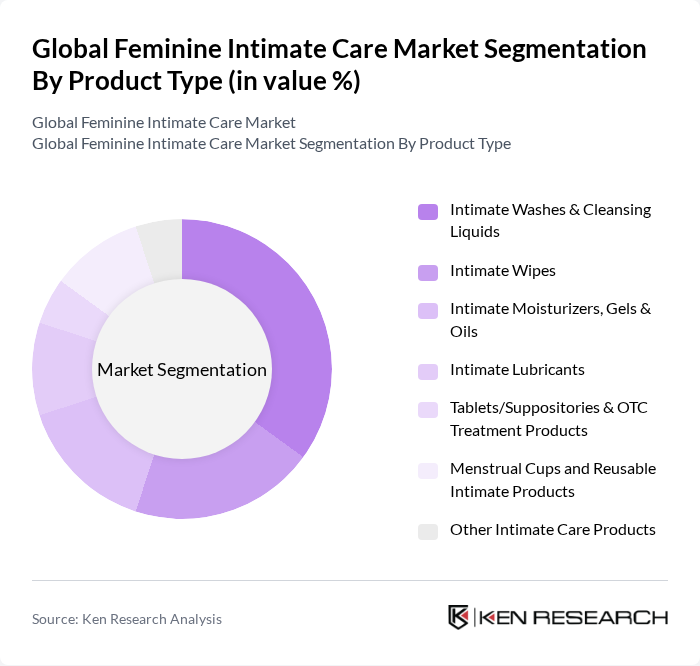
By Product Type:The product type segmentation includes various categories such as intimate washes & cleansing liquids, intimate wipes, intimate moisturizers, gels & oils, intimate lubricants, tablets/suppositories & OTC treatment products, menstrual cups and reusable intimate products, and other intimate care products. This structure is consistent with leading market studies that segment the category into cleansing liquids/wash gels, intimate wipes, lubricants, moisturizers, oils, and other products. Among these, intimate washes & cleansing liquids dominate the market due to their widespread acceptance and essential role in daily hygiene routines, as cleansing liquid products are reported as the leading product segment by revenue. Consumers increasingly prefer products that are gentle, pH-balanced, dermatologically tested, and free from harsh chemicals, with growing demand for natural and organic ingredients, which is driving the adoption of these items.
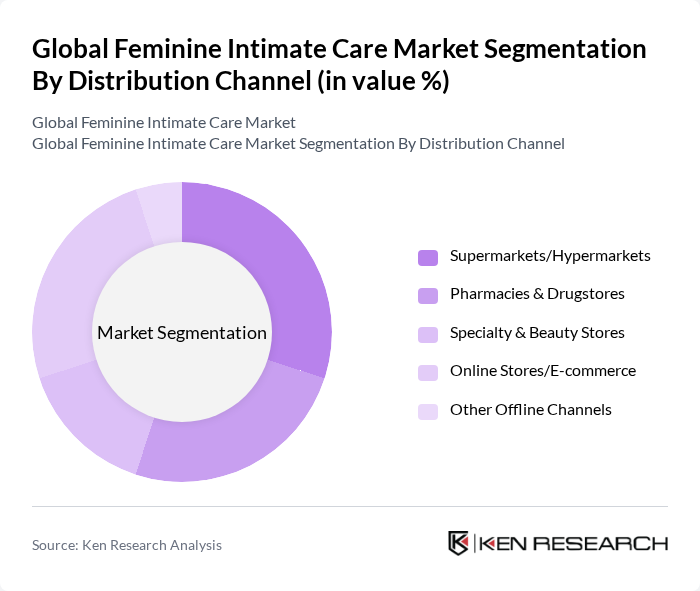
By Distribution Channel:The distribution channel segmentation encompasses supermarkets/hypermarkets, pharmacies & drugstores, specialty & beauty stores, online stores/e-commerce, and other offline channels. This aligns with industry breakdowns, which typically categorize sales into offline (supermarkets/hypermarkets, pharmacies, specialty stores) and online channels. Offline channels, particularly supermarkets/hypermarkets and pharmacies, currently account for a major share of sales, supported by consumer preference for in-store product evaluation and advice from pharmacists or store personnel. Online stores/e-commerce are rapidly gaining traction, particularly among younger consumers who prefer the convenience and privacy of shopping from home; this shift has been reinforced by broader digital adoption and increased online purchasing of personal care products following the COVID-19 period.
Global Feminine Intimate Care Market Competitive Landscape
The Global Feminine Intimate Care Market is characterized by a dynamic mix of regional and international players. Leading participants such as Procter & Gamble Co. (Always, Gillette Venus, etc.), Johnson & Johnson (Carefree, o.b., etc.), Unilever plc (Dove, Love Beauty and Planet, etc.), Kimberly-Clark Corporation (U by Kotex, Poise, etc.), Edgewell Personal Care Company (Playtex, Carefree, Stayfree, etc.), Combe Incorporated (Vagisil), Cora, Diva International Inc. (DivaCup), The Honey Pot Company, Rael Inc., Church & Dwight Co., Inc. (Summer's Eve), Natracare (Bodywise (UK) Ltd.), Essity AB (Libresse, Saba, Nosotras, etc.), Bella Hygiene (TZMO SA – Bella, Femina, etc.), OrganiCup (AllMatters) contribute to innovation, geographic expansion, and service delivery in this space.
Global Feminine Intimate Care Market Industry Analysis
Growth Drivers
- Increasing Awareness of Feminine Hygiene:The global emphasis on health and wellness has led to a significant rise in awareness regarding feminine hygiene. In future, the World Health Organization reported that 70% of women in urban areas are now aware of the importance of intimate care products. This awareness is driving demand, with an estimated 20% increase in sales of feminine hygiene products, translating to approximately $1.5 billion in additional revenue for the industry.
- Rising Demand for Organic and Natural Products:The shift towards organic and natural products is reshaping the feminine intimate care market. In future, the organic segment is projected to account for 40% of the total market share, driven by consumer preferences for chemical-free options. The global organic personal care market is expected to reach $30 billion, with feminine care products contributing significantly, reflecting a growing trend towards sustainability and health-conscious choices.
- Growth in E-commerce and Online Retailing:E-commerce has revolutionized the distribution of feminine intimate care products, with online sales projected to grow by 25% in future. According to Statista, online retailing accounted for 20% of total sales in this sector in the previous year, and this figure is expected to rise as more consumers prefer the convenience of online shopping. This shift is particularly pronounced among younger demographics, who are increasingly turning to digital platforms for their purchasing needs.
Market Challenges
- Stigma Associated with Feminine Intimate Care:Despite growing awareness, stigma surrounding feminine intimate care remains a significant barrier. A survey by the International Journal of Women's Health indicated that 50% of women feel embarrassed discussing intimate care products. This stigma can hinder market growth, as many potential consumers may avoid purchasing these products openly, limiting overall market penetration and brand visibility.
- Regulatory Hurdles in Product Approvals:The feminine intimate care market faces stringent regulatory requirements that can delay product launches. In future, the average time for product approval in the U.S. is estimated at 12 months, according to the FDA. These regulatory hurdles can stifle innovation and limit the introduction of new products, impacting the ability of companies to respond swiftly to changing consumer preferences and market demands.
Global Feminine Intimate Care Market Future Outlook
The future of the feminine intimate care market appears promising, driven by evolving consumer preferences and increasing health consciousness. As awareness of feminine hygiene continues to rise, brands are likely to invest in innovative product formulations that cater to diverse needs. Additionally, the expansion into emerging markets presents significant growth potential, as more women gain access to these essential products. Companies that prioritize sustainability and eco-friendly practices will likely capture a larger share of the market, aligning with global trends towards environmental responsibility.
Market Opportunities
- Expansion into Emerging Markets:Emerging markets present a lucrative opportunity for growth, with a projected increase in demand for feminine care products by 30% in regions like Asia-Pacific. As disposable incomes rise, more women are expected to invest in personal care, creating a substantial market for brands willing to adapt their offerings to local preferences and cultural sensitivities.
- Development of Innovative Product Formulations:There is a growing opportunity for brands to develop innovative product formulations that address specific consumer needs, such as hypoallergenic and pH-balanced products. The global market for specialized feminine care products is expected to grow by 20%, driven by consumer demand for tailored solutions that enhance comfort and safety.
Scope of the Report
| Segment | Sub-Segments |
|---|---|
| By Product Type | Intimate Washes & Cleansing Liquids Intimate Wipes Intimate Moisturizers, Gels & Oils Intimate Lubricants Tablets/Suppositories & OTC Treatment Products Menstrual Cups and Reusable Intimate Products Other Intimate Care Products |
| By Distribution Channel | Supermarkets/Hypermarkets Pharmacies & Drugstores Specialty & Beauty Stores Online Stores/E-commerce Other Offline Channels |
| By Consumer Age Group | Teenagers Adults (20–40 Years) Middle-Aged Women (41–55 Years) Seniors (56 Years & Above) Others (Postpartum, Sensitive-Skin Focused, etc.) |
| By Formulation | Natural & Organic Conventional pH-Balanced & Dermatologically Tested Hypoallergenic & Fragrance-Free Others |
| By Packaging Type | Bottles & Pumps Tubes Sachets & Single-Use Packs Jars & Tubs Others |
| By Region | North America Europe Asia-Pacific Latin America Middle East & Africa |
| By Price Range | Premium Mid-Range Economy Private Label/Store Brands |
Key Target Audience
Investors and Venture Capitalist Firms
Government and Regulatory Bodies (e.g., Food and Drug Administration, European Medicines Agency)
Manufacturers and Producers
Distributors and Retailers
Health and Wellness Organizations
Pharmaceutical Companies
Personal Care Product Companies
Market Analysts and Industry Experts
Players Mentioned in the Report:
Procter & Gamble Co. (Always, Gillette Venus, etc.)
Johnson & Johnson (Carefree, o.b., etc.)
Unilever plc (Dove, Love Beauty and Planet, etc.)
Kimberly-Clark Corporation (U by Kotex, Poise, etc.)
Edgewell Personal Care Company (Playtex, Carefree, Stayfree, etc.)
Combe Incorporated (Vagisil)
Cora
Diva International Inc. (DivaCup)
The Honey Pot Company
Rael Inc.
Church & Dwight Co., Inc. (Summer's Eve)
Natracare (Bodywise (UK) Ltd.)
Essity AB (Libresse, Saba, Nosotras, etc.)
Bella Hygiene (TZMO SA Bella, Femina, etc.)
OrganiCup (AllMatters)
Table of Contents
Market Assessment Phase
1. Executive Summary and Approach
2. Global Feminine Intimate Care Market Overview
2.1 Key Insights and Strategic Recommendations
2.2 Global Feminine Intimate Care Market Overview
2.3 Definition and Scope
2.4 Evolution of Market Ecosystem
2.5 Timeline of Key Regulatory Milestones
2.6 Value Chain & Stakeholder Mapping
2.7 Business Cycle Analysis
2.8 Policy & Incentive Landscape
3. Global Feminine Intimate Care Market Analysis
3.1 Growth Drivers
3.1.1 Increasing awareness of feminine hygiene
3.1.2 Rising demand for organic and natural products
3.1.3 Growth in e-commerce and online retailing
3.1.4 Expanding product offerings by key players
3.2 Market Challenges
3.2.1 Stigma associated with feminine intimate care
3.2.2 Regulatory hurdles in product approvals
3.2.3 Intense competition among established brands
3.2.4 Price sensitivity among consumers
3.3 Market Opportunities
3.3.1 Expansion into emerging markets
3.3.2 Development of innovative product formulations
3.3.3 Collaborations with healthcare professionals
3.3.4 Increasing focus on sustainability and eco-friendly products
3.4 Market Trends
3.4.1 Shift towards personalized feminine care products
3.4.2 Growth of subscription-based services
3.4.3 Rising popularity of menstrual cups and reusable products
3.4.4 Increased investment in marketing and brand awareness
3.5 Government Regulation
3.5.1 Guidelines for product safety and efficacy
3.5.2 Labeling requirements for feminine care products
3.5.3 Restrictions on harmful ingredients
3.5.4 Compliance with international standards
4. SWOT Analysis
5. Stakeholder Analysis
6. Porter's Five Forces Analysis
7. Global Feminine Intimate Care Market Market Size, 2019-2024
7.1 By Value
7.2 By Volume
7.3 By Average Selling Price
8. Global Feminine Intimate Care Market Segmentation
8.1 By Product Type
8.1.1 Intimate Washes & Cleansing Liquids
8.1.2 Intimate Wipes
8.1.3 Intimate Moisturizers, Gels & Oils
8.1.4 Intimate Lubricants
8.1.5 Tablets/Suppositories & OTC Treatment Products
8.1.6 Menstrual Cups and Reusable Intimate Products
8.1.7 Other Intimate Care Products
8.2 By Distribution Channel
8.2.1 Supermarkets/Hypermarkets
8.2.2 Pharmacies & Drugstores
8.2.3 Specialty & Beauty Stores
8.2.4 Online Stores/E-commerce
8.2.5 Other Offline Channels
8.3 By Consumer Age Group
8.3.1 Teenagers
8.3.2 Adults (20–40 Years)
8.3.3 Middle-Aged Women (41–55 Years)
8.3.4 Seniors (56 Years & Above)
8.3.5 Others (Postpartum, Sensitive-Skin Focused, etc.)
8.4 By Formulation
8.4.1 Natural & Organic
8.4.2 Conventional
8.4.3 pH-Balanced & Dermatologically Tested
8.4.4 Hypoallergenic & Fragrance-Free
8.4.5 Others
8.5 By Packaging Type
8.5.1 Bottles & Pumps
8.5.2 Tubes
8.5.3 Sachets & Single-Use Packs
8.5.4 Jars & Tubs
8.5.5 Others
8.6 By Region
8.6.1 North America
8.6.2 Europe
8.6.3 Asia-Pacific
8.6.4 Latin America
8.6.5 Middle East & Africa
8.7 By Price Range
8.7.1 Premium
8.7.2 Mid-Range
8.7.3 Economy
8.7.4 Private Label/Store Brands
9. Global Feminine Intimate Care Market Competitive Analysis
9.1 Market Share of Key Players
9.2 Cross Comparison of Key Players
9.2.1 Company Name
9.2.2 Group Size (Global, Regional, or Niche Player)
9.2.3 Global Feminine Intimate Care Revenue
9.2.4 Feminine Intimate Care Revenue Growth Rate (CAGR)
9.2.5 Market Share in Global Feminine Intimate Care
9.2.6 Geographic Footprint (Number of Countries/Regions Served)
9.2.7 Product Portfolio Breadth (Number of Intimate Care SKUs/Categories)
9.2.8 Share of Natural/Organic Products in Portfolio
9.2.9 E-commerce & D2C Penetration (Share of Digital Sales)
9.2.10 Average Realized Price Positioning (Economy/Mid/Premium)
9.2.11 Brand Awareness & Preference Index (Key Markets)
9.2.12 Regulatory & Safety Compliance Track Record
9.2.13 Marketing & Promotional Spend Intensity (as % of Category Sales)
9.3 SWOT Analysis of Top Players
9.4 Pricing Analysis
9.5 Detailed Profile of Major Companies
9.5.1 Procter & Gamble Co. (Always, Gillette Venus, etc.)
9.5.2 Johnson & Johnson (Carefree, o.b., etc.)
9.5.3 Unilever plc (Dove, Love Beauty and Planet, etc.)
9.5.4 Kimberly-Clark Corporation (U by Kotex, Poise, etc.)
9.5.5 Edgewell Personal Care Company (Playtex, Carefree, Stayfree, etc.)
9.5.6 Combe Incorporated (Vagisil)
9.5.7 Cora
9.5.8 Diva International Inc. (DivaCup)
9.5.9 The Honey Pot Company
9.5.10 Rael Inc.
9.5.11 Church & Dwight Co., Inc. (Summer's Eve)
9.5.12 Natracare (Bodywise (UK) Ltd.)
9.5.13 Essity AB (Libresse, Saba, Nosotras, etc.)
9.5.14 Bella Hygiene (TZMO SA – Bella, Femina, etc.)
9.5.15 OrganiCup (AllMatters)
10. Global Feminine Intimate Care Market End-User Analysis
10.1 Procurement Behavior of Key Ministries
10.1.1 Government procurement policies
10.1.2 Budget allocation for health and hygiene
10.1.3 Collaboration with NGOs for distribution
10.1.4 Awareness programs for feminine hygiene
10.2 Corporate Spend on Infrastructure & Energy
10.2.1 Investment in product development
10.2.2 Marketing and promotional expenditures
10.2.3 Supply chain management costs
10.2.4 Sustainability initiatives
10.3 Pain Point Analysis by End-User Category
10.3.1 Accessibility of products
10.3.2 Affordability concerns
10.3.3 Product effectiveness and safety
10.3.4 Cultural stigmas
10.4 User Readiness for Adoption
10.4.1 Awareness of product benefits
10.4.2 Willingness to switch brands
10.4.3 Availability of products in local markets
10.4.4 Education on proper usage
10.5 Post-Deployment ROI and Use Case Expansion
10.5.1 Measurement of user satisfaction
10.5.2 Analysis of repeat purchase rates
10.5.3 Expansion into new product lines
10.5.4 Long-term brand loyalty metrics
11. Global Feminine Intimate Care Market Future Size, 2025-2030
11.1 By Value
11.2 By Volume
11.3 By Average Selling Price
Go-To-Market Strategy Phase
1. Whitespace Analysis + Business Model Canvas
1.1 Market gaps identification
1.2 Value proposition development
1.3 Revenue model exploration
1.4 Customer segmentation analysis
1.5 Competitive landscape overview
1.6 Key partnerships identification
1.7 Resource allocation strategy
2. Marketing and Positioning Recommendations
2.1 Branding strategies
2.2 Product USPs
2.3 Target audience definition
2.4 Communication channels selection
2.5 Promotional tactics
2.6 Market positioning framework
2.7 Performance metrics
3. Distribution Plan
3.1 Urban retail vs rural NGO tie-ups
3.2 E-commerce strategy
3.3 Partnerships with local distributors
3.4 Logistics and supply chain management
3.5 Inventory management practices
3.6 Customer service and support
3.7 Feedback mechanisms
4. Channel & Pricing Gaps
4.1 Underserved routes
4.2 Pricing bands
4.3 Competitor pricing analysis
4.4 Value-based pricing strategies
4.5 Discounts and promotions
4.6 Price elasticity considerations
4.7 Customer willingness to pay
5. Unmet Demand & Latent Needs
5.1 Category gaps
5.2 Consumer segments
5.3 Product innovation opportunities
5.4 Market entry barriers
5.5 Customer feedback analysis
5.6 Trends in consumer behavior
5.7 Future demand forecasting
6. Customer Relationship
6.1 Loyalty programs
6.2 After-sales service
6.3 Customer engagement strategies
6.4 Feedback and improvement loops
6.5 Community building initiatives
6.6 Customer education programs
6.7 Brand ambassador programs
7. Value Proposition
7.1 Sustainability
7.2 Integrated supply chains
7.3 Unique selling propositions
7.4 Customer-centric product development
7.5 Brand differentiation strategies
7.6 Value delivery mechanisms
7.7 Long-term customer value
8. Key Activities
8.1 Regulatory compliance
8.2 Branding
8.3 Distribution setup
8.4 Marketing execution
8.5 Product development
8.6 Performance monitoring
8.7 Stakeholder engagement
9. Entry Strategy Evaluation
9.1 Domestic Market Entry Strategy
9.1.1 Product mix
9.1.2 Pricing band
9.1.3 Packaging
9.1.4 Marketing approach
9.1.5 Distribution channels
9.1.6 Customer acquisition tactics
9.1.7 Brand positioning
9.2 Export Entry Strategy
9.2.1 Target countries
9.2.2 Compliance roadmap
9.2.3 Market entry barriers
9.2.4 Distribution partnerships
9.2.5 Marketing localization
9.2.6 Risk assessment
9.2.7 Financial projections
10. Entry Mode Assessment
10.1 JV
10.2 Greenfield
10.3 M&A
10.4 Distributor Model
10.5 Risk vs reward analysis
10.6 Strategic fit evaluation
10.7 Long-term sustainability considerations
11. Capital and Timeline Estimation
11.1 Capital requirements
11.2 Timelines
11.3 Funding sources
11.4 Financial modeling
11.5 Budget allocation
11.6 Milestone tracking
11.7 Contingency planning
12. Control vs Risk Trade-Off
12.1 Ownership vs Partnerships
12.2 Risk management strategies
12.3 Control mechanisms
12.4 Partnership evaluation criteria
12.5 Long-term relationship management
1
Research Methodology
Phase 1: Approach1
Desk Research
- Market reports from industry associations focused on feminine hygiene and intimate care
- Analysis of consumer behavior studies published in academic journals
- Review of demographic data from government health departments and global health organizations
Primary Research
- Interviews with product development managers at leading feminine care brands
- Surveys conducted with gynecologists and healthcare professionals
- Focus groups with consumers to understand preferences and purchasing behavior
Validation & Triangulation
- Cross-validation of findings with sales data from major retailers
- Triangulation of insights from consumer surveys and expert interviews
- Sanity checks through feedback from industry experts and market analysts
Phase 2: Market Size Estimation1
Top-down Assessment
- Estimation of market size based on global feminine care spending trends
- Segmentation analysis by product type, including wipes, washes, and creams
- Incorporation of regional growth rates and emerging market dynamics
Bottom-up Modeling
- Volume estimates derived from sales data of key product categories
- Cost analysis based on pricing strategies of leading brands
- Market share calculations based on distribution channels and retail presence
Forecasting & Scenario Analysis
- Multi-variable forecasting using trends in women's health awareness and product innovation
- Scenario modeling based on potential regulatory changes and market disruptions
- Development of baseline, optimistic, and pessimistic growth projections through 2030
Phase 3: CATI Sample Composition1
| Scope Item/Segment | Sample Size | Target Respondent Profiles |
|---|---|---|
| Consumer Preferences in Intimate Care | 140 | Women aged 18-45, Health-conscious Consumers |
| Healthcare Professional Insights | 100 | Gynecologists, Family Physicians |
| Retail Market Trends | 75 | Store Managers, Category Buyers |
| Product Development Feedback | 65 | R&D Managers, Brand Strategists |
| Consumer Awareness and Education | 85 | Health Educators, Community Leaders |
Frequently Asked Questions
What is the current value of the Global Feminine Intimate Care Market?
The Global Feminine Intimate Care Market is valued at approximately USD 7.8 billion, reflecting a significant growth trend driven by increased awareness of personal hygiene and women's health, particularly in emerging economies.
What factors are driving the growth of the Feminine Intimate Care Market?
Which regions are leading in the Feminine Intimate Care Market?
What types of products are included in the Feminine Intimate Care Market?
Other Regional/Country Reports
Indonesia Feminine Intimate Care Market
Malaysia Feminine Intimate Care Market
KSA Feminine Intimate Care Market
APAC Feminine Intimate Care Market
SEA Feminine Intimate Care Market
Other Adjacent Reports
Egypt Menstrual Hygiene Products Market
KSA Womens Health Supplements Market
Qatar Personal Care Wipes Market
Malaysia Organic Skincare Products Market
Indonesia E-commerce Beauty Retail Market
Bahrain Sexual Wellness Products Market
Bahrain Dermatological Care Market
Belgium Sustainable Hygiene Solutions Market
Vietnam Pharmaceutical OTC Treatments Market
Oman Beauty and Wellness Services Market
Why Buy From Us?

What makes us stand out is that our consultants follow Robust, Refine and Result (RRR) methodology. Robust for clear definitions, approaches and sanity checking, Refine for differentiating respondents' facts and opinions, and Result for presenting data with story.

We have set a benchmark in the industry by offering our clients with syndicated and customized market research reports featuring coverage of entire market as well as meticulous research and analyst insights.

While we don't replace traditional research, we flip the method upside down. Our dual approach of Top Bottom & Bottom Top ensures quality deliverable by not just verifying company fundamentals but also looking at the sector and macroeconomic factors.

With one step in the future, our research team constantly tries to show you the bigger picture. We help with some of the tough questions you may encounter along the way: How is the industry positioned? Best marketing channel? KPI's of competitors? By aligning every element, we help maximize success.

Our report gives you instant access to the answers and sources that other companies might choose to hide. We elaborate each steps of research methodology we have used and showcase you the sample size to earn your trust.

If you need any support, we are here! We pride ourselves on universe strength, data quality, and quick, friendly, and professional service.