About the Report
Base Year 2024Listen to the audio summary
Global Gaming Console Market Overview
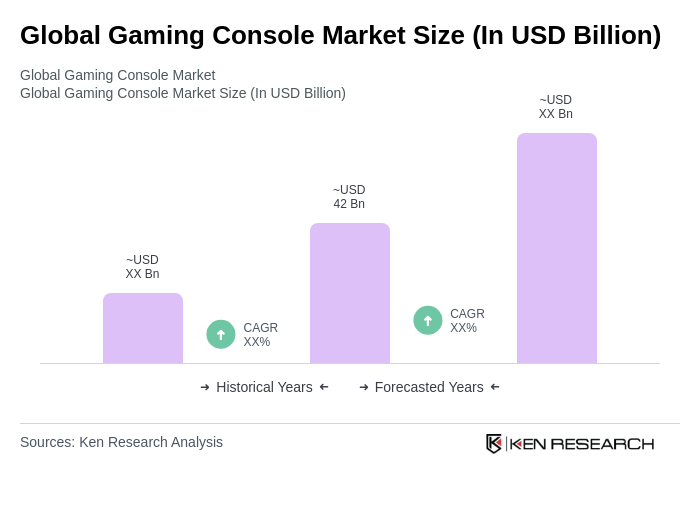
- The Global Gaming Console Market is valued at USD 42 billion, based on a five-year historical analysis. This growth is primarily driven by the increasing popularity of gaming among diverse demographics, technological advancements in console capabilities, and the rise of online gaming platforms. The market has seen a surge in demand for high-performance consoles that offer immersive gaming experiences, further fueled by the expansion of the gaming ecosystem, including accessories and digital content .
- Key players in this market include the United States, Japan, and China, which dominate due to their strong gaming culture, significant investments in gaming technology, and a large consumer base. Asia Pacific, led by China and Japan, exhibits clear dominance in the global market, supported by rising internet gaming popularity and increasing household income. The U.S. remains a major hub for gaming companies and innovation .
- Ongoing regulatory scrutiny regarding competition and mergers in the broader technology and gaming sectors continues to promote innovation and consumer choice .
Global Gaming Console Market Segmentation
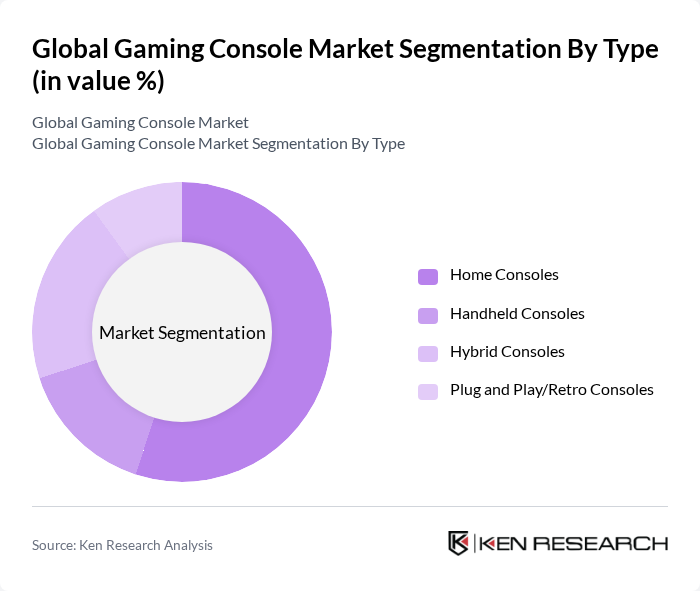
By Type:The market is segmented into various types of gaming consoles, including Home Consoles, Handheld Consoles, Hybrid Consoles, and Plug and Play/Retro Consoles. Among these,Home Consolesdominate the market due to their advanced features, high-quality graphics, and extensive game libraries. Consumers prefer these consoles for their immersive gaming experiences and the ability to connect to large screens, making them ideal for family and social gaming.Handheld Consoles, while popular for portability, have seen a decline in market share as mobile gaming rises.Hybrid Consolescombine the best of both worlds, appealing to a niche market, whilePlug and Play/Retro Consolescater to nostalgia-driven consumers .
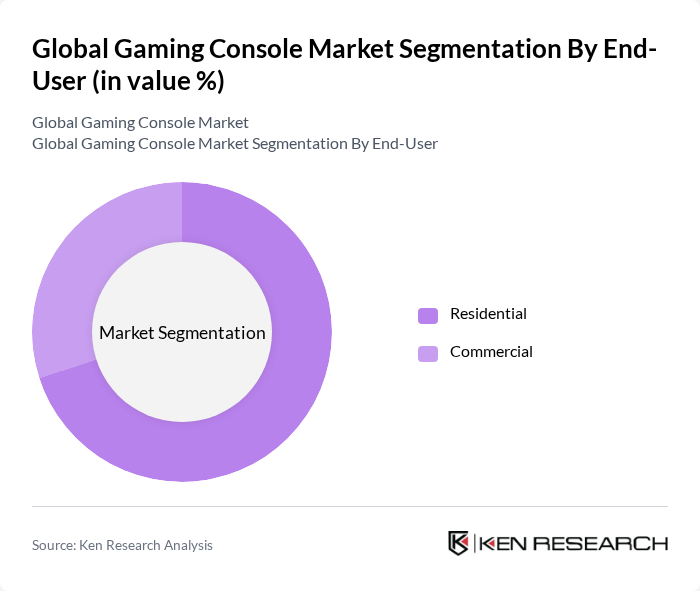
By End-User:The market is divided into Residential and Commercial segments. TheResidentialsegment is the leading sub-segment, driven by the increasing number of households investing in gaming consoles for entertainment. Families and individuals are increasingly purchasing consoles for home use, leading to a surge in demand. TheCommercialsegment, while smaller, is growing as businesses recognize the potential of gaming for employee engagement and customer entertainment in venues like arcades and gaming lounges .
Global Gaming Console Market Competitive Landscape
The Global Gaming Console Market is characterized by a dynamic mix of regional and international players. Leading participants such as Sony Interactive Entertainment, Microsoft Corporation, Nintendo Co., Ltd., Valve Corporation, Logitech International S.A., NVIDIA Corporation, Sega Sammy Holdings Inc., Bandai Namco Entertainment Inc., Capcom Co., Ltd., Atari, Inc., Tencent Holdings Ltd., Epic Games, Inc., Square Enix Holdings Co., Ltd., Ubisoft Entertainment S.A., Take-Two Interactive Software, Inc. contribute to innovation, geographic expansion, and service delivery in this space .
Global Gaming Console Market Industry Analysis
Growth Drivers
- Increasing Demand for High-Quality Graphics:The global gaming console market is experiencing a surge in demand for high-quality graphics, driven by advancements in GPU technology. In future, the global gaming hardware market is projected to reach $46 billion, with graphics processing units (GPUs) accounting for approximately $16 billion. This demand is fueled by gamers seeking immersive experiences, as 71% of gamers prioritize graphics quality when purchasing new consoles, according to industry reports.
- Rise in Online Gaming and Streaming Services:The online gaming sector is expected to generate $21 billion in revenue in future, reflecting a 16% increase from the previous period. This growth is largely attributed to the proliferation of streaming services like Twitch and YouTube Gaming, which have attracted millions of viewers. As a result, console manufacturers are investing heavily in online capabilities, with 61% of new consoles featuring enhanced online functionalities to cater to this expanding audience.
- Expansion of Esports and Competitive Gaming:The esports industry is projected to reach $1.9 billion in revenue in future, with a significant portion stemming from console-based competitions. This growth is encouraging console manufacturers to develop products tailored for competitive gaming, as 81% of esports participants prefer consoles over PCs. The increasing number of esports tournaments, with over 600 events scheduled in future, further drives demand for high-performance gaming consoles.
Market Challenges
- Intense Competition Among Major Players:The gaming console market is characterized by fierce competition, with major players like Sony, Microsoft, and Nintendo vying for market share. In future, these companies are expected to invest over $11 billion collectively in marketing and product development. This intense rivalry can lead to price wars, reducing profit margins and making it challenging for smaller companies to enter the market effectively.
- Supply Chain Disruptions:The gaming console industry is facing significant supply chain challenges, exacerbated by global semiconductor shortages. In future, it is estimated that production delays could result in a loss of $6 billion in potential revenue for console manufacturers. These disruptions hinder the ability to meet consumer demand, leading to longer wait times for new consoles and affecting overall market growth.
Global Gaming Console Market Future Outlook
The future of the gaming console market appears promising, driven by technological advancements and evolving consumer preferences. As cloud gaming gains traction, it is expected to reshape how games are accessed and played, potentially increasing user engagement. Additionally, the integration of virtual reality (VR) and augmented reality (AR) technologies is anticipated to enhance gaming experiences, attracting a broader audience. These trends indicate a dynamic market landscape, with opportunities for innovation and growth in the coming years.
Market Opportunities
- Growth in Mobile Gaming Integration:The integration of mobile gaming with consoles presents a significant opportunity, as mobile gaming revenue is projected to reach $101 billion in future. This convergence allows console manufacturers to tap into a larger audience, enhancing user engagement and driving sales through cross-platform capabilities.
- Expansion into Emerging Markets:Emerging markets, particularly in Asia and Africa, are witnessing rapid growth in gaming adoption. By future, these regions are expected to contribute an additional $11 billion to the global gaming market. Targeting these markets with affordable consoles and localized content can significantly boost sales and market presence for established brands.
Scope of the Report
| Segment | Sub-Segments |
|---|---|
| By Type | Home Consoles Handheld Consoles Hybrid Consoles Plug and Play/Retro Consoles |
| By End-User | Residential Commercial |
| By Distribution Channel | Online Retail Offline Retail Direct Sales |
| By Price Range | Budget Consoles Mid-Range Consoles Premium Consoles |
| By Game Genre | Action/Adventure Sports Role-Playing Games (RPG) Shooter Simulation Others |
| By User Demographics | Age Groups Gender Geographic Location |
| By Game Delivery Method | Physical Copies Digital Downloads Subscription Services Cloud Gaming |
Key Target Audience
Investors and Venture Capitalist Firms
Government and Regulatory Bodies (e.g., Federal Communications Commission, Entertainment Software Association)
Manufacturers and Producers
Distributors and Retailers
Content Developers and Game Studios
Telecommunications Companies
Industry Associations
Financial Institutions
Players Mentioned in the Report:
Sony Interactive Entertainment
Microsoft Corporation
Nintendo Co., Ltd.
Valve Corporation
Logitech International S.A.
NVIDIA Corporation
Sega Sammy Holdings Inc.
Bandai Namco Entertainment Inc.
Capcom Co., Ltd.
Atari, Inc.
Tencent Holdings Ltd.
Epic Games, Inc.
Square Enix Holdings Co., Ltd.
Ubisoft Entertainment S.A.
Take-Two Interactive Software, Inc.
Table of Contents
Market Assessment Phase
1. Executive Summary and Approach
2. Global Gaming Console Market Overview
2.1 Key Insights and Strategic Recommendations
2.2 Global Gaming Console Market Overview
2.3 Definition and Scope
2.4 Evolution of Market Ecosystem
2.5 Timeline of Key Regulatory Milestones
2.6 Value Chain & Stakeholder Mapping
2.7 Business Cycle Analysis
2.8 Policy & Incentive Landscape
3. Global Gaming Console Market Analysis
3.1 Growth Drivers
3.1.1 Increasing Demand for High-Quality Graphics
3.1.2 Rise in Online Gaming and Streaming Services
3.1.3 Expansion of Esports and Competitive Gaming
3.1.4 Technological Advancements in Gaming Hardware
3.2 Market Challenges
3.2.1 Intense Competition Among Major Players
3.2.2 Supply Chain Disruptions
3.2.3 Rapid Technological Changes
3.2.4 High Development and Marketing Costs
3.3 Market Opportunities
3.3.1 Growth in Mobile Gaming Integration
3.3.2 Expansion into Emerging Markets
3.3.3 Development of Subscription-Based Models
3.3.4 Partnerships with Streaming Platforms
3.4 Market Trends
3.4.1 Increasing Popularity of Cloud Gaming
3.4.2 Rise of Virtual Reality (VR) and Augmented Reality (AR)
3.4.3 Focus on Sustainability in Manufacturing
3.4.4 Growth of Cross-Platform Gaming
3.5 Government Regulation
3.5.1 Data Privacy Regulations
3.5.2 Content Rating and Age Restrictions
3.5.3 Trade Tariffs on Imported Consoles
3.5.4 Environmental Regulations on Manufacturing
4. SWOT Analysis
5. Stakeholder Analysis
6. Porter's Five Forces Analysis
7. Global Gaming Console Market Market Size, 2019-2024
7.1 By Value
7.2 By Volume
7.3 By Average Selling Price
8. Global Gaming Console Market Segmentation
8.1 By Type
8.1.1 Home Consoles
8.1.2 Handheld Consoles
8.1.3 Hybrid Consoles
8.1.4 Plug and Play/Retro Consoles
8.2 By End-User
8.2.1 Residential
8.2.2 Commercial
8.3 By Distribution Channel
8.3.1 Online Retail
8.3.2 Offline Retail
8.3.3 Direct Sales
8.4 By Price Range
8.4.1 Budget Consoles
8.4.2 Mid-Range Consoles
8.4.3 Premium Consoles
8.5 By Game Genre
8.5.1 Action/Adventure
8.5.2 Sports
8.5.3 Role-Playing Games (RPG)
8.5.4 Shooter
8.5.5 Simulation
8.5.6 Others
8.6 By User Demographics
8.6.1 Age Groups
8.6.2 Gender
8.6.3 Geographic Location
8.7 By Game Delivery Method
8.7.1 Physical Copies
8.7.2 Digital Downloads
8.7.3 Subscription Services
8.7.4 Cloud Gaming
9. Global Gaming Console Market Competitive Analysis
9.1 Market Share of Key Players
9.2 Cross Comparison of Key Players
9.2.1 Company Name
9.2.2 Group Size (Large, Medium, or Small as per industry convention)
9.2.3 Global Console Unit Shipments
9.2.4 Revenue from Console Segment
9.2.5 Market Penetration Rate (by Region and Globally)
9.2.6 Average Selling Price (ASP) of Consoles
9.2.7 R&D Expenditure as % of Revenue
9.2.8 Exclusive Titles Portfolio Size
9.2.9 Online Subscription Service Subscribers
9.2.10 Customer Retention Rate
9.2.11 Distribution Network Coverage
9.2.12 Brand Equity Score
9.3 SWOT Analysis of Top Players
9.4 Pricing Analysis
9.5 Detailed Profile of Major Companies
9.5.1 Sony Interactive Entertainment
9.5.2 Microsoft Corporation
9.5.3 Nintendo Co., Ltd.
9.5.4 Valve Corporation
9.5.5 Logitech International S.A.
9.5.6 NVIDIA Corporation
9.5.7 Sega Sammy Holdings Inc.
9.5.8 Bandai Namco Entertainment Inc.
9.5.9 Capcom Co., Ltd.
9.5.10 Atari, Inc.
9.5.11 Tencent Holdings Ltd.
9.5.12 Epic Games, Inc.
9.5.13 Square Enix Holdings Co., Ltd.
9.5.14 Ubisoft Entertainment S.A.
9.5.15 Take-Two Interactive Software, Inc.
10. Global Gaming Console Market End-User Analysis
10.1 Procurement Behavior of Key Ministries
10.1.1 Government Procurement Policies
10.1.2 Budget Allocations for Gaming Initiatives
10.1.3 Collaboration with Educational Institutions
10.2 Corporate Spend on Infrastructure & Energy
10.2.1 Investment in Gaming Infrastructure
10.2.2 Spending on Energy-Efficient Consoles
10.2.3 Corporate Sponsorships in Gaming Events
10.3 Pain Point Analysis by End-User Category
10.3.1 Accessibility Issues
10.3.2 Cost of Ownership
10.3.3 Game Availability
10.4 User Readiness for Adoption
10.4.1 Awareness of New Technologies
10.4.2 Willingness to Upgrade
10.4.3 User Training and Support Needs
10.5 Post-Deployment ROI and Use Case Expansion
10.5.1 Measurement of User Engagement
10.5.2 Expansion into New Game Genres
10.5.3 Long-term User Retention Strategies
11. Global Gaming Console Market Future Size, 2025-2030
11.1 By Value
11.2 By Volume
11.3 By Average Selling Price
Go-To-Market Strategy Phase
1. Whitespace Analysis + Business Model Canvas
1.1 Market Gaps Identification
1.2 Business Model Framework
2. Marketing and Positioning Recommendations
2.1 Branding Strategies
2.2 Product USPs
3. Distribution Plan
3.1 Urban Retail vs Rural NGO Tie-ups
4. Channel & Pricing Gaps
4.1 Underserved Routes
4.2 Pricing Bands
5. Unmet Demand & Latent Needs
5.1 Category Gaps
5.2 Consumer Segments
6. Customer Relationship
6.1 Loyalty Programs
6.2 After-sales Service
7. Value Proposition
7.1 Sustainability
7.2 Integrated Supply Chains
8. Key Activities
8.1 Regulatory Compliance
8.2 Branding
8.3 Distribution Setup
9. Entry Strategy Evaluation
9.1 Domestic Market Entry Strategy
9.1.1 Product Mix
9.1.2 Pricing Band
9.1.3 Packaging
9.2 Export Entry Strategy
9.2.1 Target Countries
9.2.2 Compliance Roadmap
10. Entry Mode Assessment
10.1 JV
10.2 Greenfield
10.3 M&A
10.4 Distributor Model
11. Capital and Timeline Estimation
11.1 Capital Requirements
11.2 Timelines
12. Control vs Risk Trade-Off
12.1 Ownership vs Partnerships
13. Profitability Outlook
13.1 Breakeven Analysis
13.2 Long-term Sustainability
14. Potential Partner List
14.1 Distributors
14.2 JVs
14.3 Acquisition Targets
15. Execution Roadmap
15.1 Phased Plan for Market Entry
15.1.1 Market Setup
15.1.2 Market Entry
15.1.3 Growth Acceleration
15.1.4 Scale & Stabilize
15.2 Key Activities and Milestones
15.2.1 Activity Timeline
15.2.2 Milestone Tracking
Research Methodology
Phase 1: Approach1
Desk Research
- Analysis of industry reports from gaming associations and market research firms
- Review of financial statements and annual reports from leading gaming console manufacturers
- Examination of consumer behavior studies and gaming trends published in academic journals
Primary Research
- Interviews with product managers and marketing executives from major gaming console brands
- Surveys conducted with gamers to understand preferences and purchasing behavior
- Focus groups with industry experts and gaming influencers to gather qualitative insights
Validation & Triangulation
- Cross-validation of data through multiple sources including sales data and consumer feedback
- Triangulation of findings from desk research, primary interviews, and market trends
- Sanity checks performed by a panel of gaming industry experts to ensure data accuracy
Phase 2: Market Size Estimation1
Top-down Assessment
- Estimation of total market size based on global gaming revenue and console sales data
- Segmentation of market by console type, including handheld, home, and hybrid consoles
- Incorporation of growth rates from emerging markets and trends in gaming technology
Bottom-up Modeling
- Collection of sales volume data from major retailers and online platforms
- Estimation of average selling prices for different console models and accessories
- Calculation of market size based on unit sales and revenue generation per segment
Forecasting & Scenario Analysis
- Multi-variable forecasting using historical sales data and market growth indicators
- Scenario analysis based on potential impacts of technological advancements and consumer trends
- Development of baseline, optimistic, and pessimistic forecasts through 2030
Phase 3: CATI Sample Composition1
| Scope Item/Segment | Sample Size | Target Respondent Profiles |
|---|---|---|
| Console Gamers | 120 | Casual Gamers, Hardcore Gamers |
| Retail Sales Representatives | 60 | Store Managers, Sales Associates |
| Game Developers | 50 | Game Designers, Product Managers |
| Industry Analysts | 40 | Market Researchers, Gaming Analysts |
| Technology Influencers | 40 | Tech Bloggers, YouTube Reviewers |
Frequently Asked Questions
What is the current value of the Global Gaming Console Market?
The Global Gaming Console Market is valued at approximately USD 42 billion, reflecting a significant growth driven by technological advancements, increasing gaming popularity across demographics, and the expansion of online gaming platforms.
Which regions dominate the Global Gaming Console Market?
What types of gaming consoles are available in the market?
What are the primary end-user segments in the gaming console market?
Other Regional/Country Reports
Malaysia Gaming Console Market
APAC Gaming Console Market
SEA Gaming Console Market
Why Buy From Us?

What makes us stand out is that our consultants follow Robust, Refine and Result (RRR) methodology. Robust for clear definitions, approaches and sanity checking, Refine for differentiating respondents' facts and opinions, and Result for presenting data with story.

We have set a benchmark in the industry by offering our clients with syndicated and customized market research reports featuring coverage of entire market as well as meticulous research and analyst insights.

While we don't replace traditional research, we flip the method upside down. Our dual approach of Top Bottom & Bottom Top ensures quality deliverable by not just verifying company fundamentals but also looking at the sector and macroeconomic factors.

With one step in the future, our research team constantly tries to show you the bigger picture. We help with some of the tough questions you may encounter along the way: How is the industry positioned? Best marketing channel? KPI's of competitors? By aligning every element, we help maximize success.

Our report gives you instant access to the answers and sources that other companies might choose to hide. We elaborate each steps of research methodology we have used and showcase you the sample size to earn your trust.

If you need any support, we are here! We pride ourselves on universe strength, data quality, and quick, friendly, and professional service.