About the Report
Base Year 2024Global General Aviation Engines Market Overview
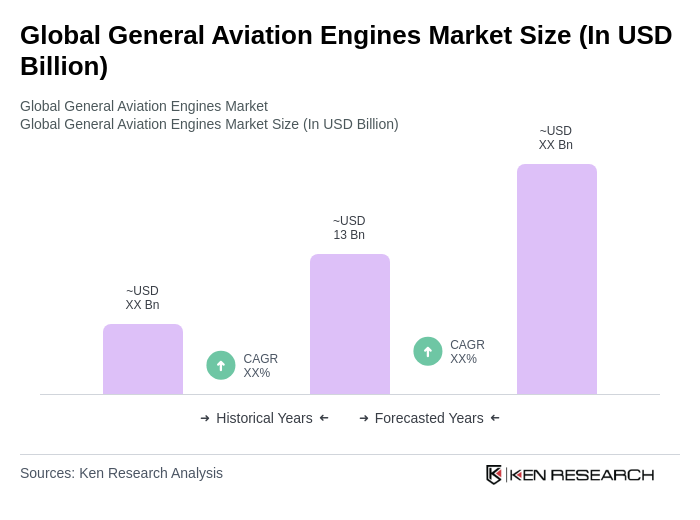
- The Global General Aviation Engines Market is valued at USD 13 billion, based on a five-year historical analysis. This reflects the scale of propulsion demand within the broader general aviation sector and aligns with industry data indicating the overall general aviation market size in the tens of billions of dollars, with engines representing a significant share of OEM and aftermarket spend . The growth is primarily driven by the increasing demand for private and business aviation, ongoing fleet renewal in training and charter segments, and advancements in engine technology that enhance fuel efficiency and reduce emissions, such as FADEC-equipped piston/turboprop engines, unleaded avgas adoption, and SAF compatibility for turbine engines . The market is also supported by a rise in recreational flying and the expansion of flight training schools, which are rebuilding and expanding fleets to meet pilot training demand in North America and other regions .
- Key players in this market include the United States, Canada, and Brazil, which dominate due to their established aviation infrastructure, a high number of private aircraft, and significant investments in aviation technology. The U.S. leads with a robust general aviation sector and the world’s largest base of general aviation aircraft and airports, while Canada and Brazil benefit from strong regional and remote aviation needs, private flying, and tourism that support piston and turboprop utilization across large geographies .
- In 2023, the Federal Aviation Administration (FAA) advanced safety and certification modernization impacting general aviation engines through ongoing Part 23/Part 33 certification updates and safety enhancements, including continued airworthiness directives and data-driven safety programs; however, there was no blanket mandate for “mandatory reporting of engine performance data” across general aviation. FAA’s activities during this period focused on risk-based certification, continued operational safety, and initiatives such as unleaded avgas transition and safety promotion for GA rather than a new universal engine data reporting rule .
Global General Aviation Engines Market Segmentation
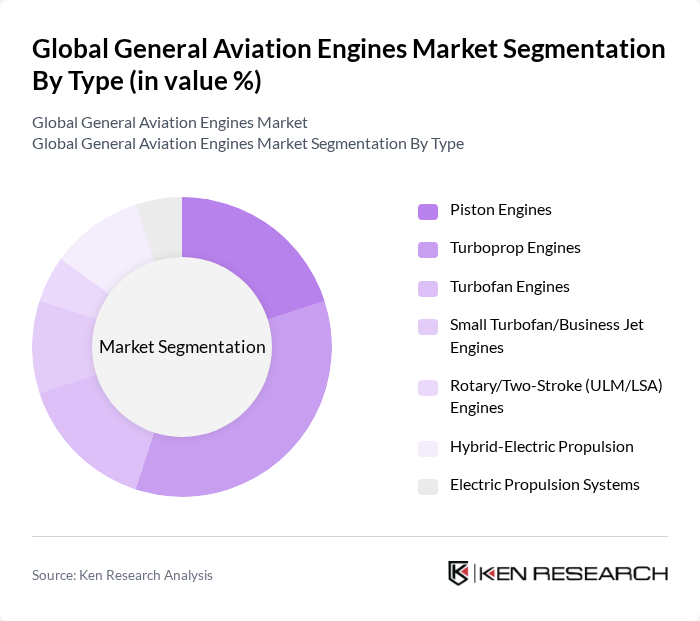
By Type:The market is segmented into various types of engines, including Piston Engines, Turboprop Engines, Turbofan Engines, Small Turbofan/Business Jet Engines, Rotary/Two-Stroke (ULM/LSA) Engines, Hybrid-Electric Propulsion, and Electric Propulsion Systems. Among these, Turboprop Engines are currently leading the market for non-jet general aviation missions due to their efficiency and versatility in regional transport, utility, and special mission roles, while piston engines remain dominant by unit volumes in training and recreational categories; business jet segments are powered by small turbofans supplied by specialized manufacturers .
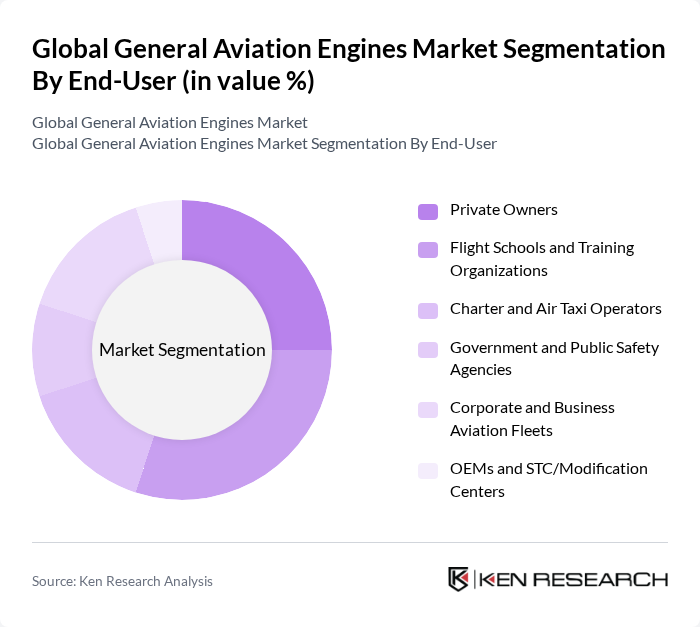
By End-User:The end-user segmentation includes Private Owners, Flight Schools and Training Organizations, Charter and Air Taxi Operators, Government and Public Safety Agencies, Corporate and Business Aviation Fleets, and OEMs and STC/Modification Centers. The segment of Flight Schools and Training Organizations is currently the most significant, driven by the increasing number of aspiring pilots and the demand for pilot training programs, which has prompted accelerated fleet additions and engine overhauls in popular training aircraft categories .
Global General Aviation Engines Market Competitive Landscape
The Global General Aviation Engines Market is characterized by a dynamic mix of regional and international players. Leading participants such as Lycoming Engines (Textron Inc.), Continental Aerospace Technologies, Rotax Aircraft Engines (BRP-Rotax GmbH & Co KG), Pratt & Whitney Canada, Williams International, GE Honda Aero Engines, Safran Helicopter Engines, Rolls-Royce (Business Aviation/Small Turbofans), Honeywell Aerospace (Turboprop/Turboshaft), MTU Aero Engines (Programs and Partnerships), Diamond Aircraft Industries (Electric/Hybrid R&D Partnerships), Cirrus Aircraft (Jet Propulsion Integration), Tecnam (P2012/Piston Integration, Unleaded Avgas Programs), PBS Velká Bíteš (PBS Aerospace) – Turboprop/Turboshaft, TurbAero (Small Turboprop Development) contribute to innovation, geographic expansion, and service delivery in this space .
Global General Aviation Engines Market Industry Analysis
Growth Drivers
- Increasing Demand for Private and Business Aviation:The global general aviation sector is witnessing a surge in demand, with the number of private jets increasing by approximately 600 units annually, reaching over 26,000 in future. This growth is driven by a rise in high-net-worth individuals, particularly in regions like Asia-Pacific, where the number of millionaires is projected to exceed 5 million in future, according to the Credit Suisse Global Wealth Report.
- Technological Advancements in Engine Efficiency:Innovations in engine technology are enhancing fuel efficiency, with new models achieving up to 15% better fuel consumption compared to older engines. The introduction of advanced materials and designs is expected to reduce weight and improve performance, contributing to a projected increase in operational efficiency for general aviation engines, as highlighted by the International Council on Clean Transportation.
- Expansion of General Aviation Infrastructure:Investment in general aviation infrastructure is on the rise, with over $4 billion allocated for airport upgrades and new facilities in future. This expansion is crucial for accommodating the growing fleet of general aviation aircraft, particularly in emerging markets where infrastructure development is lagging, as reported by the Federal Aviation Administration (FAA).
Market Challenges
- High Initial Investment Costs:The entry barrier for general aviation is significant, with the average cost of a new light aircraft exceeding $350,000. This high initial investment limits access for potential buyers, particularly in developing regions where economic conditions may not support such expenditures. The World Bank indicates that only 20% of households in low-income countries can afford such investments, impacting market growth.
- Stringent Regulatory Requirements:Compliance with aviation regulations is increasingly complex, with the FAA and EASA imposing rigorous standards on emissions and safety. The cost of meeting these regulations can exceed $1.5 million for new engine certifications, creating a financial burden for manufacturers. This challenge is compounded by the need for continuous updates to meet evolving environmental standards, as outlined in the latest ICAO reports.
Global General Aviation Engines Market Future Outlook
The future of the general aviation engines market appears promising, driven by technological advancements and increasing consumer interest in sustainable aviation solutions. As the industry adapts to regulatory pressures and environmental concerns, innovations in electric and hybrid engines are expected to gain traction. Additionally, the expansion of general aviation infrastructure in emerging markets will facilitate growth, providing new opportunities for manufacturers and service providers to capitalize on the evolving landscape of private and business aviation.
Market Opportunities
- Growth in Emerging Markets:Emerging markets, particularly in Asia and Africa, are projected to see a 10% increase in general aviation activity in future. This growth is driven by rising disposable incomes and a burgeoning middle class, creating significant opportunities for manufacturers to expand their market presence and cater to new customers.
- Development of Sustainable Aviation Fuels:The push for sustainable aviation fuels (SAFs) is gaining momentum, with investments expected to reach $3 billion in future. This shift presents opportunities for engine manufacturers to innovate and adapt their products to accommodate SAFs, aligning with global sustainability goals and attracting environmentally conscious consumers.
Scope of the Report
| Segment | Sub-Segments |
|---|---|
| By Type | Piston Engines Turboprop Engines Turbofan Engines Small Turbofan/Business Jet Engines Rotary/Two-Stroke (ULM/LSA) Engines Hybrid-Electric Propulsion Electric Propulsion Systems |
| By End-User | Private Owners Flight Schools and Training Organizations Charter and Air Taxi Operators Government and Public Safety Agencies Corporate and Business Aviation Fleets OEMs and STC/Modification Centers |
| By Application | Recreational and Sport Flying Business and Corporate Travel Emergency and Public Safety Services Agricultural and Utility Aviation Medical Evacuations and Air Ambulance Training and Pilot Development |
| By Engine Configuration | Single-Engine Fixed-Wing Multi-Engine Fixed-Wing Rotorcraft Engines (Turbine and Piston) Very Light/Light Jet Engines |
| By Fuel Type | Avgas (100LL and Unleaded Alternatives) Jet A/Jet A-1 Sustainable Aviation Fuel (SAF) Blends Electric Hybrid |
| By Distribution Channel | Direct OEM Sales Authorized Distributors and Dealers MRO and Overhaul Centers Aftermarket and STC Providers |
| By Power Rating | Below 200 HP –500 HP –1,000 HP Above 1,000 HP |
Key Target Audience
Investors and Venture Capitalist Firms
Government and Regulatory Bodies (e.g., Federal Aviation Administration, European Union Aviation Safety Agency)
Manufacturers and Producers of General Aviation Engines
Aircraft OEMs (Original Equipment Manufacturers)
Maintenance, Repair, and Overhaul (MRO) Service Providers
Aerospace and Aviation Industry Associations
Financial Institutions and Investment Banks
Suppliers of Engine Components and Materials
Players Mentioned in the Report:
Lycoming Engines (Textron Inc.)
Continental Aerospace Technologies
Rotax Aircraft Engines (BRP-Rotax GmbH & Co KG)
Pratt & Whitney Canada
Williams International
GE Honda Aero Engines
Safran Helicopter Engines
Rolls-Royce (Business Aviation/Small Turbofans)
Honeywell Aerospace (Turboprop/Turboshaft)
MTU Aero Engines (Programs and Partnerships)
Diamond Aircraft Industries (Electric/Hybrid R&D Partnerships)
Cirrus Aircraft (Jet Propulsion Integration)
Tecnam (P2012/Piston Integration, Unleaded Avgas Programs)
PBS Velka Bites (PBS Aerospace) Turboprop/Turboshaft
TurbAero (Small Turboprop Development)
Table of Contents
Market Assessment Phase
1. Executive Summary and Approach
2. Global General Aviation Engines Market Overview
2.1 Key Insights and Strategic Recommendations
2.2 Global General Aviation Engines Market Overview
2.3 Definition and Scope
2.4 Evolution of Market Ecosystem
2.5 Timeline of Key Regulatory Milestones
2.6 Value Chain & Stakeholder Mapping
2.7 Business Cycle Analysis
2.8 Policy & Incentive Landscape
3. Global General Aviation Engines Market Analysis
3.1 Growth Drivers
3.1.1 Increasing demand for private and business aviation
3.1.2 Technological advancements in engine efficiency
3.1.3 Rising disposable income among consumers
3.1.4 Expansion of general aviation infrastructure
3.2 Market Challenges
3.2.1 High initial investment costs
3.2.2 Stringent regulatory requirements
3.2.3 Limited availability of skilled workforce
3.2.4 Fluctuations in fuel prices
3.3 Market Opportunities
3.3.1 Growth in emerging markets
3.3.2 Development of sustainable aviation fuels
3.3.3 Increasing interest in electric and hybrid engines
3.3.4 Partnerships with technology firms for innovation
3.4 Market Trends
3.4.1 Shift towards lightweight materials in engine design
3.4.2 Growing focus on noise reduction technologies
3.4.3 Integration of digital technologies in engine management
3.4.4 Rise in demand for retrofitting older aircraft
3.5 Government Regulation
3.5.1 Emission standards for general aviation engines
3.5.2 Safety regulations from aviation authorities
3.5.3 Incentives for using alternative fuels
3.5.4 Certification processes for new engine technologies
4. SWOT Analysis
5. Stakeholder Analysis
6. Porter's Five Forces Analysis
7. Global General Aviation Engines Market Market Size, 2019-2024
7.1 By Value
7.2 By Volume
7.3 By Average Selling Price
8. Global General Aviation Engines Market Segmentation
8.1 By Type
8.1.1 Piston Engines
8.1.2 Turboprop Engines
8.1.3 Turbofan Engines
8.1.4 Small Turbofan/Business Jet Engines
8.1.5 Rotary/Two-Stroke (ULM/LSA) Engines
8.1.6 Hybrid-Electric Propulsion
8.1.7 Electric Propulsion Systems
8.2 By End-User
8.2.1 Private Owners
8.2.2 Flight Schools and Training Organizations
8.2.3 Charter and Air Taxi Operators
8.2.4 Government and Public Safety Agencies
8.2.5 Corporate and Business Aviation Fleets
8.2.6 OEMs and STC/Modification Centers
8.3 By Application
8.3.1 Recreational and Sport Flying
8.3.2 Business and Corporate Travel
8.3.3 Emergency and Public Safety Services
8.3.4 Agricultural and Utility Aviation
8.3.5 Medical Evacuations and Air Ambulance
8.3.6 Training and Pilot Development
8.4 By Engine Configuration
8.4.1 Single-Engine Fixed-Wing
8.4.2 Multi-Engine Fixed-Wing
8.4.3 Rotorcraft Engines (Turbine and Piston)
8.4.4 Very Light/Light Jet Engines
8.5 By Fuel Type
8.5.1 Avgas (100LL and Unleaded Alternatives)
8.5.2 Jet A/Jet A-1
8.5.3 Sustainable Aviation Fuel (SAF) Blends
8.5.4 Electric
8.5.5 Hybrid
8.6 By Distribution Channel
8.6.1 Direct OEM Sales
8.6.2 Authorized Distributors and Dealers
8.6.3 MRO and Overhaul Centers
8.6.4 Aftermarket and STC Providers
8.7 By Power Rating
8.7.1 Below 200 HP
8.7.2 200–500 HP
8.7.3 500–1,000 HP
8.7.4 Above 1,000 HP
9. Global General Aviation Engines Market Competitive Analysis
9.1 Market Share of Key Players
9.2 Cross Comparison of Key Players
9.2.1 Company Name
9.2.2 Business Scale (General Aviation Engine Segment)
9.2.3 Revenue Growth Rate (GA Engine Segment, % YoY)
9.2.4 Installed Base (Active Engines in Service)
9.2.5 Deliveries per Year (Units)
9.2.6 Backlog (Units or Years of Production)
9.2.7 Certification Coverage (EASA/FAA Programs Supported)
9.2.8 New Program Pipeline (Announced/Under Development)
9.2.9 Average TBO/Overhaul Interval (Hours)
9.2.10 Specific Fuel Consumption/Efficiency Benchmarks
9.2.11 SAF Compatibility and Unleaded Avgas Readiness
9.2.12 ASP by Engine Family (USD)
9.2.13 Gross Margin (GA Engines)
9.2.14 Aftermarket Mix (% of GA Engine Revenue)
9.2.15 Global Support Network (MRO/Service Centers Count)
9.3 SWOT Analysis of Top Players
9.4 Pricing Analysis
9.5 Detailed Profile of Major Companies
9.5.1 Lycoming Engines (Textron Inc.)
9.5.2 Continental Aerospace Technologies
9.5.3 Rotax Aircraft Engines (BRP-Rotax GmbH & Co KG)
9.5.4 Pratt & Whitney Canada
9.5.5 Williams International
9.5.6 GE Honda Aero Engines
9.5.7 Safran Helicopter Engines
9.5.8 Rolls-Royce (Business Aviation/Small Turbofans)
9.5.9 Honeywell Aerospace (Turboprop/Turboshaft)
9.5.10 MTU Aero Engines (Programs and Partnerships)
9.5.11 Diamond Aircraft Industries (Electric/Hybrid R&D Partnerships)
9.5.12 Cirrus Aircraft (Jet Propulsion Integration)
9.5.13 Tecnam (P2012/Piston Integration, Unleaded Avgas Programs)
9.5.14 PBS Velká Bíteš (PBS Aerospace) – Turboprop/Turboshaft
9.5.15 TurbAero (Small Turboprop Development)
10. Global General Aviation Engines Market End-User Analysis
10.1 Procurement Behavior of Key Ministries
10.1.1 Budget Allocation for Aviation
10.1.2 Decision-Making Processes
10.1.3 Supplier Selection Criteria
10.1.4 Contract Management Practices
10.2 Corporate Spend on Infrastructure & Energy
10.2.1 Investment in Aviation Infrastructure
10.2.2 Spending on Maintenance and Upgrades
10.2.3 Budgeting for New Aircraft Purchases
10.3 Pain Point Analysis by End-User Category
10.3.1 Cost of Ownership
10.3.2 Availability of Spare Parts
10.3.3 Regulatory Compliance Challenges
10.3.4 Training and Support Needs
10.4 User Readiness for Adoption
10.4.1 Awareness of New Technologies
10.4.2 Financial Readiness
10.4.3 Training and Skill Development
10.5 Post-Deployment ROI and Use Case Expansion
10.5.1 Measurement of Performance Metrics
10.5.2 Feedback Mechanisms for Improvement
10.5.3 Opportunities for Upselling and Cross-Selling
11. Global General Aviation Engines Market Future Size, 2025-2030
11.1 By Value
11.2 By Volume
11.3 By Average Selling Price
Go-To-Market Strategy Phase
1. Whitespace Analysis + Business Model Canvas
1.1 Market Gaps Identification
1.2 Value Proposition Development
1.3 Revenue Streams Analysis
1.4 Key Resources and Activities
1.5 Customer Segments and Relationships
1.6 Channels for Delivery
1.7 Cost Structure Overview
2. Marketing and Positioning Recommendations
2.1 Branding Strategies
2.2 Product USPs
2.3 Target Market Positioning
2.4 Communication Strategies
2.5 Digital Marketing Approaches
3. Distribution Plan
3.1 Urban Retail Strategies
3.2 Rural NGO Tie-Ups
3.3 Online Distribution Channels
3.4 Partnerships with Distributors
4. Channel & Pricing Gaps
4.1 Underserved Routes
4.2 Pricing Bands Analysis
4.3 Competitor Pricing Strategies
5. Unmet Demand & Latent Needs
5.1 Category Gaps Identification
5.2 Consumer Segments Analysis
5.3 Emerging Trends and Needs
6. Customer Relationship
6.1 Loyalty Programs
6.2 After-Sales Service Strategies
6.3 Customer Feedback Mechanisms
7. Value Proposition
7.1 Sustainability Initiatives
7.2 Integrated Supply Chains
7.3 Competitive Advantages
8. Key Activities
8.1 Regulatory Compliance
8.2 Branding Initiatives
8.3 Distribution Setup
9. Entry Strategy Evaluation
9.1 Domestic Market Entry Strategy
9.1.1 Product Mix Considerations
9.1.2 Pricing Band Strategy
9.1.3 Packaging Options
9.2 Export Entry Strategy
9.2.1 Target Countries Identification
9.2.2 Compliance Roadmap Development
10. Entry Mode Assessment
10.1 Joint Ventures
10.2 Greenfield Investments
10.3 Mergers & Acquisitions
10.4 Distributor Model Evaluation
11. Capital and Timeline Estimation
11.1 Capital Requirements Overview
11.2 Timelines for Implementation
12. Control vs Risk Trade-Off
12.1 Ownership vs Partnerships Analysis
13. Profitability Outlook
13.1 Breakeven Analysis
13.2 Long-Term Sustainability Strategies
14. Potential Partner List
14.1 Distributors
14.2 Joint Ventures
14.3 Acquisition Targets
15. Execution Roadmap
15.1 Phased Plan for Market Entry
15.1.1 Market Setup
15.1.2 Market Entry
15.1.3 Growth Acceleration
15.1.4 Scale & Stabilize
15.2 Key Activities and Milestones
15.2.1 Milestone Planning
15.2.2 Activity Tracking
Research Methodology
Phase 1: Approach1
Desk Research
- Industry reports from aviation authorities and global aviation organizations
- Market analysis publications from aerospace and defense think tanks
- Statistical data from government aviation agencies and international aviation bodies
Primary Research
- Interviews with engineers and product managers at general aviation engine manufacturers
- Surveys with aviation maintenance professionals and service providers
- Field interviews with pilots and aircraft operators to gather insights on engine performance
Validation & Triangulation
- Cross-validation of findings through multiple industry expert interviews
- Triangulation of data from market reports, expert opinions, and historical trends
- Sanity checks through feedback from a panel of aviation industry veterans
Phase 2: Market Size Estimation1
Top-down Assessment
- Analysis of global aviation market size and growth trends to estimate engine demand
- Segmentation by aircraft type, engine type, and geographical region
- Incorporation of regulatory impacts and technological advancements in engine design
Bottom-up Modeling
- Data collection from leading manufacturers on production volumes and pricing
- Estimation of market share based on sales data from key players in the industry
- Volume x price analysis to derive revenue estimates for different engine segments
Forecasting & Scenario Analysis
- Multi-variable forecasting using historical growth rates and emerging market trends
- Scenario analysis based on economic conditions, fuel prices, and technological innovations
- Development of baseline, optimistic, and pessimistic forecasts through 2030
Phase 3: CATI Sample Composition1
| Scope Item/Segment | Sample Size | Target Respondent Profiles |
|---|---|---|
| General Aviation Engine Manufacturers | 120 | Product Managers, R&D Engineers |
| Aviation Maintenance Organizations | 90 | Maintenance Managers, Technical Directors |
| Pilot and Operator Insights | 80 | Commercial Pilots, Aircraft Owners |
| Regulatory Bodies and Aviation Authorities | 50 | Regulatory Officers, Policy Makers |
| Aerospace Industry Analysts | 60 | Market Analysts, Industry Consultants |
Frequently Asked Questions
What is the current value of the Global General Aviation Engines Market?
The Global General Aviation Engines Market is valued at approximately USD 13 billion, reflecting significant demand for propulsion within the general aviation sector, which is part of a broader market worth tens of billions of dollars.
What factors are driving the growth of the General Aviation Engines Market?
Which countries dominate the General Aviation Engines Market?
What types of engines are included in the General Aviation Engines Market?
Other Regional/Country Reports
Indonesia General Aviation Engines Market
Malaysia General Aviation Engines Market
APAC General Aviation Engines Market
SEA General Aviation Engines Market
Why Buy From Us?

What makes us stand out is that our consultants follow Robust, Refine and Result (RRR) methodology. Robust for clear definitions, approaches and sanity checking, Refine for differentiating respondents' facts and opinions, and Result for presenting data with story.

We have set a benchmark in the industry by offering our clients with syndicated and customized market research reports featuring coverage of entire market as well as meticulous research and analyst insights.

While we don't replace traditional research, we flip the method upside down. Our dual approach of Top Bottom & Bottom Top ensures quality deliverable by not just verifying company fundamentals but also looking at the sector and macroeconomic factors.

With one step in the future, our research team constantly tries to show you the bigger picture. We help with some of the tough questions you may encounter along the way: How is the industry positioned? Best marketing channel? KPI's of competitors? By aligning every element, we help maximize success.

Our report gives you instant access to the answers and sources that other companies might choose to hide. We elaborate each steps of research methodology we have used and showcase you the sample size to earn your trust.

If you need any support, we are here! We pride ourselves on universe strength, data quality, and quick, friendly, and professional service.