About the Report
Base Year 2024Global Hotel Toiletries Market Overview
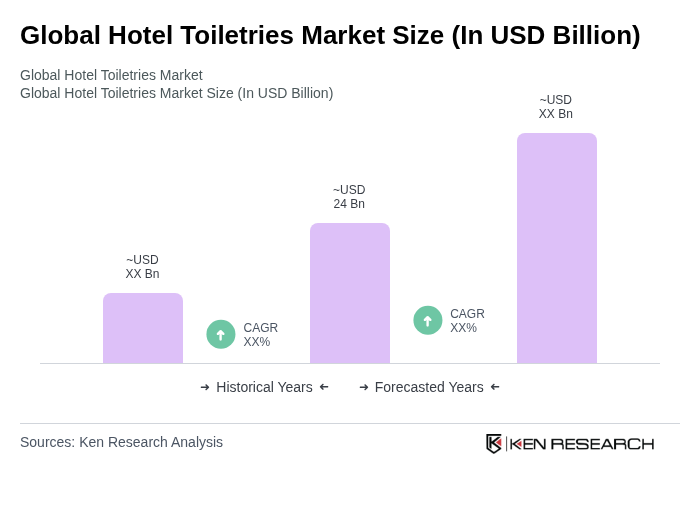
- The Global Hotel Toiletries Market is valued at USD 24 billion, based on a five-year historical analysis. This substantial growth is primarily driven by the increasing demand for high-quality personal care products in the hospitality sector, as hotels strive to enhance guest experiences and satisfaction. The rising trend of eco-friendly and organic toiletries is also contributing to market expansion, as consumers become more conscious of sustainability. Additionally, the growing preference for luxury and premium toiletries drives approximately 44% of hotel purchases globally, while the adoption of biodegradable packaging and refillable toiletry systems is being implemented by nearly 37% of hospitality providers.
- Key regions in this market include North America, Europe, and Asia-Pacific, which dominate due to their robust hospitality industries and high tourist influx. North America leads with 41% of total market share, while Europe captures 32% of the market share, driven by a robust hospitality sector and government tourism support. The U.S. is particularly significant because of its large number of luxury and boutique hotels that prioritize premium toiletries, with leading hotel chains like Marriott and Hilton enhancing their guest experience through partnerships with eco-conscious brands. Europe and Asia-Pacific are expanding their hotel sectors rapidly, catering to both domestic and international travelers.
- The EU Sustainable Products Regulation framework establishes requirements for product sustainability and circular economy principles applicable to toiletries supplied to hospitality establishments. This regulatory framework encourages hotels to adopt sustainable practices and influences the types of products offered in the market, with compliance requirements focusing on material composition, packaging recyclability, and environmental impact reduction.
Global Hotel Toiletries Market Segmentation
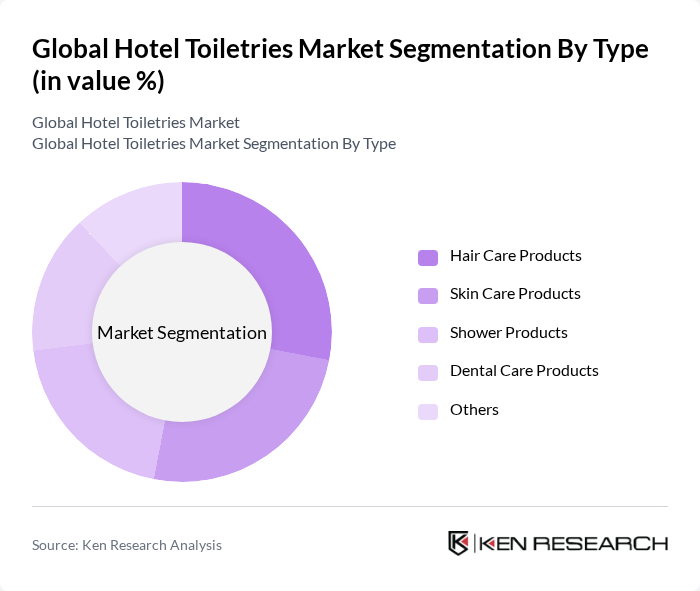
By Type:The market is segmented into various types of toiletries, including Hair Care Products, Skin Care Products, Shower Products, Dental Care Products, and Others. Each of these subsegments caters to different consumer needs and preferences, with specific products gaining popularity based on trends in personal care and hygiene. Hair Care Products account for 28% of the market, Skin Care Products represent 25%, Shower Products comprise 20%, Dental Products account for 15%, and Others represent 12%.
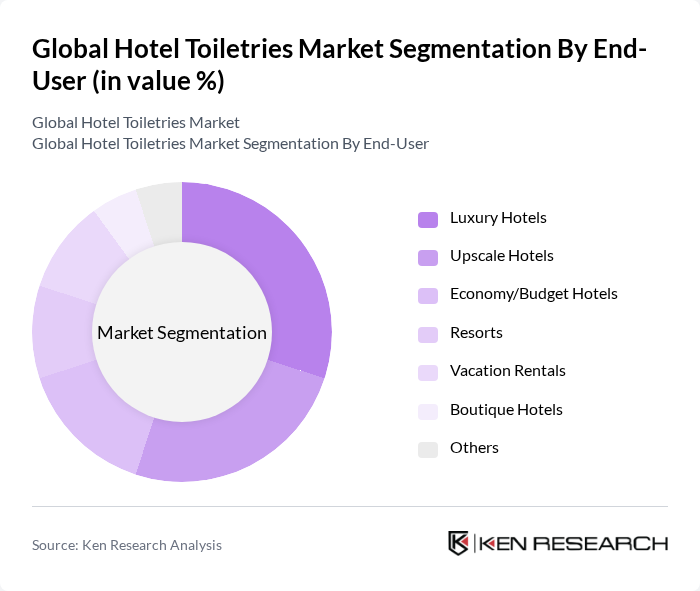
By End-User:The end-user segmentation includes Luxury Hotels, Upscale Hotels, Economy/Budget Hotels, Resorts, Vacation Rentals, Boutique Hotels, and Others. Each category reflects different market dynamics, with luxury and upscale hotels typically offering a wider range of premium toiletries to enhance guest experiences. The hotels segment is expected to contribute 37% share of the market, with increased focus on health and wellness during leisure travel.
Global Hotel Toiletries Market Competitive Landscape
The Global Hotel Toiletries Market is characterized by a dynamic mix of regional and international players. Leading participants such as Procter & Gamble, Unilever, Kimberly-Clark Corporation, Marriott International, Hilton Worldwide Holdings Inc., InterContinental Hotels Group PLC, Accor S.A., Four Seasons Hotels and Resorts, Best Western Hotels & Resorts, Radisson Hotel Group, Wyndham Hotels & Resorts, Shangri-La Hotels and Resorts, Mandarin Oriental Hotel Group, Choice Hotels International, Banyan Tree Holdings Limited, HD Fragrances, Hara Naturals contribute to innovation, geographic expansion, and service delivery in this space.
Global Hotel Toiletries Market Industry Analysis
Growth Drivers
- Increasing Demand for Eco-Friendly Products:The global market for eco-friendly toiletries is projected to reach $1.7 billion in future, driven by a 20% increase in consumer preference for sustainable products. This shift is supported by the World Bank's findings that 75% of consumers are willing to pay more for environmentally friendly options. As hotels adopt green practices, the demand for biodegradable and recyclable packaging is expected to rise significantly, enhancing the market's growth prospects.
- Rising Consumer Awareness Regarding Personal Hygiene:The COVID-19 pandemic has heightened awareness of personal hygiene, leading to a 35% increase in demand for hotel toiletries. According to the International Hotel Association, 85% of travelers now prioritize hygiene products in their accommodation choices. This trend is expected to continue, with hotels investing in high-quality, hygienic toiletries to meet consumer expectations, thereby driving market growth in the sector.
- Growth in the Hospitality Industry:The hospitality industry is projected to grow by $1.2 trillion in revenue in future, according to the IMF. This growth is fueled by a 15% increase in global travel, with international tourist arrivals expected to reach 2 billion. As hotels expand their services to accommodate more guests, the demand for toiletries will rise, creating significant opportunities for suppliers in the hotel toiletries market.
Market Challenges
- Intense Competition Among Key Players:The hotel toiletries market is characterized by fierce competition, with over 200 brands vying for market share. This saturation leads to price wars, reducing profit margins for manufacturers. According to industry reports, the top five companies hold only 30% of the market share, indicating a fragmented landscape where smaller players can disrupt pricing strategies, posing challenges for established brands.
- Fluctuating Raw Material Prices:The volatility in raw material prices, particularly for natural ingredients, poses a significant challenge. For instance, the price of essential oils has increased by 30% in the past year due to supply chain disruptions. This fluctuation can lead to increased production costs for toiletries, forcing manufacturers to either absorb costs or pass them onto consumers, which may affect demand negatively.
Global Hotel Toiletries Market Future Outlook
The future of the hotel toiletries market appears promising, driven by a growing emphasis on sustainability and hygiene. As consumer preferences shift towards eco-friendly and organic products, manufacturers are likely to innovate and adapt their offerings. Additionally, the rise of boutique hotels and personalized guest experiences will further influence product development. The integration of technology in distribution channels will streamline operations, enhancing efficiency and customer satisfaction in the coming years.
Market Opportunities
- Development of Organic and Natural Product Lines:There is a significant opportunity for brands to develop organic and natural toiletries, as consumer demand for chemical-free products is on the rise. The organic personal care market is expected to grow by $1.2 billion in future, indicating a lucrative segment for hotels to explore in their toiletries offerings.
- Expansion into Emerging Markets:Emerging markets, particularly in Asia and Africa, present substantial growth opportunities. With a projected increase in middle-class consumers by 1.8 billion in future, hotels in these regions are likely to invest in quality toiletries, creating a demand for innovative and affordable products tailored to local preferences.
Scope of the Report
| Segment | Sub-Segments |
|---|---|
| By Type | Shampoo & Conditioner Body Wash & Soap Lotion & Moisturizers Dental Care Products (Toothpaste, Mouthwash) Hand Soaps/Hand Wash Shaving Kits Feminine Hygiene Products Others |
| By End-User | Luxury Hotels Upscale Hotels Economy/Budget Hotels Resorts Vacation Rentals Boutique Hotels Others |
| By Distribution Channel | Direct Sales Online Retail Wholesale Specialty Stores Pharmacy & Drug Stores Supermarkets/Hypermarkets Others |
| By Packaging Type | Bottles Tubes Sachets Jars Dispensers Others |
| By Ingredient Type | Natural Ingredients Synthetic Ingredients Organic Ingredients Chemical-Free/Wellness Ingredients Others |
| By Price Range | Premium Mid-range Economy Others |
| By Region | North America Europe Asia-Pacific Latin America Middle East & Africa Others |
Key Target Audience
Investors and Venture Capitalist Firms
Government and Regulatory Bodies (e.g., Environmental Protection Agency, Food and Drug Administration)
Manufacturers and Producers
Distributors and Retailers
Hospitality Industry Associations
Health and Safety Regulatory Agencies (e.g., Occupational Safety and Health Administration)
Packaging Suppliers
Logistics and Supply Chain Management Firms
Players Mentioned in the Report:
Procter & Gamble
Unilever
Kimberly-Clark Corporation
Marriott International
Hilton Worldwide Holdings Inc.
InterContinental Hotels Group PLC
Accor S.A.
Four Seasons Hotels and Resorts
Best Western Hotels & Resorts
Radisson Hotel Group
Wyndham Hotels & Resorts
Shangri-La Hotels and Resorts
Mandarin Oriental Hotel Group
Choice Hotels International
Banyan Tree Holdings Limited
HD Fragrances
Hara Naturals
Table of Contents
Market Assessment Phase
1. Executive Summary and Approach
2. Global Hotel Toiletries Market Overview
2.1 Key Insights and Strategic Recommendations
2.2 Global Hotel Toiletries Market Overview
2.3 Definition and Scope
2.4 Evolution of Market Ecosystem
2.5 Timeline of Key Regulatory Milestones
2.6 Value Chain & Stakeholder Mapping
2.7 Business Cycle Analysis
2.8 Policy & Incentive Landscape
3. Global Hotel Toiletries Market Analysis
3.1 Growth Drivers
3.1.1 Increasing demand for eco-friendly products
3.1.2 Rising consumer awareness regarding personal hygiene
3.1.3 Growth in the hospitality industry
3.1.4 Expansion of travel and tourism sectors
3.2 Market Challenges
3.2.1 Intense competition among key players
3.2.2 Fluctuating raw material prices
3.2.3 Regulatory compliance issues
3.2.4 Changing consumer preferences
3.3 Market Opportunities
3.3.1 Development of organic and natural product lines
3.3.2 Expansion into emerging markets
3.3.3 Collaborations with boutique hotels
3.3.4 Customization of products for specific hotel brands
3.4 Market Trends
3.4.1 Shift towards sustainable packaging
3.4.2 Increasing use of technology in product distribution
3.4.3 Growth of private label products
3.4.4 Rising popularity of subscription-based services
3.5 Government Regulation
3.5.1 Regulations on chemical usage in toiletries
3.5.2 Standards for eco-labeling
3.5.3 Compliance with international safety standards
3.5.4 Guidelines for waste management in hospitality
4. SWOT Analysis
5. Stakeholder Analysis
6. Porter's Five Forces Analysis
7. Global Hotel Toiletries Market Market Size, 2019-2024
7.1 By Value
7.2 By Volume
7.3 By Average Selling Price
8. Global Hotel Toiletries Market Segmentation
8.1 By Type
8.1.1 Shampoo & Conditioner
8.1.2 Body Wash & Soap
8.1.3 Lotion & Moisturizers
8.1.4 Dental Care Products (Toothpaste, Mouthwash)
8.1.5 Hand Soaps/Hand Wash
8.1.6 Shaving Kits
8.1.7 Feminine Hygiene Products
8.1.8 Others
8.2 By End-User
8.2.1 Luxury Hotels
8.2.2 Upscale Hotels
8.2.3 Economy/Budget Hotels
8.2.4 Resorts
8.2.5 Vacation Rentals
8.2.6 Boutique Hotels
8.2.7 Others
8.3 By Distribution Channel
8.3.1 Direct Sales
8.3.2 Online Retail
8.3.3 Wholesale
8.3.4 Specialty Stores
8.3.5 Pharmacy & Drug Stores
8.3.6 Supermarkets/Hypermarkets
8.3.7 Others
8.4 By Packaging Type
8.4.1 Bottles
8.4.2 Tubes
8.4.3 Sachets
8.4.4 Jars
8.4.5 Dispensers
8.4.6 Others
8.5 By Ingredient Type
8.5.1 Natural Ingredients
8.5.2 Synthetic Ingredients
8.5.3 Organic Ingredients
8.5.4 Chemical-Free/Wellness Ingredients
8.5.5 Others
8.6 By Price Range
8.6.1 Premium
8.6.2 Mid-range
8.6.3 Economy
8.6.4 Others
8.7 By Region
8.7.1 North America
8.7.2 Europe
8.7.3 Asia-Pacific
8.7.4 Latin America
8.7.5 Middle East & Africa
8.7.6 Others
9. Global Hotel Toiletries Market Competitive Analysis
9.1 Market Share of Key Players
9.2 KPIs for Cross Comparison of Key Players
9.2.1 Company Name
9.2.2 Group Size (Large, Medium, Small)
9.2.3 Annual Revenue from Hotel Toiletries Segment
9.2.4 Revenue Growth Rate (YoY)
9.2.5 Market Share (%) in Hotel Toiletries
9.2.6 Geographic Coverage (Number of Countries/Regions Served)
9.2.7 Product Portfolio Breadth (Number of SKUs/Brands)
9.2.8 Sustainability Initiatives (Eco-friendly Product Ratio, Certifications)
9.2.9 Distribution Network Strength (Number of Hotel Partnerships)
9.2.10 Customer Satisfaction Score (Hotel Client NPS/Survey)
9.2.11 Innovation Index (New Product Launches per Year)
9.2.12 Pricing Strategy (Average Price per Unit/Segment)
9.2.13 Brand Recognition (Global/Regional Awards, Rankings)
9.3 SWOT Analysis of Top Players
9.4 Pricing Analysis
9.5 Detailed Profile of Major Companies
9.5.1 Procter & Gamble
9.5.2 Unilever
9.5.3 Kimberly-Clark Corporation
9.5.4 Marriott International
9.5.5 Hilton Worldwide Holdings Inc.
9.5.6 InterContinental Hotels Group PLC
9.5.7 Accor S.A.
9.5.8 Four Seasons Hotels and Resorts
9.5.9 Best Western Hotels & Resorts
9.5.10 Radisson Hotel Group
9.5.11 Wyndham Hotels & Resorts
9.5.12 Shangri-La Hotels and Resorts
9.5.13 Mandarin Oriental Hotel Group
9.5.14 Choice Hotels International
9.5.15 Banyan Tree Holdings Limited
9.5.16 HD Fragrances
9.5.17 Hara Naturals
10. Global Hotel Toiletries Market End-User Analysis
10.1 Procurement Behavior of Key Ministries
10.1.1 Government contracts for hotel supplies
10.1.2 Budget allocation for hospitality services
10.1.3 Compliance with sustainability initiatives
10.1.4 Evaluation criteria for supplier selection
10.2 Corporate Spend on Infrastructure & Energy
10.2.1 Investment in eco-friendly toiletries
10.2.2 Budgeting for guest amenities
10.2.3 Cost analysis of toiletries procurement
10.2.4 Trends in corporate spending
10.3 Pain Point Analysis by End-User Category
10.3.1 Quality vs. cost concerns
10.3.2 Supply chain disruptions
10.3.3 Demand for customization
10.3.4 Sustainability pressures
10.4 User Readiness for Adoption
10.4.1 Awareness of eco-friendly options
10.4.2 Willingness to pay for premium products
10.4.3 Feedback mechanisms for product improvement
10.4.4 Training for staff on new products
10.5 Post-Deployment ROI and Use Case Expansion
10.5.1 Measuring guest satisfaction
10.5.2 Analyzing repeat business
10.5.3 Cost savings from sustainable practices
10.5.4 Opportunities for upselling
11. Global Hotel Toiletries Market Future Size, 2025-2030
11.1 By Value
11.2 By Volume
11.3 By Average Selling Price
Go-To-Market Strategy Phase
1. Whitespace Analysis + Business Model Canvas
1.1 Market gaps and opportunities
1.2 Value proposition development
1.3 Revenue model exploration
1.4 Customer segmentation analysis
1.5 Key partnerships identification
1.6 Cost structure assessment
1.7 Channels for distribution
2. Marketing and Positioning Recommendations
2.1 Branding strategies
2.2 Product USPs
2.3 Target audience identification
2.4 Communication strategies
2.5 Digital marketing initiatives
2.6 Event sponsorship opportunities
2.7 Customer engagement tactics
3. Distribution Plan
3.1 Urban retail vs rural NGO tie-ups
3.2 E-commerce strategies
3.3 Partnerships with travel agencies
3.4 Logistics and supply chain management
3.5 Inventory management solutions
3.6 Distribution channel optimization
3.7 Performance metrics for distribution
4. Channel & Pricing Gaps
4.1 Underserved routes
4.2 Pricing bands
4.3 Competitor pricing analysis
4.4 Value-based pricing strategies
4.5 Discounts and promotions
4.6 Price elasticity assessment
4.7 Customer feedback on pricing
5. Unmet Demand & Latent Needs
5.1 Category gaps
5.2 Consumer segments
5.3 Emerging trends in consumer preferences
5.4 Product innovation opportunities
5.5 Market research insights
5.6 Customer pain points
5.7 Future demand forecasting
6. Customer Relationship
6.1 Loyalty programs
6.2 After-sales service
6.3 Customer feedback mechanisms
6.4 Engagement through social media
6.5 Personalization strategies
6.6 Community building initiatives
6.7 Customer education and support
7. Value Proposition
7.1 Sustainability
7.2 Integrated supply chains
7.3 Unique selling points
7.4 Customer-centric approach
7.5 Competitive advantages
7.6 Brand loyalty factors
7.7 Value-added services
8. Key Activities
8.1 Regulatory compliance
8.2 Branding
8.3 Distribution setup
8.4 Marketing campaigns
8.5 Product development
8.6 Training and development
8.7 Performance monitoring
9. Entry Strategy Evaluation
9.1 Domestic Market Entry Strategy
9.1.1 Product mix
9.1.2 Pricing band
9.1.3 Packaging
9.1.4 Marketing approach
9.1.5 Distribution channels
9.1.6 Customer engagement
9.1.7 Compliance considerations
9.2 Export Entry Strategy
9.2.1 Target countries
9.2.2 Compliance roadmap
9.2.3 Market entry barriers
9.2.4 Distribution partnerships
9.2.5 Marketing localization
9.2.6 Risk assessment
9.2.7 Financial projections
10. Entry Mode Assessment
10.1 JV
10.2 Greenfield
10.3 M&A
10.4 Distributor Model
10.5 Risk vs. control analysis
10.6 Strategic fit evaluation
10.7 Long-term sustainability considerations
11. Capital and Timeline Estimation
11.1 Capital requirements
11.2 Timelines
11.3 Funding sources
11.4 Financial modeling
11.5 Budget allocation
11.6 Milestone tracking
11.7 Risk management strategies
12. Control vs Risk Trade-Off
12.1 Ownership vs Partnerships
12.2 Risk assessment frameworks
12.3 Control mechanisms
12.4 Partnership evaluation criteria
12.5 Long-term strategy alignment
12.6 Exit strategies
Research Methodology
Phase 1: Approach1
Desk Research
- Industry reports from hospitality and personal care associations
- Market analysis from trade publications and journals focused on hotel amenities
- Government publications on tourism statistics and hotel occupancy rates
Primary Research
- Interviews with hotel management and procurement executives
- Surveys targeting suppliers of hotel toiletries and amenities
- Field visits to hotels to observe product usage and guest preferences
Validation & Triangulation
- Cross-validation of findings with industry expert opinions
- Triangulation of data from hotel chains, suppliers, and consumer feedback
- Sanity checks through comparison with historical market trends
Phase 2: Market Size Estimation1
Top-down Assessment
- Analysis of global hotel occupancy rates and average spend on toiletries
- Segmentation by hotel categories (luxury, mid-scale, budget) and regions
- Incorporation of trends in sustainability and eco-friendly products
Bottom-up Modeling
- Volume estimates based on the number of hotels and average toiletries provided per room
- Cost analysis of toiletries sourced from various suppliers
- Estimation of growth rates based on emerging markets and tourism recovery
Forecasting & Scenario Analysis
- Multi-variable regression analysis considering tourism growth and consumer preferences
- Scenario planning based on potential regulatory changes and sustainability trends
- Baseline, optimistic, and pessimistic forecasts through 2030
Phase 3: CATI Sample Composition1
| Scope Item/Segment | Sample Size | Target Respondent Profiles |
|---|---|---|
| Luxury Hotel Toiletries | 60 | General Managers, Procurement Managers |
| Mid-Scale Hotel Amenities | 50 | Operations Managers, Guest Experience Managers |
| Budget Hotel Supplies | 40 | Front Desk Managers, Supply Chain Managers |
| Eco-Friendly Toiletries | 40 | Sustainability Managers, Product Development Managers |
| Supplier Insights for Hotel Toiletries | 50 | Sales Managers, Product Managers |
Frequently Asked Questions
What is the current value of the Global Hotel Toiletries Market?
The Global Hotel Toiletries Market is valued at approximately USD 24 billion, reflecting significant growth driven by the demand for high-quality personal care products in the hospitality sector and the rising trend of eco-friendly and organic toiletries.
Which regions dominate the Global Hotel Toiletries Market?
What types of products are included in the hotel toiletries market?
What are the main drivers of growth in the hotel toiletries market?
Other Regional/Country Reports
Indonesia Hotel Toiletries Market
Malaysia Hotel Toiletries Market
KSA Hotel Toiletries Market
APAC Hotel Toiletries Market
SEA Hotel Toiletries Market
Vietnam Hotel Toiletries Market
Other Adjacent Reports
Indonesia Hospitality Amenities Market
Vietnam Personal Care Products Market Size Share Growth Drivers Trends Opportunities & Forecast 2025–2030KSA sustainable packaging market report Size, Share, Growth Drivers, Trends, Opportunities & Forecast 2025–2030Kuwait Organic Cosmetics Market
New Zealand Travel Retail Market Size, Share, Growth Drivers, Trends, Opportunities & Forecast 2025–2030Malaysia Hotel Supplies Market
Brazil Beauty and Wellness Market
South Korea Eco-Friendly Products Market
UAE Fragrance and Perfume MarketSingapore Hygiene and Sanitation Market
Why Buy From Us?

What makes us stand out is that our consultants follow Robust, Refine and Result (RRR) methodology. Robust for clear definitions, approaches and sanity checking, Refine for differentiating respondents' facts and opinions, and Result for presenting data with story.

We have set a benchmark in the industry by offering our clients with syndicated and customized market research reports featuring coverage of entire market as well as meticulous research and analyst insights.

While we don't replace traditional research, we flip the method upside down. Our dual approach of Top Bottom & Bottom Top ensures quality deliverable by not just verifying company fundamentals but also looking at the sector and macroeconomic factors.

With one step in the future, our research team constantly tries to show you the bigger picture. We help with some of the tough questions you may encounter along the way: How is the industry positioned? Best marketing channel? KPI's of competitors? By aligning every element, we help maximize success.

Our report gives you instant access to the answers and sources that other companies might choose to hide. We elaborate each steps of research methodology we have used and showcase you the sample size to earn your trust.

If you need any support, we are here! We pride ourselves on universe strength, data quality, and quick, friendly, and professional service.