About the Report
Base Year 2024Global OOH and DOOH Market Overview
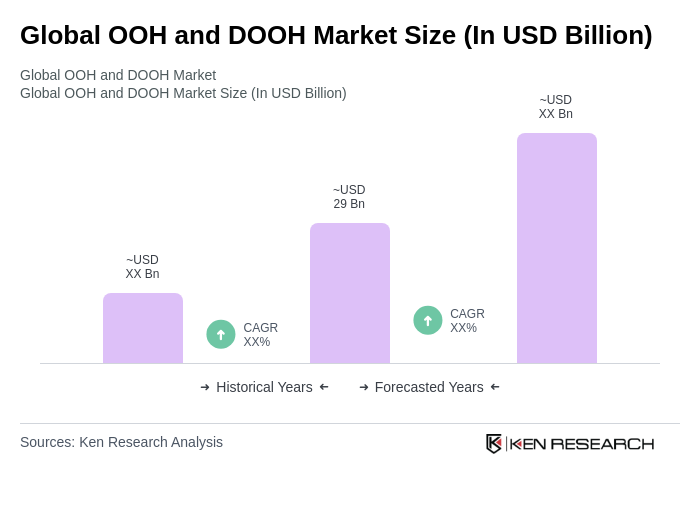
- The Global OOH and DOOH Market is valued at USD 29 billion, based on a five-year historical analysis. This growth is primarily driven by increasing urbanization, rapid adoption of digital technologies in advertising, and the rising demand for data-driven, targeted advertising solutions. The transition from traditional media to digital formats has significantly improved campaign effectiveness, with innovations such as programmatic buying, dynamic content delivery, and real-time audience analytics driving higher investments in both OOH and DOOH advertising .
- Key players in this market are concentrated in major cities such as New York, London, and Tokyo, which dominate due to their high population density, vibrant commercial activities, and advanced infrastructure. These cities act as global advertising hubs, attracting significant advertising budgets from brands seeking to reach diverse audiences in high-traffic urban environments .
- The U.S. government, through the “Transparency in Digital Advertising Act, 2024” issued by the Federal Trade Commission, established requirements for companies to disclose detailed data on ad placements and audience targeting. This regulation is designed to protect consumer privacy and ensure fair competition in the advertising sector, fostering greater trust among both consumers and advertisers. The Act mandates operational transparency, including disclosure of targeting criteria and data sources for digital ad campaigns .
Global OOH and DOOH Market Segmentation
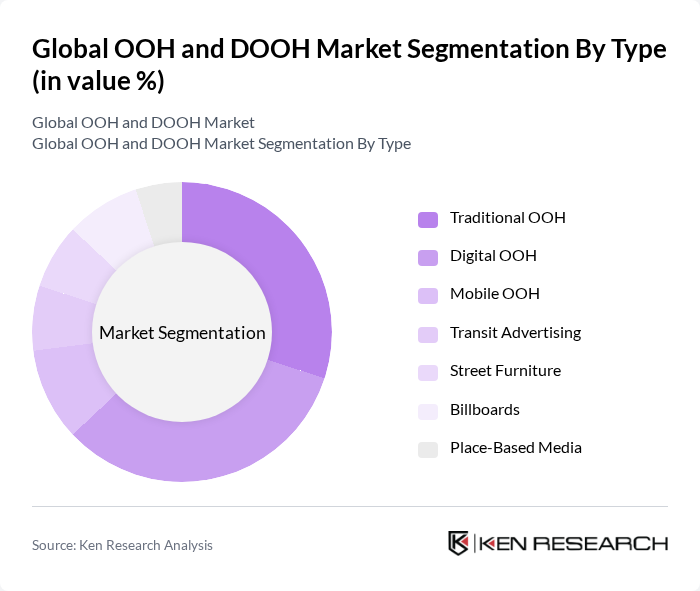
By Type:The market is segmented into Traditional OOH, Digital OOH, Mobile OOH, Transit Advertising, Street Furniture, Billboards, and Place-Based Media. Digital OOH is rapidly gaining traction due to its ability to deliver dynamic, interactive content and real-time updates, which appeals to advertisers aiming for higher engagement and precise targeting. Traditional OOH remains important, especially in regions with limited digital infrastructure, while Mobile OOH is increasingly popular for its flexibility and ability to reach consumers on the move .
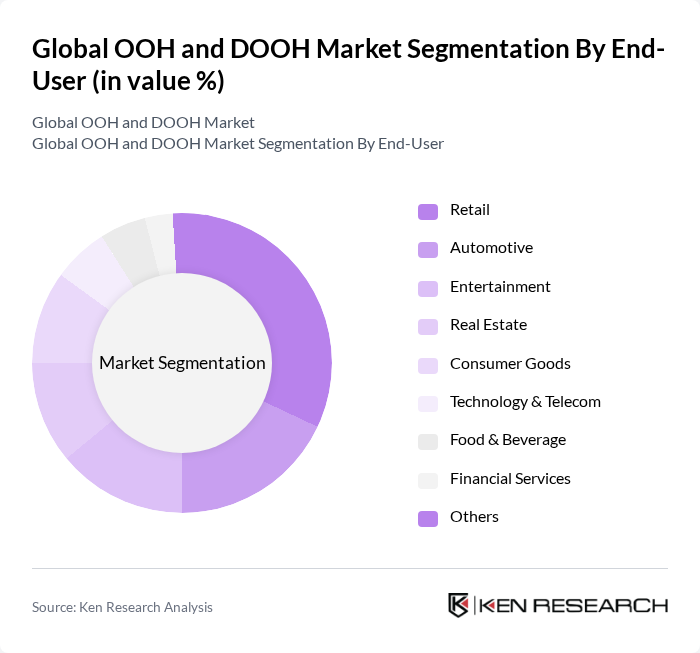
By End-User:The end-user segmentation includes Retail, Automotive, Entertainment, Real Estate, Consumer Goods, Technology & Telecom, Food & Beverage, Financial Services, and Others. Retail remains the leading segment, driven by the need for brands to attract foot traffic and enhance visibility in competitive markets. The Automotive sector also plays a significant role, leveraging OOH advertising to launch new models and highlight features, while Entertainment and Real Estate sectors utilize OOH to promote events and properties, respectively .
Global OOH and DOOH Market Competitive Landscape
The Global OOH and DOOH Market is characterized by a dynamic mix of regional and international players. Leading participants such as Clear Channel Outdoor Holdings, Inc., Lamar Advertising Company, OUTFRONT Media Inc., JCDecaux SA, Ströer SE & Co. KGaA, Global Outdoor Media Group, oOh!media Limited, APN Outdoor Group Limited, Intersection Holdings, LLC, Captivate Network, LLC, VGI Global Media Public Company Limited, Adspace Networks, Inc., Focus Media Holding Limited, Broadsign International, Inc., Adomni, Inc., Hype Loop, Talon Outdoor Ltd., BrandXR, Inc. contribute to innovation, geographic expansion, and service delivery in this space.
Global OOH and DOOH Market Industry Analysis
Growth Drivers
- Increasing Urbanization:Urbanization is a significant driver for the OOH and DOOH market, with the United Nations projecting that in future, approximately 56% of the global population will reside in urban areas, up from 55.3% in 2020. This shift leads to higher foot traffic in cities, creating more opportunities for outdoor advertising. In metropolitan areas, the average daily footfall can exceed 1 million in major cities, enhancing visibility for advertisers and increasing demand for OOH placements.
- Advancements in Digital Technology:The integration of advanced digital technologies is transforming the OOH landscape. In future, the global digital signage market is expected to reach $25 billion, driven by innovations in display technology and content management systems. This growth enables advertisers to deliver dynamic, engaging content that can be updated in real-time, enhancing audience engagement. The proliferation of high-definition screens in urban environments is expected to increase the effectiveness of advertising campaigns significantly.
- Enhanced Targeting Capabilities:The rise of data analytics and geolocation technologies is enabling more precise targeting in OOH advertising. In future, the global big data market is projected to reach $80 billion, allowing advertisers to analyze consumer behavior and optimize ad placements. This capability leads to more relevant advertising, increasing conversion rates. For instance, targeted campaigns can see engagement rates rise by up to 30%, making OOH a more attractive option for brands seeking measurable results.
Market Challenges
- Regulatory Restrictions:Regulatory challenges pose significant hurdles for the OOH and DOOH market. In many regions, strict zoning laws and advertising standards limit the placement and content of outdoor advertisements. For example, cities like San Francisco have implemented stringent regulations that restrict digital billboards, impacting the growth potential of DOOH. Compliance with these regulations can lead to increased operational costs, which may deter new entrants into the market.
- Competition from Digital Media:The OOH market faces intense competition from digital media platforms, which are increasingly capturing advertising budgets. In future, digital ad spending is expected to reach $400 billion globally, overshadowing traditional advertising channels. This shift is driven by the ability of digital media to offer targeted, measurable campaigns. As advertisers allocate more resources to online platforms, OOH may struggle to maintain its share of the advertising pie, necessitating innovation to stay relevant.
Global OOH and DOOH Market Future Outlook
The future of the OOH and DOOH market appears promising, driven by technological advancements and evolving consumer preferences. As urbanization continues, advertisers will increasingly leverage digital platforms to engage audiences effectively. The integration of AI and data analytics will enhance targeting capabilities, allowing for more personalized advertising experiences. Additionally, sustainability trends will push the industry towards eco-friendly practices, ensuring that OOH remains a vital component of the advertising ecosystem while adapting to changing market dynamics.
Market Opportunities
- Integration of AI and Big Data:The incorporation of AI and big data analytics presents a significant opportunity for the OOH market. By utilizing these technologies, advertisers can optimize campaigns in real-time, improving engagement rates. The expected growth of the AI market to $150 billion in future indicates a robust potential for enhancing advertising strategies through data-driven insights.
- Expansion into Emerging Markets:Emerging markets represent a substantial growth opportunity for the OOH sector. With urban populations in regions like Southeast Asia projected to grow by 20% in future, advertisers can tap into new audiences. This expansion can lead to increased demand for innovative advertising solutions, driving revenue growth and market penetration in previously underserved areas.
Scope of the Report
| Segment | Sub-Segments |
|---|---|
| By Type | Traditional OOH Digital OOH Mobile OOH Transit Advertising Street Furniture Billboards Place-Based Media |
| By End-User | Retail Automotive Entertainment Real Estate Consumer Goods Technology & Telecom Food & Beverage Financial Services Others |
| By Format | Static Displays Digital Screens Interactive Displays Video Walls Programmatic DOOH Others |
| By Location | Urban Areas Suburban Areas Rural Areas High Traffic Zones Transit Hubs Retail Environments Others |
| By Advertising Medium | Billboards Posters Digital Displays Transit Ads Street Furniture Place-Based Screens Others |
| By Duration of Campaign | Short-Term Campaigns Long-Term Campaigns Seasonal Campaigns Event-Based Campaigns Others |
| By Pricing Model | Cost Per Impression (CPI) Cost Per Click (CPC) Flat Rate Pricing Auction-Based Pricing Programmatic Bidding Others |
Key Target Audience
Investors and Venture Capitalist Firms
Government and Regulatory Bodies (e.g., Federal Communications Commission, Department of Transportation)
Advertising Agencies
Media Buyers and Planners
Outdoor Advertising Companies
Digital Signage Manufacturers
Real Estate Developers
Telecommunications Providers
Players Mentioned in the Report:
Clear Channel Outdoor Holdings, Inc.
Lamar Advertising Company
OUTFRONT Media Inc.
JCDecaux SA
Stroer SE & Co. KGaA
Global Outdoor Media Group
oOh!media Limited
APN Outdoor Group Limited
Intersection Holdings, LLC
Captivate Network, LLC
VGI Global Media Public Company Limited
Adspace Networks, Inc.
Focus Media Holding Limited
Broadsign International, Inc.
Adomni, Inc.
Hype Loop
Talon Outdoor Ltd.
BrandXR, Inc.
Table of Contents
Market Assessment Phase
1. Executive Summary and Approach
2. Global OOH and DOOH Market Overview
2.1 Key Insights and Strategic Recommendations
2.2 Global OOH and DOOH Market Overview
2.3 Definition and Scope
2.4 Evolution of Market Ecosystem
2.5 Timeline of Key Regulatory Milestones
2.6 Value Chain & Stakeholder Mapping
2.7 Business Cycle Analysis
2.8 Policy & Incentive Landscape
3. Global OOH and DOOH Market Analysis
3.1 Growth Drivers
3.1.1 Increasing Urbanization
3.1.2 Advancements in Digital Technology
3.1.3 Enhanced Targeting Capabilities
3.1.4 Growing Demand for Real-Time Advertising
3.2 Market Challenges
3.2.1 Regulatory Restrictions
3.2.2 Competition from Digital Media
3.2.3 Measurement and Analytics Limitations
3.2.4 High Initial Investment Costs
3.3 Market Opportunities
3.3.1 Integration of AI and Big Data
3.3.2 Expansion into Emerging Markets
3.3.3 Growth of Programmatic Advertising
3.3.4 Partnerships with Tech Companies
3.4 Market Trends
3.4.1 Shift Towards DOOH Advertising
3.4.2 Increased Focus on Sustainability
3.4.3 Rise of Interactive Advertising
3.4.4 Use of Augmented Reality in Campaigns
3.5 Government Regulation
3.5.1 Advertising Standards and Guidelines
3.5.2 Zoning Laws for Outdoor Advertising
3.5.3 Environmental Regulations
3.5.4 Data Privacy Laws Impacting Targeting
4. SWOT Analysis
5. Stakeholder Analysis
6. Porter's Five Forces Analysis
7. Global OOH and DOOH Market Market Size, 2019-2024
7.1 By Value
7.2 By Volume
7.3 By Average Selling Price
8. Global OOH and DOOH Market Segmentation
8.1 By Type
8.1.1 Traditional OOH
8.1.2 Digital OOH
8.1.3 Mobile OOH
8.1.4 Transit Advertising
8.1.5 Street Furniture
8.1.6 Billboards
8.1.7 Place-Based Media
8.2 By End-User
8.2.1 Retail
8.2.2 Automotive
8.2.3 Entertainment
8.2.4 Real Estate
8.2.5 Consumer Goods
8.2.6 Technology & Telecom
8.2.7 Food & Beverage
8.2.8 Financial Services
8.2.9 Others
8.3 By Format
8.3.1 Static Displays
8.3.2 Digital Screens
8.3.3 Interactive Displays
8.3.4 Video Walls
8.3.5 Programmatic DOOH
8.3.6 Others
8.4 By Location
8.4.1 Urban Areas
8.4.2 Suburban Areas
8.4.3 Rural Areas
8.4.4 High Traffic Zones
8.4.5 Transit Hubs
8.4.6 Retail Environments
8.4.7 Others
8.5 By Advertising Medium
8.5.1 Billboards
8.5.2 Posters
8.5.3 Digital Displays
8.5.4 Transit Ads
8.5.5 Street Furniture
8.5.6 Place-Based Screens
8.5.7 Others
8.6 By Duration of Campaign
8.6.1 Short-Term Campaigns
8.6.2 Long-Term Campaigns
8.6.3 Seasonal Campaigns
8.6.4 Event-Based Campaigns
8.6.5 Others
8.7 By Pricing Model
8.7.1 Cost Per Impression (CPI)
8.7.2 Cost Per Click (CPC)
8.7.3 Flat Rate Pricing
8.7.4 Auction-Based Pricing
8.7.5 Programmatic Bidding
8.7.6 Others
9. Global OOH and DOOH Market Competitive Analysis
9.1 Market Share of Key Players(Micro, Small, Medium, Large Enterprises)
9.2 Cross Comparison of Key Players
9.2.1 Company Name
9.2.2 Group Size (Large, Medium, or Small as per industry convention)
9.2.3 Revenue Growth Rate (YoY %)
9.2.4 Market Penetration Rate (Global/Regional Reach)
9.2.5 Customer Retention Rate (%)
9.2.6 Pricing Strategy (CPM, Programmatic, Fixed)
9.2.7 Digital Inventory Utilization (%)
9.2.8 Campaign Effectiveness Metrics (Impressions, Engagement Rate, ROI)
9.2.9 Brand Recognition Score (Survey/Index)
9.2.10 Customer Satisfaction Index (NPS or Equivalent)
9.2.11 Share of DOOH vs Traditional OOH Revenue
9.2.12 Technology Adoption Level (AI, Programmatic, Data Analytics)
9.3 SWOT Analysis of Top Players
9.4 Pricing Analysis(By Class and Payload)
9.5 Detailed Profile of Major Companies
9.5.1 Clear Channel Outdoor Holdings, Inc.
9.5.2 Lamar Advertising Company
9.5.3 OUTFRONT Media Inc.
9.5.4 JCDecaux SA
9.5.5 Ströer SE & Co. KGaA
9.5.6 Global Outdoor Media Group
9.5.7 oOh!media Limited
9.5.8 APN Outdoor Group Limited
9.5.9 Intersection Holdings, LLC
9.5.10 Captivate Network, LLC
9.5.11 VGI Global Media Public Company Limited
9.5.12 Adspace Networks, Inc.
9.5.13 Focus Media Holding Limited
9.5.14 Broadsign International, Inc.
9.5.15 Adomni, Inc.
9.5.16 Hype Loop
9.5.17 Talon Outdoor Ltd.
9.5.18 BrandXR, Inc.
10. Global OOH and DOOH Market End-User Analysis
10.1 Procurement Behavior of Key Ministries
10.1.1 Budget Allocation Trends
10.1.2 Decision-Making Processes
10.1.3 Preferred Advertising Channels
10.1.4 Evaluation Criteria for Vendors
10.2 Corporate Spend on Infrastructure & Energy
10.2.1 Investment Priorities
10.2.2 Budgeting Cycles
10.2.3 Spending Patterns by Sector
10.3 Pain Point Analysis by End-User Category
10.3.1 Budget Constraints
10.3.2 Measurement Challenges
10.3.3 Regulatory Compliance Issues
10.4 User Readiness for Adoption
10.4.1 Technology Adoption Rates
10.4.2 Training and Support Needs
10.5 Post-Deployment ROI and Use Case Expansion
10.5.1 ROI Measurement Techniques
10.5.2 Case Studies of Successful Deployments
10.5.3 Future Use Case Opportunities
11. Global OOH and DOOH Market Future Size, 2025-2030
11.1 By Value
11.2 By Volume
11.3 By Average Selling Price
Go-To-Market Strategy Phase
1. Whitespace Analysis + Business Model Canvas
1.1 Market Gaps Identification
1.2 Value Proposition Development
1.3 Revenue Streams Analysis
1.4 Cost Structure Evaluation
1.5 Key Partnerships Exploration
1.6 Customer Segments Definition
1.7 Channels Strategy
2. Marketing and Positioning Recommendations
2.1 Branding Strategies
2.2 Product USPs
2.3 Target Audience Identification
2.4 Communication Strategies
2.5 Digital Marketing Approaches
3. Distribution Plan
3.1 Urban Retail Strategies
3.2 Rural NGO Tie-Ups
3.3 Online vs Offline Distribution
3.4 Partnership Opportunities
4. Channel & Pricing Gaps
4.1 Underserved Routes
4.2 Pricing Bands Analysis
4.3 Competitor Pricing Strategies
5. Unmet Demand & Latent Needs
5.1 Category Gaps Identification
5.2 Consumer Segments Analysis
5.3 Emerging Trends Exploration
6. Customer Relationship
6.1 Loyalty Programs Development
6.2 After-Sales Service Strategies
6.3 Customer Feedback Mechanisms
7. Value Proposition
7.1 Sustainability Initiatives
7.2 Integrated Supply Chains
7.3 Unique Selling Points
8. Key Activities
8.1 Regulatory Compliance
8.2 Branding Initiatives
8.3 Distribution Setup
9. Entry Strategy Evaluation
9.1 Domestic Market Entry Strategy
9.1.1 Product Mix Considerations
9.1.2 Pricing Band Strategy
9.1.3 Packaging Options
9.2 Export Entry Strategy
9.2.1 Target Countries Analysis
9.2.2 Compliance Roadmap Development
10. Entry Mode Assessment
10.1 Joint Ventures
10.2 Greenfield Investments
10.3 Mergers & Acquisitions
10.4 Distributor Model Evaluation
11. Capital and Timeline Estimation
11.1 Capital Requirements Analysis
11.2 Timelines for Implementation
12. Control vs Risk Trade-Off
12.1 Ownership vs Partnerships
12.2 Risk Management Strategies
13. Profitability Outlook
13.1 Breakeven Analysis
13.2 Long-Term Sustainability Strategies
14. Potential Partner List
14.1 Distributors Identification
14.2 Joint Ventures Opportunities
14.3 Acquisition Targets
15. Execution Roadmap
15.1 Phased Plan for Market Entry
15.1.1 Market Setup
15.1.2 Market Entry
15.1.3 Growth Acceleration
15.1.4 Scale & Stabilize
15.2 Key Activities and Milestones
15.2.1 Milestone Planning
15.2.2 Activity Tracking
Research Methodology
Phase 1: Approach1
Desk Research
- Industry reports from global advertising associations and market research firms
- Analysis of digital advertising trends from platforms like Google and Facebook
- Review of government publications on urban infrastructure and advertising regulations
Primary Research
- Interviews with media buyers and planners in major advertising agencies
- Surveys with OOH media owners and digital signage providers
- Field interviews with brand managers from key sectors utilizing OOH advertising
Validation & Triangulation
- Cross-validation of data through multiple industry reports and market insights
- Triangulation of findings from primary interviews and secondary data sources
- Sanity checks conducted through expert panel discussions and feedback sessions
Phase 2: Market Size Estimation1
Top-down Assessment
- Analysis of global advertising spend trends with a focus on OOH and DOOH segments
- Segmentation of market size by geographic regions and advertising formats
- Incorporation of macroeconomic indicators influencing advertising budgets
Bottom-up Modeling
- Data collection from leading OOH media companies on revenue and inventory
- Estimation of average revenue per display unit across various formats
- Volume x pricing analysis based on historical performance and growth rates
Forecasting & Scenario Analysis
- Multi-variable regression analysis incorporating digital adoption rates and urbanization
- Scenario modeling based on technological advancements and consumer behavior shifts
- Development of baseline, optimistic, and pessimistic forecasts through 2030
Phase 3: CATI Sample Composition1
| Scope Item/Segment | Sample Size | Target Respondent Profiles |
|---|---|---|
| Urban OOH Advertising Strategies | 120 | Media Buyers, Advertising Executives |
| Digital Signage Implementation | 90 | IT Managers, Digital Marketing Specialists |
| Brand Engagement through DOOH | 60 | Brand Managers, Marketing Directors |
| Regulatory Impact on OOH Advertising | 50 | Compliance Officers, Legal Advisors |
| Consumer Perception of OOH Ads | 70 | Market Researchers, Consumer Insights Analysts |
Frequently Asked Questions
What is the current value of the Global OOH and DOOH Market?
The Global OOH and DOOH Market is valued at approximately USD 29 billion, reflecting a significant growth trend driven by urbanization, digital technology adoption, and the demand for targeted advertising solutions.
What factors are driving the growth of the OOH and DOOH market?
What are the main segments of the OOH and DOOH market?
Who are the key players in the Global OOH and DOOH Market?
Other Regional/Country Reports
Indonesia OOH and DOOH Market
Malaysia OOH and DOOH Market
APAC OOH and DOOH Market
Other Adjacent Reports
South Africa Location-Based Advertising Market
Indonesia Advertising Technology Market
Thailand Retail Media Market
UAE Location Targeted Mobile Advertising MarketEgypt Big Data Analytics Market
Philippines Content Management Systems Market
Saudi Arabia Smart City Infrastructure MarketBelgium Transit Advertising Market
Why Buy From Us?

What makes us stand out is that our consultants follow Robust, Refine and Result (RRR) methodology. Robust for clear definitions, approaches and sanity checking, Refine for differentiating respondents' facts and opinions, and Result for presenting data with story.

We have set a benchmark in the industry by offering our clients with syndicated and customized market research reports featuring coverage of entire market as well as meticulous research and analyst insights.

While we don't replace traditional research, we flip the method upside down. Our dual approach of Top Bottom & Bottom Top ensures quality deliverable by not just verifying company fundamentals but also looking at the sector and macroeconomic factors.

With one step in the future, our research team constantly tries to show you the bigger picture. We help with some of the tough questions you may encounter along the way: How is the industry positioned? Best marketing channel? KPI's of competitors? By aligning every element, we help maximize success.

Our report gives you instant access to the answers and sources that other companies might choose to hide. We elaborate each steps of research methodology we have used and showcase you the sample size to earn your trust.

If you need any support, we are here! We pride ourselves on universe strength, data quality, and quick, friendly, and professional service.