About the Report
Base Year 2024Listen to the audio summary
Japan Ooh And Dooh Market Overview
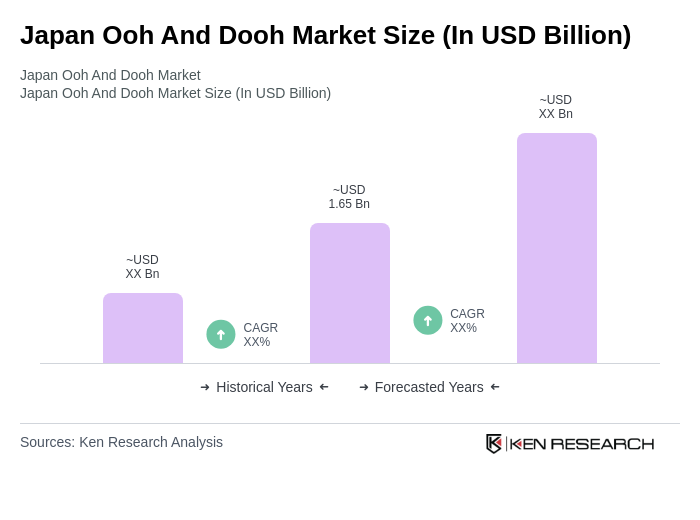
- The Japan OOH and DOOH market is valued at USD 1.65 billion, based on a five-year historical analysis. This level is consistent with recent industry reporting that places Japan’s OOH market around the mid–USD 1.6 billion range, with DOOH accounting for a substantial and rising share within overall OOH spend .
- Tokyo, Osaka, and Yokohama are the dominant cities in the Japan OOH and DOOH market due to high urban density and commuter flows concentrated around extensive rail and metro networks, which underpin OOH reach and dwell time in stations and on transit corridors .
- In 2023, the Japanese government advanced measures to enhance transparency and accountability in digital advertising, with market practice increasingly aligning to stricter privacy-by-design standards and consent management across programmatic DOOH. Industry adoption of impression-based trading through telecom-verified data exchanges (e.g., initiatives led by NTT DOCOMO–affiliated platforms) has reinforced compliance-minded audience measurement and reporting .
Japan Ooh And Dooh Market Segmentation
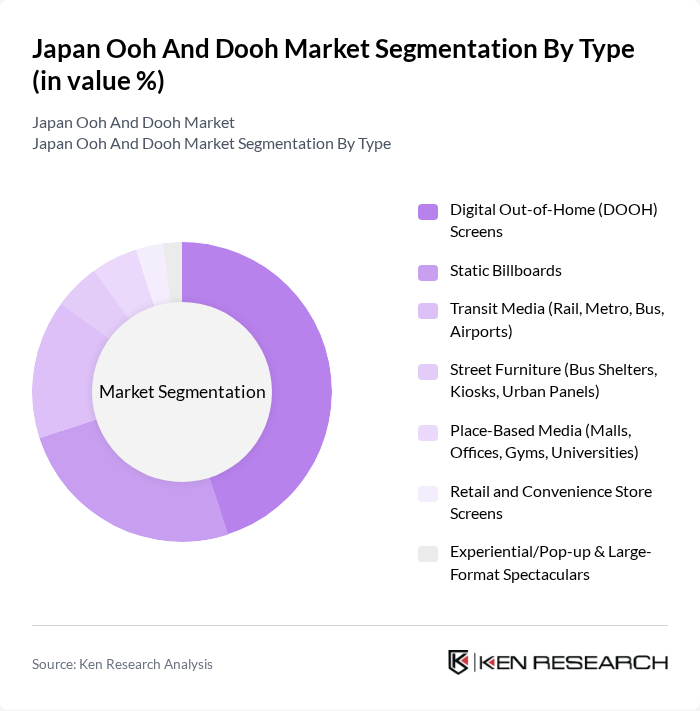
By Type:The market is segmented into various types, including Digital Out-of-Home (DOOH) screens, static billboards, transit media, street furniture, place-based media, retail and convenience store screens, and experiential/pop-up & large-format spectaculars. Among these, Digital Out-of-Home (DOOH) screens are leading the market due to their ability to deliver dynamic content and real-time updates and the rapid uptake of programmatic DOOH buying, including impression-based trading and audience verification that improve accountability and campaign optimization ; .
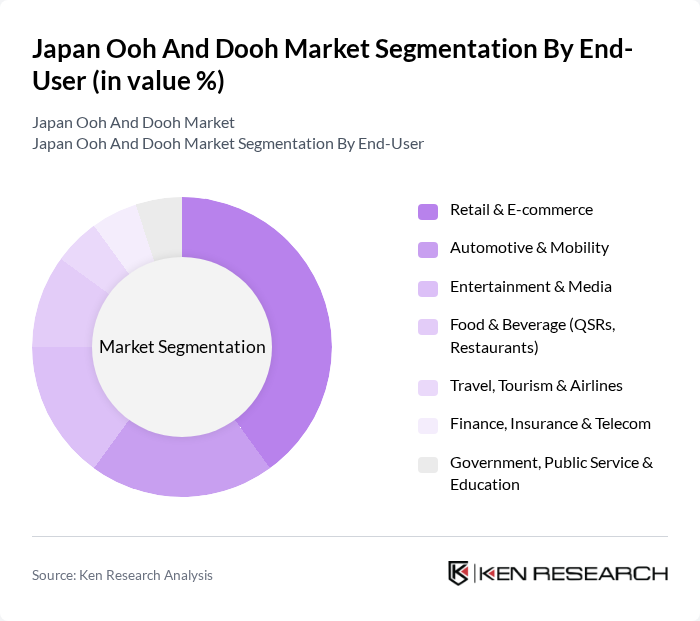
By End-User:The end-user segmentation includes retail & e-commerce, automotive & mobility, entertainment & media, food & beverage, travel, tourism & airlines, finance, insurance & telecom, and government, public service & education. The retail & e-commerce sector is the most significant contributor to the market, supported by omnichannel strategies that tie OOH to mobile and loyalty apps, location-based analytics, and attribution—tactics increasingly adopted across Japan’s high-traffic retail and transit environments .
Japan Ooh And Dooh Market Competitive Landscape
The Japan OOH and DOOH market is characterized by a dynamic mix of regional and international players. Leading participants such as Dentsu Inc., Hakuhodo DY Holdings Inc., ADK Holdings Inc. (Asatsu-DK), JR East Marketing & Communications, Inc. (jeki), Tokyo Metro Advertising, Inc., Osaka Metro Advertising, Inc., JR West Japan Marketing Communications, Inc., JR Central Marketing, Inc., qury Japan Co., Ltd. (formerly LIVE BOARD Inc.), Piala Digital Out-of-Home, Inc., VGI CJR Corporation, JR East Development Initiative Co., Ltd. (LUMINE/eki ad assets), Asatsu-DK Marketing Solutions Inc., Yahoo Japan Corporation (LY Corporation), TBWA\HAKUHODO contribute to innovation, geographic expansion, and service delivery in this space ; .
Japan Ooh And Dooh Market Industry Analysis
Growth Drivers
- Increasing Urbanization:Japan's urban population is projected to reach approximately 92% in future, according to the World Bank. This urbanization trend drives demand for Out-of-Home (OOH) and Digital Out-of-Home (DOOH) advertising, as advertisers seek to capture the attention of consumers in densely populated areas. The concentration of people in urban centers creates a prime environment for outdoor advertising, leading to increased visibility and engagement for brands targeting urban dwellers.
- Technological Advancements in Digital Advertising:The digital advertising sector in Japan is expected to grow significantly, with investments in digital signage projected to reach ¥1.2 trillion in future. This growth is fueled by advancements in technology, such as high-definition displays and real-time data analytics, which enhance the effectiveness of DOOH campaigns. Advertisers are increasingly leveraging these technologies to create dynamic, engaging content that resonates with consumers, thereby driving market growth.
- Rising Demand for Targeted Advertising:The demand for targeted advertising in Japan is on the rise, with the market for data-driven marketing expected to exceed ¥800 billion in future. Advertisers are increasingly utilizing consumer data to tailor their messages, ensuring that they reach the right audience at the right time. This trend is particularly evident in the OOH sector, where digital platforms allow for real-time adjustments based on audience demographics and behaviors, enhancing campaign effectiveness.
Market Challenges
- High Competition Among Advertisers:The Japanese OOH and DOOH market is characterized by intense competition, with over 1,500 registered advertising companies vying for market share. This saturation leads to increased pressure on pricing and innovation, making it challenging for new entrants to establish a foothold. As established players invest heavily in technology and creative solutions, smaller companies may struggle to compete effectively, impacting overall market dynamics.
- Regulatory Restrictions on Outdoor Advertising:Japan's regulatory environment poses significant challenges for outdoor advertising, with strict zoning laws and advertising standards enforced by local governments. For instance, Tokyo's regulations limit the size and brightness of digital displays, impacting visibility and effectiveness. These restrictions can hinder the growth of the OOH market, as advertisers must navigate complex compliance requirements while trying to maximize their advertising impact.
Japan Ooh And Dooh Market Future Outlook
The future of the Japan OOH and DOOH market appears promising, driven by technological innovations and evolving consumer behaviors. As urbanization continues, advertisers will increasingly leverage data analytics and programmatic advertising to enhance targeting and engagement. Additionally, the integration of augmented reality and interactive content is expected to redefine consumer experiences, making advertising more immersive. These trends indicate a shift towards more personalized and engaging advertising strategies, positioning the market for sustained growth in the coming years.
Market Opportunities
- Expansion of Smart City Initiatives:With Japan investing over ¥1 trillion in smart city projects in future, there is a significant opportunity for OOH and DOOH advertisers to integrate their campaigns into these urban developments. Smart city initiatives will enhance connectivity and data collection, allowing for more targeted and effective advertising strategies that resonate with tech-savvy consumers.
- Increased Investment in Sustainable Advertising Solutions:As sustainability becomes a priority, the Japanese advertising market is expected to see a shift towards eco-friendly advertising solutions. With over ¥300 billion projected for sustainable advertising initiatives in future, companies that adopt green practices in their OOH and DOOH campaigns will likely attract environmentally conscious consumers, enhancing brand loyalty and market share.
Scope of the Report
| Segment | Sub-Segments |
|---|---|
| By Type | Digital Out-of-Home (DOOH) Screens Static Billboards Transit Media (Rail, Metro, Bus, Airports) Street Furniture (Bus Shelters, Kiosks, Urban Panels) Place-Based Media (Malls, Offices, Gyms, Universities) Retail and Convenience Store Screens Experiential/Pop-up & Large-Format Spectaculars |
| By End-User | Retail & E-commerce Automotive & Mobility Entertainment & Media Food & Beverage (QSRs, Restaurants) Travel, Tourism & Airlines Finance, Insurance & Telecom Government, Public Service & Education |
| By Application | Brand Awareness & Equity-Building Product Launches & Promotions Event & Venue-Based Campaigns Hyperlocal & Contextual Targeting Performance/Attribution-Linked DOOH |
| By Sales Channel | Direct Sales (Media Owners) Programmatic DOOH (pDOOH) Media Agencies & Trading Desks Ad Networks & SSPs |
| By Distribution Mode | Metropolitan Hubs (Kanto, Kansai, Chubu) Secondary Cities (Tohoku, Chugoku, Hokkaido, Shikoku) Transport Hubs (Stations, Airports, Expressways) Neighborhood & Local Zones |
| By Price Range | Premium (Iconic, High-Impact Inventory) Standard Value/Budget Performance-Based/Programmatic Buys |
| By Policy Support | Municipal Permitting & Zoning Approvals Data Privacy & Consent Compliance Energy Efficiency & Sustainability Standards Public-Private Partnership (PPP) Frameworks |
Key Target Audience
Investors and Venture Capitalist Firms
Government and Regulatory Bodies (e.g., Ministry of Internal Affairs and Communications, Japan Advertising Association)
Advertising Agencies
Media Owners and Operators
Outdoor Advertising Companies
Technology Providers (e.g., Digital Signage Solutions)
Real Estate Developers
Marketing and Brand Managers
Players Mentioned in the Report:
Dentsu Inc.
Hakuhodo DY Holdings Inc.
ADK Holdings Inc. (Asatsu-DK)
JR East Marketing & Communications, Inc. (jeki)
Tokyo Metro Advertising, Inc.
Osaka Metro Advertising, Inc.
JR West Japan Marketing Communications, Inc.
JR Central Marketing, Inc.
qury Japan Co., Ltd. (formerly LIVE BOARD Inc.)
Piala Digital Out-of-Home, Inc.
VGI CJR Corporation
JR East Development Initiative Co., Ltd. (LUMINE/eki ad assets)
Asatsu-DK Marketing Solutions Inc.
Yahoo Japan Corporation (LY Corporation)
TBWA\HAKUHODO
Table of Contents
Market Assessment Phase
1. Executive Summary and Approach
2. Japan Ooh And Dooh Market Overview
2.1 Key Insights and Strategic Recommendations
2.2 Japan Ooh And Dooh Market Overview
2.3 Definition and Scope
2.4 Evolution of Market Ecosystem
2.5 Timeline of Key Regulatory Milestones
2.6 Value Chain & Stakeholder Mapping
2.7 Business Cycle Analysis
2.8 Policy & Incentive Landscape
3. Japan Ooh And Dooh Market Analysis
3.1 Growth Drivers
3.1.1 Increasing Urbanization
3.1.2 Technological Advancements in Digital Advertising
3.1.3 Rising Demand for Targeted Advertising
3.1.4 Growth of E-commerce and Online Retail
3.2 Market Challenges
3.2.1 High Competition Among Advertisers
3.2.2 Regulatory Restrictions on Outdoor Advertising
3.2.3 Changing Consumer Preferences
3.2.4 Economic Uncertainty Affecting Advertising Budgets
3.3 Market Opportunities
3.3.1 Expansion of Smart City Initiatives
3.3.2 Integration of Augmented Reality in Advertising
3.3.3 Collaborations with Local Businesses
3.3.4 Increased Investment in Sustainable Advertising Solutions
3.4 Market Trends
3.4.1 Shift Towards Programmatic Advertising
3.4.2 Growth of Interactive and Engaging Content
3.4.3 Emphasis on Data-Driven Marketing Strategies
3.4.4 Rise of Mobile Integration in OOH Advertising
3.5 Government Regulation
3.5.1 Advertising Standards and Guidelines
3.5.2 Zoning Laws Affecting Outdoor Advertising
3.5.3 Environmental Regulations on Digital Displays
3.5.4 Data Privacy Regulations Impacting Targeted Advertising
4. SWOT Analysis
5. Stakeholder Analysis
6. Porter's Five Forces Analysis
7. Japan Ooh And Dooh Market Market Size, 2019-2024
7.1 By Value
7.2 By Volume
7.3 By Average Selling Price
8. Japan Ooh And Dooh Market Segmentation
8.1 By Type
8.1.1 Digital Out-of-Home (DOOH) Screens
8.1.2 Static Billboards
8.1.3 Transit Media (Rail, Metro, Bus, Airports)
8.1.4 Street Furniture (Bus Shelters, Kiosks, Urban Panels)
8.1.5 Place-Based Media (Malls, Offices, Gyms, Universities)
8.1.6 Retail and Convenience Store Screens
8.1.7 Experiential/Pop-up & Large-Format Spectaculars
8.2 By End-User
8.2.1 Retail & E-commerce
8.2.2 Automotive & Mobility
8.2.3 Entertainment & Media
8.2.4 Food & Beverage (QSRs, Restaurants)
8.2.5 Travel, Tourism & Airlines
8.2.6 Finance, Insurance & Telecom
8.2.7 Government, Public Service & Education
8.3 By Application
8.3.1 Brand Awareness & Equity-Building
8.3.2 Product Launches & Promotions
8.3.3 Event & Venue-Based Campaigns
8.3.4 Hyperlocal & Contextual Targeting
8.3.5 Performance/Attribution-Linked DOOH
8.4 By Sales Channel
8.4.1 Direct Sales (Media Owners)
8.4.2 Programmatic DOOH (pDOOH)
8.4.3 Media Agencies & Trading Desks
8.4.4 Ad Networks & SSPs
8.5 By Distribution Mode
8.5.1 Metropolitan Hubs (Kanto, Kansai, Chubu)
8.5.2 Secondary Cities (Tohoku, Chugoku, Hokkaido, Shikoku)
8.5.3 Transport Hubs (Stations, Airports, Expressways)
8.5.4 Neighborhood & Local Zones
8.6 By Price Range
8.6.1 Premium (Iconic, High-Impact Inventory)
8.6.2 Standard
8.6.3 Value/Budget
8.6.4 Performance-Based/Programmatic Buys
8.7 By Policy Support
8.7.1 Municipal Permitting & Zoning Approvals
8.7.2 Data Privacy & Consent Compliance
8.7.3 Energy Efficiency & Sustainability Standards
8.7.4 Public-Private Partnership (PPP) Frameworks
9. Japan Ooh And Dooh Market Competitive Analysis
9.1 Market Share of Key Players
9.2 Cross Comparison of Key Players
9.2.1 Company Name
9.2.2 Inventory Scale (faces/screens; metro/transport coverage)
9.2.3 Revenue Growth Rate (YoY)
9.2.4 Sell-through Rate & Occupancy
9.2.5 Market Penetration (regions, venues, transport lines)
9.2.6 Renewal/Retention Rate of Advertisers
9.2.7 Average CPM/CPT & Yield Management
9.2.8 Programmatic Share of DOOH Revenue
9.2.9 Audience Measurement Coverage (impressions; JAAA/JR data)
9.2.10 Attribution/ROAS Enabled Campaigns
9.3 SWOT Analysis of Top Players
9.4 Pricing Analysis
9.5 Detailed Profile of Major Companies
9.5.1 Dentsu Inc.
9.5.2 Hakuhodo DY Holdings Inc.
9.5.3 ADK Holdings Inc. (Asatsu-DK)
9.5.4 JR East Marketing & Communications, Inc. (jeki)
9.5.5 Tokyo Metro Advertising, Inc.
9.5.6 Osaka Metro Advertising, Inc.
9.5.7 JR West Japan Marketing Communications, Inc.
9.5.8 JR Central Marketing, Inc.
9.5.9 qury Japan Co., Ltd. (formerly LIVE BOARD Inc.)
9.5.10 Piala Digital Out-of-Home, Inc.
9.5.11 VGI CJR Corporation
9.5.12 JR East Development Initiative Co., Ltd. (LUMINE/eki ad assets)
9.5.13 Asatsu-DK Marketing Solutions Inc.
9.5.14 Yahoo Japan Corporation (LY Corporation)
9.5.15 TBWA\HAKUHODO
10. Japan Ooh And Dooh Market End-User Analysis
10.1 Procurement Behavior of Key Ministries
10.1.1 Ministry of Internal Affairs and Communications
10.1.2 Ministry of Economy, Trade and Industry
10.1.3 Ministry of Land, Infrastructure, Transport and Tourism
10.2 Corporate Spend on Infrastructure & Energy
10.2.1 Advertising Budgets of Major Corporations
10.2.2 Investment in Digital Infrastructure
10.2.3 Trends in Corporate Sponsorships
10.3 Pain Point Analysis by End-User Category
10.3.1 Budget Constraints
10.3.2 Regulatory Compliance Issues
10.3.3 Effectiveness of Advertising Channels
10.4 User Readiness for Adoption
10.4.1 Awareness of Digital OOH Advertising
10.4.2 Willingness to Invest in New Technologies
10.4.3 Training and Support Needs
10.5 Post-Deployment ROI and Use Case Expansion
10.5.1 Measurement of Advertising Effectiveness
10.5.2 Case Studies of Successful Campaigns
10.5.3 Opportunities for Upscaling
11. Japan Ooh And Dooh Market Future Size, 2025-2030
11.1 By Value
11.2 By Volume
11.3 By Average Selling Price
Go-To-Market Strategy Phase
1. Whitespace Analysis + Business Model Canvas
1.1 Identification of Market Gaps
1.2 Value Proposition Development
1.3 Revenue Streams Analysis
1.4 Cost Structure Evaluation
1.5 Key Partnerships Identification
1.6 Customer Segments Analysis
1.7 Channels for Delivery
2. Marketing and Positioning Recommendations
2.1 Branding Strategies
2.2 Product USPs
3. Distribution Plan
3.1 Urban Retail vs Rural NGO Tie-ups
4. Channel & Pricing Gaps
4.1 Underserved Routes
4.2 Pricing Bands
5. Unmet Demand & Latent Needs
5.1 Category Gaps
5.2 Consumer Segments
6. Customer Relationship
6.1 Loyalty Programs
6.2 After-sales Service
7. Value Proposition
7.1 Sustainability
7.2 Integrated Supply Chains
8. Key Activities
8.1 Regulatory Compliance
8.2 Branding
8.3 Distribution Setup
9. Entry Strategy Evaluation
9.1 Domestic Market Entry Strategy
9.1.1 Product Mix
9.1.2 Pricing Band
9.1.3 Packaging
9.2 Export Entry Strategy
9.2.1 Target Countries
9.2.2 Compliance Roadmap
10. Entry Mode Assessment
10.1 JV
10.2 Greenfield
10.3 M&A
10.4 Distributor Model
11. Capital and Timeline Estimation
11.1 Capital Requirements
11.2 Timelines
12. Control vs Risk Trade-Off
12.1 Ownership vs Partnerships
13. Profitability Outlook
13.1 Breakeven Analysis
13.2 Long-term Sustainability
14. Potential Partner List
14.1 Distributors
14.2 JVs
14.3 Acquisition Targets
15. Execution Roadmap
15.1 Phased Plan for Market Entry
15.1.1 Market Setup
15.1.2 Market Entry
15.1.3 Growth Acceleration
15.1.4 Scale & Stabilize
15.2 Key Activities and Milestones
15.2.1 Milestone Planning
15.2.2 Activity Scheduling
Research Methodology
Phase 1: Approach1
Desk Research
- Analysis of industry reports from Japanese advertising associations and market research firms
- Review of government publications on outdoor advertising regulations and trends
- Examination of financial reports and press releases from leading OOH and DOOH companies in Japan
Primary Research
- Interviews with marketing executives from major brands utilizing OOH and DOOH advertising
- Surveys with media planners and buyers to understand spending patterns and preferences
- Field interviews with technology providers specializing in digital out-of-home solutions
Validation & Triangulation
- Cross-validation of data through multiple sources including trade publications and expert insights
- Triangulation of findings from primary interviews with secondary data trends
- Sanity checks conducted through expert panel discussions and feedback sessions
Phase 2: Market Size Estimation1
Top-down Assessment
- Estimation of total advertising spend in Japan with a focus on OOH and DOOH segments
- Analysis of growth rates in urban areas versus rural areas for targeted advertising
- Incorporation of macroeconomic indicators influencing advertising budgets
Bottom-up Modeling
- Collection of revenue data from key OOH and DOOH operators across various regions
- Estimation of average cost per impression and reach metrics for different formats
- Volume x cost analysis based on historical performance and projected growth
Forecasting & Scenario Analysis
- Multi-factor regression analysis incorporating digital adoption rates and consumer behavior shifts
- Scenario modeling based on potential regulatory changes and technological advancements
- Development of baseline, optimistic, and pessimistic forecasts through 2028
Phase 3: CATI Sample Composition1
| Scope Item/Segment | Sample Size | Target Respondent Profiles |
|---|---|---|
| Urban OOH Advertising Insights | 150 | Marketing Directors, Brand Managers |
| Digital Out-of-Home Technology Adoption | 100 | IT Managers, Digital Strategy Leads |
| Consumer Engagement with DOOH Campaigns | 80 | Market Researchers, Advertising Analysts |
| Regulatory Impact on OOH Advertising | 70 | Legal Advisors, Compliance Officers |
| Trends in Outdoor Advertising Spend | 90 | Media Buyers, Advertising Executives |
Frequently Asked Questions
What is the current value of the Japan OOH and DOOH market?
The Japan OOH and DOOH market is valued at approximately USD 1.65 billion, reflecting a consistent trend in recent industry reports that place the market within the mid-USD 1.6 billion range, with DOOH gaining a significant share.
Which cities dominate the Japan OOH and DOOH market?
What are the main types of advertising in the Japan OOH and DOOH market?
What are the key growth drivers for the Japan OOH and DOOH market?
Other Regional/Country Reports
Indonesia Ooh And Dooh Market
Malaysia Ooh And Dooh Market
APAC Ooh And Dooh Market
Why Buy From Us?

What makes us stand out is that our consultants follow Robust, Refine and Result (RRR) methodology. Robust for clear definitions, approaches and sanity checking, Refine for differentiating respondents' facts and opinions, and Result for presenting data with story.

We have set a benchmark in the industry by offering our clients with syndicated and customized market research reports featuring coverage of entire market as well as meticulous research and analyst insights.

While we don't replace traditional research, we flip the method upside down. Our dual approach of Top Bottom & Bottom Top ensures quality deliverable by not just verifying company fundamentals but also looking at the sector and macroeconomic factors.

With one step in the future, our research team constantly tries to show you the bigger picture. We help with some of the tough questions you may encounter along the way: How is the industry positioned? Best marketing channel? KPI's of competitors? By aligning every element, we help maximize success.

Our report gives you instant access to the answers and sources that other companies might choose to hide. We elaborate each steps of research methodology we have used and showcase you the sample size to earn your trust.

If you need any support, we are here! We pride ourselves on universe strength, data quality, and quick, friendly, and professional service.