About the Report
Base Year 2024Global Organic Baby Shampoo Market Overview
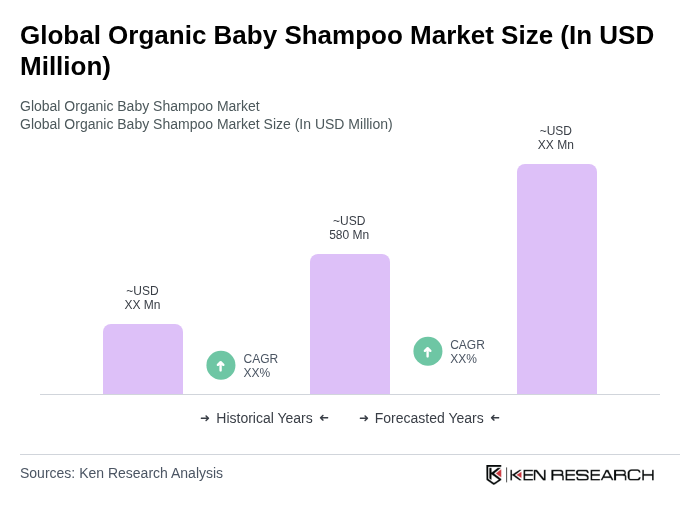
- The Global Organic Baby Shampoo Market is valued at USD 580 million, based on a five-year historical analysis. This growth is primarily driven by increasing consumer awareness regarding the harmful effects of synthetic chemicals in personal care products, alongside a rising preference for organic and natural ingredients among parents. The market is also supported by the growing trend of eco-friendly and sustainable products, including plant-based, hypoallergenic, and cruelty-free formulations, which resonates with the values of modern consumers seeking safer solutions for infants.
- Key players in this market are predominantly located in North America and Europe, where there is a strong demand for organic products. The United States leads the market due to its high disposable income, strong presence of premium baby care brands, and a well-established retail and e-commerce infrastructure that supports rapid penetration of organic baby products. Additionally, countries like Germany and the UK are significant contributors, driven by high per-capita spending on natural personal care, strong retail penetration of certified organic cosmetics, and a growing trend towards organic living among young families.
- The European Union regulates baby shampoos under Regulation (EC) No 1223/2009 on cosmetic products, issued by the European Parliament and the Council, which mandates that all cosmetic products, including baby shampoos, placed on the EU market must be safe for human health when used under normal or reasonably foreseeable conditions. This regulation requires a cosmetic product safety assessment, a cosmetic product safety report, responsible person designation, notification through the Cosmetic Products Notification Portal, and strict control of substances such as preservatives, colorants, and allergens, including for products marketed as organic. In parallel, many organic baby shampoo brands in Europe align with voluntary organic and natural cosmetic standards such as COSMOS and Ecocert, which emphasize transparency in ingredient sourcing and a high proportion of naturally derived and organically farmed ingredients, influencing manufacturers to adapt formulations and labelling practices.
Global Organic Baby Shampoo Market Segmentation
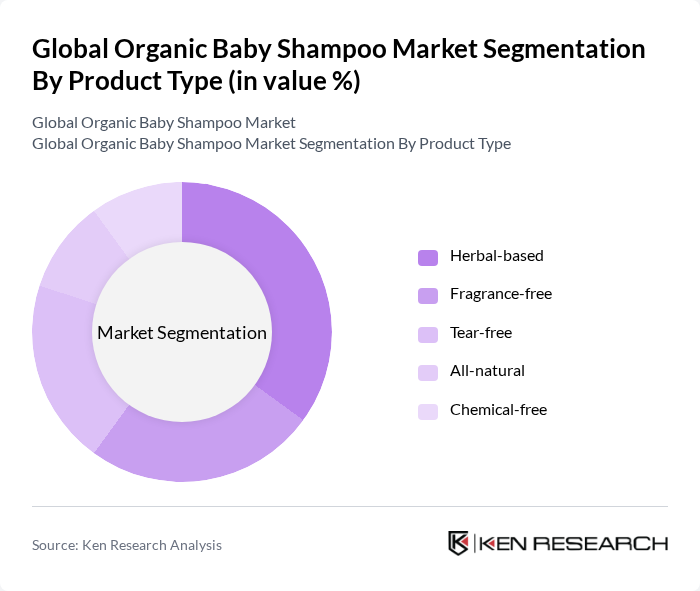
By Product Type:The product type segmentation includes various categories such as herbal-based, fragrance-free, tear-free, all-natural, and chemical-free shampoos. Herbal-based shampoos, typically incorporating plant-derived ingredients such as chamomile, calendula, aloe vera, and coconut-based surfactants, are gaining significant traction due to their perceived safety, mildness on sensitive infant skin, and holistic positioning. Consumers are increasingly opting for products that are free from synthetic additives such as sulfates, parabens, phthalates, artificial fragrances, and dyes, leading to a rise in demand for herbal and naturally derived formulations that are dermatologically tested and often hypoallergenic. The tear-free segment is also popular, especially among parents looking for gentle options for their infants, with brands focusing on mild surfactant systems and ophthalmologist-tested claims to reduce eye irritation during bathing.
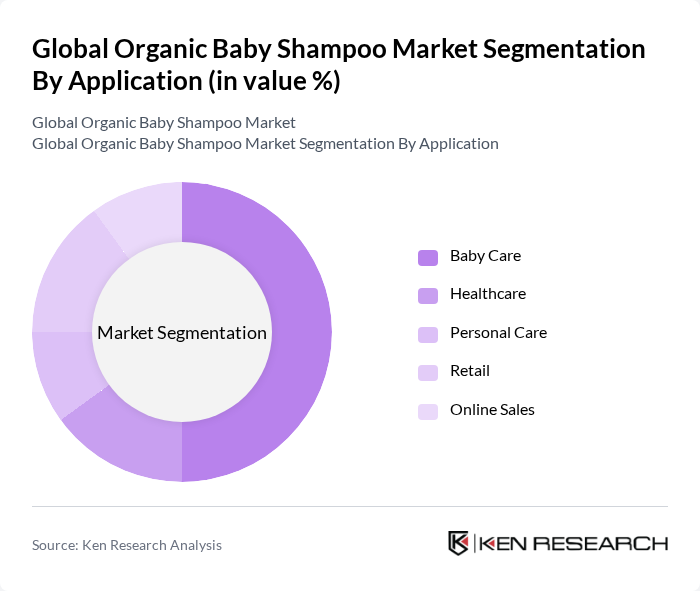
By Application:The application segmentation encompasses baby care, healthcare, personal care, retail, and online sales. The baby care segment dominates the market, driven by the increasing focus on infant health and safety, rising willingness of parents to pay a premium for certified organic and toxin-free baby toiletries, and the strong presence of baby-focused brands in pharmacies, supermarkets, and specialist baby stores. Parents are more inclined to purchase organic products for their babies, leading to a surge in demand for baby shampoos that highlight clean-label ingredient lists, pediatrician recommendations, and sustainability credentials such as recyclable or biodegradable packaging. Online sales are also witnessing rapid growth, as e-commerce platforms and direct-to-consumer channels provide convenience, access to niche and premium organic brands, subscription models, and user reviews that strongly influence purchase decisions among digitally engaged parents.
Global Organic Baby Shampoo Market Competitive Landscape
The Global Organic Baby Shampoo Market is characterized by a dynamic mix of regional and international players. Leading participants such as Johnson & Johnson (Johnson's Baby), Burt's Bees Baby, Babyganics, Earth Mama Organics, Weleda AG, The Honest Company, Inc., SheaMoisture (Sundial Brands), Aveeno Baby (Johnson & Johnson), Mustela (Laboratoires Expanscience), Little Green Cares, Pura D'or, CeraVe Baby (L'Oréal), Noodle & Boo, Baby Dove (Unilever), Dr. Bronner's Magic Soaps contribute to innovation, geographic expansion, and service delivery in this space. Many of these brands focus on certified organic or naturally derived formulations, invest in dermatological and pediatric testing, and leverage digital marketing and influencer partnerships to reach health-conscious parents across both developed and emerging markets.
Global Organic Baby Shampoo Market Industry Analysis
Growth Drivers
- Increasing Consumer Awareness of Organic Products:The global organic personal care market is projected to reach $30 billion in future, driven by heightened consumer awareness regarding the benefits of organic products. A survey by the Organic Trade Association indicates that 85% of consumers are willing to pay more for organic baby care items. This trend is particularly strong in regions where health-conscious parenting is prevalent, leading to increased demand for organic baby shampoos.
- Rising Demand for Chemical-Free Baby Care Products:The global market for chemical-free baby care products is expected to exceed $15 billion in future, reflecting a significant shift in consumer preferences. Parents are increasingly concerned about the potential health risks associated with synthetic chemicals in baby products. This has led to a surge in demand for organic baby shampoos, which are perceived as safer alternatives, particularly in developed markets where health regulations are stringent.
- Growth in E-commerce and Online Retailing:E-commerce sales in the organic baby care segment are projected to grow by 25% annually, reaching $7 billion in future. The convenience of online shopping, coupled with the ability to access a wider range of organic products, is driving this growth. Major e-commerce platforms are increasingly featuring organic baby shampoos, making them more accessible to consumers who prioritize organic and natural products for their children.
Market Challenges
- High Competition Among Established Brands:The organic baby shampoo market is characterized by intense competition, with major players like Johnson & Johnson and Burt's Bees dominating the landscape. These brands invest heavily in marketing and product development, making it challenging for new entrants to gain market share. In future, the top five brands accounted for over 65% of the market, creating barriers for smaller companies attempting to establish themselves.
- Price Sensitivity Among Consumers:Despite the growing demand for organic products, price sensitivity remains a significant challenge. Many consumers in emerging markets are unable to afford premium-priced organic baby shampoos, which can be 35% higher than conventional options. This price disparity limits market penetration and growth potential in regions where disposable income is lower, affecting overall sales and brand loyalty.
Global Organic Baby Shampoo Market Future Outlook
The future of the organic baby shampoo market appears promising, driven by increasing consumer demand for natural and sustainable products. As awareness of the benefits of organic ingredients continues to rise, brands are likely to innovate with new formulations that cater to health-conscious parents. Additionally, the expansion of e-commerce platforms will facilitate greater access to organic baby shampoos, particularly in emerging markets, where growth potential is significant. Companies that prioritize transparency and sustainability will likely gain a competitive edge.
Market Opportunities
- Expansion into Emerging Markets:Emerging markets present a lucrative opportunity for organic baby shampoo brands, with a projected growth rate of 20% annually. As disposable incomes rise, more parents are seeking organic options for their children, creating a demand for affordable yet high-quality products. Companies that tailor their marketing strategies to these regions can capitalize on this growing trend.
- Development of Innovative Product Formulations:There is a significant opportunity for brands to develop innovative formulations that cater to specific needs, such as sensitive skin or allergies. The introduction of products with unique ingredients, such as plant-based extracts, can attract health-conscious consumers. This trend is supported by a report indicating that 50% of parents are actively seeking specialized organic baby care products.
Scope of the Report
| Segment | Sub-Segments |
|---|---|
| By Product Type | Herbal-based Fragrance-free Tear-free All-natural Chemical-free |
| By Application | Baby Care Healthcare Personal Care Retail Online Sales |
| By Packaging Format | Bottles Pumps Pouches & Refills Others |
| By Distribution Channel | Hypermarkets & Supermarkets Pharmacies & Drug Stores E-commerce Others |
| By Certification Type | Certified Organic Natural / Clean Label Private Label & Store Brands |
| By Price Range | Premium Mid-Range Economy |
| By Region | North America Europe Asia-Pacific Latin America Middle East & Africa |
Key Target Audience
Investors and Venture Capitalist Firms
Government and Regulatory Bodies (e.g., U.S. Food and Drug Administration, European Commission)
Manufacturers and Producers
Distributors and Retailers
Natural Product Certification Organizations
Health and Wellness Organizations
Environmental Advocacy Groups
Financial Institutions
Players Mentioned in the Report:
Johnson & Johnson (Johnson's Baby)
Burt's Bees Baby
Babyganics
Earth Mama Organics
Weleda AG
The Honest Company, Inc.
SheaMoisture (Sundial Brands)
Aveeno Baby (Johnson & Johnson)
Mustela (Laboratoires Expanscience)
Little Green Cares
Pura D'or
CeraVe Baby (L'Oreal)
Noodle & Boo
Baby Dove (Unilever)
Dr. Bronner's Magic Soaps
Table of Contents
Market Assessment Phase
1. Executive Summary and Approach
2. Global Organic Baby Shampoo Market Overview
2.1 Key Insights and Strategic Recommendations
2.2 Global Organic Baby Shampoo Market Overview
2.3 Definition and Scope
2.4 Evolution of Market Ecosystem
2.5 Timeline of Key Regulatory Milestones
2.6 Value Chain & Stakeholder Mapping
2.7 Business Cycle Analysis
2.8 Policy & Incentive Landscape
3. Global Organic Baby Shampoo Market Analysis
3.1 Growth Drivers
3.1.1 Increasing Consumer Awareness of Organic Products
3.1.2 Rising Demand for Chemical-Free Baby Care Products
3.1.3 Growth in E-commerce and Online Retailing
3.1.4 Expansion of Product Lines by Key Players
3.2 Market Challenges
3.2.1 High Competition Among Established Brands
3.2.2 Price Sensitivity Among Consumers
3.2.3 Regulatory Compliance and Certification Issues
3.2.4 Limited Awareness in Emerging Markets
3.3 Market Opportunities
3.3.1 Expansion into Emerging Markets
3.3.2 Development of Innovative Product Formulations
3.3.3 Collaborations with E-commerce Platforms
3.3.4 Increasing Demand for Eco-Friendly Packaging
3.4 Market Trends
3.4.1 Shift Towards Sustainable and Natural Ingredients
3.4.2 Growth of Subscription-Based Models
3.4.3 Rising Popularity of Multi-Functional Baby Products
3.4.4 Increased Focus on Transparency in Ingredient Sourcing
3.5 Government Regulation
3.5.1 Stricter Regulations on Chemical Ingredients
3.5.2 Certification Requirements for Organic Products
3.5.3 Labeling Standards for Baby Care Products
3.5.4 Incentives for Sustainable Manufacturing Practices
4. SWOT Analysis
5. Stakeholder Analysis
6. Porter's Five Forces Analysis
7. Global Organic Baby Shampoo Market Size, 2019-2024
7.1 By Value
7.2 By Volume
7.3 By Average Selling Price
8. Global Organic Baby Shampoo Market Segmentation
8.1 By Product Type
8.1.1 Herbal-based
8.1.2 Fragrance-free
8.1.3 Tear-free
8.1.4 All-natural
8.1.5 Chemical-free
8.2 By Application
8.2.1 Baby Care
8.2.2 Healthcare
8.2.3 Personal Care
8.2.4 Retail
8.2.5 Online Sales
8.3 By Packaging Format
8.3.1 Bottles
8.3.2 Pumps
8.3.3 Pouches & Refills
8.3.4 Others
8.4 By Distribution Channel
8.4.1 Hypermarkets & Supermarkets
8.4.2 Pharmacies & Drug Stores
8.4.3 E-commerce
8.4.4 Others
8.5 By Certification Type
8.5.1 Certified Organic
8.5.2 Natural / Clean Label
8.5.3 Private Label & Store Brands
8.6 By Price Range
8.6.1 Premium
8.6.2 Mid-Range
8.6.3 Economy
8.7 By Region
8.7.1 North America
8.7.2 Europe
8.7.3 Asia-Pacific
8.7.4 Latin America
8.7.5 Middle East & Africa
9. Global Organic Baby Shampoo Market Competitive Analysis
9.1 Market Share of Key Players
9.2 Cross Comparison of Key Players
9.2.1 Company Name
9.2.2 Global Organic Baby Shampoo Revenue (USD Million)
9.2.3 Organic Baby Shampoo Revenue CAGR (Historical & Forecast)
9.2.4 Organic Portfolio Share in Total Baby Haircare Revenue (%)
9.2.5 Market Share by Region (%)
9.2.6 Average Selling Price Band and Gross Margin (%)
9.2.7 R&D Intensity (% of Revenue)
9.2.8 Marketing & Promotion Spend (% of Revenue)
9.2.9 E-commerce Revenue Share (%)
9.2.10 Customer Lifetime Value and Repeat Purchase Rate
9.3 SWOT Analysis of Top Players
9.4 Pricing Analysis
9.5 Detailed Profile of Major Companies
9.5.1 Johnson & Johnson (Johnson's Baby)
9.5.2 Burt's Bees Baby
9.5.3 Babyganics
9.5.4 Earth Mama Organics
9.5.5 Weleda AG
9.5.6 The Honest Company, Inc.
9.5.7 SheaMoisture (Sundial Brands)
9.5.8 Aveeno Baby (Johnson & Johnson)
9.5.9 Mustela (Laboratoires Expanscience)
9.5.10 Little Green Cares
9.5.11 Pura D'or
9.5.12 CeraVe Baby (L'Oréal)
9.5.13 Noodle & Boo
9.5.14 Baby Dove (Unilever)
9.5.15 Dr. Bronner's Magic Soaps
10. Global Organic Baby Shampoo Market End-User Analysis
10.1 Procurement Behavior of Key Ministries
10.1.1 Government Procurement Policies
10.1.2 Budget Allocations for Baby Care Products
10.1.3 Supplier Selection Criteria
10.1.4 Contract Management Practices
10.2 Corporate Spend on Infrastructure & Energy
10.2.1 Investment in Sustainable Practices
10.2.2 Budgeting for Organic Product Lines
10.2.3 Cost-Benefit Analysis of Organic Products
10.2.4 Corporate Social Responsibility Initiatives
10.3 Pain Point Analysis by End-User Category
10.3.1 Safety Concerns
10.3.2 Ingredient Transparency
10.3.3 Availability of Products
10.3.4 Price Sensitivity
10.4 User Readiness for Adoption
10.4.1 Awareness of Organic Benefits
10.4.2 Willingness to Pay a Premium
10.4.3 Accessibility of Products
10.4.4 Brand Loyalty Factors
10.5 Post-Deployment ROI and Use Case Expansion
10.5.1 Measurement of Customer Satisfaction
10.5.2 Repeat Purchase Rates
10.5.3 Expansion into New Markets
10.5.4 Long-term Brand Loyalty
11. Global Organic Baby Shampoo Market Future Size, 2025-2030
11.1 By Value
11.2 By Volume
11.3 By Average Selling Price
Go-To-Market Strategy Phase
1. Whitespace Analysis + Business Model Canvas
1.1 Market Gaps Identification
1.2 Business Model Framework
2. Marketing and Positioning Recommendations
2.1 Branding Strategies
2.2 Product USPs
3. Distribution Plan
3.1 Urban Retail Strategies
3.2 Rural NGO Tie-ups
4. Channel & Pricing Gaps
4.1 Underserved Routes
4.2 Pricing Bands
5. Unmet Demand & Latent Needs
5.1 Category Gaps
5.2 Consumer Segments
6. Customer Relationship
6.1 Loyalty Programs
6.2 After-sales Service
7. Value Proposition
7.1 Sustainability Initiatives
7.2 Integrated Supply Chains
8. Key Activities
8.1 Regulatory Compliance
8.2 Branding Efforts
8.3 Distribution Setup
9. Entry Strategy Evaluation
9.1 Domestic Market Entry Strategy
9.1.1 Product Mix Considerations
9.1.2 Pricing Band Strategy
9.1.3 Packaging Innovations
9.2 Export Entry Strategy
9.2.1 Target Countries Identification
9.2.2 Compliance Roadmap Development
10. Entry Mode Assessment
10.1 Joint Ventures
10.2 Greenfield Investments
10.3 Mergers & Acquisitions
10.4 Distributor Model Evaluation
11. Capital and Timeline Estimation
11.1 Capital Requirements
11.2 Timelines for Implementation
12. Control vs Risk Trade-Off
12.1 Ownership Considerations
12.2 Partnerships Evaluation
13. Profitability Outlook
13.1 Breakeven Analysis
13.2 Long-term Sustainability Strategies
14. Potential Partner List
14.1 Distributors
14.2 Joint Ventures
14.3 Acquisition Targets
15. Execution Roadmap
15.1 Phased Plan for Market Entry
15.1.1 Market Setup
15.1.2 Market Entry
15.1.3 Growth Acceleration
15.1.4 Scale & Stabilize
15.2 Key Activities and Milestones
15.2.1 Milestone Planning
15.2.2 Activity Tracking
Research Methodology
Phase 1: Approach1
Desk Research
- Market reports from industry associations focused on organic products
- Consumer behavior studies published by child care and parenting organizations
- Regulatory guidelines and safety standards from health authorities regarding baby care products
Primary Research
- Interviews with product development managers at organic baby shampoo manufacturers
- Surveys with parents regarding their purchasing preferences and product usage
- Focus groups with pediatric dermatologists to understand product efficacy and safety concerns
Validation & Triangulation
- Cross-validation of findings with sales data from retail partners
- Triangulation of consumer insights with expert opinions from industry analysts
- Sanity checks through feedback from a panel of pediatricians and dermatologists
Phase 2: Market Size Estimation1
Top-down Assessment
- Analysis of overall baby care market growth trends to estimate organic segment share
- Segmentation by geographic regions and distribution channels
- Incorporation of demographic trends influencing organic product adoption among parents
Bottom-up Modeling
- Volume estimates based on sales data from leading organic baby shampoo brands
- Price point analysis across different product categories and packaging sizes
- Estimation of market penetration rates based on consumer surveys and retail data
Forecasting & Scenario Analysis
- Multi-variable regression analysis incorporating factors like health trends and environmental awareness
- Scenario modeling based on potential regulatory changes and market entry of new brands
- Development of baseline, optimistic, and pessimistic forecasts through 2030
Phase 3: CATI Sample Composition1
| Scope Item/Segment | Sample Size | Target Respondent Profiles |
|---|---|---|
| Organic Baby Shampoo Users | 150 | Parents of infants and toddlers, Caregivers |
| Retail Buyers for Baby Care Products | 90 | Category Managers, Purchasing Agents |
| Pediatric Dermatologists | 50 | Healthcare Professionals, Skin Care Specialists |
| Organic Product Retailers | 80 | Store Owners, Sales Managers |
| Market Analysts in Baby Care Sector | 60 | Industry Analysts, Research Consultants |
Frequently Asked Questions
What is the current value of the Global Organic Baby Shampoo Market?
The Global Organic Baby Shampoo Market is valued at approximately USD 580 million, reflecting a growing trend towards organic and natural ingredients among parents concerned about the harmful effects of synthetic chemicals in personal care products.
What factors are driving the growth of the organic baby shampoo market?
Which regions are leading in the organic baby shampoo market?
What types of products are included in the organic baby shampoo market?
Other Regional/Country Reports
Indonesia Organic Baby Shampoo Market
Malaysia Organic Baby Shampoo Market
KSA Organic Baby Shampoo Market
APAC Organic Baby Shampoo Market
SEA Organic Baby Shampoo Market
Vietnam Organic Baby Shampoo Market
Other Adjacent Reports
Vietnam Organic Baby Skincare Market
Brazil Natural Baby Food Market
GCC Organic Personal Care MarketPhilippines Herbal Cosmetics Market
South Korea Eco-Friendly Baby Products Market
Singapore Hypoallergenic Baby Care Market
South Africa Plant-Based Surfactants Market
Europe Sustainable Packaging Market Size, Share & Forecast 2025-2031Kuwait Infant Hair Care Market
Oman Cruelty-Free Beauty Market
Why Buy From Us?

What makes us stand out is that our consultants follow Robust, Refine and Result (RRR) methodology. Robust for clear definitions, approaches and sanity checking, Refine for differentiating respondents' facts and opinions, and Result for presenting data with story.

We have set a benchmark in the industry by offering our clients with syndicated and customized market research reports featuring coverage of entire market as well as meticulous research and analyst insights.

While we don't replace traditional research, we flip the method upside down. Our dual approach of Top Bottom & Bottom Top ensures quality deliverable by not just verifying company fundamentals but also looking at the sector and macroeconomic factors.

With one step in the future, our research team constantly tries to show you the bigger picture. We help with some of the tough questions you may encounter along the way: How is the industry positioned? Best marketing channel? KPI's of competitors? By aligning every element, we help maximize success.

Our report gives you instant access to the answers and sources that other companies might choose to hide. We elaborate each steps of research methodology we have used and showcase you the sample size to earn your trust.

If you need any support, we are here! We pride ourselves on universe strength, data quality, and quick, friendly, and professional service.