About the Report
Base Year 2024Global Printed Tissue Paper Market Overview
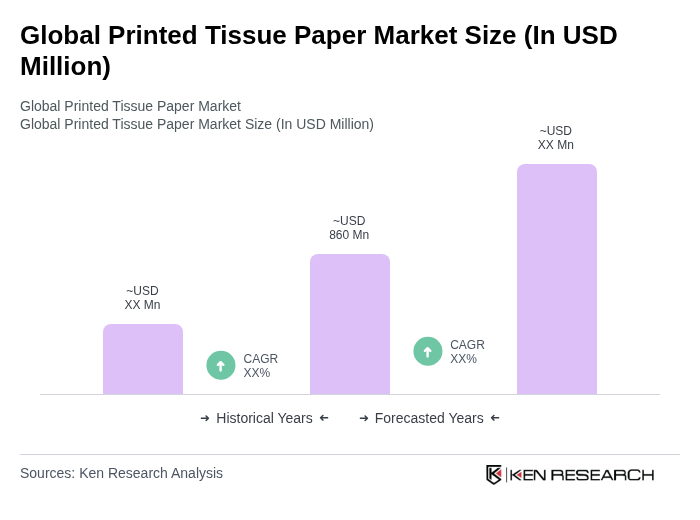
- The Global Printed Tissue Paper Market is valued at USD 860 million, based on a five-year historical analysis. This growth is primarily driven by increasing consumer demand for hygiene products, rising disposable incomes, and the growing trend of eco-friendly and premium packaging solutions. The market has seen a significant uptick in the use of printed tissue paper in various applications, including personal care, food service, and gift and e?commerce packaging, reflecting changing consumer preferences toward customized and aesthetically appealing products.
- Key players in this market include the United States, China, and Germany. The United States dominates due to its large consumer base, advanced manufacturing capabilities, and high per-capita tissue consumption within a mature tissue paper market. China has emerged as a significant player due to its extensive production capacity, cost-effective manufacturing processes, and strong export orientation in tissue and paper products. Germany's strong emphasis on sustainability, recycled fiber use, and innovation in packaging solutions further solidifies its position in the market, particularly within Europe’s premium and eco-friendly tissue segment.
- In 2023, the European Union implemented regulations aimed at reducing plastic waste, which includes promoting the use of biodegradable and recyclable materials in packaging. In particular, the Regulation (EU) 2023/1542 on batteries and waste batteries and the ongoing implementation of the Single-Use Plastics Directive (EU) 2019/904, issued by the European Parliament and the Council, reinforce targets on waste prevention, recycled content, and the substitution of certain plastic items with paper- and fiber-based alternatives in packaging and food-service applications. This regulatory environment encourages manufacturers to adopt printed tissue paper and other fiber-based substrates as sustainable alternatives, thereby boosting its demand in the market.
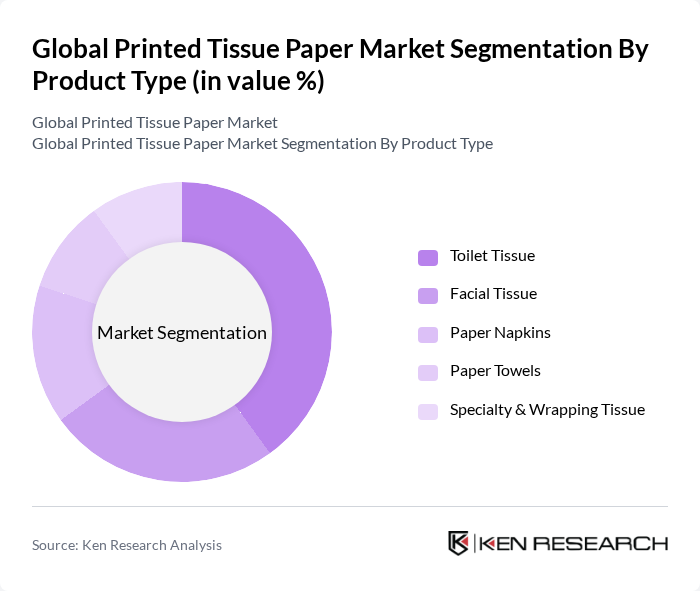
Global Printed Tissue Paper Market Segmentation
By Product Type:The product type segmentation includes various categories such as Toilet Tissue, Facial Tissue, Paper Napkins, Paper Towels, and Specialty & Wrapping Tissue. Among these, Toilet Tissue is the leading sub-segment, driven by its essential role in personal hygiene, high usage frequency, and increasing consumer awareness regarding health and sanitation across both developed and emerging markets. The demand for Facial Tissue has also seen a rise, particularly in urban areas, due to its convenience, softness, and multi-functional use in personal care and on-the-go hygiene. Paper Napkins and Paper Towels are gaining traction in the food service and hospitality industry as hygiene and table presentation standards increase, while Specialty & Wrapping Tissue caters to niche markets, including gift wrapping, retail branding, e?commerce packaging, and decorative uses where custom printing and sustainability are key differentiators.
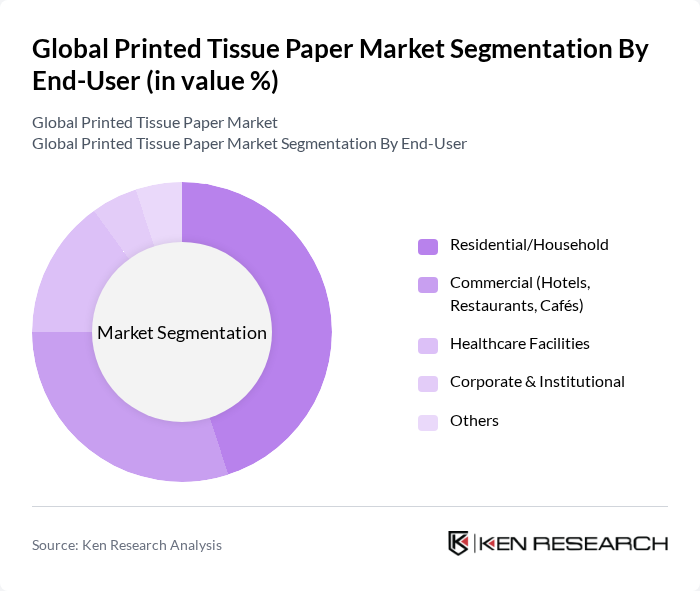
By End-User:The end-user segmentation encompasses Residential/Household, Commercial (Hotels, Restaurants, Cafés), Healthcare Facilities, Corporate & Institutional, and Others. The Residential/Household segment is the largest, driven by the increasing need for hygiene products in homes, higher tissue consumption per capita, and the growing availability of printed and themed products for events and festive occasions. The Commercial segment is also significant, as hotels, restaurants, and cafés require printed tissue paper and napkins for customer service, table presentation, and brand visibility. Healthcare Facilities are increasingly adopting tissue products for patient care, infection control, and disposable hygiene solutions, with opportunities for printed branding and instructions on packaging and outer wraps. Corporate & Institutional users are focusing on sustainability and corporate branding in their operations, using printed tissue and napkin products in offices, events, and cafeterias, while Others include entertainment venues, airlines, and retail gift services that utilize printed tissue for customer experience enhancement.
Global Printed Tissue Paper Market Competitive Landscape
The Global Printed Tissue Paper Market is characterized by a dynamic mix of regional and international players. Leading participants such as Kimberly-Clark Corporation, Procter & Gamble Co., Georgia-Pacific LLC, Svenska Cellulosa Aktiebolaget SCA, Cascades Inc., Essity AB, Clearwater Paper Corporation, Metsä Group, Domtar Corporation, Nippon Paper Industries Co., Ltd., Hengan International Group Company Limited, Cellynne Holdings, Inc., Ahlstrom-Munksjö Oyj, International Paper Company, Mondi Group contribute to innovation, geographic expansion, and service delivery in this space.
Global Printed Tissue Paper Market Industry Analysis
Growth Drivers
- Increasing Demand for Eco-Friendly Products:The global shift towards sustainability is driving the demand for eco-friendly printed tissue paper. In future, the market for biodegradable materials is projected to reach $160 billion, reflecting a 10% increase from previous years. This trend is supported by consumer preferences, with 70% of consumers willing to pay more for sustainable products, according to a 2023 Nielsen report. This growing awareness is propelling manufacturers to innovate and offer eco-friendly options, thus boosting market growth.
- Rising Consumer Preference for Aesthetic Packaging:The aesthetic appeal of packaging is increasingly influencing consumer purchasing decisions. In future, the global packaging market is expected to reach $1.1 trillion, with decorative tissue paper playing a significant role. Research indicates that 60% of consumers are attracted to products with visually appealing packaging. This trend is particularly strong in the gift and retail sectors, where printed tissue paper enhances product presentation, driving demand and market expansion.
- Growth in the E-commerce Sector:The e-commerce sector is experiencing rapid growth, projected to reach $7 trillion in sales by future. This surge is creating a higher demand for printed tissue paper for packaging and presentation. With 80% of online retailers using tissue paper for packaging, the need for customized and branded solutions is increasing. This trend is further supported by the rise of subscription box services, which often utilize printed tissue paper to enhance unboxing experiences, thus driving market growth.
Market Challenges
- Fluctuating Raw Material Prices:The printed tissue paper industry faces challenges due to fluctuating raw material prices, particularly pulp and recycled paper. In future, the price of wood pulp is expected to rise by 15% due to supply chain constraints and increased demand from the packaging sector. This volatility can impact production costs and profit margins for manufacturers, making it difficult to maintain competitive pricing in the market.
- Competition from Alternative Packaging Solutions:The rise of alternative packaging solutions, such as plastic and biodegradable films, poses a significant challenge to the printed tissue paper market. In future, the biodegradable packaging market is projected to reach $350 billion, attracting consumers seeking durable and sustainable options. This competition can lead to market share erosion for printed tissue paper products, necessitating innovation and differentiation strategies among manufacturers to remain relevant.
Global Printed Tissue Paper Market Future Outlook
The future of the printed tissue paper market appears promising, driven by increasing consumer awareness of sustainability and aesthetic packaging. Innovations in sustainable printing technologies are expected to enhance product offerings, while the expansion into emerging markets will provide new growth avenues. As e-commerce continues to thrive, the demand for customized packaging solutions will further propel market dynamics. Companies that adapt to these trends and invest in eco-friendly practices will likely gain a competitive edge in the evolving landscape.
Market Opportunities
- Innovations in Sustainable Printing Technologies:The development of sustainable printing technologies presents a significant opportunity for growth. Companies investing in eco-friendly inks and processes can attract environmentally conscious consumers. With the global sustainable printing market expected to reach $25 billion in future, this innovation can enhance brand loyalty and market share for printed tissue paper manufacturers.
- Customization and Personalization Trends:The trend towards customization in packaging offers a lucrative opportunity for printed tissue paper. As brands seek to differentiate themselves, personalized tissue paper can enhance customer engagement. The global personalized packaging market is projected to grow to $35 billion in future, indicating a strong demand for tailored solutions that can drive sales and customer satisfaction in the printed tissue paper sector.
Scope of the Report
| Segment | Sub-Segments |
|---|---|
| By Product Type | Toilet Tissue Facial Tissue Paper Napkins Paper Towels Specialty & Wrapping Tissue |
| By End-User | Residential/Household Commercial (Hotels, Restaurants, Cafés) Healthcare Facilities Corporate & Institutional Others |
| By Application | At-Home Use Away-From-Home Use Gift Wrapping & Decorative Uses Food Service & Packaging Others |
| By Distribution Channel | Supermarkets/Hypermarkets Convenience & Grocery Stores Specialty Stores Online/E-commerce Others |
| By Region | North America Europe Asia-Pacific Latin America Middle East & Africa |
| By Material Type | Recycled Fiber Virgin Pulp Blended & Others |
| By Printing Technology | Flexographic Printing Digital Printing Offset Printing Others |
Key Target Audience
Investors and Venture Capitalist Firms
Government and Regulatory Bodies (e.g., Environmental Protection Agency, Food and Drug Administration)
Manufacturers and Producers
Distributors and Retailers
Packaging Companies
Brand Owners and Marketers
Trade Associations
Financial Institutions
Players Mentioned in the Report:
Kimberly-Clark Corporation
Procter & Gamble Co.
Georgia-Pacific LLC
Svenska Cellulosa Aktiebolaget SCA
Cascades Inc.
Essity AB
Clearwater Paper Corporation
Metsa Group
Domtar Corporation
Nippon Paper Industries Co., Ltd.
Hengan International Group Company Limited
Cellynne Holdings, Inc.
Ahlstrom-Munksjo Oyj
International Paper Company
Mondi Group
Table of Contents
Market Assessment Phase
1. Executive Summary and Approach
2. Global Printed Tissue Paper Market Overview
2.1 Key Insights and Strategic Recommendations
2.2 Global Printed Tissue Paper Market Overview
2.3 Definition and Scope
2.4 Evolution of Market Ecosystem
2.5 Timeline of Key Regulatory Milestones
2.6 Value Chain & Stakeholder Mapping
2.7 Business Cycle Analysis
2.8 Policy & Incentive Landscape
3. Global Printed Tissue Paper Market Analysis
3.1 Growth Drivers
3.1.1 Increasing Demand for Eco-Friendly Products
3.1.2 Rising Consumer Preference for Aesthetic Packaging
3.1.3 Growth in the E-commerce Sector
3.1.4 Expansion of the Food and Beverage Industry
3.2 Market Challenges
3.2.1 Fluctuating Raw Material Prices
3.2.2 Stringent Environmental Regulations
3.2.3 Competition from Alternative Packaging Solutions
3.2.4 Supply Chain Disruptions
3.3 Market Opportunities
3.3.1 Innovations in Sustainable Printing Technologies
3.3.2 Expansion into Emerging Markets
3.3.3 Customization and Personalization Trends
3.3.4 Collaborations with E-commerce Platforms
3.4 Market Trends
3.4.1 Increasing Use of Biodegradable Materials
3.4.2 Growth of Online Retailing
3.4.3 Rising Popularity of Decorative Tissue Paper
3.4.4 Shift Towards Minimalist Packaging Designs
3.5 Government Regulation
3.5.1 Regulations on Waste Management
3.5.2 Standards for Sustainable Sourcing
3.5.3 Guidelines for Chemical Usage in Printing
3.5.4 Policies Promoting Recycling Initiatives
4. SWOT Analysis
5. Stakeholder Analysis
6. Porter's Five Forces Analysis
7. Global Printed Tissue Paper Market Market Size, 2019-2024
7.1 By Value
7.2 By Volume
7.3 By Average Selling Price
8. Global Printed Tissue Paper Market Segmentation
8.1 By Product Type
8.1.1 Toilet Tissue
8.1.2 Facial Tissue
8.1.3 Paper Napkins
8.1.4 Paper Towels
8.1.5 Specialty & Wrapping Tissue
8.2 By End-User
8.2.1 Residential/Household
8.2.2 Commercial (Hotels, Restaurants, Cafés)
8.2.3 Healthcare Facilities
8.2.4 Corporate & Institutional
8.2.5 Others
8.3 By Application
8.3.1 At-Home Use
8.3.2 Away-From-Home Use
8.3.3 Gift Wrapping & Decorative Uses
8.3.4 Food Service & Packaging
8.3.5 Others
8.4 By Distribution Channel
8.4.1 Supermarkets/Hypermarkets
8.4.2 Convenience & Grocery Stores
8.4.3 Specialty Stores
8.4.4 Online/E-commerce
8.4.5 Others
8.5 By Region
8.5.1 North America
8.5.2 Europe
8.5.3 Asia-Pacific
8.5.4 Latin America
8.5.5 Middle East & Africa
8.6 By Material Type
8.6.1 Recycled Fiber
8.6.2 Virgin Pulp
8.6.3 Blended & Others
8.7 By Printing Technology
8.7.1 Flexographic Printing
8.7.2 Digital Printing
8.7.3 Offset Printing
8.7.4 Others
9. Global Printed Tissue Paper Market Competitive Analysis
9.1 Market Share of Key Players
9.2 Cross Comparison of Key Players
9.2.1 Company Name
9.2.2 Group Size (Large, Medium, or Small as per industry convention)
9.2.3 Printed Tissue Paper Revenue (US$ Million)
9.2.4 Printed Tissue Paper Revenue CAGR (Last 3–5 Years)
9.2.5 EBITDA Margin (%)
9.2.6 Market Share in Global Printed Tissue Paper (%)
9.2.7 Geographic Footprint (No. of Countries/Regions Served)
9.2.8 Installed Production Capacity for Printed Tissue (Tons/Year)
9.2.9 Product Portfolio Breadth (No. of Printed SKUs)
9.2.10 R&D Intensity (% of Revenue)
9.2.11 Capex Intensity (% of Revenue)
9.2.12 Digital & E-commerce Penetration (% of Sales via Online Channels)
9.2.13 Sustainability Performance (Share of Recycled/Certified Fiber, Emissions Intensity)
9.3 SWOT Analysis of Top Players
9.4 Pricing Analysis
9.5 Detailed Profile of Major Companies
9.5.1 Kimberly-Clark Corporation
9.5.2 Procter & Gamble Co.
9.5.3 Georgia-Pacific LLC
9.5.4 Svenska Cellulosa Aktiebolaget SCA
9.5.5 Cascades Inc.
9.5.6 Essity AB
9.5.7 Clearwater Paper Corporation
9.5.8 Metsä Group
9.5.9 Domtar Corporation
9.5.10 Nippon Paper Industries Co., Ltd.
9.5.11 Hengan International Group Company Limited
9.5.12 Cellynne Holdings, Inc.
9.5.13 Ahlstrom-Munksjö Oyj
9.5.14 International Paper Company
9.5.15 Mondi Group
10. Global Printed Tissue Paper Market End-User Analysis
10.1 Procurement Behavior of Key Ministries
10.1.1 Budget Allocation Trends
10.1.2 Supplier Selection Criteria
10.1.3 Contracting Processes
10.1.4 Sustainability Considerations
10.2 Corporate Spend on Infrastructure & Energy
10.2.1 Investment Trends in Packaging
10.2.2 Budgeting for Sustainability Initiatives
10.2.3 Spending on Innovation
10.2.4 Cost Management Strategies
10.3 Pain Point Analysis by End-User Category
10.3.1 Quality Concerns
10.3.2 Supply Chain Reliability
10.3.3 Cost Pressures
10.3.4 Regulatory Compliance Issues
10.4 User Readiness for Adoption
10.4.1 Awareness of Sustainable Options
10.4.2 Willingness to Pay for Quality
10.4.3 Adoption Barriers
10.4.4 Training and Support Needs
10.5 Post-Deployment ROI and Use Case Expansion
10.5.1 Measurement of Success Metrics
10.5.2 Case Studies of Successful Implementations
10.5.3 Feedback Mechanisms
10.5.4 Future Expansion Plans
11. Global Printed Tissue Paper Market Future Size, 2025-2030
11.1 By Value
11.2 By Volume
11.3 By Average Selling Price
Go-To-Market Strategy Phase
1. Whitespace Analysis + Business Model Canvas
1.1 Market Gaps Identification
1.2 Value Proposition Development
1.3 Revenue Streams Analysis
1.4 Cost Structure Evaluation
1.5 Key Partnerships Exploration
1.6 Customer Segmentation
1.7 Channels of Distribution
2. Marketing and Positioning Recommendations
2.1 Branding Strategies
2.2 Product USPs
2.3 Target Market Identification
2.4 Communication Strategies
2.5 Digital Marketing Approaches
3. Distribution Plan
3.1 Urban Retail Strategies
3.2 Rural NGO Tie-ups
3.3 E-commerce Integration
3.4 Logistics and Supply Chain Management
4. Channel & Pricing Gaps
4.1 Underserved Routes
4.2 Pricing Bands Analysis
4.3 Competitive Pricing Strategies
5. Unmet Demand & Latent Needs
5.1 Category Gaps Identification
5.2 Consumer Segments Analysis
5.3 Product Development Opportunities
6. Customer Relationship
6.1 Loyalty Programs
6.2 After-sales Service Enhancements
6.3 Customer Feedback Mechanisms
7. Value Proposition
7.1 Sustainability Initiatives
7.2 Integrated Supply Chains
7.3 Customer-Centric Innovations
8. Key Activities
8.1 Regulatory Compliance
8.2 Branding Initiatives
8.3 Distribution Setup
9. Entry Strategy Evaluation
9.1 Domestic Market Entry Strategy
9.1.1 Product Mix Considerations
9.1.2 Pricing Band Strategies
9.1.3 Packaging Innovations
9.2 Export Entry Strategy
9.2.1 Target Countries Analysis
9.2.2 Compliance Roadmap Development
10. Entry Mode Assessment
10.1 Joint Ventures
10.2 Greenfield Investments
10.3 Mergers & Acquisitions
10.4 Distributor Model Evaluation
11. Capital and Timeline Estimation
11.1 Capital Requirements Analysis
11.2 Timelines for Implementation
12. Control vs Risk Trade-Off
12.1 Ownership vs Partnerships
12.2 Risk Mitigation Strategies
13. Profitability Outlook
13.1 Breakeven Analysis
13.2 Long-term Sustainability Strategies
14. Potential Partner List
14.1 Distributors
14.2 Joint Ventures
14.3 Acquisition Targets
15. Execution Roadmap
15.1 Phased Plan for Market Entry
15.1.1 Market Setup
15.1.2 Market Entry
15.1.3 Growth Acceleration
15.1.4 Scale & Stabilize
15.2 Key Activities and Milestones
15.2.1 Milestone Planning
15.2.2 Activity Tracking
Research Methodology
Phase 1: Approach1
Desk Research
- Industry reports from market research firms focusing on the printed tissue paper sector
- Trade statistics and import/export data from global trade organizations
- Published articles and white papers on consumer trends and sustainability in tissue paper
Primary Research
- Interviews with product managers at leading tissue paper manufacturers
- Surveys with retailers and distributors to understand market demand
- Field interviews with end-users in the hospitality and food service sectors
Validation & Triangulation
- Cross-validation of findings through multiple industry sources and expert opinions
- Triangulation of data from sales figures, market trends, and consumer feedback
- Sanity checks conducted through expert panel discussions and reviews
Phase 2: Market Size Estimation1
Top-down Assessment
- Analysis of global tissue paper consumption trends and growth rates
- Segmentation of the market by product type, application, and region
- Incorporation of macroeconomic factors influencing demand, such as population growth and urbanization
Bottom-up Modeling
- Estimation of production capacities and output from major tissue paper manufacturers
- Cost analysis based on raw material prices and production processes
- Volume estimates derived from sales data across various distribution channels
Forecasting & Scenario Analysis
- Multi-variable forecasting using historical data and market indicators
- Scenario analysis based on potential shifts in consumer preferences and regulatory changes
- Development of baseline, optimistic, and pessimistic market projections through 2030
Phase 3: CATI Sample Composition1
| Scope Item/Segment | Sample Size | Target Respondent Profiles |
|---|---|---|
| Retail Tissue Paper Sales | 120 | Store Managers, Category Buyers |
| Food Service Industry Usage | 90 | Restaurant Owners, Catering Managers |
| Hospitality Sector Demand | 75 | Hotel Procurement Officers, Facility Managers |
| Consumer Preferences Survey | 140 | Household Consumers, Eco-conscious Buyers |
| Export Market Insights | 70 | Export Managers, Trade Analysts |
Frequently Asked Questions
What is the current value of the Global Printed Tissue Paper Market?
The Global Printed Tissue Paper Market is valued at approximately USD 860 million, reflecting a significant growth trend driven by increasing consumer demand for hygiene products and eco-friendly packaging solutions.
What factors are driving the growth of the printed tissue paper market?
Which countries are the leading players in the printed tissue paper market?
How has the regulatory environment impacted the printed tissue paper market?
Other Regional/Country Reports
Indonesia Printed Tissue Paper Market
Malaysia Printed Tissue Paper Market
KSA Printed Tissue Paper Market
APAC Printed Tissue Paper Market
SEA Printed Tissue Paper Market
Vietnam Printed Tissue Paper Market
Other Adjacent Reports
Philippines Hygiene Products Market
South Africa E-commerce Packaging Market
Qatar Disposable Tableware Market
Malaysia Gift Wrapping Market
UAE Food Service Packaging MarketPhilippines Recycled Paper Market
Vietnam Personal Care Products Market Size, Share & Forecast, By Product Type, Price Tier & Distribution Channel, 2025–2032Why Buy From Us?

What makes us stand out is that our consultants follow Robust, Refine and Result (RRR) methodology. Robust for clear definitions, approaches and sanity checking, Refine for differentiating respondents' facts and opinions, and Result for presenting data with story.

We have set a benchmark in the industry by offering our clients with syndicated and customized market research reports featuring coverage of entire market as well as meticulous research and analyst insights.

While we don't replace traditional research, we flip the method upside down. Our dual approach of Top Bottom & Bottom Top ensures quality deliverable by not just verifying company fundamentals but also looking at the sector and macroeconomic factors.

With one step in the future, our research team constantly tries to show you the bigger picture. We help with some of the tough questions you may encounter along the way: How is the industry positioned? Best marketing channel? KPI's of competitors? By aligning every element, we help maximize success.

Our report gives you instant access to the answers and sources that other companies might choose to hide. We elaborate each steps of research methodology we have used and showcase you the sample size to earn your trust.

If you need any support, we are here! We pride ourselves on universe strength, data quality, and quick, friendly, and professional service.