About the Report
Base Year 2024Global Protective Textiles Market Overview
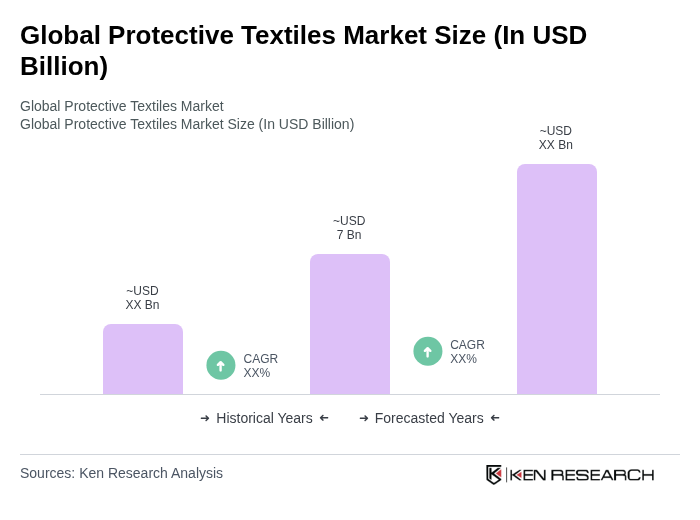
- The Global Protective Textiles Market is valued at USD 7 billion, based on a five-year historical analysis. This growth is primarily driven by increasing awareness of workplace safety across sectors like healthcare, manufacturing, and construction, where demand for flame-, chemical-, and ballistic-resistant fabrics is on the rise. Technological advancements in high-performance fibers and coatings are enabling lighter, more comfortable protective wear, further expanding adoption worldwide.
- Key players in this market include DuPont, W. L. Gore & Associates, TenCate, TEIJIN, 3M, Honeywell, and Schoeller Textil. These companies play a significant role in driving growth and maintaining high standards in protective textiles through innovation in high-performance, durable products. Regions like North America and Europe dominate the market due to stringent safety regulations and advanced industrial infrastructure, which bolster demand for protective textiles.
- In 2024, regulatory developments such as bans on PFAS in firefighter gear, implemented by states like Massachusetts and Connecticut, mandate PFAS-free protective gear by 2027 and 2028. This shift is reshaping industry requirements for safety and sustainability, pushing manufacturers to innovate and comply with new standards.
Global Protective Textiles Market Segmentation
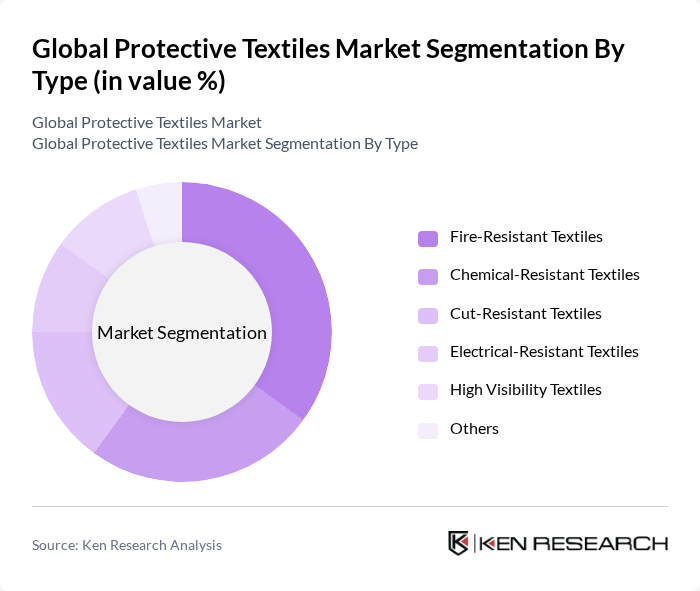
By Type:The protective textiles market is segmented into various types, including fire-resistant textiles, chemical-resistant textiles, cut-resistant textiles, electrical-resistant textiles, high visibility textiles, and others. Among these, fire-resistant textiles dominate the market due to their critical application in industries such as firefighting, oil and gas, and manufacturing, where exposure to flames and heat is prevalent. The increasing focus on safety regulations and the need for protective gear in hazardous environments further drive the demand for fire-resistant textiles.
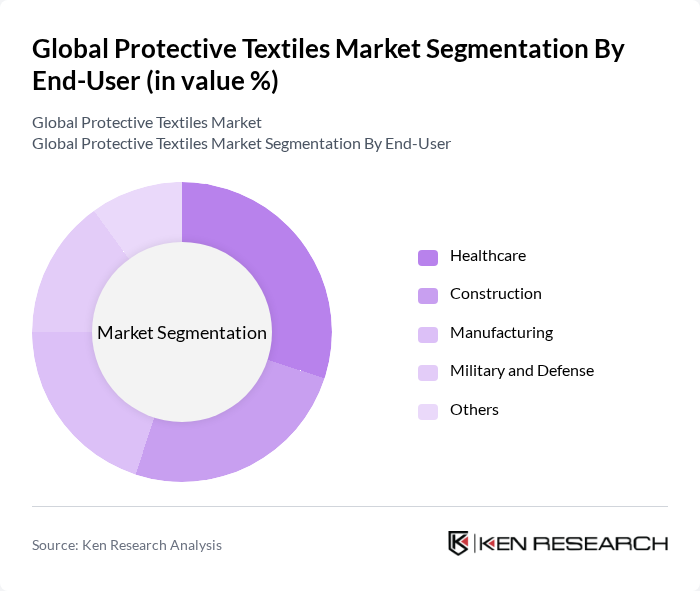
By End-User:The market is also segmented by end-user industries, including healthcare, construction, manufacturing, military and defense, and others. The healthcare sector is a significant contributor to the protective textiles market, driven by the need for protective clothing and equipment to ensure safety against biological hazards and chemicals. The construction and manufacturing sectors also show strong demand due to the high-risk environments in which workers operate, necessitating the use of protective textiles.
Global Protective Textiles Market Competitive Landscape
The Global Protective Textiles Market is characterized by a dynamic mix of regional and international players. Leading participants such as DuPont, 3M, Honeywell International Inc., Milliken & Company, Teijin Limited, W. L. Gore & Associates, BASF SE, TenCate Protective Fabrics, Ansell Limited, Protective Industrial Products, Inc., MCR Safety, Lakeland Industries, Inc., Carhartt, Inc., Cordura (Invista), Aegis Protective Gear contribute to innovation, geographic expansion, and service delivery in this space.
Global Protective Textiles Market Industry Analysis
Growth Drivers
- Urbanization in the United States:In future, the urban population in the U.S. is projected to increase by approximately 83 million compared to 2020 levels. This surge in urban dwellers drives demand for enhanced infrastructure and occupational safety products, including protective textiles. As cities expand, industries such as construction and manufacturing require advanced protective gear to ensure worker safety, thereby boosting the protective textiles market significantly. Source: World Bank data on urban population growth.
- GDP Growth and Disposable Income:In future, global emerging markets are expected to see a GDP increase of USD 2.1 trillion compared to the previous year. This economic growth translates into higher disposable incomes, leading to increased spending on safety and protective equipment, including textiles. As businesses invest more in safety measures, the demand for high-quality protective textiles is anticipated to rise, further propelling market growth. Source: World Bank / IMF national accounts data.
- Technology Adoption: Improved Testing Infrastructure:The U.S. Consumer Product Safety Commission (CPSC) revised flammability testing standards effective in future, introducing new specifications for protective textiles. This advancement in testing infrastructure enhances the quality and safety of protective textiles, encouraging manufacturers to innovate and produce higher-quality products. As a result, the market is likely to experience growth driven by technological advancements in textile manufacturing. Source: U.S. CPSC rule amendment.
Market Challenges
- Regulatory Constraints around PFAS:Recent studies indicate that PFAS-laden turnout gear has been linked to 66% of firefighter deaths from 2002 to 2019. Growing health concerns and regulatory scrutiny surrounding PFAS in protective gear are leading to increased compliance burdens for manufacturers. As states implement stricter regulations, the industry faces challenges in reformulating products, which may disrupt supply chains and increase production costs. Source: The Guardian report.
- State-Level PFAS Bans Expanding:California's PFAS limits are set to decrease from 100 ppm in future to 50 ppm by future, with similar regulations rolling out in New York and Colorado starting January 1, future. These expanding bans necessitate significant reformulation efforts from manufacturers of protective textiles, increasing costs and complicating compliance processes. The regulatory landscape is becoming increasingly complex, posing challenges for industry players. Source: McGuireWoods Contaminants Compass.
Global Protective Textiles Market Future Outlook
The protective textiles market is poised for significant transformation driven by innovation in PFAS-free firefighting gear, mandated by upcoming bans in several states. Additionally, advancements in flammability testing standards will facilitate the development of safer, higher-quality materials. As manufacturers adapt to new regulations, the focus on sustainability and circular economy models will likely reshape the industry landscape, creating opportunities for growth and innovation in protective textiles.
Market Opportunities
- PFAS-Free Protective Gear Innovation:With PFAS-free turnout gear adoption mandated by future in Massachusetts and future in Connecticut, manufacturers have a unique opportunity to develop innovative protective textiles. This shift not only addresses health concerns but also positions companies to capture market share ahead of competitors who may lag in compliance. Source: The Guardian.
- EPR Compliance Service and Circular Textile Solutions:California's Extended Producer Responsibility law requires producers to join a Producer Responsibility Organization by future. This creates opportunities for service providers and manufacturers to integrate waste management and recycling solutions into their operations, promoting sustainability and compliance with emerging regulations. Source: Enhesa.
Scope of the Report
| Segment | Sub-Segments |
|---|---|
| By Type | Fire-Resistant Textiles Chemical-Resistant Textiles Cut-Resistant Textiles Electrical-Resistant Textiles High Visibility Textiles Others |
| By End-User | Healthcare Construction Manufacturing Military and Defense Others |
| By Application | Protective Clothing Protective Equipment Home Textiles Industrial Textiles Others |
| By Material | Natural Fibers Synthetic Fibers Composite Materials Others |
| By Region | North America Europe Asia-Pacific Latin America Middle East & Africa |
| By Distribution Channel | Online Retail Offline Retail Direct Sales Others |
| By Price Range | Budget Mid-Range Premium Others |
Key Target Audience
Investors and Venture Capitalist Firms
Government and Regulatory Bodies (e.g., U.S. Department of Defense, European Chemicals Agency)
Manufacturers and Producers
Distributors and Retailers
Military and Defense Organizations
Aerospace and Aviation Authorities
Healthcare and Medical Institutions
Fire and Safety Departments
Players Mentioned in the Report:
DuPont
3M
Honeywell International Inc.
Milliken & Company
Teijin Limited
W. L. Gore & Associates
BASF SE
TenCate Protective Fabrics
Ansell Limited
Protective Industrial Products, Inc.
MCR Safety
Lakeland Industries, Inc.
Carhartt, Inc.
Cordura (Invista)
Aegis Protective Gear
Table of Contents
Market Assessment Phase
1. Executive Summary and Approach
2. Global Protective Textiles Market Overview
2.1 Key Insights and Strategic Recommendations
2.2 Global Protective Textiles Market Overview
2.3 Definition and Scope
2.4 Evolution of Market Ecosystem
2.5 Timeline of Key Regulatory Milestones
2.6 Value Chain & Stakeholder Mapping
2.7 Business Cycle Analysis
2.8 Policy & Incentive Landscape
3. Global Protective Textiles Market Analysis
3.1 Growth Drivers
3.1.1 Increasing demand for safety and protection in various industries
3.1.2 Technological advancements in textile manufacturing
3.1.3 Rising awareness regarding workplace safety
3.1.4 Government regulations mandating protective gear
3.2 Market Challenges
3.2.1 High production costs of advanced protective textiles
3.2.2 Competition from alternative materials
3.2.3 Limited awareness in emerging markets
3.2.4 Regulatory compliance complexities
3.3 Market Opportunities
3.3.1 Expansion into emerging markets
3.3.2 Development of eco-friendly protective textiles
3.3.3 Customization and personalization of protective gear
3.3.4 Collaborations with technology firms for smart textiles
3.4 Market Trends
3.4.1 Increasing integration of IoT in protective textiles
3.4.2 Growth in e-commerce for protective gear
3.4.3 Shift towards lightweight and comfortable materials
3.4.4 Rising demand for multi-functional protective textiles
3.5 Government Regulation
3.5.1 Standards for personal protective equipment (PPE)
3.5.2 Environmental regulations on textile production
3.5.3 Safety regulations in industrial sectors
3.5.4 Compliance requirements for export markets
4. SWOT Analysis
5. Stakeholder Analysis
6. Porter's Five Forces Analysis
7. Global Protective Textiles Market Market Size, 2019-2024
7.1 By Value
7.2 By Volume
7.3 By Average Selling Price
8. Global Protective Textiles Market Segmentation
8.1 By Type
8.1.1 Fire-Resistant Textiles
8.1.2 Chemical-Resistant Textiles
8.1.3 Cut-Resistant Textiles
8.1.4 Electrical-Resistant Textiles
8.1.5 High Visibility Textiles
8.1.6 Others
8.2 By End-User
8.2.1 Healthcare
8.2.2 Construction
8.2.3 Manufacturing
8.2.4 Military and Defense
8.2.5 Others
8.3 By Application
8.3.1 Protective Clothing
8.3.2 Protective Equipment
8.3.3 Home Textiles
8.3.4 Industrial Textiles
8.3.5 Others
8.4 By Material
8.4.1 Natural Fibers
8.4.2 Synthetic Fibers
8.4.3 Composite Materials
8.4.4 Others
8.5 By Region
8.5.1 North America
8.5.2 Europe
8.5.3 Asia-Pacific
8.5.4 Latin America
8.5.5 Middle East & Africa
8.6 By Distribution Channel
8.6.1 Online Retail
8.6.2 Offline Retail
8.6.3 Direct Sales
8.6.4 Others
8.7 By Price Range
8.7.1 Budget
8.7.2 Mid-Range
8.7.3 Premium
8.7.4 Others
9. Global Protective Textiles Market Competitive Analysis
9.1 Market Share of Key Players
9.2 Cross Comparison of Key Players
9.2.1 Company Name
9.2.2 Group Size (Large, Medium, or Small as per industry convention)
9.2.3 Revenue Growth Rate
9.2.4 Market Penetration Rate
9.2.5 Customer Retention Rate
9.2.6 Product Innovation Rate
9.2.7 Pricing Strategy
9.2.8 Distribution Efficiency
9.2.9 Brand Recognition
9.2.10 Customer Satisfaction Score
9.3 SWOT Analysis of Top Players
9.4 Pricing Analysis
9.5 Detailed Profile of Major Companies
9.5.1 DuPont
9.5.2 3M
9.5.3 Honeywell International Inc.
9.5.4 Milliken & Company
9.5.5 Teijin Limited
9.5.6 W. L. Gore & Associates
9.5.7 BASF SE
9.5.8 TenCate Protective Fabrics
9.5.9 Ansell Limited
9.5.10 Protective Industrial Products, Inc.
9.5.11 MCR Safety
9.5.12 Lakeland Industries, Inc.
9.5.13 Carhartt, Inc.
9.5.14 Cordura (Invista)
9.5.15 Aegis Protective Gear
10. Global Protective Textiles Market End-User Analysis
10.1 Procurement Behavior of Key Ministries
10.1.1 Government procurement policies
10.1.2 Budget allocation for protective gear
10.1.3 Supplier selection criteria
10.1.4 Contract management practices
10.2 Corporate Spend on Infrastructure & Energy
10.2.1 Investment trends in protective textiles
10.2.2 Budgeting for safety equipment
10.2.3 Long-term contracts with suppliers
10.2.4 Impact of economic conditions on spending
10.3 Pain Point Analysis by End-User Category
10.3.1 Safety compliance challenges
10.3.2 Quality assurance issues
10.3.3 Cost management concerns
10.3.4 Supply chain disruptions
10.4 User Readiness for Adoption
10.4.1 Awareness of protective textile benefits
10.4.2 Training and education needs
10.4.3 Adoption barriers in various sectors
10.4.4 Feedback mechanisms for improvement
10.5 Post-Deployment ROI and Use Case Expansion
10.5.1 Measurement of effectiveness
10.5.2 Case studies of successful implementations
10.5.3 Expansion into new applications
10.5.4 Long-term benefits analysis
11. Global Protective Textiles Market Future Size, 2025-2030
11.1 By Value
11.2 By Volume
11.3 By Average Selling Price
Go-To-Market Strategy Phase
1. Whitespace Analysis + Business Model Canvas
1.1 Market gaps identification
1.2 Value proposition development
1.3 Revenue model exploration
1.4 Customer segmentation analysis
1.5 Competitive landscape overview
1.6 Key partnerships identification
1.7 Resource allocation strategy
2. Marketing and Positioning Recommendations
2.1 Branding strategies
2.2 Product USPs
2.3 Target audience identification
2.4 Communication strategy
2.5 Digital marketing approach
2.6 Trade show participation
2.7 Customer engagement tactics
3. Distribution Plan
3.1 Urban retail vs rural NGO tie-ups
3.2 E-commerce strategy
3.3 Direct sales approach
3.4 Distribution partnerships
3.5 Logistics and supply chain management
3.6 Inventory management practices
3.7 Customer service integration
4. Channel & Pricing Gaps
4.1 Underserved routes
4.2 Pricing bands
4.3 Competitor pricing analysis
4.4 Value-based pricing strategies
4.5 Discount and promotion strategies
4.6 Price elasticity considerations
4.7 Customer feedback on pricing
5. Unmet Demand & Latent Needs
5.1 Category gaps
5.2 Consumer segments
5.3 Product development opportunities
5.4 Market entry barriers
5.5 Innovation needs
5.6 Customer pain points
5.7 Future trends anticipation
6. Customer Relationship
6.1 Loyalty programs
6.2 After-sales service
6.3 Customer feedback loops
6.4 Community engagement
6.5 Relationship management tools
6.6 Customer education initiatives
6.7 Personalization strategies
7. Value Proposition
7.1 Sustainability
7.2 Integrated supply chains
7.3 Cost-effectiveness
7.4 Quality assurance
7.5 Innovation in product offerings
7.6 Customer-centric approach
7.7 Competitive differentiation
8. Key Activities
8.1 Regulatory compliance
8.2 Branding
8.3 Distribution setup
8.4 Market research
8.5 Training and development
8.6 Performance monitoring
8.7 Stakeholder engagement
9. Entry Strategy Evaluation
9.1 Domestic Market Entry Strategy
9.1.1 Product mix
9.1.2 Pricing band
9.1.3 Packaging
9.2 Export Entry Strategy
9.2.1 Target countries
9.2.2 Compliance roadmap
10. Entry Mode Assessment
10.1 JV
10.2 Greenfield
10.3 M&A
10.4 Distributor Model
11. Capital and Timeline Estimation
11.1 Capital requirements
11.2 Timelines
12. Control vs Risk Trade-Off
12.1 Ownership vs Partnerships
13. Profitability Outlook
13.1 Breakeven analysis
13.2 Long-term sustainability
14. Potential Partner List
14.1 Distributors
14.2 JVs
14.3 Acquisition targets
15. Execution Roadmap
15.1 Phased Plan for Market Entry
15.1.1 Market Setup
15.1.2 Market Entry
15.1.3 Growth Acceleration
15.1.4 Scale & Stabilize
15.2 Key Activities and Milestones
15.2.1 Milestone tracking
15.2.2 Activity scheduling
15.2.3 Resource allocation
Research Methodology
Phase 1: Approach1
Desk Research
- Industry reports from textile associations and global market research firms
- Analysis of trade statistics from international trade databases and customs reports
- Review of academic journals and publications on protective textile innovations
Primary Research
- Interviews with product managers at leading protective textile manufacturers
- Surveys with end-users in sectors such as healthcare, military, and construction
- Focus groups with safety equipment distributors and retailers
Validation & Triangulation
- Cross-validation of findings through multiple industry expert interviews
- Triangulation of data from market reports, sales figures, and regulatory insights
- Sanity checks through feedback from a panel of industry specialists
Phase 2: Market Size Estimation1
Top-down Assessment
- Analysis of global protective textile market size based on historical growth rates
- Segmentation by application areas such as industrial, medical, and military
- Incorporation of macroeconomic factors influencing demand, such as safety regulations
Bottom-up Modeling
- Estimation of market size based on production volumes from key manufacturers
- Cost analysis of raw materials and production processes for protective textiles
- Volume x price calculations for various protective textile categories
Forecasting & Scenario Analysis
- Multi-variable forecasting using trends in workplace safety and health regulations
- Scenario modeling based on technological advancements and material innovations
- Development of baseline, optimistic, and pessimistic market growth scenarios through 2030
Phase 3: CATI Sample Composition1
| Scope Item/Segment | Sample Size | Target Respondent Profiles |
|---|---|---|
| Industrial Protective Textiles | 150 | Safety Managers, Procurement Officers |
| Medical Protective Textiles | 100 | Healthcare Administrators, Product Development Leads |
| Military and Defense Textiles | 80 | Defense Procurement Officers, R&D Managers |
| Fire-Resistant Fabrics | 70 | Fire Safety Officers, Compliance Managers |
| Consumer Protective Gear | 90 | Retail Buyers, Brand Managers |
Frequently Asked Questions
What is the current value of the Global Protective Textiles Market?
The Global Protective Textiles Market is valued at approximately USD 7 billion, driven by increasing workplace safety awareness across various sectors, including healthcare, manufacturing, and construction, where demand for specialized protective fabrics is growing.
What are the main types of protective textiles?
Who are the key players in the Global Protective Textiles Market?
What factors are driving the growth of the protective textiles market?
Other Regional/Country Reports
Indonesia Protective Textiles Market
Malaysia Protective Textiles Market
KSA Protective Textiles Market
APAC Protective Textiles Market
SEA Protective Textiles Market
Vietnam Protective Textiles Market
Other Adjacent Reports
Qatar Fire-Resistant Textiles Market
Bahrain Chemical-Resistant Textiles Market
Indonesia Cut-Resistant Textiles Market
Thailand Electrical-Resistant Textiles Market
Belgium High Visibility Textiles Market
Kuwait Healthcare Protective Equipment Market
Belgium Construction Safety Gear Market
Philippines Manufacturing Safety Equipment Market
Japan Military and Defense Gear Market
Japan Sustainable Textiles Market
Why Buy From Us?

What makes us stand out is that our consultants follow Robust, Refine and Result (RRR) methodology. Robust for clear definitions, approaches and sanity checking, Refine for differentiating respondents' facts and opinions, and Result for presenting data with story.

We have set a benchmark in the industry by offering our clients with syndicated and customized market research reports featuring coverage of entire market as well as meticulous research and analyst insights.

While we don't replace traditional research, we flip the method upside down. Our dual approach of Top Bottom & Bottom Top ensures quality deliverable by not just verifying company fundamentals but also looking at the sector and macroeconomic factors.

With one step in the future, our research team constantly tries to show you the bigger picture. We help with some of the tough questions you may encounter along the way: How is the industry positioned? Best marketing channel? KPI's of competitors? By aligning every element, we help maximize success.

Our report gives you instant access to the answers and sources that other companies might choose to hide. We elaborate each steps of research methodology we have used and showcase you the sample size to earn your trust.

If you need any support, we are here! We pride ourselves on universe strength, data quality, and quick, friendly, and professional service.