About the Report
Base Year 2024Global Ship Leasing Market Overview
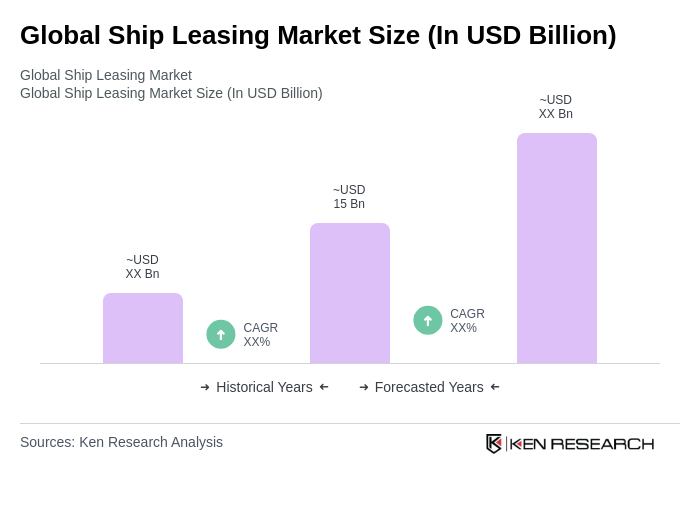
- The Global Ship Leasing Market is valued at USD 15 billion, based on a five-year historical analysis. This level reflects robust leasing demand tied to seaborne trade recovery and active ordering/chartering in the container and bulk segments as supply chains normalized and cargo volumes remained elevated.
- Key players by maritime activity and influence include Greece, Japan, and China. Greece controls one of the world’s largest merchant fleets by deadweight tonnage, while Japan and China are among the top shipbuilding nations and major lessors/owners through banks, leasing houses, and industrial groups, supported by advanced shipyard capacity and maritime finance ecosystems.
- The International Maritime Organization has implemented energy and carbon-efficiency measures, including the Energy Efficiency Existing Ship Index (EEXI) and the Carbon Intensity Indicator (CII), which entered into force and became applicable to the existing fleet to curb greenhouse gas emissions. These measures are incentivizing investment and chartering of newer, more efficient vessels—an effect visible in leasing market activity as owners seek compliant tonnage.
Global Ship Leasing Market Segmentation
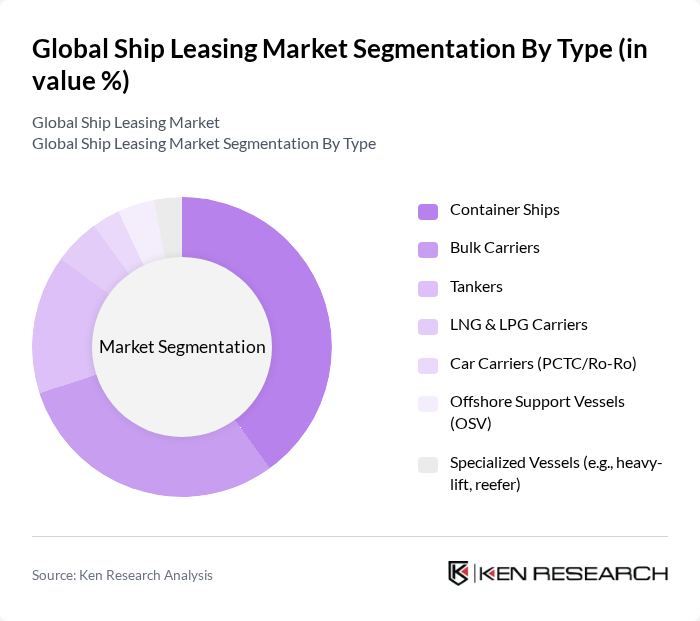
By Type:The ship leasing market spans container ships, bulk carriers, tankers, LNG & LPG carriers, car carriers, offshore support vessels, and specialized vessels. Container ships and bulk carriers are prominent within leasing portfolios due to their central role in global trade flows and raw material transport; container vessels are favored for standardized, high-throughput cargo movement, while bulk carriers underpin commodity trades across iron ore, coal, and grains.
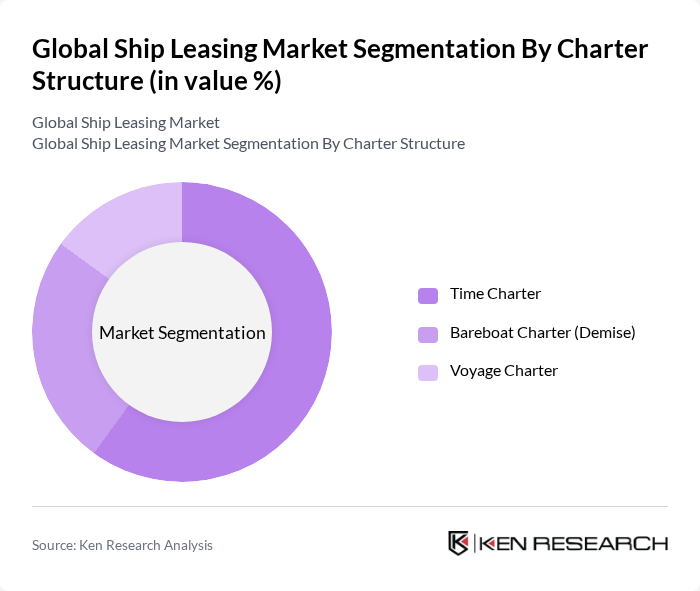
By Charter Structure:The charter structure includes time charter, bareboat charter, and voyage charter. Time charters typically dominate institutional leasing strategies because they provide predictable cash flows over a defined period while allowing operators flexibility in deployment without full ownership—features widely cited in market analyses and reflected in lessor contracting practices.
Global Ship Leasing Market Competitive Landscape
The Global Ship Leasing Market is characterized by a dynamic mix of regional and international players. Leading participants such as Global Ship Lease, Inc., Danaos Corporation, Costamare Inc., Seaspan Corporation (Atlas Corp.), Ocean Yield ASA, Capital Product Partners L.P. (Capital Maritime & Trading Group), Navios Maritime Partners L.P., MPC Container Ships ASA, Maersk Product Tankers A/S, Scorpio Tankers Inc., Teekay Corporation, BW LPG Limited, Hoegh LNG Holdings Ltd., NYK Line (Nippon Yusen Kabushiki Kaisha), and MOL (Mitsui O.S.K. Lines, Ltd.) contribute to innovation, geographic expansion, and service delivery in this space.
Additional validation and enhancements: - EEXI applies to existing ships above 400 gross tonnage and CII to ships above 5,000 gross tonnage on international voyages; both measures are now part of MARPOL Annex VI’s energy-efficiency framework, reinforcing the trend toward chartering compliant vessels via leasing. - Market participants have reported strong multi?year forward charter cover and high utilization in the container segment, consistent with the prevalence of time charters in lessor portfolios.
Global Ship Leasing Market Industry Analysis
Growth Drivers
- Increasing Global Trade:The global trade volume is projected to reach approximately $31 trillion in future, driven by rising demand for goods across continents. This surge in trade necessitates efficient shipping solutions, propelling the ship leasing market. The World Trade Organization (WTO) anticipates a 4% increase in merchandise trade volume, which directly correlates with the demand for leased vessels, as companies seek to optimize logistics and reduce capital expenditure.
- Demand for Cost-Effective Shipping Solutions:As shipping costs continue to rise, companies are increasingly turning to leasing as a cost-effective alternative to purchasing vessels. In future, the average cost of owning a large container ship is estimated at $50 million, while leasing can reduce upfront capital requirements significantly. This trend is further supported by the International Maritime Organization (IMO), which emphasizes operational efficiency, encouraging firms to adopt leasing models to manage expenses effectively.
- Technological Advancements in Ship Design:Innovations in ship design, such as the development of energy-efficient vessels, are transforming the leasing landscape. In future, the introduction of new designs is expected to reduce fuel consumption by up to 20%, according to industry reports. These advancements not only lower operational costs but also attract leasing companies looking to modernize their fleets, thereby enhancing competitiveness in the global market.
Market Challenges
- Fluctuating Fuel Prices:The volatility of fuel prices poses a significant challenge for the ship leasing market. In future, the average price of bunker fuel is projected to fluctuate between $500 and $700 per ton, impacting operational costs for leased vessels. This unpredictability can deter potential lessees, as companies may hesitate to commit to long-term leases amid uncertain fuel expenses, affecting overall market stability.
- Regulatory Compliance Costs:Compliance with stringent environmental regulations is becoming increasingly costly for ship leasing companies. In future, the implementation of the IMO's new emissions regulations is expected to require an investment of approximately $10 billion across the industry for retrofitting and compliance measures. These rising costs can strain leasing companies' financial resources, potentially leading to higher lease rates and reduced market competitiveness.
Global Ship Leasing Market Future Outlook
The future of the ship leasing market appears promising, driven by ongoing digitalization and a heightened focus on sustainability. As companies increasingly adopt advanced technologies for fleet management, operational efficiencies are expected to improve significantly. Furthermore, the shift towards eco-friendly vessels will likely create new leasing opportunities, as firms seek to align with environmental standards while optimizing costs. The market is poised for growth, with strategic partnerships and innovative leasing models emerging as key trends in the coming years.
Market Opportunities
- Expansion into Emerging Markets:Emerging markets, particularly in Asia and Africa, present significant growth opportunities for ship leasing. With trade volumes in these regions expected to increase by 6% annually, leasing companies can capitalize on the rising demand for shipping services, enhancing their market presence and profitability.
- Investment in Eco-Friendly Vessels:The growing emphasis on sustainability is driving investment in eco-friendly vessels. In future, the market for green ships is projected to reach $15 billion, providing leasing companies with opportunities to diversify their fleets. This shift not only meets regulatory requirements but also attracts environmentally conscious clients, enhancing competitive advantage.
Scope of the Report
| Segment | Sub-Segments |
|---|---|
| By Type | Container Ships Bulk Carriers Tankers LNG & LPG Carriers Car Carriers (PCTC/Ro-Ro) Offshore Support Vessels (OSV) Specialized Vessels (e.g., heavy-lift, reefer) |
| By Charter Structure | Time Charter Bareboat Charter (Demise) Voyage Charter |
| By Lease Type (Accounting/Ownership) | Operating Lease Finance Lease Sale-and-Leaseback |
| By Lessee Profile | Liner Operators Dry Bulk Operators Tanker Operators Energy & Offshore Services Government & Defense |
| By Vessel Age | Newbuilds Mid-Age (5–15 years) Older Vessels (15+ years) |
| By Financing Source | Bank Debt Export Credit Agencies (ECA) Private Equity & Alternative Credit Public Markets (Equity/Bonds) |
| By Compliance & Technology | IMO 2020/2050-Compliant (scrubber/LNG/MGO) Dual-Fuel & Alternative Fuels (LNG, methanol, ammonia-ready) Digitalized/Smart Vessels (IoT/telematics) |
| By Region | North America Europe Asia-Pacific Latin America Middle East & Africa |
Key Target Audience
Investors and Venture Capitalist Firms
Government and Regulatory Bodies (e.g., International Maritime Organization, U.S. Coast Guard)
Shipping Companies and Operators
Shipbuilders and Manufacturers
Port Authorities and Terminal Operators
Financial Institutions and Banks
Insurance Companies and Underwriters
Logistics and Supply Chain Management Firms
Players Mentioned in the Report:
Global Ship Lease, Inc.
Danaos Corporation
Costamare Inc.
Seaspan Corporation (Atlas Corp.)
Ocean Yield ASA
Capital Product Partners L.P. (Capital Maritime & Trading Group)
Navios Maritime Partners L.P.
MPC Container Ships ASA
Maersk Product Tankers A/S
Scorpio Tankers Inc.
Teekay Corporation
BW LPG Limited
Hoegh LNG Holdings Ltd.
NYK Line (Nippon Yusen Kabushiki Kaisha)
MOL (Mitsui O.S.K. Lines, Ltd.)
Table of Contents
Market Assessment Phase
1. Executive Summary and Approach
2. Global Ship Leasing Market Overview
2.1 Key Insights and Strategic Recommendations
2.2 Global Ship Leasing Market Overview
2.3 Definition and Scope
2.4 Evolution of Market Ecosystem
2.5 Timeline of Key Regulatory Milestones
2.6 Value Chain & Stakeholder Mapping
2.7 Business Cycle Analysis
2.8 Policy & Incentive Landscape
3. Global Ship Leasing Market Analysis
3.1 Growth Drivers
3.1.1 Increasing Global Trade
3.1.2 Demand for Cost-Effective Shipping Solutions
3.1.3 Technological Advancements in Ship Design
3.1.4 Environmental Regulations Driving Fleet Modernization
3.2 Market Challenges
3.2.1 Fluctuating Fuel Prices
3.2.2 Regulatory Compliance Costs
3.2.3 Economic Uncertainty Affecting Shipping Demand
3.2.4 Competition from Alternative Transport Modes
3.3 Market Opportunities
3.3.1 Expansion into Emerging Markets
3.3.2 Growth in E-commerce and Logistics
3.3.3 Investment in Eco-Friendly Vessels
3.3.4 Strategic Partnerships with Shipping Companies
3.4 Market Trends
3.4.1 Digitalization of Fleet Management
3.4.2 Increasing Focus on Sustainability
3.4.3 Shift Towards Short-Term Leasing Models
3.4.4 Adoption of Advanced Analytics for Operational Efficiency
3.5 Government Regulation
3.5.1 International Maritime Organization (IMO) Regulations
3.5.2 Environmental Protection Agency (EPA) Standards
3.5.3 Local Port Authority Regulations
3.5.4 Tax Incentives for Green Shipping Initiatives
4. SWOT Analysis
5. Stakeholder Analysis
6. Porter's Five Forces Analysis
7. Global Ship Leasing Market Market Size, 2019-2024
7.1 By Value
7.2 By Volume
7.3 By Average Selling Price
8. Global Ship Leasing Market Segmentation
8.1 By Type
8.1.1 Container Ships
8.1.2 Bulk Carriers
8.1.3 Tankers
8.1.4 LNG & LPG Carriers
8.1.5 Car Carriers (PCTC/Ro-Ro)
8.1.6 Offshore Support Vessels (OSV)
8.1.7 Specialized Vessels (e.g., heavy-lift, reefer)
8.2 By Charter Structure
8.2.1 Time Charter
8.2.2 Bareboat Charter (Demise)
8.2.3 Voyage Charter
8.3 By Lease Type (Accounting/Ownership)
8.3.1 Operating Lease
8.3.2 Finance Lease
8.3.3 Sale-and-Leaseback
8.4 By Lessee Profile
8.4.1 Liner Operators
8.4.2 Dry Bulk Operators
8.4.3 Tanker Operators
8.4.4 Energy & Offshore Services
8.4.5 Government & Defense
8.5 By Vessel Age
8.5.1 Newbuilds
8.5.2 Mid-Age (5–15 years)
8.5.3 Older Vessels (15+ years)
8.6 By Financing Source
8.6.1 Bank Debt
8.6.2 Export Credit Agencies (ECA)
8.6.3 Private Equity & Alternative Credit
8.6.4 Public Markets (Equity/Bonds)
8.7 By Compliance & Technology
8.7.1 IMO 2020/2050-Compliant (scrubber/LNG/MGO)
8.7.2 Dual-Fuel & Alternative Fuels (LNG, methanol, ammonia-ready)
8.7.3 Digitalized/Smart Vessels (IoT/telematics)
8.8 By Region
8.8.1 North America
8.8.2 Europe
8.8.3 Asia-Pacific
8.8.4 Latin America
8.8.5 Middle East & Africa
9. Global Ship Leasing Market Competitive Analysis
9.1 Market Share of Key Players
9.2 Cross Comparison of Key Players
9.2.1 Company Name
9.2.2 Fleet Size (number of vessels)
9.2.3 Fleet Capacity (TEU/DWT/Cbm)
9.2.4 Fleet Age (average years)
9.2.5 Contract Coverage (forward charter coverage, % of days)
9.2.6 Utilization (operating days/available days, %)
9.2.7 Average Charter Duration (years)
9.2.8 Revenue (latest FY) and YoY Growth
9.2.9 EBITDA Margin
9.2.10 Leverage (Net debt/EBITDA)
9.2.11 Average Daily Charter Rate (by segment)
9.2.12 Orderbook and Newbuild Commitments
9.2.13 Exposure by Vessel Type (mix %)
9.2.14 Counterparty Concentration (top-3 customers, % revenue)
9.2.15 Environmental Readiness (scrubber/dual-fuel %, EEXI/CII compliance)
9.3 SWOT Analysis of Top Players
9.4 Pricing Analysis
9.5 Detailed Profile of Major Companies
9.5.1 Global Ship Lease, Inc.
9.5.2 Danaos Corporation
9.5.3 Costamare Inc.
9.5.4 Seaspan Corporation (Atlas Corp.)
9.5.5 Ocean Yield ASA
9.5.6 Capital Product Partners L.P. (Capital Maritime & Trading Group)
9.5.7 Navios Maritime Partners L.P.
9.5.8 MPC Container Ships ASA
9.5.9 Maersk Product Tankers A/S
9.5.10 Scorpio Tankers Inc.
9.5.11 Teekay Corporation
9.5.12 BW LPG Limited
9.5.13 Hoegh LNG Holdings Ltd.
9.5.14 NYK Line (Nippon Yusen Kabushiki Kaisha)
9.5.15 MOL (Mitsui O.S.K. Lines, Ltd.)
10. Global Ship Leasing Market End-User Analysis
10.1 Procurement Behavior of Key Ministries
10.1.1 Government Procurement Policies
10.1.2 Budget Allocations for Shipping
10.1.3 Decision-Making Processes
10.2 Corporate Spend on Infrastructure & Energy
10.2.1 Investment Trends in Shipping Infrastructure
10.2.2 Corporate Budgeting for Fleet Expansion
10.2.3 Energy Efficiency Investments
10.3 Pain Point Analysis by End-User Category
10.3.1 Cost Management Challenges
10.3.2 Regulatory Compliance Issues
10.3.3 Operational Efficiency Concerns
10.4 User Readiness for Adoption
10.4.1 Technology Adoption Rates
10.4.2 Training and Skill Development Needs
10.4.3 Infrastructure Readiness
10.5 Post-Deployment ROI and Use Case Expansion
10.5.1 Measuring ROI on Leasing Contracts
10.5.2 Use Case Diversification Opportunities
10.5.3 Long-Term Value Assessment
11. Global Ship Leasing Market Future Size, 2025-2030
11.1 By Value
11.2 By Volume
11.3 By Average Selling Price
Go-To-Market Strategy Phase
1. Whitespace Analysis + Business Model Canvas
1.1 Market Gaps Identification
1.2 Value Proposition Development
1.3 Revenue Streams Analysis
1.4 Key Partnerships Exploration
1.5 Customer Segmentation
1.6 Cost Structure Evaluation
1.7 Competitive Advantage Assessment
2. Marketing and Positioning Recommendations
2.1 Branding Strategies
2.2 Product USPs
2.3 Target Market Identification
2.4 Communication Strategies
2.5 Digital Marketing Approaches
3. Distribution Plan
3.1 Urban Retail Strategies
3.2 Rural NGO Tie-Ups
3.3 Direct Sales Channels
3.4 Online Distribution Platforms
4. Channel & Pricing Gaps
4.1 Underserved Routes
4.2 Pricing Bands Analysis
4.3 Competitor Pricing Strategies
5. Unmet Demand & Latent Needs
5.1 Category Gaps Identification
5.2 Consumer Segments Analysis
5.3 Emerging Trends Exploration
6. Customer Relationship
6.1 Loyalty Programs
6.2 After-Sales Service
6.3 Customer Feedback Mechanisms
7. Value Proposition
7.1 Sustainability Initiatives
7.2 Integrated Supply Chains
7.3 Competitive Differentiation
8. Key Activities
8.1 Regulatory Compliance
8.2 Branding Efforts
8.3 Distribution Setup
9. Entry Strategy Evaluation
9.1 Domestic Market Entry Strategy
9.1.1 Product Mix Considerations
9.1.2 Pricing Band Strategy
9.1.3 Packaging Options
9.2 Export Entry Strategy
9.2.1 Target Countries
9.2.2 Compliance Roadmap
10. Entry Mode Assessment
10.1 Joint Ventures
10.2 Greenfield Investments
10.3 Mergers & Acquisitions
10.4 Distributor Model
11. Capital and Timeline Estimation
11.1 Capital Requirements
11.2 Timelines for Implementation
12. Control vs Risk Trade-Off
12.1 Ownership Considerations
12.2 Partnerships Evaluation
13. Profitability Outlook
13.1 Breakeven Analysis
13.2 Long-Term Sustainability
14. Potential Partner List
14.1 Distributors
14.2 Joint Ventures
14.3 Acquisition Targets
15. Execution Roadmap
15.1 Phased Plan for Market Entry
15.1.1 Market Setup
15.1.2 Market Entry
15.1.3 Growth Acceleration
15.1.4 Scale & Stabilize
15.2 Key Activities and Milestones
15.2.1 Milestone Planning
15.2.2 Activity Tracking
Research Methodology
Phase 1: Approach1
Desk Research
- Analysis of global shipping industry reports from maritime organizations and trade associations
- Review of financial statements and annual reports from leading ship leasing companies
- Examination of regulatory frameworks and maritime policies from international maritime authorities
Primary Research
- Interviews with executives from ship leasing firms to gather insights on market trends
- Surveys with shipowners and operators to understand leasing preferences and challenges
- Field interviews with maritime analysts and consultants to validate findings
Validation & Triangulation
- Cross-validation of data through multiple industry reports and expert opinions
- Triangulation of quantitative data from shipping statistics and qualitative insights from interviews
- Sanity checks through expert panel discussions to ensure data reliability
Phase 2: Market Size Estimation1
Top-down Assessment
- Estimation of the global ship leasing market size based on shipping industry revenue
- Segmentation by vessel type, including bulk carriers, tankers, and container ships
- Incorporation of macroeconomic indicators such as global trade volumes and shipping demand
Bottom-up Modeling
- Collection of leasing rates and terms from major ship leasing contracts
- Analysis of fleet size and utilization rates across different shipping segments
- Calculation of market size based on the number of vessels leased and average lease values
Forecasting & Scenario Analysis
- Multi-variable forecasting using historical growth rates and shipping demand projections
- Scenario analysis based on geopolitical factors and environmental regulations impacting shipping
- Development of baseline, optimistic, and pessimistic market growth scenarios through 2030
Phase 3: CATI Sample Composition1
| Scope Item/Segment | Sample Size | Target Respondent Profiles |
|---|---|---|
| Bulk Carrier Leasing | 120 | Fleet Managers, Leasing Executives |
| Tanker Leasing Insights | 90 | Operations Directors, Financial Analysts |
| Container Ship Leasing Trends | 100 | Shipping Line Executives, Market Analysts |
| Specialized Vessel Leasing | 70 | Technical Managers, Business Development Heads |
| Leasing Market Regulations | 60 | Regulatory Affairs Specialists, Compliance Officers |
Frequently Asked Questions
What is the current value of the Global Ship Leasing Market?
The Global Ship Leasing Market is valued at approximately USD 15 billion, reflecting strong demand for leasing services driven by the recovery of seaborne trade and elevated cargo volumes as supply chains normalize.
Which countries are key players in the ship leasing market?
What types of vessels are commonly leased in the ship leasing market?
What are the main charter structures in ship leasing?
Other Regional/Country Reports
Indonesia Ship Leasing Market
Malaysia Ship Leasing Market
APAC Ship Leasing Market
SEA Ship Leasing Market
Why Buy From Us?

What makes us stand out is that our consultants follow Robust, Refine and Result (RRR) methodology. Robust for clear definitions, approaches and sanity checking, Refine for differentiating respondents' facts and opinions, and Result for presenting data with story.

We have set a benchmark in the industry by offering our clients with syndicated and customized market research reports featuring coverage of entire market as well as meticulous research and analyst insights.

While we don't replace traditional research, we flip the method upside down. Our dual approach of Top Bottom & Bottom Top ensures quality deliverable by not just verifying company fundamentals but also looking at the sector and macroeconomic factors.

With one step in the future, our research team constantly tries to show you the bigger picture. We help with some of the tough questions you may encounter along the way: How is the industry positioned? Best marketing channel? KPI's of competitors? By aligning every element, we help maximize success.

Our report gives you instant access to the answers and sources that other companies might choose to hide. We elaborate each steps of research methodology we have used and showcase you the sample size to earn your trust.

If you need any support, we are here! We pride ourselves on universe strength, data quality, and quick, friendly, and professional service.