About the Report
Base Year 2024Listen to the audio summary
Global Synthetic Biology Market Overview
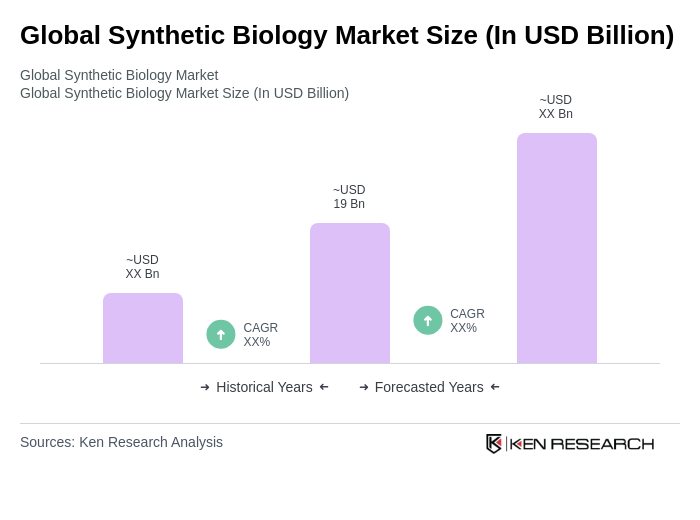
- The Global Synthetic Biology Market is valued at USD 19 billion, based on a five-year historical analysis. This growth is primarily driven by advancements in genetic engineering, increasing demand for biofuels, and the rising need for sustainable agricultural practices. Additional growth drivers include the rapid adoption of synthetic biology in multiplexed diagnostics, therapeutic genome editing, and the development of sustainable and renewable energy sources. The integration of synthetic biology in healthcare, industrial manufacturing, and environmental management continues to propel market expansion .
- The United States, Germany, and China dominate the Global Synthetic Biology Market due to robust research and development infrastructure, significant investments in biotechnology, and a strong presence of leading companies. The U.S. is particularly influential, supported by advanced academic institutions and a regulatory environment that encourages innovation and commercialization. North America leads the market with the highest share, attributed to substantial private and public investments and progressive regulatory frameworks .
- In 2023, the U.S. government implemented the National Bioeconomy Strategy, which aims to enhance the country's synthetic biology capabilities. This initiative includes a commitment of USD 1 billion to support research, development, and commercialization of synthetic biology technologies, promoting sustainable practices and economic growth in the sector. The National Bioeconomy Blueprint, issued by the White House Office of Science and Technology Policy in 2023, outlines operational priorities for federal agencies, including funding thresholds, compliance requirements for research institutions, and standards for commercialization of synthetic biology products .
Global Synthetic Biology Market Segmentation
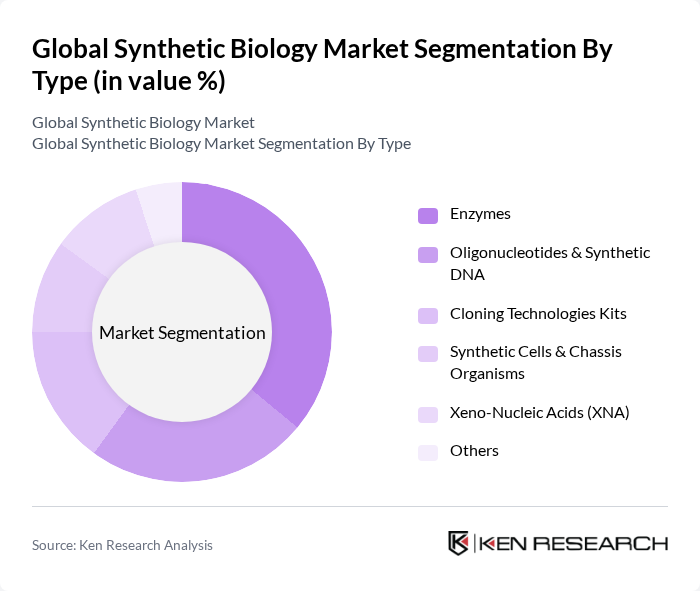
By Type:The synthetic biology market is segmented into various types, including Enzymes, Oligonucleotides & Synthetic DNA, Cloning Technologies Kits, Synthetic Cells & Chassis Organisms, Xeno-Nucleic Acids (XNA), and Others. Among these,Enzymesare leading the market due to their extensive applications in pharmaceuticals, industrial processes, and biotechnological research. The demand for enzymes is driven by their efficiency in catalyzing biochemical reactions, making them essential in genetic engineering, protein synthesis, and metabolic pathway construction .
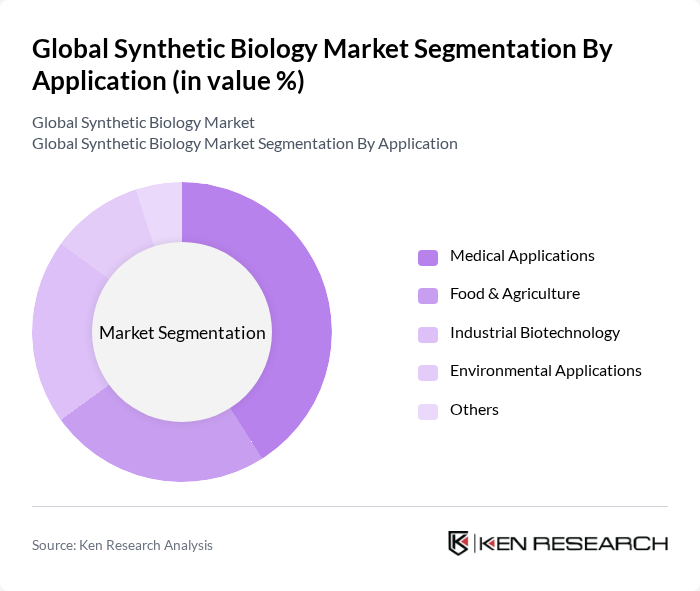
By Application:The applications of synthetic biology are diverse, including Medical Applications (Pharmaceuticals, Drug Discovery & Therapeutics, Artificial Tissue & Regeneration), Food & Agriculture, Industrial Biotechnology, Environmental Applications, and Others.Medical Applicationsrepresent the largest segment, driven by the increasing need for innovative therapies, personalized medicine, and efficient drug discovery processes. The rising prevalence of chronic diseases and the demand for advanced biotechnological solutions further reinforce this segment's dominance .
Global Synthetic Biology Market Competitive Landscape
The Global Synthetic Biology Market is characterized by a dynamic mix of regional and international players. Leading participants such as Ginkgo Bioworks Holdings, Inc., Amyris, Inc., Synlogic, Inc., Twist Bioscience Corporation, Genomatica, Inc., Novozymes A/S, Integrated DNA Technologies, Inc., Codexis, Inc., Synthetic Genomics, Inc., BioAmber Inc., Bota Biosciences Inc., Synthego Corporation, Arzeda Corporation, Thermo Fisher Scientific Inc., Illumina, Inc., Eurofins Scientific SE, New England Biolabs, Inc., Merck KGaA, Pareto Biotechnologies, Inc., Scarab Genomics LLC, Creative Biogene, Creative Enzymes, EnBiotix, Inc., F. Hoffmann-La Roche Ltd. contribute to innovation, geographic expansion, and service delivery in this space.
Global Synthetic Biology Market Industry Analysis
Growth Drivers
- Increasing Demand for Sustainable Solutions:The global push for sustainability is driving the synthetic biology market, with the bioplastics sector projected to reach $44 billion in future. This demand is fueled by a growing consumer preference for eco-friendly products, as evidenced by a 30% increase in sales of biodegradable materials in future. Additionally, the World Bank estimates that sustainable practices could reduce global greenhouse gas emissions by 25% in future, further propelling the need for innovative solutions in synthetic biology.
- Advancements in Genetic Engineering Technologies:The synthetic biology sector is experiencing rapid growth due to advancements in genetic engineering technologies, particularly CRISPR. In future, the global CRISPR market was valued at approximately $3.5 billion, with expectations to reach $6 billion in future. These technologies enable precise modifications in organisms, enhancing productivity in agriculture and healthcare. The increasing efficiency of gene editing tools is expected to drive research and development investments, which totaled $10 billion in future, further supporting market growth.
- Rising Investment in Biomanufacturing:Biomanufacturing is gaining traction, with investments reaching $12 billion in future, reflecting a 20% increase from the previous period. This growth is driven by the need for sustainable production methods and the rising demand for bio-based products. The International Monetary Fund (IMF) projects that biomanufacturing could contribute $1 trillion to the global economy in future. This trend is supported by government initiatives promoting biomanufacturing as a key component of economic development and sustainability.
Market Challenges
- Regulatory Hurdles:The synthetic biology market faces significant regulatory challenges, with over 50 countries implementing stringent biosafety regulations. These regulations can delay product development and market entry, impacting investment returns. For instance, the European Union's regulatory framework for genetically modified organisms (GMOs) has resulted in a 40% increase in approval times for new products. This regulatory landscape creates uncertainty for companies, hindering innovation and slowing market growth.
- High Research and Development Costs:The high costs associated with research and development in synthetic biology pose a significant challenge. In future, the average R&D expenditure for biotech firms was approximately $1.5 billion, with many companies struggling to secure funding. This financial burden can limit the ability to innovate and bring new products to market. Furthermore, the lengthy development timelines, often exceeding five years, exacerbate the financial risks associated with synthetic biology projects.
Global Synthetic Biology Market Future Outlook
The future of the synthetic biology market appears promising, driven by technological advancements and increasing applications across various sectors. The integration of artificial intelligence in research is expected to enhance data analysis and accelerate product development. Additionally, the focus on circular economy practices will likely lead to innovative solutions that minimize waste and promote sustainability. As public awareness grows, the acceptance of synthetic biology solutions is anticipated to increase, further expanding market potential.
Market Opportunities
- Growth in Personalized Medicine:The rise of personalized medicine presents a significant opportunity for synthetic biology, with the global market projected to reach $2.5 trillion in future. This growth is driven by advancements in genomics and biotechnology, enabling tailored treatments for patients. Companies that leverage synthetic biology to develop personalized therapies can capitalize on this expanding market, addressing unmet medical needs and improving patient outcomes.
- Expansion of Synthetic Biology in Agriculture:The agricultural sector is increasingly adopting synthetic biology solutions, with the market for bioengineered crops expected to reach $10 billion in future. This expansion is driven by the need for sustainable farming practices and increased food production. Innovations in crop resilience and yield enhancement through synthetic biology can significantly impact food security, presenting lucrative opportunities for companies in this space.
Scope of the Report
| Segment | Sub-Segments |
|---|---|
| By Type | Enzymes Oligonucleotides & Synthetic DNA Cloning Technologies Kits Synthetic Cells & Chassis Organisms Xeno-Nucleic Acids (XNA) Others |
| By Application | Medical Applications (Pharmaceuticals, Drug Discovery & Therapeutics, Artificial Tissue & Regeneration) Food & Agriculture Industrial Biotechnology Environmental Applications Others |
| By End-User | Pharmaceutical & Biotechnology Companies Academic & Research Institutions Agricultural Firms Industrial Manufacturers Others |
| By Component | Instruments Reagents Software Services Others |
| By Sales Channel | Direct Sales Distributors Online Sales Others |
| By Distribution Mode | Offline Distribution Online Distribution Hybrid Distribution Others |
| By Price Range | Low Price Mid Price High Price Others |
Key Target Audience
Investors and Venture Capitalist Firms
Government and Regulatory Bodies (e.g., U.S. Environmental Protection Agency, European Food Safety Authority)
Biotechnology and Pharmaceutical Companies
Agri-tech Firms
Healthcare Providers and Organizations
Biomanufacturers
Industry Associations (e.g., Synthetic Biology Leadership Council)
Financial Institutions and Investment Banks
Players Mentioned in the Report:
Ginkgo Bioworks Holdings, Inc.
Amyris, Inc.
Synlogic, Inc.
Twist Bioscience Corporation
Genomatica, Inc.
Novozymes A/S
Integrated DNA Technologies, Inc.
Codexis, Inc.
Synthetic Genomics, Inc.
BioAmber Inc.
Bota Biosciences Inc.
Synthego Corporation
Arzeda Corporation
Thermo Fisher Scientific Inc.
Illumina, Inc.
Eurofins Scientific SE
New England Biolabs, Inc.
Merck KGaA
Pareto Biotechnologies, Inc.
Scarab Genomics LLC
Creative Biogene
Creative Enzymes
EnBiotix, Inc.
F. Hoffmann-La Roche Ltd.
Table of Contents
Market Assessment Phase
1. Executive Summary and Approach
2. Global Synthetic Biology Market Overview
2.1 Key Insights and Strategic Recommendations
2.2 Global Synthetic Biology Market Overview
2.3 Definition and Scope
2.4 Evolution of Market Ecosystem
2.5 Timeline of Key Regulatory Milestones
2.6 Value Chain & Stakeholder Mapping
2.7 Business Cycle Analysis
2.8 Policy & Incentive Landscape
3. Global Synthetic Biology Market Analysis
3.1 Growth Drivers
3.1.1 Increasing Demand for Sustainable Solutions
3.1.2 Advancements in Genetic Engineering Technologies
3.1.3 Rising Investment in Biomanufacturing
3.1.4 Expanding Applications in Healthcare and Agriculture
3.2 Market Challenges
3.2.1 Regulatory Hurdles
3.2.2 High Research and Development Costs
3.2.3 Ethical Concerns Surrounding Genetic Modifications
3.2.4 Limited Public Awareness and Acceptance
3.3 Market Opportunities
3.3.1 Growth in Personalized Medicine
3.3.2 Expansion of Synthetic Biology in Agriculture
3.3.3 Development of Biodegradable Materials
3.3.4 Collaborations with Academic Institutions
3.4 Market Trends
3.4.1 Increasing Use of CRISPR Technology
3.4.2 Integration of AI in Synthetic Biology
3.4.3 Focus on Circular Economy Practices
3.4.4 Rise of Bioinformatics in Research
3.5 Government Regulation
3.5.1 Biosafety Regulations
3.5.2 Environmental Impact Assessments
3.5.3 Intellectual Property Rights for Biotechnologies
3.5.4 Funding and Grants for Research Initiatives
4. SWOT Analysis
5. Stakeholder Analysis
6. Porter's Five Forces Analysis
7. Global Synthetic Biology Market Market Size, 2019-2024
7.1 By Value
7.2 By Volume
7.3 By Average Selling Price
8. Global Synthetic Biology Market Segmentation
8.1 By Type
8.1.1 Enzymes
8.1.2 Oligonucleotides & Synthetic DNA
8.1.3 Cloning Technologies Kits
8.1.4 Synthetic Cells & Chassis Organisms
8.1.5 Xeno-Nucleic Acids (XNA)
8.1.6 Others
8.2 By Application
8.2.1 Medical Applications (Pharmaceuticals, Drug Discovery & Therapeutics, Artificial Tissue & Regeneration)
8.2.2 Food & Agriculture
8.2.3 Industrial Biotechnology
8.2.4 Environmental Applications
8.2.5 Others
8.3 By End-User
8.3.1 Pharmaceutical & Biotechnology Companies
8.3.2 Academic & Research Institutions
8.3.3 Agricultural Firms
8.3.4 Industrial Manufacturers
8.3.5 Others
8.4 By Component
8.4.1 Instruments
8.4.2 Reagents
8.4.3 Software
8.4.4 Services
8.4.5 Others
8.5 By Sales Channel
8.5.1 Direct Sales
8.5.2 Distributors
8.5.3 Online Sales
8.5.4 Others
8.6 By Distribution Mode
8.6.1 Offline Distribution
8.6.2 Online Distribution
8.6.3 Hybrid Distribution
8.6.4 Others
8.7 By Price Range
8.7.1 Low Price
8.7.2 Mid Price
8.7.3 High Price
8.7.4 Others
9. Global Synthetic Biology Market Competitive Analysis
9.1 Market Share of Key Players
9.2 KPIs for Cross Comparison of Key Players
9.2.1 Company Name
9.2.2 Group Size (Large, Medium, or Small)
9.2.3 Revenue Growth Rate (YoY %)
9.2.4 R&D Investment as % of Revenue
9.2.5 Number of Patents Filed/Granted
9.2.6 Product Portfolio Breadth (Number of Product Lines)
9.2.7 Geographic Presence (Number of Countries/Regions)
9.2.8 Strategic Partnerships & Collaborations (Count)
9.2.9 Regulatory Approvals (Count, e.g., FDA, EMA)
9.2.10 Market Penetration Rate (% of Target Market)
9.2.11 Customer Segmentation (Healthcare, Agriculture, Industrial, etc.)
9.2.12 Sustainability Initiatives (e.g., % of revenue from sustainable products)
9.2.13 Intellectual Property Strength (Patent Citations, IP Litigation)
9.2.14 Employee Count (FTEs)
9.2.15 EBITDA Margin (%)
9.3 SWOT Analysis of Top Players
9.4 Pricing Analysis
9.5 Detailed Profile of Major Companies
9.5.1 Ginkgo Bioworks Holdings, Inc.
9.5.2 Amyris, Inc.
9.5.3 Synlogic, Inc.
9.5.4 Twist Bioscience Corporation
9.5.5 Genomatica, Inc.
9.5.6 Novozymes A/S
9.5.7 Integrated DNA Technologies, Inc.
9.5.8 Codexis, Inc.
9.5.9 Synthetic Genomics, Inc.
9.5.10 BioAmber Inc.
9.5.11 Bota Biosciences Inc.
9.5.12 Synthego Corporation
9.5.13 Arzeda Corporation
9.5.14 Thermo Fisher Scientific Inc.
9.5.15 Illumina, Inc.
9.5.16 Eurofins Scientific SE
9.5.17 New England Biolabs, Inc.
9.5.18 Merck KGaA
9.5.19 Pareto Biotechnologies, Inc.
9.5.20 Scarab Genomics LLC
9.5.21 Creative Biogene
9.5.22 Creative Enzymes
9.5.23 EnBiotix, Inc.
9.5.24 F. Hoffmann-La Roche Ltd.
10. Global Synthetic Biology Market End-User Analysis
10.1 Procurement Behavior of Key Ministries
10.1.1 Government Funding Trends
10.1.2 Procurement Processes and Timelines
10.1.3 Key Decision-Making Factors
10.2 Corporate Spend on Infrastructure & Energy
10.2.1 Investment in Biotech Facilities
10.2.2 Budget Allocation for R&D
10.2.3 Spending on Sustainable Practices
10.3 Pain Point Analysis by End-User Category
10.3.1 Regulatory Compliance Issues
10.3.2 High Costs of Innovation
10.3.3 Skills Gap in Workforce
10.4 User Readiness for Adoption
10.4.1 Awareness of Synthetic Biology Benefits
10.4.2 Training and Support Needs
10.4.3 Technology Adoption Barriers
10.5 Post-Deployment ROI and Use Case Expansion
10.5.1 Measurement of Success Metrics
10.5.2 Case Studies of Successful Implementations
10.5.3 Future Expansion Opportunities
11. Global Synthetic Biology Market Future Size, 2025-2030
11.1 By Value
11.2 By Volume
11.3 By Average Selling Price
Go-To-Market Strategy Phase
1. Whitespace Analysis + Business Model Canvas
1.1 Market Gaps Identification
1.2 Business Model Development
2. Marketing and Positioning Recommendations
2.1 Branding Strategies
2.2 Product USPs
3. Distribution Plan
3.1 Urban Retail vs Rural NGO Tie-ups
4. Channel & Pricing Gaps
4.1 Underserved Routes
4.2 Pricing Bands
5. Unmet Demand & Latent Needs
5.1 Category Gaps
5.2 Consumer Segments
6. Customer Relationship
6.1 Loyalty Programs
6.2 After-sales Service
7. Value Proposition
7.1 Sustainability
7.2 Integrated Supply Chains
8. Key Activities
8.1 Regulatory Compliance
8.2 Branding
8.3 Distribution Setup
9. Entry Strategy Evaluation
9.1 Domestic Market Entry Strategy
9.1.1 Product Mix
9.1.2 Pricing Band
9.1.3 Packaging
9.2 Export Entry Strategy
9.2.1 Target Countries
9.2.2 Compliance Roadmap
10. Entry Mode Assessment
10.1 JV
10.2 Greenfield
10.3 M&A
10.4 Distributor Model
11. Capital and Timeline Estimation
11.1 Capital Requirements
11.2 Timelines
12. Control vs Risk Trade-Off
12.1 Ownership vs Partnerships
13. Profitability Outlook
13.1 Breakeven Analysis
13.2 Long-term Sustainability
14. Potential Partner List
14.1 Distributors
14.2 JVs
14.3 Acquisition Targets
15. Execution Roadmap
15.1 Phased Plan for Market Entry
15.1.1 Market Setup
15.1.2 Market Entry
15.1.3 Growth Acceleration
15.1.4 Scale & Stabilize
15.2 Key Activities and Milestones
15.2.1 Activity Planning
15.2.2 Milestone Tracking
Research Methodology
Phase 1: Approach1
Desk Research
- Analysis of market reports from industry associations such as the Synthetic Biology Leadership Council
- Review of academic journals and publications focusing on advancements in synthetic biology technologies
- Examination of patent filings and intellectual property trends in synthetic biology applications
Primary Research
- Interviews with leading researchers and scientists in synthetic biology from academic institutions
- Surveys with executives from biotech firms specializing in synthetic biology solutions
- Field interviews with regulatory experts to understand compliance challenges in the market
Validation & Triangulation
- Cross-validation of findings through multiple data sources including market reports and expert opinions
- Triangulation of quantitative data with qualitative insights from industry experts
- Sanity checks through peer reviews and feedback from advisory panels
Phase 2: Market Size Estimation1
Top-down Assessment
- Estimation of market size based on global biotechnology spending and its allocation to synthetic biology
- Segmentation of the market by application areas such as healthcare, agriculture, and industrial biotechnology
- Incorporation of growth rates from related sectors to project synthetic biology market trends
Bottom-up Modeling
- Collection of revenue data from key players in the synthetic biology space
- Estimation of market share based on product offerings and geographic presence
- Volume and pricing analysis of synthetic biology products and services
Forecasting & Scenario Analysis
- Utilization of time-series analysis to project future market growth based on historical data
- Scenario modeling based on potential regulatory changes and technological advancements
- Development of best-case, worst-case, and most-likely scenarios through 2030
Phase 3: CATI Sample Composition1
| Scope Item/Segment | Sample Size | Target Respondent Profiles |
|---|---|---|
| Healthcare Applications of Synthetic Biology | 120 | Biotech Researchers, Pharmaceutical Executives |
| Agricultural Biotechnology Innovations | 90 | Agronomists, Crop Scientists |
| Industrial Biotechnology Processes | 80 | Manufacturing Managers, Process Engineers |
| Environmental Applications of Synthetic Biology | 60 | Sustainability Experts, Environmental Scientists |
| Regulatory Perspectives on Synthetic Biology | 50 | Regulatory Affairs Specialists, Compliance Officers |
Frequently Asked Questions
What is the current value of the Global Synthetic Biology Market?
The Global Synthetic Biology Market is valued at approximately USD 19 billion, driven by advancements in genetic engineering, biofuels demand, and sustainable agricultural practices. This valuation is based on a comprehensive five-year historical analysis.
What are the main drivers of growth in the synthetic biology market?
Which countries dominate the Global Synthetic Biology Market?
What role does the U.S. government play in the synthetic biology sector?
Other Regional/Country Reports
Indonesia Synthetic Biology Market
Malaysia Synthetic Biology Market
APAC Synthetic Biology Market
Other Adjacent Reports
South Korea Genetic Engineering Market
Middle East Biofuels Market Report Size Share Growth Drivers Trends Opportunities & Forecast 2025–2030Bahrain Bioplastics Market Report Size Share Growth Drivers Trends Opportunities & Forecast 2025–2030UAE Crispr Technology MarketMexico Biomanufacturing Market
US personalized medicine market Size, Share, Growth Drivers, Trends, Opportunities & Forecast 2025–2030Kuwait Agricultural Biotechnology Market Size, Share, Growth Drivers, Trends, Opportunities & Forecast 2025–2030Philippines Drug Discovery Market
Qatar genome editing market report size, share, growth drivers, trends, opportunities & forecast 2025–2030Mexico Environmental Biotechnology Market
Why Buy From Us?

What makes us stand out is that our consultants follow Robust, Refine and Result (RRR) methodology. Robust for clear definitions, approaches and sanity checking, Refine for differentiating respondents' facts and opinions, and Result for presenting data with story.

We have set a benchmark in the industry by offering our clients with syndicated and customized market research reports featuring coverage of entire market as well as meticulous research and analyst insights.

While we don't replace traditional research, we flip the method upside down. Our dual approach of Top Bottom & Bottom Top ensures quality deliverable by not just verifying company fundamentals but also looking at the sector and macroeconomic factors.

With one step in the future, our research team constantly tries to show you the bigger picture. We help with some of the tough questions you may encounter along the way: How is the industry positioned? Best marketing channel? KPI's of competitors? By aligning every element, we help maximize success.

Our report gives you instant access to the answers and sources that other companies might choose to hide. We elaborate each steps of research methodology we have used and showcase you the sample size to earn your trust.

If you need any support, we are here! We pride ourselves on universe strength, data quality, and quick, friendly, and professional service.