About the Report
Base Year 2024Listen to the audio summary
US Personalized Medicine Market Overview
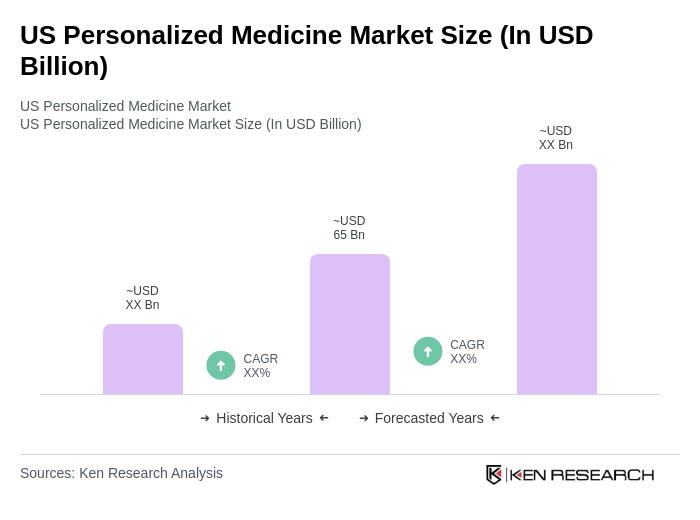
- The US Personalized Medicine Market is valued at USD 65 billion, based on a five-year historical analysis. This growth is primarily driven by advancements in genomics, increased adoption of targeted therapies, and a growing emphasis on individualized patient care. The integration of technology in healthcare, such as artificial intelligence and big data analytics, has further propelled the market, enabling more precise diagnostics and treatment options. Additional growth drivers include the rising incidence of chronic diseases such as cancer, cardiovascular disorders, and diabetes, as well as increased healthcare spending and supportive government initiatives that foster innovation in personalized healthcare solutions .
- Key players in this market include major cities like San Francisco, Boston, and New York, which dominate due to their robust healthcare infrastructure, presence of leading biotech firms, and strong research institutions. These regions foster innovation and collaboration, attracting investments and talent, which are crucial for the development of personalized medicine solutions .
- The 21st Century Cures Act, issued by the US Congress in 2016, remains a cornerstone regulation for the sector. This Act aims to accelerate medical product development and bring new innovations to patients faster. It emphasizes the importance of personalized medicine by promoting the use of real-world evidence and streamlining the approval process for personalized therapies and diagnostics, thereby enhancing patient access to tailored treatments. The Act mandates the Food and Drug Administration (FDA) to incorporate patient perspectives and data-driven evidence into regulatory decision-making, directly impacting the development and approval of personalized medicine products .
US Personalized Medicine Market Segmentation
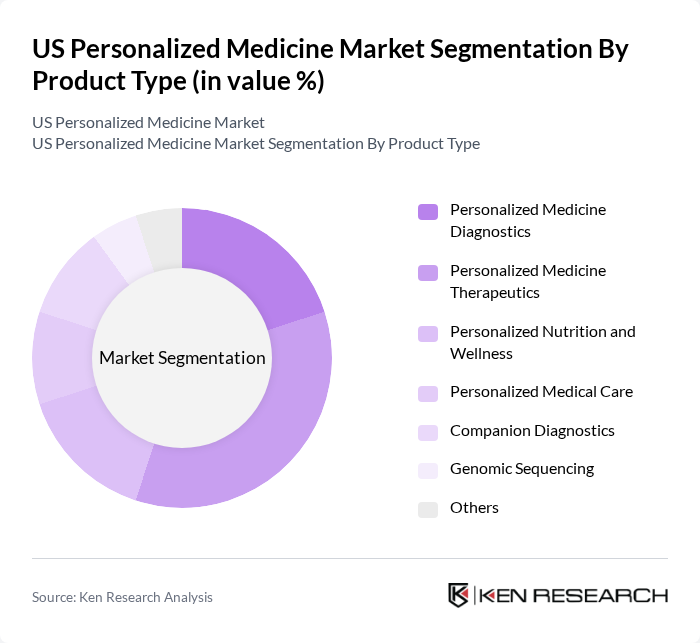
By Product Type:The product type segmentation includes various subsegments such as Personalized Medicine Diagnostics, Personalized Medicine Therapeutics, Personalized Nutrition and Wellness, Personalized Medical Care, Companion Diagnostics, Genomic Sequencing, and Others. Among these, Personalized Medicine Therapeutics is currently the leading subsegment, driven by the increasing demand for targeted therapies that cater to individual patient profiles. The rise in chronic diseases and the need for effective treatment options have further fueled the growth of this segment. Personalized Nutrition and Wellness is also expanding rapidly, reflecting consumer demand for individualized health and lifestyle solutions .
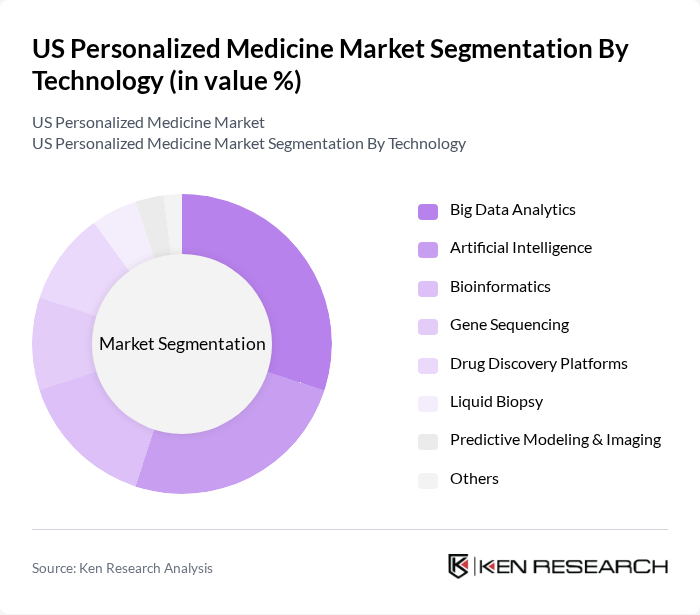
By Technology:The technology segmentation encompasses Big Data Analytics, Artificial Intelligence, Bioinformatics, Gene Sequencing, Drug Discovery Platforms, Liquid Biopsy, Predictive Modeling & Imaging, and Others. Big Data Analytics is the dominant technology in this market, as it enables healthcare providers to analyze vast amounts of patient data to derive insights that lead to personalized treatment plans. The increasing reliance on data-driven decision-making in healthcare is propelling the growth of this segment. Artificial Intelligence is also rapidly gaining adoption, supporting clinical decision-making and accelerating drug discovery processes .
US Personalized Medicine Market Competitive Landscape
The US Personalized Medicine Market is characterized by a dynamic mix of regional and international players. Leading participants such as Illumina, Inc., Thermo Fisher Scientific Inc., Danaher Corporation (Cepheid Inc.), Foundation Medicine, Inc., Myriad Genetics, Inc., Exact Sciences Corporation, Guardant Health, Inc., Genentech, Inc., Pfizer Inc., Roche Holding AG, Novartis AG, GSK plc, AstraZeneca PLC, Merck & Co., Inc., Regeneron Pharmaceuticals, Inc. contribute to innovation, geographic expansion, and service delivery in this space.
US Personalized Medicine Market Industry Analysis
Growth Drivers
- Increasing Prevalence of Chronic Diseases:The US is witnessing a significant rise in chronic diseases, with approximately 60% of adults living with at least one chronic condition as of the future. This translates to around 150 million individuals, creating a substantial demand for personalized medicine solutions. The Centers for Disease Control and Prevention (CDC) reports that chronic diseases account for 7 out of 10 deaths annually, emphasizing the urgent need for tailored treatment options that can effectively address these health challenges.
- Advancements in Genomic Technologies:The US personalized medicine market is being propelled by rapid advancements in genomic technologies, with the cost of whole-genome sequencing dropping to approximately $1,000 in the future. This accessibility allows for broader implementation of genomic testing in clinical settings, enabling healthcare providers to offer more precise and individualized treatment plans. The National Human Genome Research Institute indicates that these technological improvements are crucial for enhancing patient outcomes and driving the adoption of personalized therapies.
- Rising Demand for Targeted Therapies:The market for targeted therapies is expanding, with an estimated 30% of new cancer drugs approved in the future being classified as targeted therapies. This shift is driven by the increasing recognition of the effectiveness of personalized treatment approaches, which are tailored to the genetic profile of individual patients. The American Society of Clinical Oncology reports that targeted therapies can lead to improved survival rates, further fueling demand for personalized medicine solutions across various therapeutic areas.
Market Challenges
- High Costs of Personalized Treatments:One of the significant challenges facing the US personalized medicine market is the high cost associated with personalized treatments, which can exceed $100,000 annually for certain therapies. This financial burden limits access for many patients, particularly those without adequate insurance coverage. The National Institutes of Health (NIH) highlights that while personalized medicine can improve outcomes, the economic implications pose a barrier to widespread adoption and utilization in clinical practice.
- Regulatory Hurdles and Compliance Issues:The regulatory landscape for personalized medicine is complex, with the FDA overseeing numerous guidelines that can delay the approval of new therapies. In the future, the average time for FDA approval of personalized therapies is approximately 12-18 months, which can hinder innovation and market entry. Additionally, compliance with HIPAA regulations regarding patient data privacy adds another layer of complexity, making it challenging for companies to navigate the regulatory environment effectively.
US Personalized Medicine Market Future Outlook
The future of the US personalized medicine market appears promising, driven by ongoing technological advancements and a growing emphasis on patient-centric care. As healthcare systems increasingly adopt value-based care models, personalized medicine is expected to play a pivotal role in improving patient outcomes and reducing overall healthcare costs. Furthermore, the integration of artificial intelligence in treatment planning and diagnostics is anticipated to enhance the precision and efficiency of personalized therapies, paving the way for innovative solutions in the coming years.
Market Opportunities
- Expansion of Telemedicine Services:The rise of telemedicine presents a significant opportunity for personalized medicine, with an estimated 30 million telehealth visits projected in the future. This growth allows for greater access to personalized consultations and genomic testing, particularly in underserved areas. By leveraging telehealth platforms, healthcare providers can offer tailored treatment plans and follow-up care, enhancing patient engagement and adherence to personalized therapies.
- Development of Companion Diagnostics:The increasing focus on companion diagnostics is creating new opportunities in the personalized medicine market. In the future, the companion diagnostics market is expected to reach $5 billion, driven by the need for tests that identify patients who will benefit from specific therapies. This trend supports the development of targeted treatments and enhances the overall effectiveness of personalized medicine, aligning with the growing demand for precision healthcare solutions.
Scope of the Report
| Segment | Sub-Segments |
|---|---|
| By Product Type | Personalized Medicine Diagnostics Personalized Medicine Therapeutics Personalized Nutrition and Wellness Personalized Medical Care Companion Diagnostics Genomic Sequencing Others |
| By Technology | Big Data Analytics Artificial Intelligence Bioinformatics Gene Sequencing Drug Discovery Platforms Liquid Biopsy Predictive Modeling & Imaging Others |
| By Application | Oncology Central Nervous System (CNS) Disorders Immunology Cardiovascular Diseases Infectious Diseases Respiratory Diseases Liver Diseases Rheumatology Others |
| By End-User | Hospitals Diagnostic Centers/Laboratories Research & Academic Institutes Pharmaceutical & Biotechnology Companies Others |
| By Distribution Channel | Direct Sales Online Sales Distributors Retail Pharmacies Others |
| By Region | Northeast Midwest South West Others |
| By Patient Demographics | Age Group Gender Socioeconomic Status Others |
| By Pricing Strategy | Premium Pricing Competitive Pricing Value-Based Pricing Others |
Key Target Audience
Investors and Venture Capitalist Firms
Government and Regulatory Bodies (e.g., Food and Drug Administration, National Institutes of Health)
Pharmaceutical Companies
Biotechnology Firms
Healthcare Providers and Systems
Health Insurance Companies
Diagnostic Laboratories
Medical Device Manufacturers
Players Mentioned in the Report:
Illumina, Inc.
Thermo Fisher Scientific Inc.
Danaher Corporation (Cepheid Inc.)
Foundation Medicine, Inc.
Myriad Genetics, Inc.
Exact Sciences Corporation
Guardant Health, Inc.
Genentech, Inc.
Pfizer Inc.
Roche Holding AG
Novartis AG
GSK plc
AstraZeneca PLC
Merck & Co., Inc.
Regeneron Pharmaceuticals, Inc.
Table of Contents
Market Assessment Phase
1. Executive Summary and Approach
2. US Personalized Medicine Market Overview
2.1 Key Insights and Strategic Recommendations
2.2 US Personalized Medicine Market Overview
2.3 Definition and Scope
2.4 Evolution of Market Ecosystem
2.5 Timeline of Key Regulatory Milestones
2.6 Value Chain & Stakeholder Mapping
2.7 Business Cycle Analysis
2.8 Policy & Incentive Landscape
3. US Personalized Medicine Market Analysis
3.1 Growth Drivers
3.1.1 Increasing prevalence of chronic diseases
3.1.2 Advancements in genomic technologies
3.1.3 Rising demand for targeted therapies
3.1.4 Growing investment in research and development
3.2 Market Challenges
3.2.1 High costs of personalized treatments
3.2.2 Regulatory hurdles and compliance issues
3.2.3 Limited awareness among healthcare providers
3.2.4 Data privacy concerns
3.3 Market Opportunities
3.3.1 Expansion of telemedicine services
3.3.2 Collaborations between biotech firms and healthcare providers
3.3.3 Development of companion diagnostics
3.3.4 Increasing focus on preventive healthcare
3.4 Market Trends
3.4.1 Integration of AI in personalized medicine
3.4.2 Shift towards value-based care models
3.4.3 Growth of patient-centric approaches
3.4.4 Rise of digital health solutions
3.5 Government Regulation
3.5.1 FDA guidelines on personalized medicine
3.5.2 Medicare coverage for genomic testing
3.5.3 HIPAA regulations on patient data
3.5.4 State-level initiatives for personalized therapies
4. SWOT Analysis
5. Stakeholder Analysis
6. Porter's Five Forces Analysis
7. US Personalized Medicine Market Market Size, 2019-2024
7.1 By Value
7.2 By Volume
7.3 By Average Selling Price
8. US Personalized Medicine Market Segmentation
8.1 By Product Type
8.1.1 Personalized Medicine Diagnostics
8.1.2 Personalized Medicine Therapeutics
8.1.3 Personalized Nutrition and Wellness
8.1.4 Personalized Medical Care
8.1.5 Companion Diagnostics
8.1.6 Genomic Sequencing
8.1.7 Others
8.2 By Technology
8.2.1 Big Data Analytics
8.2.2 Artificial Intelligence
8.2.3 Bioinformatics
8.2.4 Gene Sequencing
8.2.5 Drug Discovery Platforms
8.2.6 Liquid Biopsy
8.2.7 Predictive Modeling & Imaging
8.2.8 Others
8.3 By Application
8.3.1 Oncology
8.3.2 Central Nervous System (CNS) Disorders
8.3.3 Immunology
8.3.4 Cardiovascular Diseases
8.3.5 Infectious Diseases
8.3.6 Respiratory Diseases
8.3.7 Liver Diseases
8.3.8 Rheumatology
8.3.9 Others
8.4 By End-User
8.4.1 Hospitals
8.4.2 Diagnostic Centers/Laboratories
8.4.3 Research & Academic Institutes
8.4.4 Pharmaceutical & Biotechnology Companies
8.4.5 Others
8.5 By Distribution Channel
8.5.1 Direct Sales
8.5.2 Online Sales
8.5.3 Distributors
8.5.4 Retail Pharmacies
8.5.5 Others
8.6 By Region
8.6.1 Northeast
8.6.2 Midwest
8.6.3 South
8.6.4 West
8.6.5 Others
8.7 By Patient Demographics
8.7.1 Age Group
8.7.2 Gender
8.7.3 Socioeconomic Status
8.7.4 Others
8.8 By Pricing Strategy
8.8.1 Premium Pricing
8.8.2 Competitive Pricing
8.8.3 Value-Based Pricing
8.8.4 Others
9. US Personalized Medicine Market Competitive Analysis
9.1 Market Share of Key Players
9.2 KPIs for Cross Comparison of Key Players
9.2.1 Company Name
9.2.2 Group Size (Large, Medium, or Small as per industry convention)
9.2.3 US Personalized Medicine Revenue
9.2.4 Revenue Growth Rate (US Market)
9.2.5 R&D Expenditure as % of Revenue
9.2.6 Number of FDA-Approved Personalized Therapies/Diagnostics
9.2.7 Market Penetration Rate (US)
9.2.8 Pipeline Strength (Number of Personalized Medicine Candidates)
9.2.9 Strategic Partnerships/Collaborations
9.2.10 Customer Retention Rate
9.2.11 Product Development Cycle Time
9.2.12 Pricing Strategy
9.2.13 Sales Conversion Rate
9.2.14 Average Order Value
9.2.15 Customer Satisfaction Score (Net Promoter Score or equivalent)
9.3 SWOT Analysis of Top Players
9.4 Pricing Analysis
9.5 Detailed Profile of Major Companies
9.5.1 Illumina, Inc.
9.5.2 Thermo Fisher Scientific Inc.
9.5.3 Danaher Corporation (Cepheid Inc.)
9.5.4 Foundation Medicine, Inc.
9.5.5 Myriad Genetics, Inc.
9.5.6 Exact Sciences Corporation
9.5.7 Guardant Health, Inc.
9.5.8 Genentech, Inc.
9.5.9 Pfizer Inc.
9.5.10 Roche Holding AG
9.5.11 Novartis AG
9.5.12 GSK plc
9.5.13 AstraZeneca PLC
9.5.14 Merck & Co., Inc.
9.5.15 Regeneron Pharmaceuticals, Inc.
10. US Personalized Medicine Market End-User Analysis
10.1 Procurement Behavior of Key Ministries
10.1.1 Federal Health Agencies
10.1.2 State Health Departments
10.1.3 Veteran Affairs
10.2 Corporate Spend on Infrastructure & Energy
10.2.1 Healthcare Facilities
10.2.2 Research Institutions
10.2.3 Pharmaceutical Companies
10.3 Pain Point Analysis by End-User Category
10.3.1 Healthcare Providers
10.3.2 Patients
10.3.3 Payers
10.4 User Readiness for Adoption
10.4.1 Awareness Levels
10.4.2 Training Needs
10.4.3 Technology Infrastructure
10.5 Post-Deployment ROI and Use Case Expansion
10.5.1 Cost Savings
10.5.2 Improved Patient Outcomes
10.5.3 Scalability of Solutions
11. US Personalized Medicine Market Future Size, 2025-2030
11.1 By Value
11.2 By Volume
11.3 By Average Selling Price
Go-To-Market Strategy Phase
1. Whitespace Analysis + Business Model Canvas
1.1 Market Gaps Identification
1.2 Value Proposition Development
1.3 Revenue Streams Analysis
1.4 Cost Structure Evaluation
1.5 Key Partnerships Exploration
1.6 Customer Segmentation
1.7 Channels of Distribution
2. Marketing and Positioning Recommendations
2.1 Branding Strategies
2.2 Product USPs
3. Distribution Plan
3.1 Urban Retail vs Rural NGO Tie-ups
4. Channel & Pricing Gaps
4.1 Underserved Routes
4.2 Pricing Bands
5. Unmet Demand & Latent Needs
5.1 Category Gaps
5.2 Consumer Segments
6. Customer Relationship
6.1 Loyalty Programs
6.2 After-sales Service
7. Value Proposition
7.1 Sustainability
7.2 Integrated Supply Chains
8. Key Activities
8.1 Regulatory Compliance
8.2 Branding
8.3 Distribution Setup
9. Entry Strategy Evaluation
9.1 Domestic Market Entry Strategy
9.1.1 Product Mix
9.1.2 Pricing Band
9.1.3 Packaging
9.2 Export Entry Strategy
9.2.1 Target Countries
9.2.2 Compliance Roadmap
10. Entry Mode Assessment
10.1 JV
10.2 Greenfield
10.3 M&A
10.4 Distributor Model
11. Capital and Timeline Estimation
11.1 Capital Requirements
11.2 Timelines
12. Control vs Risk Trade-Off
12.1 Ownership vs Partnerships
13. Profitability Outlook
13.1 Breakeven Analysis
13.2 Long-term Sustainability
14. Potential Partner List
14.1 Distributors
14.2 JVs
14.3 Acquisition Targets
15. Execution Roadmap
15.1 Phased Plan for Market Entry
15.1.1 Market Setup
15.1.2 Market Entry
15.1.3 Growth Acceleration
15.1.4 Scale & Stabilize
15.2 Key Activities and Milestones
15.2.1 Activity Planning
15.2.2 Milestone Tracking
Research Methodology
Phase 1: Approach1
Desk Research
- Analysis of industry reports from leading healthcare organizations and market research firms
- Review of published articles in medical journals focusing on advancements in personalized medicine
- Examination of government publications and healthcare policy documents related to personalized medicine initiatives
Primary Research
- Interviews with key opinion leaders in genomics and personalized medicine
- Surveys conducted with healthcare providers and specialists in oncology and rare diseases
- Focus groups with patients utilizing personalized medicine therapies to gather insights on experiences and outcomes
Validation & Triangulation
- Cross-validation of findings through multiple data sources including clinical trial results and market forecasts
- Triangulation of insights from primary interviews with secondary data trends
- Sanity checks through expert panel discussions to ensure data reliability and relevance
Phase 2: Market Size Estimation1
Top-down Assessment
- Estimation of market size based on national healthcare expenditure and allocation towards personalized medicine
- Segmentation of the market by therapeutic areas such as oncology, cardiology, and rare diseases
- Incorporation of demographic trends and patient population growth impacting personalized medicine adoption
Bottom-up Modeling
- Collection of data from leading personalized medicine companies on product sales and service utilization
- Estimation of market penetration rates based on current adoption levels in various healthcare settings
- Volume x pricing analysis for personalized therapies and diagnostic tests
Forecasting & Scenario Analysis
- Multi-variable forecasting models incorporating technological advancements and regulatory changes
- Scenario analysis based on potential shifts in healthcare policies and reimbursement frameworks
- Development of baseline, optimistic, and pessimistic market projections through 2030
Phase 3: CATI Sample Composition1
| Scope Item/Segment | Sample Size | Target Respondent Profiles |
|---|---|---|
| Oncology Personalized Treatments | 120 | Oncologists, Clinical Researchers |
| Genomic Testing Services | 90 | Laboratory Directors, Genetic Counselors |
| Patient Experience in Personalized Medicine | 60 | Patients, Caregivers |
| Pharmaceutical Development for Rare Diseases | 50 | Pharmaceutical Executives, R&D Managers |
| Healthcare Policy Impact on Personalized Medicine | 40 | Healthcare Policy Analysts, Government Officials |
Frequently Asked Questions
What is the current value of the US Personalized Medicine Market?
The US Personalized Medicine Market is valued at approximately USD 65 billion, driven by advancements in genomics, targeted therapies, and a focus on individualized patient care. This valuation is based on a comprehensive five-year historical analysis.
What are the main drivers of growth in the US Personalized Medicine Market?
Which regions in the US are leading in personalized medicine?
What role does the 21st Century Cures Act play in personalized medicine?
Other Regional/Country Reports
Indonesia Personalized Medicine Market
Malaysia Personalized Medicine Market
APAC Personalized Medicine Market
Other Adjacent Reports
Why Buy From Us?

What makes us stand out is that our consultants follow Robust, Refine and Result (RRR) methodology. Robust for clear definitions, approaches and sanity checking, Refine for differentiating respondents' facts and opinions, and Result for presenting data with story.

We have set a benchmark in the industry by offering our clients with syndicated and customized market research reports featuring coverage of entire market as well as meticulous research and analyst insights.

While we don't replace traditional research, we flip the method upside down. Our dual approach of Top Bottom & Bottom Top ensures quality deliverable by not just verifying company fundamentals but also looking at the sector and macroeconomic factors.

With one step in the future, our research team constantly tries to show you the bigger picture. We help with some of the tough questions you may encounter along the way: How is the industry positioned? Best marketing channel? KPI's of competitors? By aligning every element, we help maximize success.

Our report gives you instant access to the answers and sources that other companies might choose to hide. We elaborate each steps of research methodology we have used and showcase you the sample size to earn your trust.

If you need any support, we are here! We pride ourselves on universe strength, data quality, and quick, friendly, and professional service.