About the Report
Base Year 2024Global Tetrahydrocannabinol THC Water Market Overview
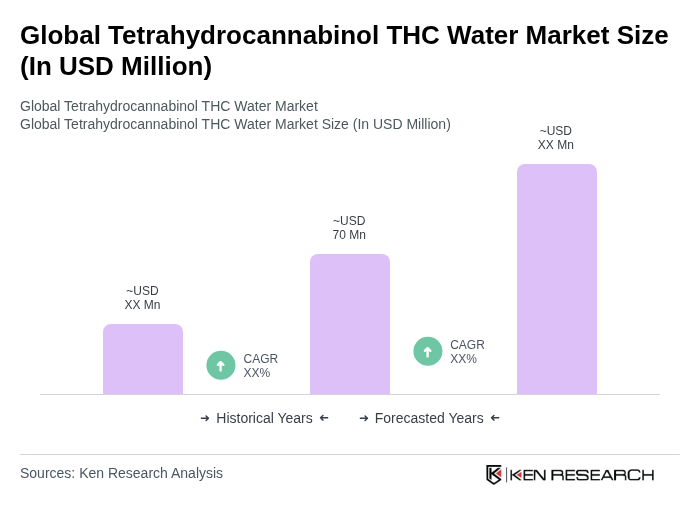
- The Global Tetrahydrocannabinol THC Water Market is valued at USD 70 million, based on a five-year historical analysis. This growth is primarily driven by the increasing acceptance of cannabis-infused beverages, rising consumer interest in wellness-oriented and functional drinks, and the expanding legalization of cannabis for medical and adult-use purposes in various regions. The market has seen a surge in demand as consumers seek smoke-free, dose-controlled alternatives to traditional cannabis consumption that offer both recreational and perceived therapeutic benefits, including relaxation, stress relief, and social consumption occasions.
- Key players in this market include the United States and Canada, which dominate due to their progressive cannabis frameworks and established infrastructure for cannabis cultivation, processing, and distribution. North America accounts for a very high share of global THC water revenues, supported by a large consumer base, broad product portfolios, and active innovation in low-dose and functional beverages in the U.S., while Canada’s nationwide legalization of recreational cannabis has fostered product development, brand diversification, and capital inflows into infused beverage formats.
- In the United States, THC-infused beverages are regulated at the state level under individual cannabis programs, which commonly require licensed manufacturers to conduct laboratory testing for potency (THC content), residual solvents, pesticides, heavy metals, and microbiological contaminants before products can be sold to consumers. For example, in California, the Department of Cannabis Control enforces the Medicinal and Adult-Use Cannabis Regulation and Safety Act (MAUCRSA), which requires all cannabis-infused beverages to be tested by a state-licensed laboratory for cannabinoid potency, homogeneity, and specified contaminants prior to retail sale, with batch-level certificates of analysis and strict packaging and labeling obligations for THC content and warnings.
Global Tetrahydrocannabinol THC Water Market Segmentation
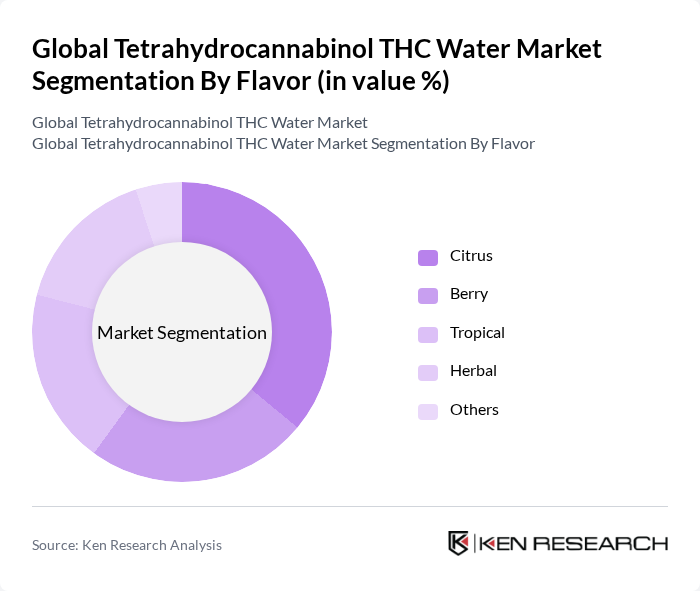
By Flavor:The flavor profile of THC water is crucial for consumer acceptance and market growth. The leading sub-segments include Citrus, Berry, Tropical, Herbal, and Others. Citrus flavors are particularly popular due to their refreshing taste and ability to mask the earthy or bitter notes of cannabinoids, making them appealing to a broader audience; citrus-flavored THC water accounts for the largest share of global revenues among flavors. Berry flavors also attract health-conscious consumers who associate berries with antioxidants and natural ingredients, while Tropical flavors cater to those seeking more exotic and indulgent experiences in social and leisure settings. Herbal flavors are gaining traction among wellness enthusiasts looking for natural, botanical-forward options, often positioned around relaxation, adaptogens, or functional ingredients, and the “Others” segment includes niche and experimental flavor blends that support premium and craft positioning.
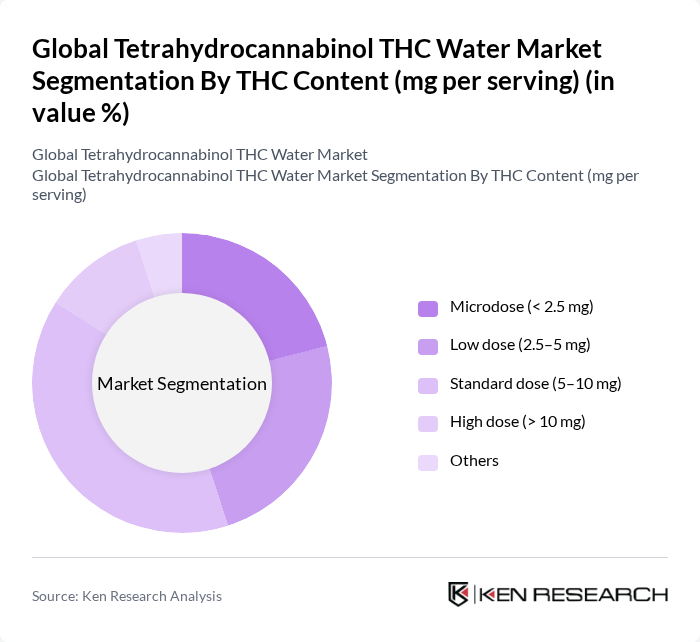
By THC Content (mg per serving):The THC content in beverages is a significant factor influencing consumer choice. The market is segmented into Microdose (< 2.5 mg), Low dose (2.5–5 mg), Standard dose (5–10 mg), High dose (> 10 mg), and Others. The Standard dose segment is currently leading the market as it provides a balanced experience for both novice and experienced users and aligns with common state-level serving guidelines around 5–10 mg THC per serving for adult-use beverages. Microdosing is also gaining popularity among consumers looking for subtle, functional effects without overwhelming psychoactivity, especially for daytime, social, or wellness-focused consumption, while low-dose formats appeal to new users and those seeking alcohol alternatives.
Global Tetrahydrocannabinol THC Water Market Competitive Landscape
The Global Tetrahydrocannabinol THC Water Market is characterized by a dynamic mix of regional and international players. Leading participants such as CannaCraft Inc., Cann Social Tonics, Keef Brands, WLD WTR, Climbing Kites, Calexo, Drink Delta, Snapdragon Hemp, Canopy Growth Corporation, Tilray Brands, Inc., Hexo Corp., Trulieve Cannabis Corp., Curaleaf Holdings, Inc., Green Thumb Industries Inc., Cresco Labs Inc. contribute to innovation, geographic expansion, and service delivery in this space.
Global Tetrahydrocannabinol THC Water Market Industry Analysis
Growth Drivers
- Increasing Consumer Demand for Wellness Products:The wellness industry is projected to reach $4.9 trillion in future, with consumers increasingly seeking products that promote health and well-being. In future, the global demand for functional beverages, including THC-infused options, surged by 25%, driven by a shift towards healthier lifestyles. This trend is supported by a 20% increase in consumer spending on wellness products, indicating a robust market for THC water as part of this growing segment.
- Rising Legalization of Cannabis Products:As of future, over 40 countries have legalized cannabis for medicinal or recreational use, significantly expanding the market for THC products. The U.S. cannabis market alone is expected to exceed $35 billion, with states like California and Colorado leading the way. This legal framework not only enhances consumer access but also encourages investment in THC water production, fostering innovation and market growth in regions where cannabis is legalized.
- Growing Awareness of the Health Benefits of THC:Research indicates that THC can alleviate symptoms of anxiety, chronic pain, and insomnia, contributing to its rising popularity. A study found that 70% of consumers are more likely to purchase THC products due to increased awareness of their health benefits. This growing recognition is driving demand for THC water, as consumers seek natural alternatives to traditional pharmaceuticals, further propelling market growth.
Market Challenges
- Regulatory Hurdles in Various Regions:The regulatory landscape for THC products remains complex and fragmented. In future, over 45% of countries still impose strict regulations on cannabis, creating barriers to market entry. Compliance with varying laws can lead to increased operational costs and delays in product launches. This regulatory uncertainty poses a significant challenge for companies looking to expand their THC water offerings in diverse markets.
- Stigma Associated with Cannabis Products:Despite growing acceptance, stigma surrounding cannabis persists, particularly in conservative regions. A survey revealed that 35% of consumers still view THC products negatively, impacting market penetration. This societal perception can hinder marketing efforts and limit consumer adoption, posing a challenge for brands aiming to establish a foothold in the THC water market and reach broader audiences.
Global Tetrahydrocannabinol THC Water Market Future Outlook
The future of the THC water market appears promising, driven by increasing consumer interest in wellness and the ongoing legalization of cannabis products. As more regions embrace cannabis, companies are likely to innovate with diverse formulations that cater to specific health needs. Additionally, the rise of e-commerce platforms will facilitate broader distribution, allowing brands to reach consumers directly. This evolving landscape presents significant opportunities for growth and market expansion in the coming years.
Market Opportunities
- Development of Innovative Product Formulations:There is a growing opportunity for brands to create unique THC water formulations that cater to specific health concerns, such as stress relief or enhanced hydration. By leveraging consumer insights and scientific research, companies can differentiate their products, potentially increasing market share and consumer loyalty in a competitive landscape.
- Expansion into Emerging Markets:Emerging markets, particularly in Asia and Latin America, present untapped potential for THC water products. As legalization progresses and consumer awareness grows, companies can strategically enter these markets, capitalizing on the increasing demand for wellness beverages. This expansion could significantly enhance revenue streams and brand visibility on a global scale.
Scope of the Report
| Segment | Sub-Segments |
|---|---|
| By Flavor | Citrus Berry Tropical Herbal Others |
| By THC Content (mg per serving) | Microdose (< 2.5 mg) Low dose (2.5–5 mg) Standard dose (5–10 mg) High dose (> 10 mg) Others |
| By Distribution Channel | Hypermarkets & Supermarkets Specialty Stores & Dispensaries Online Retail Others |
| By Packaging Type | Bottles Cans Others |
| By Region | North America Europe Asia-Pacific Latin America Middle East & Africa |
| By Price Range | Premium Mid-range Economy Others |
| By Cannabinoid Formulation | THC-only THC + CBD (Hybrid) THC with functional additives (adaptogens, vitamins, etc.) Others |
Key Target Audience
Investors and Venture Capitalist Firms
Government and Regulatory Bodies (e.g., Food and Drug Administration, Drug Enforcement Administration)
Manufacturers and Producers of THC Water
Distributors and Retailers of Cannabis Products
Health and Wellness Companies
Pharmaceutical Companies
Industry Associations (e.g., National Cannabis Industry Association)
Financial Institutions and Investment Banks
Players Mentioned in the Report:
CannaCraft Inc.
Cann Social Tonics
Keef Brands
WLD WTR
Climbing Kites
Calexo
Drink Delta
Snapdragon Hemp
Canopy Growth Corporation
Tilray Brands, Inc.
Hexo Corp.
Trulieve Cannabis Corp.
Curaleaf Holdings, Inc.
Green Thumb Industries Inc.
Cresco Labs Inc.
Table of Contents
Market Assessment Phase
1. Executive Summary and Approach
2. Global Tetrahydrocannabinol THC Water Market Overview
2.1 Key Insights and Strategic Recommendations
2.2 Global Tetrahydrocannabinol THC Water Market Overview
2.3 Definition and Scope
2.4 Evolution of Market Ecosystem
2.5 Timeline of Key Regulatory Milestones
2.6 Value Chain & Stakeholder Mapping
2.7 Business Cycle Analysis
2.8 Policy & Incentive Landscape
3. Global Tetrahydrocannabinol THC Water Market Analysis
3.1 Growth Drivers
3.1.1 Increasing consumer demand for wellness products
3.1.2 Rising legalization of cannabis products
3.1.3 Growing awareness of the health benefits of THC
3.1.4 Expansion of distribution channels
3.2 Market Challenges
3.2.1 Regulatory hurdles in various regions
3.2.2 Stigma associated with cannabis products
3.2.3 Supply chain complexities
3.2.4 Competition from alternative wellness beverages
3.3 Market Opportunities
3.3.1 Development of innovative product formulations
3.3.2 Expansion into emerging markets
3.3.3 Collaborations with health and wellness brands
3.3.4 Increasing online sales channels
3.4 Market Trends
3.4.1 Shift towards organic and natural ingredients
3.4.2 Customization of products for specific health needs
3.4.3 Rise of functional beverages
3.4.4 Increased focus on sustainability in packaging
3.5 Government Regulation
3.5.1 Legalization of THC in various jurisdictions
3.5.2 Regulations on labeling and marketing
3.5.3 Taxation policies affecting cannabis products
3.5.4 Compliance requirements for production and distribution
4. SWOT Analysis
5. Stakeholder Analysis
6. Porter's Five Forces Analysis
7. Global Tetrahydrocannabinol THC Water Market Market Size, 2019-2024
7.1 By Value
7.2 By Volume
7.3 By Average Selling Price
8. Global Tetrahydrocannabinol THC Water Market Segmentation
8.1 By Flavor
8.1.1 Citrus
8.1.2 Berry
8.1.3 Tropical
8.1.4 Herbal
8.1.5 Others
8.2 By THC Content (mg per serving)
8.2.1 Microdose (< 2.5 mg)
8.2.2 Low dose (2.5–5 mg)
8.2.3 Standard dose (5–10 mg)
8.2.4 High dose (> 10 mg)
8.2.5 Others
8.3 By Distribution Channel
8.3.1 Hypermarkets & Supermarkets
8.3.2 Specialty Stores & Dispensaries
8.3.3 Online Retail
8.3.4 Others
8.4 By Packaging Type
8.4.1 Bottles
8.4.2 Cans
8.4.3 Others
8.5 By Region
8.5.1 North America
8.5.2 Europe
8.5.3 Asia-Pacific
8.5.4 Latin America
8.5.5 Middle East & Africa
8.6 By Price Range
8.6.1 Premium
8.6.2 Mid-range
8.6.3 Economy
8.6.4 Others
8.7 By Cannabinoid Formulation
8.7.1 THC-only
8.7.2 THC + CBD (Hybrid)
8.7.3 THC with functional additives (adaptogens, vitamins, etc.)
8.7.4 Others
9. Global Tetrahydrocannabinol THC Water Market Competitive Analysis
9.1 Market Share of Key Players
9.2 Cross Comparison of Key Players
9.2.1 Company Name
9.2.2 Group Size (Large, Medium, or Small as per industry convention)
9.2.3 THC Water Segment Revenue (USD)
9.2.4 THC Water Revenue CAGR (3–5 years)
9.2.5 EBITDA Margin from Beverages Business (%)
9.2.6 Average Realized Price per Unit (USD/liter or USD/unit)
9.2.7 Market Share in THC Beverages (%)
9.2.8 Geographic Revenue Mix (Domestic vs International)
9.2.9 R&D Spend as % of Revenue
9.2.10 Marketing & Promotion Spend as % of Revenue
9.2.11 Distribution Reach (Number of retail points / states / countries)
9.2.12 Product Portfolio Breadth (SKUs in THC beverages)
9.2.13 Digital & E-commerce Revenue Share (%)
9.3 SWOT Analysis of Top Players
9.4 Pricing Analysis
9.5 Detailed Profile of Major Companies
9.5.1 CannaCraft Inc.
9.5.2 Cann Social Tonics
9.5.3 Keef Brands
9.5.4 WLD WTR
9.5.5 Climbing Kites
9.5.6 Calexo
9.5.7 Drink Delta
9.5.8 Snapdragon Hemp
9.5.9 Canopy Growth Corporation
9.5.10 Tilray Brands, Inc.
9.5.11 Hexo Corp.
9.5.12 Trulieve Cannabis Corp.
9.5.13 Curaleaf Holdings, Inc.
9.5.14 Green Thumb Industries Inc.
9.5.15 Cresco Labs Inc.
10. Global Tetrahydrocannabinol THC Water Market End-User Analysis
10.1 Procurement Behavior of Key Ministries
10.1.1 Government procurement policies
10.1.2 Budget allocation for wellness products
10.1.3 Evaluation criteria for suppliers
10.1.4 Trends in public sector consumption
10.2 Corporate Spend on Infrastructure & Energy
10.2.1 Investment in wellness initiatives
10.2.2 Corporate wellness programs
10.2.3 Partnerships with health brands
10.2.4 Trends in corporate spending
10.3 Pain Point Analysis by End-User Category
10.3.1 Health concerns among consumers
10.3.2 Accessibility issues
10.3.3 Price sensitivity
10.3.4 Product availability
10.4 User Readiness for Adoption
10.4.1 Awareness of THC benefits
10.4.2 Willingness to try new products
10.4.3 Perceived risks vs. benefits
10.4.4 Feedback from early adopters
10.5 Post-Deployment ROI and Use Case Expansion
10.5.1 Measurement of health outcomes
10.5.2 Customer feedback and satisfaction
10.5.3 Expansion into new markets
10.5.4 Long-term consumer engagement strategies
11. Global Tetrahydrocannabinol THC Water Market Future Size, 2025-2030
11.1 By Value
11.2 By Volume
11.3 By Average Selling Price
Go-To-Market Strategy Phase
1. Whitespace Analysis + Business Model Canvas
1.1 Market gaps and opportunities
1.2 Business model components
2. Marketing and Positioning Recommendations
2.1 Branding strategies
2.2 Product USPs
3. Distribution Plan
3.1 Urban retail vs rural NGO tie-ups
4. Channel & Pricing Gaps
4.1 Underserved routes
4.2 Pricing bands
5. Unmet Demand & Latent Needs
5.1 Category gaps
5.2 Consumer segments
6. Customer Relationship
6.1 Loyalty programs
6.2 After-sales service
7. Value Proposition
7.1 Sustainability
7.2 Integrated supply chains
8. Key Activities
8.1 Regulatory compliance
8.2 Branding
8.3 Distribution setup
9. Entry Strategy Evaluation
9.1 Domestic Market Entry Strategy
9.1.1 Product mix
9.1.2 Pricing band
9.1.3 Packaging
9.2 Export Entry Strategy
9.2.1 Target countries
9.2.2 Compliance roadmap
10. Entry Mode Assessment
10.1 JV
10.2 Greenfield
10.3 M&A
10.4 Distributor Model
11. Capital and Timeline Estimation
11.1 Capital requirements
11.2 Timelines
12. Control vs Risk Trade-Off
12.1 Ownership vs Partnerships
13. Profitability Outlook
13.1 Breakeven analysis
13.2 Long-term sustainability
14. Potential Partner List
14.1 Distributors
14.2 JVs
14.3 Acquisition targets
15. Execution Roadmap
15.1 Phased Plan for Market Entry
15.1.1 Market Setup
15.1.2 Market Entry
15.1.3 Growth Acceleration
15.1.4 Scale & Stabilize
15.2 Key Activities and Milestones
15.2.1 Milestone tracking
15.2.2 Activity scheduling
Research Methodology
Phase 1: Approach1
Desk Research
- Analysis of market reports from industry associations and trade publications related to THC water
- Review of scientific literature on the health benefits and applications of THC in beverages
- Examination of regulatory frameworks and compliance guidelines from health authorities regarding THC products
Primary Research
- Interviews with product development managers at beverage companies specializing in THC-infused products
- Surveys with distributors and retailers to understand market demand and consumer preferences
- Focus groups with consumers to gauge perceptions and acceptance of THC water
Validation & Triangulation
- Cross-validation of findings through multiple data sources, including sales data and market trends
- Triangulation of insights from primary interviews with secondary data from market reports
- Sanity checks conducted through expert panels comprising industry veterans and regulatory experts
Phase 2: Market Size Estimation1
Top-down Assessment
- Estimation of the total addressable market for THC water based on overall beverage market size
- Segmentation of the market by geographic regions and consumer demographics
- Incorporation of growth rates from related sectors, such as functional beverages and wellness products
Bottom-up Modeling
- Collection of sales data from key players in the THC beverage market to establish baseline volumes
- Analysis of pricing strategies and cost structures of THC water products
- Volume projections based on consumer adoption rates and market penetration strategies
Forecasting & Scenario Analysis
- Development of forecasting models using historical sales data and market growth indicators
- Scenario analysis based on potential regulatory changes and shifts in consumer behavior
- Creation of multiple growth scenarios (baseline, optimistic, and pessimistic) through 2030
Phase 3: CATI Sample Composition1
| Scope Item/Segment | Sample Size | Target Respondent Profiles |
|---|---|---|
| THC Water Retailers | 100 | Store Managers, Beverage Category Buyers |
| THC Beverage Manufacturers | 80 | Product Development Leads, Marketing Directors |
| Health and Wellness Influencers | 60 | Nutritionists, Fitness Coaches |
| Regulatory Bodies | 50 | Compliance Officers, Policy Makers |
| Consumers of THC Products | 120 | Health-Conscious Consumers, Cannabis Enthusiasts |
Frequently Asked Questions
What is the current value of the Global Tetrahydrocannabinol THC Water Market?
The Global Tetrahydrocannabinol THC Water Market is valued at approximately USD 70 million, reflecting a growing trend towards cannabis-infused beverages and increasing consumer interest in wellness-oriented drinks.
What factors are driving the growth of the THC water market?
Which regions dominate the THC water market?
What are the popular flavors of THC water?
Other Regional/Country Reports
Indonesia Tetrahydrocannabinol THC Water Market
Malaysia Tetrahydrocannabinol THC Water Market
KSA Tetrahydrocannabinol THC Water Market
APAC Tetrahydrocannabinol THC Water Market
SEA Tetrahydrocannabinol THC Water Market
Vietnam Tetrahydrocannabinol THC Water Market
Other Adjacent Reports
UAE CBD Infused Beverages Market
Global Functional Beverages Market Size, Share & Forecast, By Product Type, Function & Distribution Channel, 2026-2031Germany Wellness Drinks Market
Kuwait Edible Cannabis Market
Bahrain Medical Cannabis Market Report Size Share Growth Drivers Trends Opportunities & Forecast 2025–2030Vietnam Recreational Cannabis Market
Mexico Hemp Products Market
Singapore Nutraceutical Beverages Market
Egypt Herbal Beverages Market
Why Buy From Us?

What makes us stand out is that our consultants follow Robust, Refine and Result (RRR) methodology. Robust for clear definitions, approaches and sanity checking, Refine for differentiating respondents' facts and opinions, and Result for presenting data with story.

We have set a benchmark in the industry by offering our clients with syndicated and customized market research reports featuring coverage of entire market as well as meticulous research and analyst insights.

While we don't replace traditional research, we flip the method upside down. Our dual approach of Top Bottom & Bottom Top ensures quality deliverable by not just verifying company fundamentals but also looking at the sector and macroeconomic factors.

With one step in the future, our research team constantly tries to show you the bigger picture. We help with some of the tough questions you may encounter along the way: How is the industry positioned? Best marketing channel? KPI's of competitors? By aligning every element, we help maximize success.

Our report gives you instant access to the answers and sources that other companies might choose to hide. We elaborate each steps of research methodology we have used and showcase you the sample size to earn your trust.

If you need any support, we are here! We pride ourselves on universe strength, data quality, and quick, friendly, and professional service.