About the Report
Base Year 2024Listen to the audio summary
Global Topical Scar Treatment Market Overview
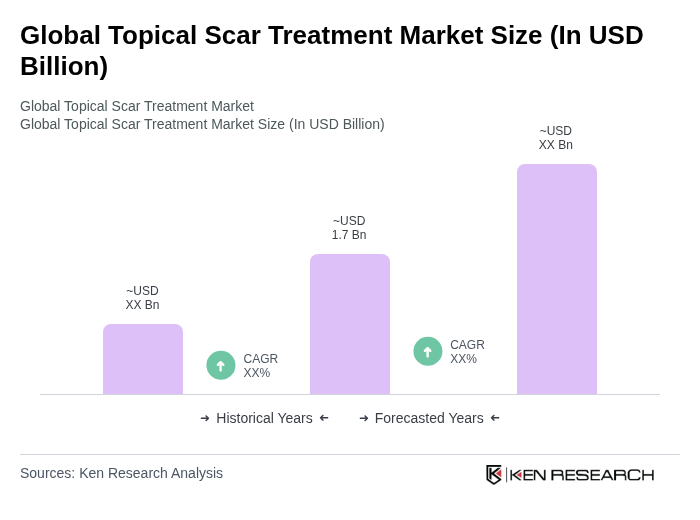
- The Global Topical Scar Treatment Market is valued at USD 1.7 billion, based on a five-year historical analysis. This growth is primarily driven by the increasing prevalence of scars due to surgeries, injuries, and acne, alongside rising consumer awareness regarding skin health and aesthetics. The market is also supported by advancements in product formulations, including silicone-based gels, bioactive ingredients, and combination products, as well as the introduction of innovative treatments that enhance efficacy, patient adherence, and user experience.
- Key players in this market have historically been concentrated in regions such as North America and Europe; however, Asia Pacific now accounts for the largest share of the broader topical scar treatment market, driven by high aesthetic consciousness, increasing disposable incomes, and rapid adoption of advanced products. North America and Europe continue to exhibit strong demand for advanced skincare products, supported by established healthcare infrastructure and a growing trend towards cosmetic and reconstructive procedures. Additionally, countries such as the United States, Germany, and Japan lead in product innovation, clinical research, and omnichannel distribution networks (including e-commerce and pharmacy chains), further solidifying their market position.
- Topical scar treatments in the United States are generally regulated either as over-the-counter drugs or medical devices, depending on their active ingredients and intended use, under the Federal Food, Drug, and Cosmetic Act administered by the U.S. Food and Drug Administration (FDA). For example, silicone gel sheeting products intended for scar management are typically classified as Class II medical devices and are subject to premarket notification requirements under section 510(k), device labeling standards, and quality system regulations as specified in Title 21 of the Code of Federal Regulations. These requirements ensure that manufacturers generate appropriate safety and performance data, maintain compliant manufacturing practices, and provide labeling with adequate directions and risk information, thereby supporting product quality and consumer confidence in topical scar treatments.
Global Topical Scar Treatment Market Segmentation
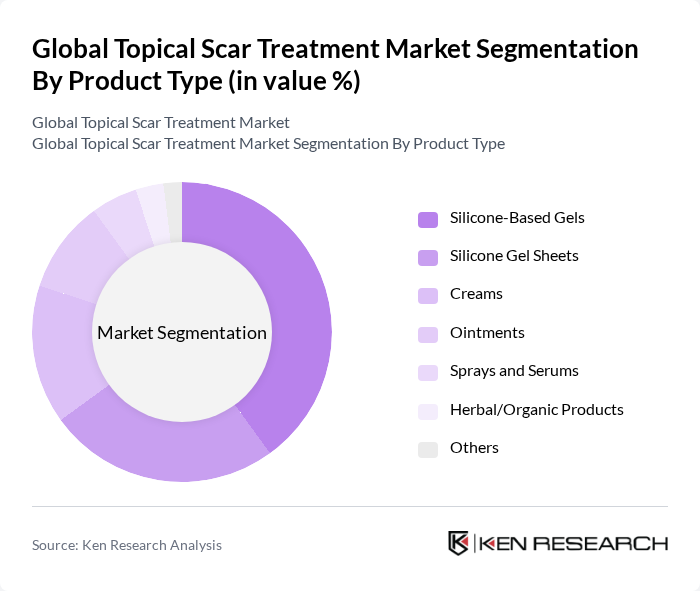
By Product Type:The product type segmentation includes various forms of topical treatments designed to address scars. The dominant sub-segment is silicone-based gels, which are widely recognized in clinical practice and guidelines for their effectiveness in managing hypertrophic and keloid scars, particularly in post-surgical and traumatic scars. Silicone gel sheets and creams also hold significant market shares due to their ease of use, over-the-counter availability, and established efficacy in improving scar texture and appearance. The increasing consumer preference for non-invasive treatments, combined with growing demand for dermatologist-recommended and cosmetically elegant formulations (including serums, sprays, and combination products with botanicals or antioxidants), has led to a steady rise in the popularity of these products across both clinical and homecare settings.
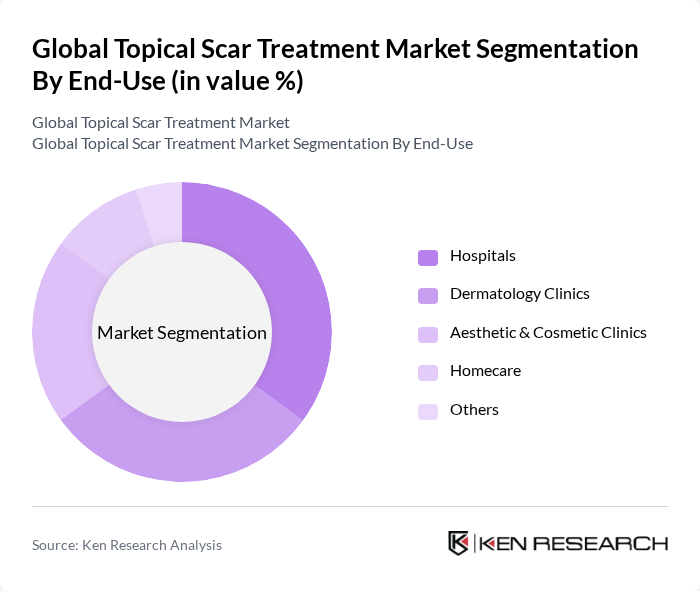
By End-Use:The end-use segmentation highlights the various settings in which topical scar treatments are utilized. Hospitals and dermatology clinics are the leading sub-segments, driven by the high volume of patients seeking professional treatment for post-surgical, burn-related, and acne scars, where silicone-based and prescription-strength topical agents are frequently recommended as first-line or adjunctive therapy. Aesthetic and cosmetic clinics also contribute significantly to the market, as consumers increasingly opt for cosmetic procedures (such as plastic surgery, laser resurfacing, and minimally invasive treatments) that require effective scar management protocols incorporating topical products. Homecare products are gaining traction as consumers seek convenient, over-the-counter options for scar treatment, supported by expanding e-commerce channels and growing awareness of self-managed scar care.
Global Topical Scar Treatment Market Competitive Landscape
The Global Topical Scar Treatment Market is characterized by a dynamic mix of regional and international players. Leading participants such as Mederma (HRA Pharma), Biocorneum (Sientra), ScarAway, Kelo-cote (Alliance Pharma), Cica-Care (Smith & Nephew), NewGel+, Strataderm (Stratpharma), Dermatix (Meda / Mylan), Silagen, Rejuvaskin, SkinMedica (Allergan), Eucerin (Beiersdorf), Bio-Oil, La Roche-Posay, and others contribute to innovation, geographic expansion, and service delivery in this space.
Global Topical Scar Treatment Market Industry Analysis
Growth Drivers
- Increasing Prevalence of Scars:The World Health Organization reported that approximately 20 million surgical procedures are performed annually worldwide, leading to a significant number of scars. Additionally, the National Safety Council estimates that over 4.6 million people seek medical treatment for non-fatal injuries each year in the U.S. alone. This rising incidence of accidents and surgeries directly correlates with the growing demand for effective topical scar treatments, driving market growth in the None region.
- Rising Awareness About Scar Treatment Options:A survey by the American Academy of Dermatology found that 72% of individuals are now aware of various scar treatment options available. This increased awareness is fueled by educational campaigns and social media, leading to a higher demand for topical treatments. As consumers become more informed about the effectiveness of these products, the market in None is expected to see a surge in sales, particularly among younger demographics seeking cosmetic solutions.
- Advancements in Topical Treatment Formulations:The global investment in research and development for scar treatments reached USD 1.3 billion in future, with a focus on innovative formulations. New technologies, such as silicone gel sheets and bioactive compounds, have shown improved efficacy in scar management. As these advanced products become more accessible, the market in None is likely to expand, catering to consumers seeking effective and scientifically-backed solutions for scar treatment.
Market Challenges
- High Cost of Advanced Scar Treatment Products:The average cost of advanced topical scar treatments can range from USD 55 to USD 160 per unit, which poses a significant barrier for many consumers. According to the Bureau of Labor Statistics, healthcare spending in the U.S. is projected to reach USD 6.4 trillion in future, indicating that consumers may prioritize essential healthcare over cosmetic treatments. This high cost can limit market penetration in the None region, affecting overall sales.
- Limited Reimbursement Policies for Scar Treatments:A report from the Centers for Medicare & Medicaid Services indicates that only 32% of scar treatment procedures are covered by insurance. This limited reimbursement creates a financial burden for patients seeking effective treatments, leading to decreased adoption rates. In the None region, the lack of supportive policies may hinder market growth, as consumers may opt for less effective alternatives due to cost concerns.
Global Topical Scar Treatment Market Future Outlook
The future of the topical scar treatment market in None appears promising, driven by increasing consumer awareness and technological advancements. As more individuals seek effective solutions for scar management, the market is likely to witness a shift towards personalized treatment options. Additionally, the integration of e-commerce platforms will facilitate easier access to products, enhancing consumer engagement. Companies that focus on innovative formulations and sustainable practices will likely gain a competitive edge in this evolving landscape.
Market Opportunities
- Expansion into Emerging Markets:Emerging markets in Asia and Africa are experiencing rapid urbanization, leading to increased disposable incomes. This trend presents a significant opportunity for topical scar treatment companies to introduce their products to new consumer bases, potentially increasing market share and revenue in the None region.
- Development of Innovative and Natural Ingredients:The growing consumer preference for organic products is driving demand for scar treatments made from natural ingredients. Companies that invest in research to develop effective, eco-friendly formulations can tap into this lucrative market segment, appealing to health-conscious consumers in the None region.
Scope of the Report
| Segment | Sub-Segments |
|---|---|
| By Product Type | Silicone-Based Gels Silicone Gel Sheets Creams Ointments Sprays and Serums Herbal/Organic Products Others |
| By End-Use | Hospitals Dermatology Clinics Aesthetic & Cosmetic Clinics Homecare Others |
| By Scar Type | Atrophic Scars (including acne scars) Hypertrophic Scars Keloid Scars Contracture Scars Stretch Marks Others |
| By Distribution Channel | Hospital Pharmacies Retail Pharmacies & Drug Stores E-commerce/Online Platforms Supermarkets/Hypermarkets Others |
| By Region | North America Europe Asia-Pacific Latin America Middle East & Africa |
| By Ingredient Type | Natural Ingredients Synthetic Ingredients Hybrid/Combination Ingredients Others |
| By Product Formulation | Water-based Formulations Oil-based Formulations Silicone-based Formulations Others |
Key Target Audience
Investors and Venture Capitalist Firms
Government and Regulatory Bodies (e.g., U.S. Food and Drug Administration, European Medicines Agency)
Manufacturers and Producers
Distributors and Retailers
Pharmaceutical Companies
Healthcare Providers and Clinics
Industry Associations
Financial Institutions
Players Mentioned in the Report:
Mederma (HRA Pharma)
Biocorneum (Sientra)
ScarAway
Kelo-cote (Alliance Pharma)
Cica-Care (Smith & Nephew)
NewGel+
Strataderm (Stratpharma)
Dermatix (Meda / Mylan)
Silagen
Rejuvaskin
SkinMedica (Allergan)
Eucerin (Beiersdorf)
Bio-Oil
La Roche-Posay
Others (Emerging Regional Brands)
Table of Contents
Market Assessment Phase
1. Executive Summary and Approach
2. Global Topical Scar Treatment Market Overview
2.1 Key Insights and Strategic Recommendations
2.2 Global Topical Scar Treatment Market Overview
2.3 Definition and Scope
2.4 Evolution of Market Ecosystem
2.5 Timeline of Key Regulatory Milestones
2.6 Value Chain & Stakeholder Mapping
2.7 Business Cycle Analysis
2.8 Policy & Incentive Landscape
3. Global Topical Scar Treatment Market Analysis
3.1 Growth Drivers
3.1.1 Increasing prevalence of scars due to accidents and surgeries
3.1.2 Rising awareness about scar treatment options
3.1.3 Advancements in topical treatment formulations
3.1.4 Growing demand for cosmetic procedures
3.2 Market Challenges
3.2.1 High cost of advanced scar treatment products
3.2.2 Limited reimbursement policies for scar treatments
3.2.3 Competition from alternative treatment methods
3.2.4 Variability in product effectiveness among consumers
3.3 Market Opportunities
3.3.1 Expansion into emerging markets
3.3.2 Development of innovative and natural ingredients
3.3.3 Increasing online sales channels
3.3.4 Collaborations with dermatology clinics
3.4 Market Trends
3.4.1 Growing preference for silicone-based treatments
3.4.2 Rise in demand for organic and natural products
3.4.3 Increasing use of digital marketing strategies
3.4.4 Focus on personalized scar treatment solutions
3.5 Government Regulation
3.5.1 Stricter regulations on product safety and efficacy
3.5.2 Guidelines for clinical trials and product approvals
3.5.3 Labeling requirements for topical treatments
3.5.4 Environmental regulations affecting product ingredients
4. SWOT Analysis
5. Stakeholder Analysis
6. Porter's Five Forces Analysis
7. Global Topical Scar Treatment Market Market Size, 2019-2024
7.1 By Value
7.2 By Volume
7.3 By Average Selling Price
8. Global Topical Scar Treatment Market Segmentation
8.1 By Product Type
8.1.1 Silicone-Based Gels
8.1.2 Silicone Gel Sheets
8.1.3 Creams
8.1.4 Ointments
8.1.5 Sprays and Serums
8.1.6 Herbal/Organic Products
8.1.7 Others
8.2 By End-Use
8.2.1 Hospitals
8.2.2 Dermatology Clinics
8.2.3 Aesthetic & Cosmetic Clinics
8.2.4 Homecare
8.2.5 Others
8.3 By Scar Type
8.3.1 Atrophic Scars (including acne scars)
8.3.2 Hypertrophic Scars
8.3.3 Keloid Scars
8.3.4 Contracture Scars
8.3.5 Stretch Marks
8.3.6 Others
8.4 By Distribution Channel
8.4.1 Hospital Pharmacies
8.4.2 Retail Pharmacies & Drug Stores
8.4.3 E-commerce/Online Platforms
8.4.4 Supermarkets/Hypermarkets
8.4.5 Others
8.5 By Region
8.5.1 North America
8.5.2 Europe
8.5.3 Asia-Pacific
8.5.4 Latin America
8.5.5 Middle East & Africa
8.6 By Ingredient Type
8.6.1 Natural Ingredients
8.6.2 Synthetic Ingredients
8.6.3 Hybrid/Combination Ingredients
8.6.4 Others
8.7 By Product Formulation
8.7.1 Water-based Formulations
8.7.2 Oil-based Formulations
8.7.3 Silicone-based Formulations
8.7.4 Others
9. Global Topical Scar Treatment Market Competitive Analysis
9.1 Market Share of Key Players
9.2 Cross Comparison of Key Players
9.2.1 Company Name
9.2.2 Ownership Type (Public / Private / Subsidiary)
9.2.3 Group Size (Large, Medium, or Small as per industry convention)
9.2.4 Total Revenue (Latest Fiscal Year, USD Million)
9.2.5 Topical Scar Treatment Revenue (USD Million, Estimated)
9.2.6 3-Year CAGR in Topical Scar Treatment Revenue
9.2.7 EBITDA Margin (%) – Overall Business
9.2.8 R&D Intensity (% of Revenue)
9.2.9 Geographic Revenue Mix (Domestic vs International, %)
9.2.10 Market Share in Global Topical Scar Treatment Market (%)
9.2.11 Average Selling Price Positioning (Premium / Mid / Value)
9.2.12 Channel Mix (% Revenue from Offline vs Online)
9.2.13 New Product Launches in Last 3 Years (Number)
9.2.14 Key Strategic Partnerships / Distribution Agreements (Number)
9.2.15 Digital Reach (Website Traffic, Social Media Followers – Indexed)
9.3 SWOT Analysis of Top Players
9.4 Pricing Analysis
9.5 Detailed Profile of Major Companies
9.5.1 Mederma (HRA Pharma)
9.5.2 Biocorneum (Sientra)
9.5.3 ScarAway
9.5.4 Kelo-cote (Alliance Pharma)
9.5.5 Cica-Care (Smith & Nephew)
9.5.6 NewGel+
9.5.7 Strataderm (Stratpharma)
9.5.8 Dermatix (Meda / Mylan)
9.5.9 Silagen
9.5.10 Rejuvaskin
9.5.11 SkinMedica (Allergan)
9.5.12 Eucerin (Beiersdorf)
9.5.13 Bio-Oil
9.5.14 La Roche-Posay
9.5.15 Others (Emerging Regional Brands)
10. Global Topical Scar Treatment Market End-User Analysis
10.1 Procurement Behavior of Key Ministries
10.1.1 Government procurement policies
10.1.2 Budget allocation for healthcare
10.1.3 Preference for local vs. international suppliers
10.1.4 Evaluation criteria for product selection
10.2 Corporate Spend on Infrastructure & Energy
10.2.1 Investment in healthcare infrastructure
10.2.2 Spending on dermatological treatments
10.2.3 Budget for employee health programs
10.2.4 Trends in corporate healthcare spending
10.3 Pain Point Analysis by End-User Category
10.3.1 Challenges faced by hospitals
10.3.2 Issues in dermatology clinics
10.3.3 Homecare user challenges
10.3.4 Others
10.4 User Readiness for Adoption
10.4.1 Awareness of scar treatment options
10.4.2 Willingness to invest in treatments
10.4.3 Accessibility of products
10.4.4 Others
10.5 Post-Deployment ROI and Use Case Expansion
10.5.1 Evaluation of treatment effectiveness
10.5.2 Long-term user satisfaction
10.5.3 Opportunities for product line expansion
10.5.4 Others
11. Global Topical Scar Treatment Market Future Size, 2025-2030
11.1 By Value
11.2 By Volume
11.3 By Average Selling Price
Go-To-Market Strategy Phase
1. Whitespace Analysis + Business Model Canvas
1.1 Market gaps and opportunities
1.2 Business model components
2. Marketing and Positioning Recommendations
2.1 Branding strategies
2.2 Product USPs
3. Distribution Plan
3.1 Urban retail vs rural NGO tie-ups
4. Channel & Pricing Gaps
4.1 Underserved routes
4.2 Pricing bands
5. Unmet Demand & Latent Needs
5.1 Category gaps
5.2 Consumer segments
6. Customer Relationship
6.1 Loyalty programs
6.2 After-sales service
7. Value Proposition
7.1 Sustainability
7.2 Integrated supply chains
8. Key Activities
8.1 Regulatory compliance
8.2 Branding
8.3 Distribution setup
9. Entry Strategy Evaluation
9.1 Domestic Market Entry Strategy
9.1.1 Product mix
9.1.2 Pricing band
9.1.3 Packaging
9.2 Export Entry Strategy
9.2.1 Target countries
9.2.2 Compliance roadmap
10. Entry Mode Assessment
10.1 JV
10.2 Greenfield
10.3 M&A
10.4 Distributor Model
11. Capital and Timeline Estimation
11.1 Capital requirements
11.2 Timelines
12. Control vs Risk Trade-Off
12.1 Ownership vs Partnerships
13. Profitability Outlook
13.1 Breakeven analysis
13.2 Long-term sustainability
14. Potential Partner List
14.1 Distributors
14.2 JVs
14.3 Acquisition targets
15. Execution Roadmap
15.1 Phased Plan for Market Entry
15.1.1 Market Setup
15.1.2 Market Entry
15.1.3 Growth Acceleration
15.1.4 Scale & Stabilize
15.2 Key Activities and Milestones
15.2.1 Milestone planning
15.2.2 Activity tracking
Research Methodology
Phase 1: Approach1
Desk Research
- Analysis of market reports from industry associations and healthcare organizations
- Review of published clinical studies and journals on topical scar treatments
- Examination of regulatory guidelines and approvals from health authorities
Primary Research
- Interviews with dermatologists and plastic surgeons specializing in scar treatments
- Surveys with patients who have undergone topical scar treatment procedures
- Consultations with product managers from leading pharmaceutical companies
Validation & Triangulation
- Cross-validation of findings through multiple expert interviews
- Triangulation of data from clinical studies, market reports, and expert opinions
- Sanity checks through feedback from a panel of industry experts
Phase 2: Market Size Estimation1
Top-down Assessment
- Estimation of market size based on global healthcare expenditure on dermatological treatments
- Segmentation by geographical regions and treatment types
- Incorporation of trends in cosmetic procedures and patient demographics
Bottom-up Modeling
- Volume estimates based on sales data from leading topical scar treatment products
- Cost analysis of treatment options including over-the-counter and prescription products
- Calculation of market share based on product usage frequency and patient population
Forecasting & Scenario Analysis
- Multi-variable regression analysis incorporating factors like aging population and skin health awareness
- Scenario modeling based on potential market disruptions and technological advancements
- Development of baseline, optimistic, and pessimistic market forecasts through 2030
Phase 3: CATI Sample Composition1
| Scope Item/Segment | Sample Size | Target Respondent Profiles |
|---|---|---|
| Dermatology Clinics | 120 | Dermatologists, Clinic Managers |
| Plastic Surgery Centers | 90 | Plastic Surgeons, Patient Coordinators |
| Pharmaceutical Companies | 70 | Product Managers, Marketing Directors |
| Patient Advocacy Groups | 50 | Patient Representatives, Healthcare Advocates |
| Cosmetic Dermatology Practices | 80 | Cosmetic Dermatologists, Aesthetic Practitioners |
Frequently Asked Questions
What is the current value of the Global Topical Scar Treatment Market?
The Global Topical Scar Treatment Market is valued at approximately USD 1.7 billion, reflecting a significant growth trend driven by the increasing prevalence of scars from surgeries, injuries, and acne, along with rising consumer awareness regarding skin health and aesthetics.
What factors are driving the growth of the topical scar treatment market?
Which regions dominate the Global Topical Scar Treatment Market?
What types of products are available in the topical scar treatment market?
Other Regional/Country Reports
Indonesia Topical Scar Treatment Market
Malaysia Topical Scar Treatment Market
KSA Topical Scar Treatment Market
APAC Topical Scar Treatment Market
SEA Topical Scar Treatment Market
Vietnam Topical Scar Treatment Market
Other Adjacent Reports
UAE Acne Treatment Market
Kuwait Aesthetic Medicine Market Report Size Share Growth Drivers Trends Opportunities & Forecast 2025–2030Kuwait Dermatology Products Market
Kuwait Cosmetic Surgery Market
Oman Skin Rejuvenation Market
Global Burn Care Market Report Size Share Growth Drivers Trends Opportunities & Forecast 2025–2030Kuwait Laser Skin Treatment Market
Qatar Regenerative Medicine Market Report Size Share Growth Drivers Trends Opportunities & Forecast 2025–2030Indonesia Topical Dermatologicals Market
Why Buy From Us?

What makes us stand out is that our consultants follow Robust, Refine and Result (RRR) methodology. Robust for clear definitions, approaches and sanity checking, Refine for differentiating respondents' facts and opinions, and Result for presenting data with story.

We have set a benchmark in the industry by offering our clients with syndicated and customized market research reports featuring coverage of entire market as well as meticulous research and analyst insights.

While we don't replace traditional research, we flip the method upside down. Our dual approach of Top Bottom & Bottom Top ensures quality deliverable by not just verifying company fundamentals but also looking at the sector and macroeconomic factors.

With one step in the future, our research team constantly tries to show you the bigger picture. We help with some of the tough questions you may encounter along the way: How is the industry positioned? Best marketing channel? KPI's of competitors? By aligning every element, we help maximize success.

Our report gives you instant access to the answers and sources that other companies might choose to hide. We elaborate each steps of research methodology we have used and showcase you the sample size to earn your trust.

If you need any support, we are here! We pride ourselves on universe strength, data quality, and quick, friendly, and professional service.