About the Report
Base Year 2024Global Wine Cooler Market Overview
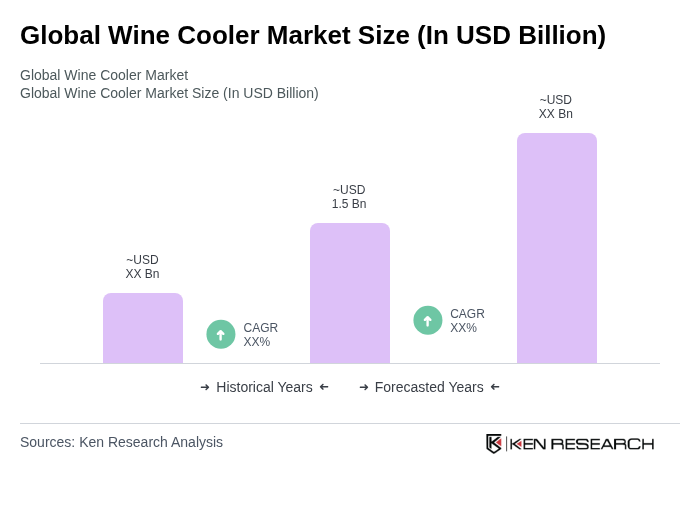
- The Global Wine Cooler Market is valued at USD 1.5 billion, based on a five-year historical analysis and recent industry estimates indicating the market size around USD 1.5 billion for the mid?2020s. This growth is primarily driven by the increasing popularity of wine consumption, particularly among millennials, and the rising trend of home entertaining, which has led to a surge in demand for wine storage solutions. Additionally, the growing awareness of wine preservation techniques, combined with the availability of specialized beverage and wine coolers offering precise temperature and humidity control, has further fueled the market's expansion.
- Key players in this market include the United States, Germany, and France, which are among the leading markets due to their rich wine culture and established wine and beverage industries. The U.S. is a significant consumer market, supported by a robust home?entertainment culture and high demand for high?end wine coolers and beverage freezers, while major European wine?producing countries such as France and Germany contribute through strong production, export capabilities, and widespread use of wine storage equipment. These countries benefit from a combination of high disposable incomes, a strong preference for premium wine products, and a well-developed retail and hospitality infrastructure that supports sales of dedicated wine cooling appliances.
- In 2023, the European Union implemented updated regulations aimed at improving energy efficiency in household refrigeration appliances, including wine coolers, through the Energy Labelling Regulation (EU) 2019/2016 and the Ecodesign Regulation (EU) 2019/2019 issued by the European Commission. These regulations mandate that new household refrigerating appliances placed on the EU market, such as wine coolers and beverage refrigerators, meet specific maximum energy consumption thresholds, display standardized energy labels, and comply with design requirements that promote the use of energy?efficient technologies and environmentally friendly refrigerants, encouraging manufacturers to innovate in their product designs.
Global Wine Cooler Market Segmentation
By Installation Type:The market is segmented into Freestanding, Countertop, and Built-in / Integrated wine coolers. Each type serves different consumer needs and preferences, with freestanding models being popular for their versatility and ease of placement, while built-in options are favored for their seamless integration into kitchen designs.
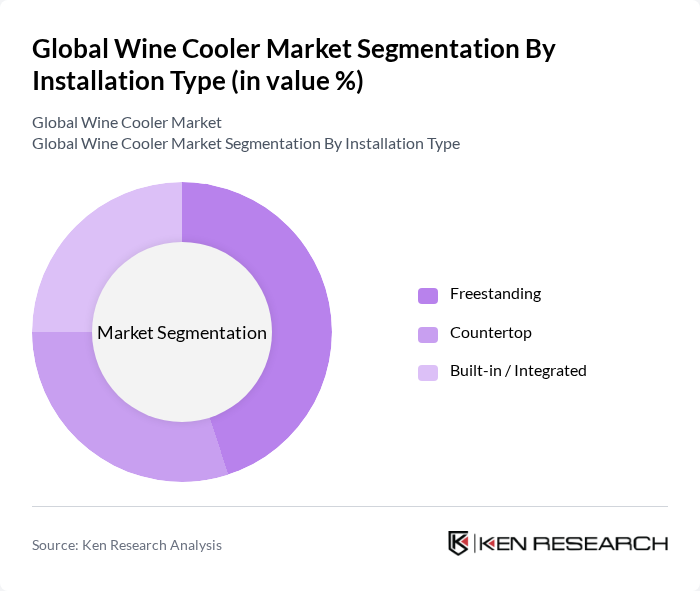
The Freestanding segment leads the market due to its flexibility and ease of use, appealing to consumers who may not have dedicated spaces for built-in units. These coolers are often portable and can be placed in various locations, making them ideal for both residential and commercial settings. The Countertop segment is also gaining traction, particularly among consumers with limited space and in urban apartments, while Built-in models are preferred by those looking for a more permanent, premium, and aesthetically pleasing solution that integrates with cabinetry and high-end kitchen designs.
By Application / End-User:The market is segmented into Residential, Commercial, and HoReCa (Hotels, Restaurants & Cafés). Each segment caters to different consumer bases, with residential users focusing on personal wine collections and commercial users emphasizing bulk storage and display.
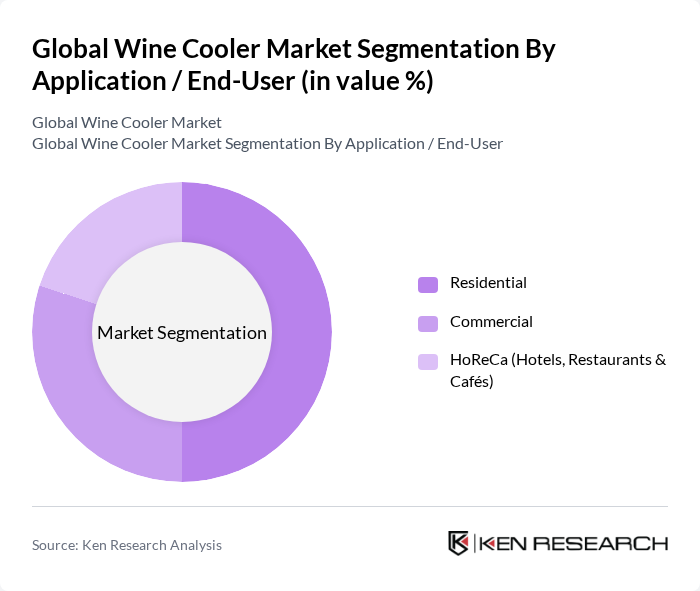
The Residential segment dominates the market, driven by the increasing trend of wine consumption at home, a robust home?entertainment culture, and rising disposable incomes that support purchases of dedicated wine and beverage coolers. This segment is characterized by a wide range of products catering to different price points and preferences, from compact countertop units to large-capacity multi?zone cabinets. The Commercial segment is also significant, as retail outlets and specialty wine stores seek efficient storage and attractive display solutions for their wine offerings, while the HoReCa segment is growing as restaurants, wine bars, and hotels enhance their wine service capabilities and invest in temperature?controlled storage to improve the guest experience.
Global Wine Cooler Market Competitive Landscape
The Global Wine Cooler Market is characterized by a dynamic mix of regional and international players. Leading participants such as Haier, Vinotemp, EdgeStar, NewAir, Danby, Whynter, Kalamera, Ivation, Allavino, Vissani, Cavanova, Wine Enthusiast, SPT, Koldfront, Frigidaire contribute to innovation, geographic expansion, and service delivery in this space.
Global Wine Cooler Market Industry Analysis
Growth Drivers
- Increasing Consumer Interest in Wine:The global wine consumption reached approximatelyabout 237 million hectolitersin future, reflecting a growing interest among consumers. This trend is particularly pronounced in regions like None, where wine appreciation is rising. The increase in wine consumption correlates with a demand for specialized storage solutions, such as wine coolers, which are essential for maintaining optimal wine quality. As consumers become more knowledgeable about wine, the need for proper storage will continue to drive market growth.
- Rising Disposable Incomes:In None, the average disposable income is projected to reach$35,000per capita in future, up from$32,000in the recent past. This increase in disposable income allows consumers to invest in premium products, including wine coolers. As more households can afford luxury items, the demand for wine coolers is expected to rise. This trend is further supported by a growing middle class that prioritizes quality and lifestyle enhancements, driving sales in the wine cooler segment.
- Growth of the Hospitality Industry:The hospitality sector in None is anticipated to grow by5%annually, with hotel and restaurant establishments increasingly investing in wine storage solutions. In future, the number of new restaurants is expected to increase by1,500, creating a significant demand for wine coolers. This growth is driven by the rising popularity of wine pairings in dining experiences, prompting establishments to enhance their wine offerings and storage capabilities, thereby boosting the wine cooler market.
Market Challenges
- High Initial Investment Costs:The average cost of a quality wine cooler ranges fromabout USD 300 to USD 2,500, which can deter potential buyers, especially in None where price sensitivity is prevalent. Many consumers may opt for traditional refrigeration solutions, which are often less expensive. This challenge is compounded by the need for consumers to justify the investment in specialized cooling systems, limiting market penetration and growth potential in the region.
- Competition from Traditional Refrigeration:Traditional refrigerators dominate the market due to their lower price points and multifunctionality. In None, approximately70%of households still rely on conventional refrigeration for wine storage. This widespread usage poses a significant challenge for wine cooler manufacturers, as they must differentiate their products through unique features and benefits to capture market share and convince consumers to switch from traditional options.
Global Wine Cooler Market Future Outlook
The future of the wine cooler market in None appears promising, driven by evolving consumer preferences and technological advancements. As wine appreciation continues to grow, the demand for specialized storage solutions will likely increase. Additionally, the integration of smart technology in wine coolers is expected to enhance user experience, making them more appealing. Companies that focus on sustainability and energy efficiency will also find opportunities to capture environmentally conscious consumers, further shaping the market landscape in the coming years.
Market Opportunities
- Expansion into Emerging Markets:Emerging markets in None present significant growth opportunities for wine cooler manufacturers. With increasing urbanization and rising disposable incomes, more consumers are likely to invest in wine storage solutions. Targeting these markets can lead to substantial sales growth, as local demand for wine continues to rise alongside a burgeoning middle class.
- Development of Energy-Efficient Models:There is a growing consumer preference for energy-efficient appliances, with60%of buyers in None indicating that energy consumption influences their purchasing decisions. Manufacturers can capitalize on this trend by developing energy-efficient wine coolers that not only reduce electricity costs but also appeal to environmentally conscious consumers, enhancing market competitiveness.
Scope of the Report
| Segment | Sub-Segments |
|---|---|
| By Installation Type | Freestanding Countertop Built-in / Integrated |
| By Application / End-User | Residential Commercial HoReCa (Hotels, Restaurants & Cafés) |
| By Bottle Capacity | Less than 20 Bottles –50 Bottles –100 Bottles More than 100 Bottles |
| By Cooling Technology | Compressor Thermoelectric Others |
| By Temperature Zone / Structure | Single Zone Dual Zone Multi Zone / Triple Zone & Others |
| By Distribution Channel | B2B Specialty Stores Online Others |
| By Price Range | Low-cost / Budget Mass / Mid-Range Premium |
Key Target Audience
Investors and Venture Capitalist Firms
Government and Regulatory Bodies (e.g., Food and Drug Administration, Alcohol and Tobacco Tax and Trade Bureau)
Manufacturers and Producers
Distributors and Retailers
Importers and Exporters
Hospitality Industry Stakeholders (e.g., Hotels, Restaurants, Bars)
Packaging Suppliers
Trade Associations (e.g., Wine Institute, National Association of Beverage Importers)
Players Mentioned in the Report:
Haier
Vinotemp
EdgeStar
NewAir
Danby
Whynter
Kalamera
Ivation
Allavino
Vissani
Cavanova
Wine Enthusiast
SPT
Koldfront
Frigidaire
Table of Contents
Market Assessment Phase
1. Executive Summary and Approach
2. Global Wine Cooler Market Overview
2.1 Key Insights and Strategic Recommendations
2.2 Global Wine Cooler Market Overview
2.3 Definition and Scope
2.4 Evolution of Market Ecosystem
2.5 Timeline of Key Regulatory Milestones
2.6 Value Chain & Stakeholder Mapping
2.7 Business Cycle Analysis
2.8 Policy & Incentive Landscape
3. Global Wine Cooler Market Analysis
3.1 Growth Drivers
3.1.1 Increasing consumer interest in wine
3.1.2 Rising disposable incomes
3.1.3 Growth of the hospitality industry
3.1.4 Technological advancements in cooling systems
3.2 Market Challenges
3.2.1 High initial investment costs
3.2.2 Competition from traditional refrigeration
3.2.3 Regulatory compliance issues
3.2.4 Fluctuating raw material prices
3.3 Market Opportunities
3.3.1 Expansion into emerging markets
3.3.2 Development of energy-efficient models
3.3.3 Collaborations with wine producers
3.3.4 Customization options for consumers
3.4 Market Trends
3.4.1 Increasing demand for smart wine coolers
3.4.2 Growth in online sales channels
3.4.3 Rising popularity of wine tourism
3.4.4 Focus on sustainable and eco-friendly products
3.5 Government Regulation
3.5.1 Standards for energy efficiency
3.5.2 Import/export regulations
3.5.3 Safety standards for electrical appliances
3.5.4 Environmental regulations on refrigerants
4. SWOT Analysis
5. Stakeholder Analysis
6. Porter's Five Forces Analysis
7. Global Wine Cooler Market Market Size, 2019-2024
7.1 By Value
7.2 By Volume
7.3 By Average Selling Price
8. Global Wine Cooler Market Segmentation
8.1 By Installation Type
8.1.1 Freestanding
8.1.2 Countertop
8.1.3 Built-in / Integrated
8.2 By Application / End-User
8.2.1 Residential
8.2.2 Commercial
8.2.3 HoReCa (Hotels, Restaurants & Cafés)
8.3 By Bottle Capacity
8.3.1 Less than 20 Bottles
8.3.2 20–50 Bottles
8.3.3 51–100 Bottles
8.3.4 More than 100 Bottles
8.4 By Cooling Technology
8.4.1 Compressor
8.4.2 Thermoelectric
8.4.3 Others
8.5 By Temperature Zone / Structure
8.5.1 Single Zone
8.5.2 Dual Zone
8.5.3 Multi Zone / Triple Zone & Others
8.6 By Distribution Channel
8.6.1 B2B
8.6.2 Specialty Stores
8.6.3 Online
8.6.4 Others
8.7 By Price Range
8.7.1 Low-cost / Budget
8.7.2 Mass / Mid-Range
8.7.3 Premium
9. Global Wine Cooler Market Competitive Analysis
9.1 Market Share of Key Players
9.2 Cross Comparison of Key Players
9.2.1 Company Name
9.2.2 Company Size (by Revenue Tier: Large, Medium, Small)
9.2.3 3-year Revenue CAGR (%)
9.2.4 EBITDA Margin (%)
9.2.5 Market Share (%) in Global Wine Cooler Segment
9.2.6 Geographic Footprint (No. of Regions / Key Countries Served)
9.2.7 Product Portfolio Breadth (No. of SKUs / Capacity & Technology Coverage)
9.2.8 R&D Intensity (% of Revenue Spent on R&D)
9.2.9 Average Selling Price Positioning (Value / Mid / Premium)
9.2.10 Channel Mix (% Revenue by B2B / Retail / Online)
9.2.11 Installed Base (Estimated Units in Operation)
9.2.12 Customer Retention / Repeat Purchase Rate (%)
9.3 SWOT Analysis of Top Players
9.4 Pricing Analysis
9.5 Detailed Profile of Major Companies
9.5.1 Haier
9.5.2 Vinotemp
9.5.3 EdgeStar
9.5.4 NewAir
9.5.5 Danby
9.5.6 Whynter
9.5.7 Kalamera
9.5.8 Ivation
9.5.9 Allavino
9.5.10 Vissani
9.5.11 Cavanova
9.5.12 Wine Enthusiast
9.5.13 SPT
9.5.14 Koldfront
9.5.15 Frigidaire
10. Global Wine Cooler Market End-User Analysis
10.1 Procurement Behavior of Key Ministries
10.1.1 Budget Allocation Trends
10.1.2 Decision-Making Processes
10.1.3 Supplier Selection Criteria
10.1.4 Contract Management Practices
10.2 Corporate Spend on Infrastructure & Energy
10.2.1 Investment Trends in Wine Storage
10.2.2 Budgeting for Wine Coolers
10.2.3 Cost-Benefit Analysis
10.2.4 Long-term Financial Planning
10.3 Pain Point Analysis by End-User Category
10.3.1 Residential Users
10.3.2 Commercial Users
10.3.3 Hospitality Sector
10.3.4 Retail Sector
10.4 User Readiness for Adoption
10.4.1 Awareness Levels
10.4.2 Adoption Barriers
10.4.3 Training and Support Needs
10.4.4 Feedback Mechanisms
10.5 Post-Deployment ROI and Use Case Expansion
10.5.1 Performance Metrics
10.5.2 User Satisfaction Levels
10.5.3 Expansion Opportunities
10.5.4 Case Studies
11. Global Wine Cooler Market Future Size, 2025-2030
11.1 By Value
11.2 By Volume
11.3 By Average Selling Price
Go-To-Market Strategy Phase
1. Whitespace Analysis + Business Model Canvas
1.1 Market Gaps Identification
1.2 Business Model Development
2. Marketing and Positioning Recommendations
2.1 Branding Strategies
2.2 Product USPs
3. Distribution Plan
3.1 Urban Retail vs Rural NGO Tie-ups
4. Channel & Pricing Gaps
4.1 Underserved Routes
4.2 Pricing Bands
5. Unmet Demand & Latent Needs
5.1 Category Gaps
5.2 Consumer Segments
6. Customer Relationship
6.1 Loyalty Programs
6.2 After-sales Service
7. Value Proposition
7.1 Sustainability
7.2 Integrated Supply Chains
8. Key Activities
8.1 Regulatory Compliance
8.2 Branding
8.3 Distribution Setup
9. Entry Strategy Evaluation
9.1 Domestic Market Entry Strategy
9.1.1 Product Mix
9.1.2 Pricing Band
9.1.3 Packaging
9.2 Export Entry Strategy
9.2.1 Target Countries
9.2.2 Compliance Roadmap
10. Entry Mode Assessment
10.1 JV
10.2 Greenfield
10.3 M&A
10.4 Distributor Model
11. Capital and Timeline Estimation
11.1 Capital Requirements
11.2 Timelines
12. Control vs Risk Trade-Off
12.1 Ownership vs Partnerships
13. Profitability Outlook
13.1 Breakeven Analysis
13.2 Long-term Sustainability
14. Potential Partner List
14.1 Distributors
14.2 JVs
14.3 Acquisition Targets
15. Execution Roadmap
15.1 Phased Plan for Market Entry
15.1.1 Market Setup
15.1.2 Market Entry
15.1.3 Growth Acceleration
15.1.4 Scale & Stabilize
15.2 Key Activities and Milestones
15.2.1 Milestone Planning
15.2.2 Activity Tracking
Research Methodology
Phase 1: Approach1
Desk Research
- Analysis of industry reports from wine market associations and trade publications
- Review of market data from government agricultural departments and export agencies
- Examination of consumer behavior studies and market trends from academic journals
Primary Research
- Interviews with wine cooler manufacturers and distributors to gather insights on production and sales
- Surveys with retailers and e-commerce platforms to understand consumer preferences and purchasing patterns
- Field interviews with sommeliers and wine experts to assess market trends and product innovations
Validation & Triangulation
- Cross-validation of data through multiple sources including trade associations and market surveys
- Triangulation of findings from primary interviews and secondary data sources
- Sanity checks conducted through expert panel reviews and feedback sessions
Phase 2: Market Size Estimation1
Top-down Assessment
- Estimation of market size based on overall wine consumption trends and growth rates
- Segmentation analysis by geographic regions and consumer demographics
- Incorporation of market share data from leading wine cooler brands and product categories
Bottom-up Modeling
- Volume estimates derived from sales data of wine coolers across various retail channels
- Cost analysis based on manufacturing expenses and pricing strategies of key players
- Calculation of market size using unit sales multiplied by average selling prices
Forecasting & Scenario Analysis
- Multi-factor regression analysis incorporating economic indicators and consumer spending patterns
- Scenario modeling based on potential shifts in consumer preferences and market dynamics
- Development of baseline, optimistic, and pessimistic forecasts through 2030
Phase 3: CATI Sample Composition1
| Scope Item/Segment | Sample Size | Target Respondent Profiles |
|---|---|---|
| Retail Wine Cooler Sales | 120 | Store Managers, Retail Buyers |
| Online Wine Cooler Purchases | 90 | E-commerce Managers, Digital Marketing Specialists |
| Wine Enthusiast Insights | 60 | Wine Collectors, Sommelier Professionals |
| Distribution Channel Analysis | 50 | Logistics Coordinators, Supply Chain Analysts |
| Consumer Preference Studies | 110 | General Consumers, Wine Club Members |
Frequently Asked Questions
What is the current value of the Global Wine Cooler Market?
The Global Wine Cooler Market is valued at approximately USD 1.5 billion, with projections indicating continued growth driven by increasing wine consumption and home entertaining trends, particularly among millennials.
What factors are driving the growth of the wine cooler market?
Which regions are leading in the wine cooler market?
What are the different types of wine coolers available?
Other Regional/Country Reports
Malaysia Wine Cooler Market
KSA Wine Cooler Market
APAC Wine Cooler Market
SEA Wine Cooler Market
Vietnam Wine Cooler Market
Other Adjacent Reports
South Africa Beverage Cooler Market
Thailand Commercial Refrigeration Market
Qatar Kitchen Appliance Market
Germany Major Home Appliance MarketOman Freezer Market
Indonesia Wine Storage Market
Egypt Hospitality Equipment Market
Mexico Bar Equipment Market
Brazil Smart Appliance Market
Indonesia Luxury Appliance Market
Why Buy From Us?

What makes us stand out is that our consultants follow Robust, Refine and Result (RRR) methodology. Robust for clear definitions, approaches and sanity checking, Refine for differentiating respondents' facts and opinions, and Result for presenting data with story.

We have set a benchmark in the industry by offering our clients with syndicated and customized market research reports featuring coverage of entire market as well as meticulous research and analyst insights.

While we don't replace traditional research, we flip the method upside down. Our dual approach of Top Bottom & Bottom Top ensures quality deliverable by not just verifying company fundamentals but also looking at the sector and macroeconomic factors.

With one step in the future, our research team constantly tries to show you the bigger picture. We help with some of the tough questions you may encounter along the way: How is the industry positioned? Best marketing channel? KPI's of competitors? By aligning every element, we help maximize success.

Our report gives you instant access to the answers and sources that other companies might choose to hide. We elaborate each steps of research methodology we have used and showcase you the sample size to earn your trust.

If you need any support, we are here! We pride ourselves on universe strength, data quality, and quick, friendly, and professional service.