About the Report
Base Year 2024India Blue Economy and Ocean Tech Market Overview
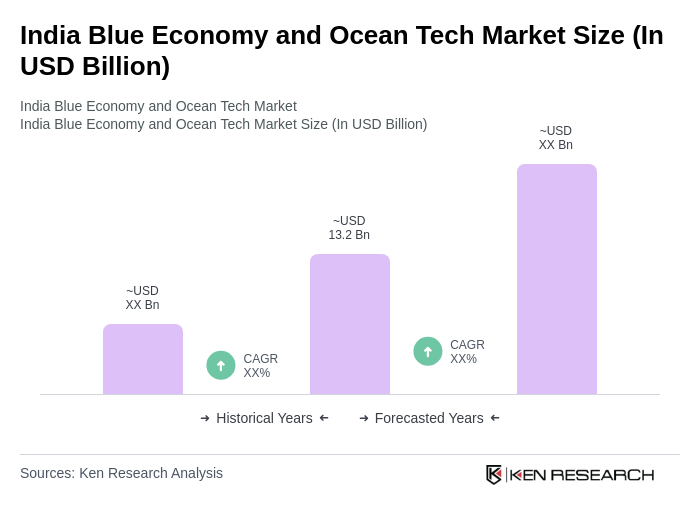
- The India Blue Economy and Ocean Tech Market is valued at approximately USD 13.2 billion, based on a five-year historical analysis. This growth is primarily driven by increasing investments in marine renewable energy, aquaculture, and coastal infrastructure development, alongside rising awareness of sustainable ocean practices and technologies.
- Key players in this market include coastal states like Maharashtra, Tamil Nadu, and Gujarat, which dominate due to their extensive coastlines, established port infrastructure, and active government initiatives promoting marine technology and conservation efforts. These regions are pivotal for both economic activities and environmental sustainability.
- The Ministry of Earth Sciences (MoES) produced a dedicated Draft Blue Economy Policy in 2022, which aims to improve the contribution of the sector to India's GDP, preserve marine biodiversity, and maintain the national security of marine areas and resources. This policy prioritizes several initiatives including deep-sea exploration, eco-tourism, sustainable fisheries development, and enhancement of maritime infrastructure, ensuring a balanced approach to ocean resource management.
India Blue Economy and Ocean Tech Market Segmentation
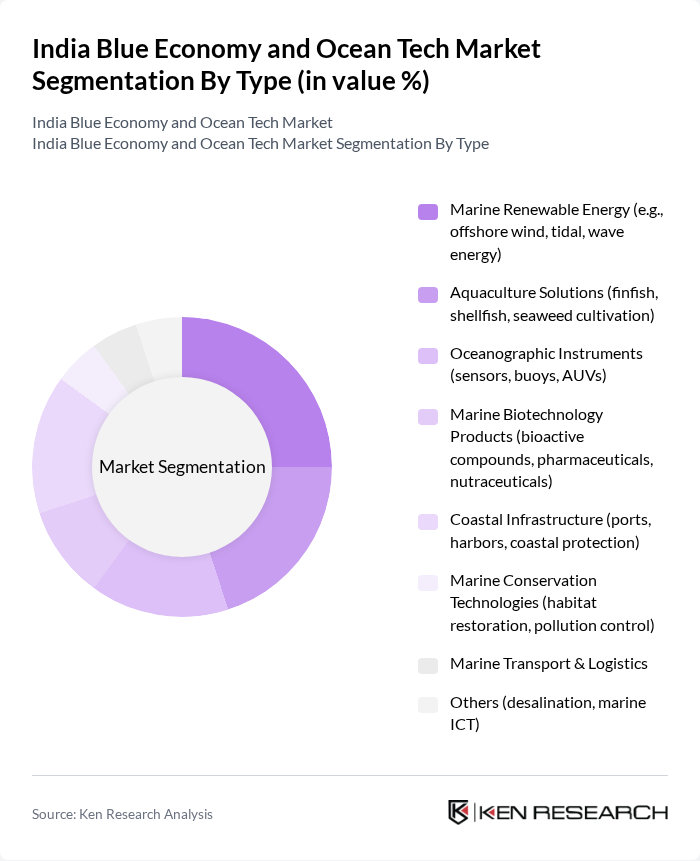
By Type:The market is segmented into various types, including Marine Renewable Energy, Aquaculture Solutions, Oceanographic Instruments, Marine Biotechnology Products, Coastal Infrastructure, Marine Conservation Technologies, Marine Transport & Logistics, and Others. Each of these segments plays a crucial role in the overall growth and sustainability of the blue economy.
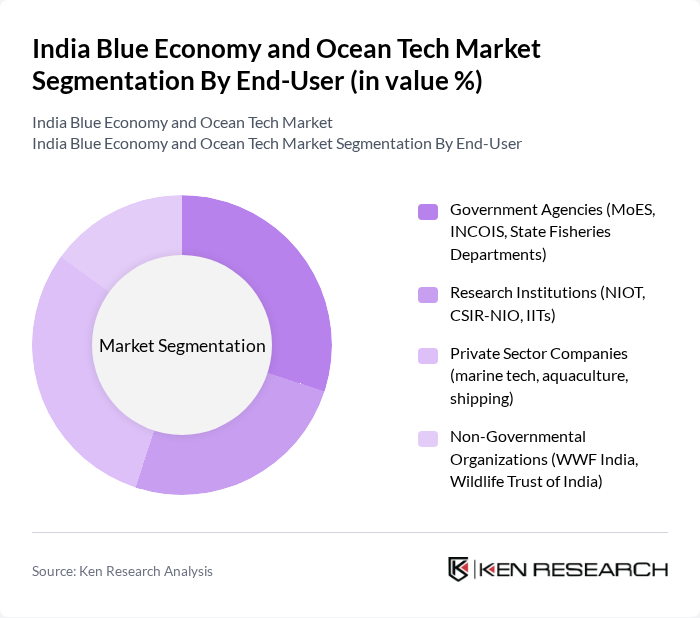
By End-User:The end-user segmentation includes Government Agencies, Research Institutions, Private Sector Companies, and Non-Governmental Organizations. Each of these groups utilizes ocean technologies and resources differently, contributing to the overall market dynamics.
India Blue Economy and Ocean Tech Market Competitive Landscape
The India Blue Economy and Ocean Tech Market is characterized by a dynamic mix of regional and international players. Leading participants such as National Institute of Ocean Technology (NIOT), Indian National Centre for Ocean Information Services (INCOIS), Reliance Industries Limited (Offshore & Marine Division), Tata Power Renewable Energy Ltd. (Offshore Wind & Marine Energy), Adani Ports and Special Economic Zone Ltd., Central Marine Fisheries Research Institute (CMFRI), Sea6 Energy Pvt. Ltd., Aquaconnect (Aquaculture Tech), OceanSpark Technologies Pvt. Ltd., WWF India (Marine Conservation), Indian Institute of Technology Madras (Ocean Engineering), CSIR-National Institute of Oceanography (NIO), Kerala State Coastal Area Development Corporation Ltd., Indian Maritime University, Wildlife Trust of India (Marine Projects) contribute to innovation, geographic expansion, and service delivery in this space.
India Blue Economy and Ocean Tech Market Industry Analysis
Growth Drivers
- Sustainable Fisheries Development:The Indian fisheries sector contributes approximately ?1.75 lakh crore to the national economy, employing over 14 million people. The government aims to enhance fish production to 22 million tons in future, driven by initiatives like the Pradhan Mantri Matsya Sampada Yojana, which allocates ?20,050 crore for sustainable practices. This focus on sustainability is expected to boost both economic growth and environmental health, fostering a resilient fisheries sector.
- Marine Renewable Energy Initiatives:India has set an ambitious target of achieving 175 GW of renewable energy capacity in future, with a significant portion coming from marine sources. The National Institute of Ocean Technology estimates that India's ocean energy potential is around 40 GW. Investments in offshore wind and tidal energy projects are projected to exceed ?1,000 crore in future, enhancing energy security and promoting sustainable development in coastal regions.
- Coastal Tourism Expansion:The coastal tourism sector in India is projected to grow to ?1.2 lakh crore in future, driven by increasing domestic and international tourist arrivals. The government has identified 13 coastal districts for development under the Coastal Regulation Zone Notification, aiming to enhance infrastructure and services. This expansion is expected to create over 1 million jobs, significantly contributing to local economies and promoting sustainable tourism practices.
Market Challenges
- Regulatory Compliance Issues:The complex regulatory framework governing the blue economy poses significant challenges for businesses. Compliance with multiple regulations, such as the Coastal Regulation Zone Notification and Environmental Impact Assessment Regulations, can lead to delays and increased costs. In future, over 60% of marine projects faced regulatory hurdles, impacting investment and operational efficiency in the sector, which is crucial for sustainable growth.
- Environmental Degradation:Coastal and marine ecosystems in India are under severe threat, with over 30% of mangroves lost in the last few decades. Pollution from urban runoff and industrial discharges has led to a decline in marine biodiversity, affecting fisheries and tourism. The World Bank estimates that environmental degradation costs India approximately ?3.75 lakh crore annually, highlighting the urgent need for sustainable practices to protect these vital resources.
India Blue Economy and Ocean Tech Market Future Outlook
The future of the India Blue Economy and Ocean Tech market appears promising, driven by increasing investments in sustainable practices and technological innovations. The government’s commitment to enhancing marine resource management and promoting renewable energy will likely attract both domestic and foreign investments. Additionally, the rise of smart port development and marine biotechnology is expected to create new avenues for growth, fostering collaboration among stakeholders to address environmental challenges and enhance economic resilience.
Market Opportunities
- Blue Carbon Initiatives:The potential for blue carbon initiatives in India is significant, with an estimated 4,921 square kilometers (approximately 0.49 million hectares) of mangroves available for restoration. These initiatives can sequester approximately 1.5 billion tons of CO2, providing a dual benefit of climate mitigation and biodiversity conservation. Investment in these projects could attract funding from international climate finance mechanisms, enhancing local livelihoods and ecosystem health.
- Marine Biotechnology Innovations:The marine biotechnology sector in India is poised for growth, with an estimated market value of ?5,000 crore in future. Innovations in pharmaceuticals, nutraceuticals, and biofuels derived from marine resources present lucrative opportunities. Collaborations with research institutions and private enterprises can accelerate product development, positioning India as a leader in marine bioproducts and sustainable solutions.
Scope of the Report
| Segment | Sub-Segments |
|---|---|
| By Type | Marine Renewable Energy (e.g., offshore wind, tidal, wave energy) Aquaculture Solutions (finfish, shellfish, seaweed cultivation) Oceanographic Instruments (sensors, buoys, AUVs) Marine Biotechnology Products (bioactive compounds, pharmaceuticals, nutraceuticals) Coastal Infrastructure (ports, harbors, coastal protection) Marine Conservation Technologies (habitat restoration, pollution control) Marine Transport & Logistics Others (desalination, marine ICT) |
| By End-User | Government Agencies (MoES, INCOIS, State Fisheries Departments) Research Institutions (NIOT, CSIR-NIO, IITs) Private Sector Companies (marine tech, aquaculture, shipping) Non-Governmental Organizations (WWF India, Wildlife Trust of India) |
| By Region | North India South India East India West India |
| By Technology | Remote Sensing Technologies (satellite, drone, GIS) Autonomous Underwater Vehicles (AUVs, ROVs) Marine Data Analytics Platforms (IoT, AI, cloud-based ocean data) |
| By Application | Environmental Monitoring Disaster Management Resource Management Marine Tourism |
| By Investment Source | Government Funding Private Investments International Grants |
| By Policy Support | Government Subsidies Tax Incentives Research Grants Regulatory Support |
Key Target Audience
Investors and Venture Capitalist Firms
Government and Regulatory Bodies (e.g., Ministry of Earth Sciences, Ministry of Shipping)
Marine Technology Developers
Port Authorities and Maritime Organizations
Environmental NGOs and Conservation Groups
Shipping and Logistics Companies
Fisheries and Aquaculture Enterprises
Renewable Energy Companies (focused on ocean energy)
Players Mentioned in the Report:
National Institute of Ocean Technology (NIOT)
Indian National Centre for Ocean Information Services (INCOIS)
Reliance Industries Limited (Offshore & Marine Division)
Tata Power Renewable Energy Ltd. (Offshore Wind & Marine Energy)
Adani Ports and Special Economic Zone Ltd.
Central Marine Fisheries Research Institute (CMFRI)
Sea6 Energy Pvt. Ltd.
Aquaconnect (Aquaculture Tech)
OceanSpark Technologies Pvt. Ltd.
WWF India (Marine Conservation)
Indian Institute of Technology Madras (Ocean Engineering)
CSIR-National Institute of Oceanography (NIO)
Kerala State Coastal Area Development Corporation Ltd.
Indian Maritime University
Wildlife Trust of India (Marine Projects)
Table of Contents
Market Assessment Phase
1. Executive Summary and Approach
2. India Blue Economy and Ocean Tech Market Overview
2.1 Key Insights and Strategic Recommendations
2.2 India Blue Economy and Ocean Tech Market Overview
2.3 Definition and Scope
2.4 Evolution of Market Ecosystem
2.5 Timeline of Key Regulatory Milestones
2.6 Value Chain & Stakeholder Mapping
2.7 Business Cycle Analysis
2.8 Policy & Incentive Landscape
3. India Blue Economy and Ocean Tech Market Analysis
3.1 Growth Drivers
3.1.1 Sustainable Fisheries Development
3.1.2 Marine Renewable Energy Initiatives
3.1.3 Coastal Tourism Expansion
3.1.4 Technological Advancements in Ocean Monitoring
3.2 Market Challenges
3.2.1 Regulatory Compliance Issues
3.2.2 Environmental Degradation
3.2.3 Limited Investment in Infrastructure
3.2.4 Competition from Traditional Industries
3.3 Market Opportunities
3.3.1 Blue Carbon Initiatives
3.3.2 Marine Biotechnology Innovations
3.3.3 Smart Port Development
3.3.4 International Collaboration for Ocean Research
3.4 Market Trends
3.4.1 Increased Focus on Sustainability
3.4.2 Growth of Ocean Data Analytics
3.4.3 Rise of Aquaculture Technologies
3.4.4 Expansion of Marine Spatial Planning
3.5 Government Regulation
3.5.1 Coastal Regulation Zone Notification
3.5.2 National Policy on Marine Fisheries
3.5.3 Marine Spatial Planning Guidelines
3.5.4 Environmental Impact Assessment Regulations
4. SWOT Analysis
5. Stakeholder Analysis
6. Porter's Five Forces Analysis
7. India Blue Economy and Ocean Tech Market Market Size, 2019-2024
7.1 By Value
7.2 By Volume
7.3 By Average Selling Price
8. India Blue Economy and Ocean Tech Market Segmentation
8.1 By Type
8.1.1 Marine Renewable Energy (e.g., offshore wind, tidal, wave energy)
8.1.2 Aquaculture Solutions (finfish, shellfish, seaweed cultivation)
8.1.3 Oceanographic Instruments (sensors, buoys, AUVs)
8.1.4 Marine Biotechnology Products (bioactive compounds, pharmaceuticals, nutraceuticals)
8.1.5 Coastal Infrastructure (ports, harbors, coastal protection)
8.1.6 Marine Conservation Technologies (habitat restoration, pollution control)
8.1.7 Marine Transport & Logistics
8.1.8 Others (desalination, marine ICT)
8.2 By End-User
8.2.1 Government Agencies (MoES, INCOIS, State Fisheries Departments)
8.2.2 Research Institutions (NIOT, CSIR-NIO, IITs)
8.2.3 Private Sector Companies (marine tech, aquaculture, shipping)
8.2.4 Non-Governmental Organizations (WWF India, Wildlife Trust of India)
8.3 By Region
8.3.1 North India
8.3.2 South India
8.3.3 East India
8.3.4 West India
8.4 By Technology
8.4.1 Remote Sensing Technologies (satellite, drone, GIS)
8.4.2 Autonomous Underwater Vehicles (AUVs, ROVs)
8.4.3 Marine Data Analytics Platforms (IoT, AI, cloud-based ocean data)
8.5 By Application
8.5.1 Environmental Monitoring
8.5.2 Disaster Management
8.5.3 Resource Management
8.5.4 Marine Tourism
8.6 By Investment Source
8.6.1 Government Funding
8.6.2 Private Investments
8.6.3 International Grants
8.7 By Policy Support
8.7.1 Government Subsidies
8.7.2 Tax Incentives
8.7.3 Research Grants
8.7.4 Regulatory Support
9. India Blue Economy and Ocean Tech Market Competitive Analysis
9.1 Market Share of Key Players
9.2 Cross Comparison of Key Players
9.2.1 Company Name
9.2.2 Group Size (Large, Medium, or Small as per industry convention)
9.2.3 Revenue Growth Rate (YoY %)
9.2.4 Market Penetration Rate (share in target segment or geography)
9.2.5 R&D Intensity (R&D spend as % of revenue)
9.2.6 Technology Adoption Index (level of digital/tech integration)
9.2.7 Product Portfolio Breadth (number of distinct product/service lines)
9.2.8 Operational Efficiency Ratio (cost per unit output, asset utilization)
9.2.9 Sustainability Score (ESG metrics, certifications, impact)
9.2.10 Strategic Partnerships (number and quality of collaborations/JVs)
9.3 SWOT Analysis of Top Players
9.4 Pricing Analysis
9.5 Detailed Profile of Major Companies
9.5.1 National Institute of Ocean Technology (NIOT)
9.5.2 Indian National Centre for Ocean Information Services (INCOIS)
9.5.3 Reliance Industries Limited (Offshore & Marine Division)
9.5.4 Tata Power Renewable Energy Ltd. (Offshore Wind & Marine Energy)
9.5.5 Adani Ports and Special Economic Zone Ltd.
9.5.6 Central Marine Fisheries Research Institute (CMFRI)
9.5.7 Sea6 Energy Pvt. Ltd.
9.5.8 Aquaconnect (Aquaculture Tech)
9.5.9 OceanSpark Technologies Pvt. Ltd.
9.5.10 WWF India (Marine Conservation)
9.5.11 Indian Institute of Technology Madras (Ocean Engineering)
9.5.12 CSIR-National Institute of Oceanography (NIO)
9.5.13 Kerala State Coastal Area Development Corporation Ltd.
9.5.14 Indian Maritime University
9.5.15 Wildlife Trust of India (Marine Projects)
10. India Blue Economy and Ocean Tech Market End-User Analysis
10.1 Procurement Behavior of Key Ministries
10.1.1 Ministry of Earth Sciences
10.1.2 Ministry of Fisheries, Animal Husbandry and Dairying
10.1.3 Ministry of Environment, Forest and Climate Change
10.2 Corporate Spend on Infrastructure & Energy
10.2.1 Investment in Coastal Infrastructure
10.2.2 Funding for Renewable Energy Projects
10.2.3 Expenditure on Marine Research
10.3 Pain Point Analysis by End-User Category
10.3.1 Regulatory Compliance Challenges
10.3.2 Funding Limitations
10.3.3 Technology Adoption Barriers
10.4 User Readiness for Adoption
10.4.1 Awareness of Ocean Technologies
10.4.2 Training and Skill Development Needs
10.4.3 Infrastructure Readiness
10.5 Post-Deployment ROI and Use Case Expansion
10.5.1 Measurement of Environmental Impact
10.5.2 Economic Benefits Analysis
10.5.3 Scalability of Solutions
11. India Blue Economy and Ocean Tech Market Future Size, 2025-2030
11.1 By Value
11.2 By Volume
11.3 By Average Selling Price
Go-To-Market Strategy Phase
1. Whitespace Analysis + Business Model Canvas
1.1 Market Gaps Identification
1.2 Value Proposition Development
1.3 Revenue Streams Analysis
1.4 Cost Structure Evaluation
1.5 Key Partnerships Exploration
1.6 Customer Segmentation
1.7 Channels of Distribution
2. Marketing and Positioning Recommendations
2.1 Branding Strategies
2.2 Product USPs
3. Distribution Plan
3.1 Urban Retail vs Rural NGO Tie-ups
4. Channel & Pricing Gaps
4.1 Underserved Routes
4.2 Pricing Bands
5. Unmet Demand & Latent Needs
5.1 Category Gaps
5.2 Consumer Segments
6. Customer Relationship
6.1 Loyalty Programs
6.2 After-sales Service
7. Value Proposition
7.1 Sustainability
7.2 Integrated Supply Chains
8. Key Activities
8.1 Regulatory Compliance
8.2 Branding
8.3 Distribution Setup
9. Entry Strategy Evaluation
9.1 Domestic Market Entry Strategy
9.1.1 Product Mix
9.1.2 Pricing Band
9.1.3 Packaging
9.2 Export Entry Strategy
9.2.1 Target Countries
9.2.2 Compliance Roadmap
10. Entry Mode Assessment
10.1 JV, Greenfield, M&A, Distributor Model
11. Capital and Timeline Estimation
11.1 Capital Requirements
11.2 Timelines
12. Control vs Risk Trade-Off
12.1 Ownership vs Partnerships
13. Profitability Outlook
13.1 Breakeven Analysis
13.2 Long-term Sustainability
14. Potential Partner List
14.1 Distributors
14.2 JVs
14.3 Acquisition Targets
15. Execution Roadmap
15.1 Phased Plan for Market Entry
15.1.1 Market Setup
15.1.2 Market Entry
15.1.3 Growth Acceleration
15.1.4 Scale & Stabilize
15.2 Key Activities and Milestones
15.2.1 Activity Planning
15.2.2 Milestone Tracking
Research Methodology
Phase 1: Approach1
Desk Research
- Analysis of government reports on the Blue Economy from the Ministry of Earth Sciences
- Review of industry publications and white papers on ocean technology advancements
- Examination of trade statistics and export-import data related to marine resources
Primary Research
- Interviews with key stakeholders in marine biotechnology firms
- Surveys with oceanographic researchers and academic experts in marine sciences
- Field interviews with representatives from coastal communities engaged in sustainable fishing
Validation & Triangulation
- Cross-validation of findings through multiple data sources including government and industry reports
- Triangulation of insights from expert interviews with quantitative data from market analysis
- Sanity checks through feedback from a panel of ocean technology experts
Phase 2: Market Size Estimation1
Top-down Assessment
- Estimation of the Blue Economy's contribution to GDP based on national economic data
- Segmentation of the market by key sectors such as fisheries, tourism, and marine energy
- Incorporation of government initiatives aimed at promoting sustainable ocean practices
Bottom-up Modeling
- Collection of firm-level data from leading ocean tech companies and startups
- Operational cost analysis based on service pricing in marine resource management
- Volume and revenue projections based on historical growth rates in marine sectors
Forecasting & Scenario Analysis
- Multi-factor regression analysis incorporating climate change impacts and policy shifts
- Scenario modeling based on varying levels of investment in ocean technology
- Development of baseline, optimistic, and pessimistic forecasts through 2035
Phase 3: CATI Sample Composition1
| Scope Item/Segment | Sample Size | Target Respondent Profiles |
|---|---|---|
| Marine Biotechnology Sector | 60 | Biotech Researchers, Product Development Managers |
| Coastal Tourism Industry | 50 | Tourism Operators, Environmental Consultants |
| Fisheries Management | 70 | Fishermen Association Leaders, Regulatory Authorities |
| Marine Renewable Energy | 40 | Energy Analysts, Project Managers in Renewable Sectors |
| Oceanographic Research Institutions | 45 | Marine Scientists, Research Directors |
Frequently Asked Questions
What is the current value of the India Blue Economy and Ocean Tech Market?
The India Blue Economy and Ocean Tech Market is valued at approximately USD 13.2 billion, driven by investments in marine renewable energy, aquaculture, and coastal infrastructure development, alongside a growing emphasis on sustainable ocean practices.
Which regions in India are key players in the Blue Economy?
What initiatives are included in India's Draft Blue Economy Policy?
What are the growth drivers of the India Blue Economy?
Other Regional/Country Reports
Indonesia Blue Economy and Ocean Tech Market
Malaysia Blue Economy and Ocean Tech Market
KSA Blue Economy and Ocean Tech Market
APAC Blue Economy and Ocean Tech Market
SEA Blue Economy and Ocean Tech Market
Other Adjacent Reports
South Africa Marine Renewable Energy Market
Qatar Aquaculture Solutions Market
Bahrain Oceanographic Instruments Market
Belgium Marine Biotechnology Products Market
Indonesia Coastal Infrastructure Market
KSA Marine Conservation Technologies Market
Malaysia Marine Transport Logistics Market
South Africa Sustainable Fisheries Market
UAE Offshore Wind Energy MarketSingapore Blue Carbon Initiatives Market
Why Buy From Us?

What makes us stand out is that our consultants follow Robust, Refine and Result (RRR) methodology. Robust for clear definitions, approaches and sanity checking, Refine for differentiating respondents' facts and opinions, and Result for presenting data with story.

We have set a benchmark in the industry by offering our clients with syndicated and customized market research reports featuring coverage of entire market as well as meticulous research and analyst insights.

While we don't replace traditional research, we flip the method upside down. Our dual approach of Top Bottom & Bottom Top ensures quality deliverable by not just verifying company fundamentals but also looking at the sector and macroeconomic factors.

With one step in the future, our research team constantly tries to show you the bigger picture. We help with some of the tough questions you may encounter along the way: How is the industry positioned? Best marketing channel? KPI's of competitors? By aligning every element, we help maximize success.

Our report gives you instant access to the answers and sources that other companies might choose to hide. We elaborate each steps of research methodology we have used and showcase you the sample size to earn your trust.

If you need any support, we are here! We pride ourselves on universe strength, data quality, and quick, friendly, and professional service.